

What doki doki means: a pounding heart
Doki doki belongs to a large family of Japanese sound-symbolic words. Some, called giongo, imitate real sounds, like wan wan for a dog's bark. Others, called gitaigo, describe states and feelings. Doki doki sits between the two: it represents the thump of a heart beating quickly, and by extension the feeling that makes it race.
The key thing to understand is that doki doki describes a physical reaction, not a particular emotion. Your heart can race because you are scared, nervous, excited or attracted to someone, and Japanese uses the same word for all of them. English does something similar with my heart was pounding.
Doki doki is everyday language, not slang or baby talk. Adults use it in conversation, in writing and even in polite speech, as in doki doki shimashita, I was nervous.
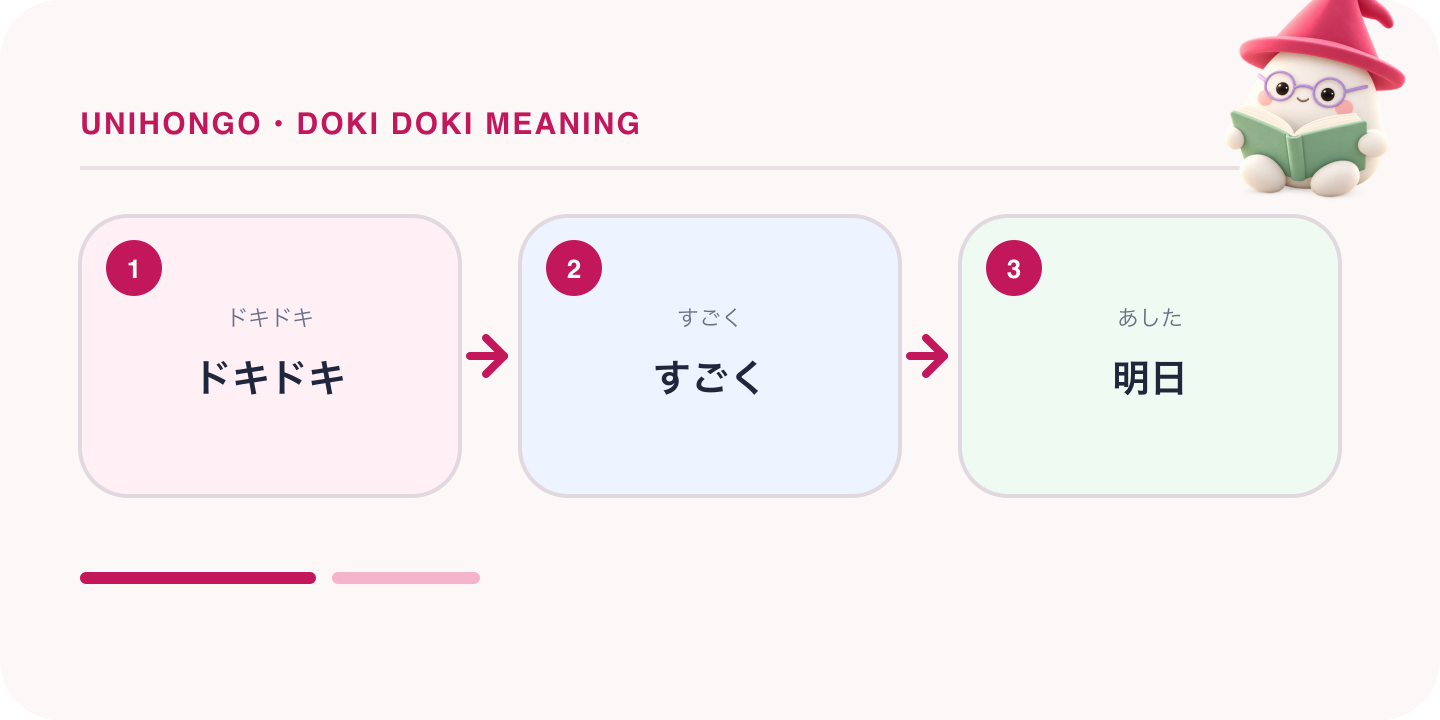
| Japanese | Romaji | Meaning |
|---|---|---|
| ドキドキする。 | Doki doki suru. | My heart is racing. / I'm nervous. |
| 胸がドキドキしている。 | Mune ga doki doki shite iru. | My heart is pounding. |
| すごくドキドキした。 | Sugoku doki doki shita. | My heart was really racing. |
| ドキドキしました。 | Doki doki shimashita. | I was nervous. (polite) |
Doki doki for nerves
Before exams, interviews, speeches, medical results and first days at work, Japanese speakers often say doki doki suru. It is a gentler, more personal way of saying I am nervous than kinchō suru, the standard word for tension or nervousness, and the two often appear together.
Waiting for results is a classic doki doki situation. Happyō, an announcement of results, or kekka, the results, are words you will often hear alongside it. Saying doki doki shite nemurenai means I am too nervous to sleep.
| Japanese | Romaji | Meaning |
|---|---|---|
| 明日の面接、ドキドキする。 | Ashita no mensetsu, doki doki suru. | I'm nervous about tomorrow's interview. |
| 結果を見るのがドキドキする。 | Kekka o miru no ga doki doki suru. | I'm nervous about seeing the results. |
| 緊張してドキドキしています。 | Kinchō shite doki doki shite imasu. | I'm tense and my heart is racing. |
| ドキドキして眠れない。 | Doki doki shite nemurenai. | I'm too nervous to sleep. |
| 人前で話すとドキドキします。 | Hitomae de hanasu to doki doki shimasu. | I get nervous speaking in front of people. |
Doki doki for excitement and thrills
Doki doki also describes exciting moments: a close football match, the final scene of a mystery, a roller coaster climbing to the top. Here it overlaps with English thrilling or edge-of-your-seat. Doki doki no tenkai is a thrilling plot development, and a doki doki suru eiga is a film that keeps you tense.
Children's television and games use doki doki in titles to promise fun and excitement, and it appears in advertising for events, lotteries and sales. The feeling can be pleasant anticipation mixed with nerves, such as buying a lottery ticket or opening a surprise present.
| Japanese | Romaji | Meaning |
|---|---|---|
| ドキドキの展開 | doki doki no tenkai | A thrilling turn of events |
| 最後までドキドキした。 | Saigo made doki doki shita. | I was on the edge of my seat until the end. |
| ジェットコースター、ドキドキするね。 | Jetto kōsutā, doki doki suru ne. | Roller coasters get your heart racing, don't they? |
| ドキドキしながらプレゼントを開けた。 | Doki doki shinagara purezento o aketa. | I opened the present with my heart pounding. |
Doki doki for romance
This is the use most learners meet first, through anime, manga, games and J-pop. When a character sees their crush, holds hands for the first time or is about to confess their feelings, the panel is full of doki doki. Suki na hito to hanasu to doki doki suru means my heart races when I talk to the person I like.
Romantic doki doki often comes with related words. Kyun or mune ga kyun to suru describes a tight, sweet squeeze in the chest, the feeling of being charmed; the slang verb kyun desu and the noun mune kyun come from it. Tokimeku and tokimeki describe a flutter of the heart, a slightly more literary word for attraction or delight.
| Japanese | Romaji | Meaning |
|---|---|---|
| 好きな人と話すとドキドキする。 | Suki na hito to hanasu to doki doki suru. | My heart races when I talk to someone I like. |
| 初デートでドキドキした。 | Hatsu dēto de doki doki shita. | I was so nervous on our first date. |
| 胸がキュンとした。 | Mune ga kyun to shita. | My heart skipped a beat. (charmed) |
| ときめく | tokimeku | To flutter, to feel a thrill of attraction or joy |
| ドキドキが止まらない。 | Doki doki ga tomaranai. | My heart won't stop racing. |
Dokitto and doki tto suru: a sudden jolt
Doki doki is a continuing state, a heart beating fast for a while. Dokitto, often written ドキッと and used as doki tto suru, is a single sudden beat: the moment you are startled, caught out or suddenly struck by someone. The small tsu shows the abruptness.
You feel doki tto when a teacher calls your name unexpectedly, when your boss walks in as you are complaining about work, or when someone you like gives you an unexpected compliment. It can be a scare or a flutter; again, context decides.
| Japanese | Romaji | Meaning |
|---|---|---|
| 名前を呼ばれてドキッとした。 | Namae o yobarete doki tto shita. | My heart jumped when my name was called. |
| 急に笑顔を見せられてドキッとした。 | Kyū ni egao o miserarete doki tto shita. | When they suddenly smiled at me, my heart skipped. |
| ドキッとする一言 | doki tto suru hitokoto | A remark that hits home |
| 図星でドキッとした。 | Zuboshi de doki tto shita. | They were spot on, and I flinched. |
Related words: waku waku, hara hara, biku biku and sowa sowa
Japanese has a whole set of feeling words that are close to doki doki but not identical. Learning them together helps you choose the right one, because each has a clear emotional colour.
Waku waku is joyful anticipation, the excitement of something fun coming up. Hara hara is anxious worry while watching something that might go wrong, often about someone else, like a parent watching a child on a high wall. Biku biku is jumpy fear, being on edge or timid. Sowa sowa is restless fidgeting, unable to settle because you are waiting for something. Ira ira, irritation, is a useful contrast: a racing heart from anger is not doki doki.
| Word | Feeling | Typical situation |
|---|---|---|
| ドキドキ doki doki | Heart racing: nerves, thrill, romance | Interview, results, a crush |
| ドキッと doki tto | One sudden jolt | Being startled or caught out |
| ワクワク waku waku | Happy anticipation | The night before a trip |
| ハラハラ hara hara | Anxious worry while watching | A close match, a child climbing |
| ビクビク biku biku | Jumpy fear, being on edge | Walking home alone in the dark |
| そわそわ sowa sowa | Restless, fidgety | Waiting for a call or a date |
| キュン kyun | A sweet squeeze of the heart | Something cute or romantic |
Many people feel several at once. Before a first trip abroad you might be waku waku about the adventure and doki doki about the flight, and it is natural to say both: waku waku to doki doki de ippai desu, I'm full of excitement and nerves.
Grammar: using doki doki in sentences
Most Japanese mimetic words work the same way, so learning the patterns for doki doki helps with dozens of others. The most common is doki doki suru, making it a verb. You can conjugate suru normally: doki doki shita, doki doki shite iru, doki doki shimasu.
Doki doki can also modify a noun with no, as in doki doki no shunkan, a nerve-racking moment, or doki doki suru plus a noun, as in doki doki suru hanashi, a thrilling story. As an adverb it can come before a verb: doki doki shinagara matsu, to wait with a pounding heart. The subject is often the heart or chest, mune or shinzō.
| Japanese | Romaji | Meaning |
|---|---|---|
| ドキドキの瞬間 | doki doki no shunkan | A nerve-racking moment |
| ドキドキする話 | doki doki suru hanashi | A thrilling story |
| ドキドキしながら待った。 | Doki doki shinagara matta. | I waited with my heart pounding. |
| 心臓がドキドキする。 | Shinzō ga doki doki suru. | My heart is pounding. |
| 少しドキドキしています。 | Sukoshi doki doki shite imasu. | I'm a little nervous. |
How to respond when someone says doki doki
When a friend says they are doki doki before something, a supportive reply is best. Daijōbu da yo, it'll be fine, and ganbatte, good luck, are the classic responses. Wakaru, wakaru, I know the feeling, shows empathy. If they are excited rather than nervous, share the mood: tanoshimi da ne, you must be looking forward to it.
With a colleague who says kinchō shite imasu or doki doki shimasu before a presentation, a polite encouragement such as kitto daijōbu desu yo, I'm sure you'll be fine, sounds natural.
| Japanese | Romaji | Meaning |
|---|---|---|
| 大丈夫だよ。 | Daijōbu da yo. | You'll be fine. |
| わかる、わかる。 | Wakaru, wakaru. | I know the feeling. |
| 楽しみだね。 | Tanoshimi da ne. | You must be looking forward to it. |
| きっと大丈夫ですよ。 | Kitto daijōbu desu yo. | I'm sure you'll be fine. |
Common learner mistakes with doki doki
- Assuming doki doki is always romantic; it is just as often nerves or thrills.
- Using doki doki for anger or irritation, where ira ira is the right word.
- Mixing up doki doki and waku waku: waku waku is only happy anticipation.
- Using doki doki for a single shock; doki tto is the sudden jolt.
- Forgetting suru: doki doki suru and doki doki shite iru are the standard ways to describe your own feeling.
- Writing it with a space in Japanese script: it is one word, ドキドキ.