
Naming a cat in Japanese
The basic words are simple. A cat is neko (猫), a name is namae, and to give a name is namae o tsukeru. Japanese owners very often call their pet uchi no ko, our child, and talk about it with the same warmth as a family member. Cat names are usually written in katakana or hiragana, which makes them look friendly and easy to read.
| Japanese | Romaji | Meaning |
|---|---|---|
| 猫の名前 | neko no namae | a cat's name |
| 名前をつけました。 | Namae o tsukemashita. | I gave it a name. |
| うちの子 | uchi no ko | our pet (lit. our child) |
| 保護猫 | hogoneko | a rescued cat |
| 猫派 | nekoha | a cat person |
| 犬派 | inuha | a dog person |
Hogoneko, a rescued cat, is a word you will hear a lot: many cats in Japan are adopted from shelters and volunteer groups, and owners say so with pride. The adoption is often called satooya, becoming a foster or adoptive parent.
Nekoha desu ka, inuha desu ka?, are you a cat person or a dog person?, is a classic small-talk question in Japan, at work drinks as much as at a first meeting. If you answer nekoha, expect the next question to be about your own cat's name, so it is worth being able to explain it in a sentence or two.
Four classic cat names
These four are the names a Japanese grandmother might give a cat, and they still appear in picture books and on real cats today. Each one is short, two syllables, easy to call across a garden.
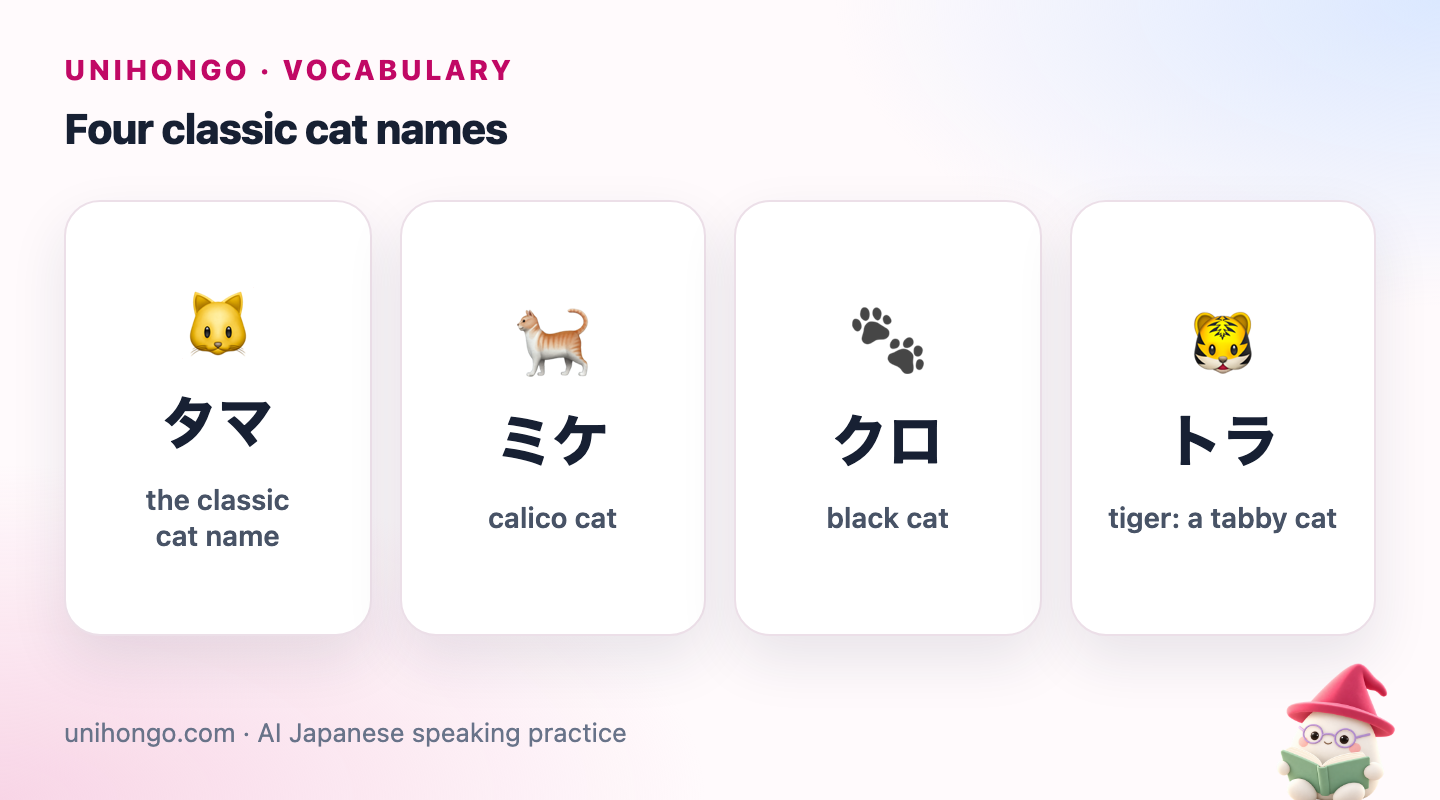
| Japanese | Romaji | Meaning |
|---|---|---|
| タマ | Tama | the classic cat name |
| ミケ | Mike | calico cat |
| クロ | Kuro | black cat |
| トラ | Tora | tiger: a tabby cat |
| シロ | Shiro | white cat |
| チビ | Chibi | little one, tiny |
| ブチ | Buchi | spotted, patches |
Mike is pronounced mi-ke, two syllables, not like the English name. Chibi means a little one and is given to tiny kittens, often staying with them when they grow into very large cats, which Japanese owners find funny. Buchi describes a cat with patches.
Coat words every cat lover uses
Japanese has a rich set of everyday words for cat coats, and owners use them constantly: on adoption pages, in photos posted online and when chatting in the park. Many of these words are used as names too, especially the short versions.
| Japanese | Romaji | Meaning |
|---|---|---|
| 三毛猫 | mikeneko | calico (white, black, orange) |
| 黒猫 | kuroneko | black cat |
| 茶トラ | chatora | orange or ginger tabby |
| キジトラ | kijitora | brown tabby (like a pheasant) |
| サバトラ | sabatora | grey tabby (like mackerel) |
| 茶白 | chashiro | orange and white |
| ハチワレ | hachiware | face split by white, often tuxedo |
| サビ猫 | sabineko | tortoiseshell (lit. rusty cat) |
Notice the fun logic: kiji is a pheasant, whose brown feathers look like a brown tabby, and saba is a mackerel, whose silvery grey stripes look like a grey tabby. Sabi means rust, which describes the mottled black and orange of a tortoiseshell. Once you know them, you can describe almost any cat you meet.
Modern and human-style cat names
Many cats today get names that sound modern: katakana words borrowed from English and other languages, names from nature and the seasons, or human names. You will meet cats called Sora (sky), Hana (flower) and Yuki (snow), and others called Leo, Luna or Coco. Human names, especially old-fashioned ones like Kotetsu or Kojirō, are popular with owners who like a touch of humour: a tiny kitten with a samurai's name.
| Japanese | Romaji | Meaning |
|---|---|---|
| ソラ | Sora | sky · unisex |
| ハナ | Hana | flower · usually female |
| ユキ | Yuki | snow · usually for white cats |
| レオ | Reo | Leo, lion · usually male |
| ルナ | Runa | Luna, moon · usually female |
| コテツ | Kotetsu | an old-fashioned, cool name · male |
| 小次郎 | Kojirō | little second son · male |
Owners give cats human names in Japan without any feeling that it is odd. Some prefer old-style human names, which sound affectionate and a little comic on a cat. Others choose the name of a favourite place, a season or the day the cat arrived.
Endings that give a pet name character
A favourite Japanese trick is to add an ending to a simple name. These endings come from old boys' names and give the pet a playful, grand or old-time feel. They are mostly used for male cats, but owners use them freely.
| Japanese | Romaji | Meaning |
|---|---|---|
| トラ丸 | Toramaru | Tora + maru · male |
| クロ助 | Kurosuke | Kuro + suke · male |
| ミケちゃん | Mike chan | little Mike (affectionate) |
| タマにゃん | Tama nyan | Tama + meow (baby talk) |
| Ending | From | Example | Feel |
|---|---|---|---|
| -maru (丸) | old boys' names and ship names | トラ丸 Toramaru | Cute and a little grand |
| -kichi (吉) | old merchant names, luck | トラ吉 Torakichi | Old-time, lucky |
| -suke (助) | old boys' names | クロ助 Kurosuke | Friendly, cheeky |
| -tarō (太郎) | classic first son | ミケ太郎 Miketarō | Comic, affectionate |
Owners also add -chan to almost any pet name, and in baby talk you will hear -nyan, from nyā, meow. These are fine at home and with friends, but in a vet's waiting room, the staff will usually call the cat by its plain name with -chan or -kun, plus your surname.
Talking to a cat and about one
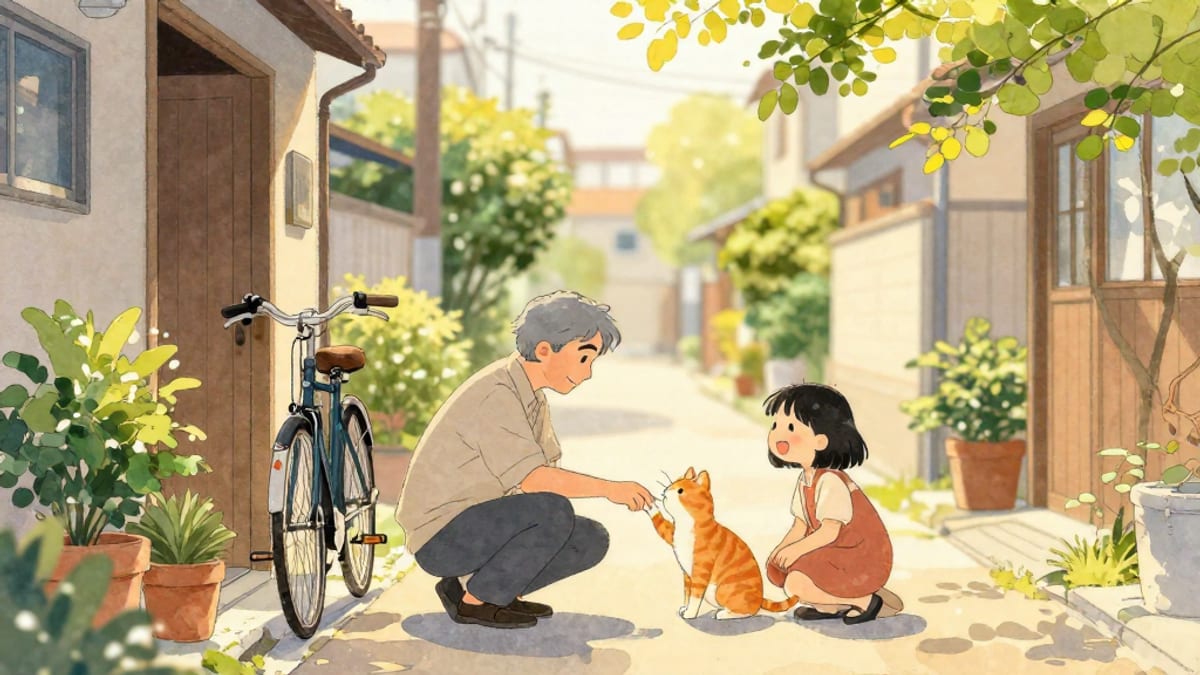
Japanese cat owners talk to their cats in soft, casual Japanese. When you talk with a neighbour about their cat, switch to polite Japanese for the owner, and keep the casual words for the cat itself.
| Japanese | Romaji | Meaning |
|---|---|---|
| おいで。 | Oide. | Come here. (to a cat) |
| ごはんだよ。 | Gohan da yo. | Dinner time! (to a cat) |
| いい子だね。 | Ii ko da ne. | Good kitty. (lit. good child) |
| 猫ちゃん、何て名前ですか。 | Neko chan, nante namae desu ka. | What's your cat's name? (friendly polite) |
| オスですか、メスですか。 | Osu desu ka, mesu desu ka. | Is it a boy or a girl? |
| 触ってもいいですか。 | Sawatte mo ii desu ka. | May I pet it? |
| 人懐っこいですね。 | Hitonatsukkoi desu ne. | He's so friendly with people. |
Mini dialogue: the cat next door
You meet your neighbour in front of her house, with her cat on the step.
| Japanese | Romaji | Meaning |
|---|---|---|
| かわいい猫ちゃんですね。お名前は? | Kawaii neko chan desu ne. Onamae wa? | You: What a cute cat. What's its name? |
| コテツです。もう十歳なんですよ。 | Kotetsu desu. Mō jussai nan desu yo. | Neighbour: Kotetsu. He's already ten. |
| コテツくん。かっこいい名前ですね。 | Kotetsu kun. Kakkoii namae desu ne. | You: Kotetsu. What a cool name. |
| 保護猫だったんです。来た日が雨で。 | Hogoneko datta n desu. Kita hi ga ame de. | Neighbour: He was a rescue. It rained the day he came. |
| 触ってもいいですか。 | Sawatte mo ii desu ka. | You: May I pet him? |
| どうぞ。背中が好きですよ。 | Dōzo. Senaka ga suki desu yo. | Neighbour: Go ahead. He likes his back stroked. |
A cat-coat photo deck with Mocchi
- Ask Mocchi, "Make flashcards for the cat coat words in this post, like mikeneko, kijitora and hachiware." You pick a photo for each card, so every word is tied to a real coat.
- Mocchi reviews the deck with you using spaced repetition, so sabatora and kijitora come back more often if you keep swapping them.
- For a fast round, open Kotoba Tank with your own flashcards: you hear a coat word and hit the right one.
Mistakes to avoid when talking about cats
- Saying otoko or onna for a cat's sex. For animals, use osu (male) and mesu (female), or casually otoko no ko and onna no ko as owners sometimes do.
- Counting cats with tsu or nin. Small animals take hiki: ippiki, nihiki, sanbiki.
- Using aru for a cat. Living things take iru: neko ga iru, there is a cat.
- Pronouncing Mike like the English name. It is mi-ke, two short syllables.
- Touching a neighbour's or café's cat without asking. Sawatte mo ii desu ka costs you nothing.