
I will do my best: the four key phrases
The verb ganbaru (頑張る) means to persevere or to make an effort. In the polite masu form, ganbarimasu, it becomes the all-purpose I will do my best. The other three cards add more weight as the situation gets more serious.
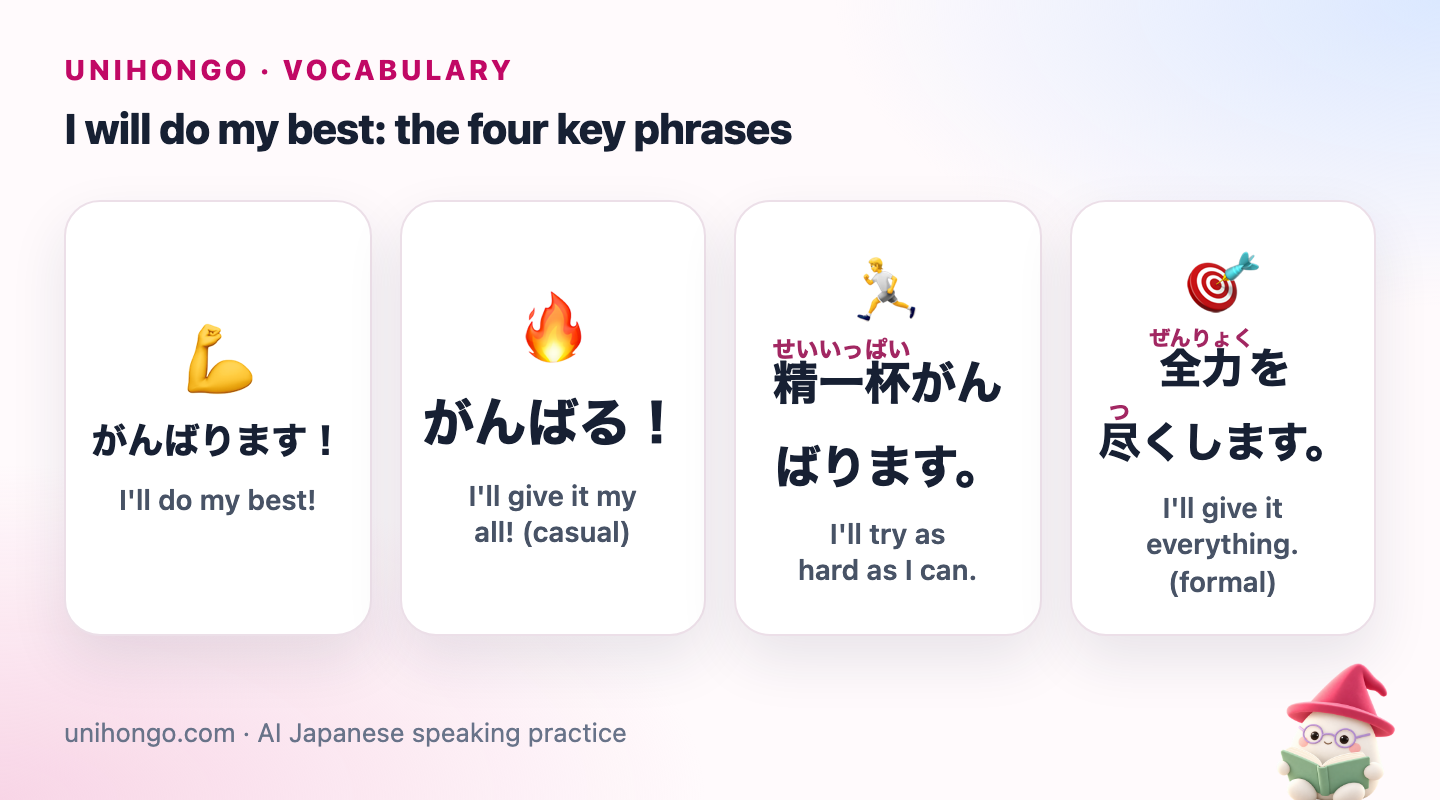
| Japanese | Romaji | Meaning |
|---|---|---|
| がんばります! | Ganbarimasu! | I'll do my best! |
| がんばる! | Ganbaru! | I'll give it my all! (casual) |
| 精一杯がんばります。 | Sei-ippai ganbarimasu. | I'll try as hard as I can. |
| 全力を尽くします。 | Zenryoku o tsukushimasu. | I'll give it everything. (formal) |
Ganbarimasu: a promise of effort
Ganbarimasu is said at the start of something: a new job, a project, an exam, a match, a year. The important nuance is that it promises effort rather than success. You cannot promise to pass an exam, but you can promise to try hard, and that modesty is exactly why the phrase sounds right in Japanese.
You can make it specific with a noun: shiken, ganbarimasu, I'll do my best in the exam; atarashii shigoto o ganbarimasu, I'll work hard at my new job. Motto ganbarimasu, I'll try harder, is a common response to feedback, and tsugi wa ganbarimasu, I'll do better next time, is what people say after a disappointment.
Issho ni ganbarimashō, let's do our best together, invites a team or classmates to join in. It is a lovely phrase at the start of a group project.
| Japanese | Romaji | Meaning |
|---|---|---|
| 明日の試験、がんばります。 | Ashita no shiken, ganbarimasu. | I'll do my best in tomorrow's exam. |
| もっとがんばります。 | Motto ganbarimasu. | I'll try harder. |
| 次はがんばります。 | Tsugi wa ganbarimasu. | I'll do better next time. |
| 一緒にがんばりましょう。 | Issho ni ganbarimashō. | Let's do our best together. |
| がんばってきます。 | Ganbatte kimasu. | I'm off to give it my best. |
Saying it about yourself vs cheering someone else
Learners often mix up the two directions. Ganbatte and ganbatte kudasai are what you say to others: good luck, hang in there. Ganbarimasu and ganbaru are what you say about yourself. So when a friend says ganbatte ne before your exam, the answer is un, ganbaru, yeah, I'll do my best, or arigatō, ganbaru ne.
The form that confuses people is ganbatte kimasu, which contains ganbatte but means I'll go and do my best. Another is ganbatte imasu, I am working hard, which describes your current effort, for example when someone asks how your Japanese is going: mainichi benkyō o ganbatte imasu.
| Japanese | Romaji | Meaning |
|---|---|---|
| がんばってね。 | Ganbatte ne. | Good luck! (to someone else, casual) |
| うん、がんばるね。 | Un, ganbaru ne. | Yeah, I'll do my best. (about yourself) |
| 毎日勉強をがんばっています。 | Mainichi benkyō o ganbatte imasu. | I'm working hard at my studies every day. |
At work: from ganbarimasu to tsutomemasu
At work, ganbarimasu remains fine in most spoken situations, especially for a new person. The standard first-day line is isshōkenmei ganbarimasu node, yoroshiku onegai itashimasu, I will work as hard as I can, so I look forward to working with you. Isshōkenmei (一生懸命) means with all one's effort.
As the setting becomes more formal, other verbs take over. Tsutomemasu (努めます), I will endeavour, and doryoku itashimasu, I will make every effort, sound mature and are common in speeches and emails. Saizen o tsukushimasu, I will do my utmost, is often used when promising a customer that you will try to solve a problem. Go-kitai ni soeru yō tsutomemasu, I will strive to meet your expectations, is the polished business version.
| Japanese | Romaji | Meaning |
|---|---|---|
| 一生懸命がんばりますので、よろしくお願いいたします。 | Isshōkenmei ganbarimasu node, yoroshiku onegai itashimasu. | I'll work as hard as I can, so I look forward to working with you. |
| 最善を尽くします。 | Saizen o tsukushimasu. | I'll do everything I can. |
| 努力いたします。 | Doryoku itashimasu. | I will make every effort. (humble) |
| ご期待に沿えるよう努めます。 | Go-kitai ni soeru yō tsutomemasu. | I'll strive to meet your expectations. |
In a job interview
Interviewers hear ganbarimasu many times a day, so it rarely makes an impression on its own. What works better is a concrete goal followed by a promise of effort. Say what you will contribute, then close with sei-ippai tsutomemasu or ganbaritai to omoimasu, I would like to give it my best, which sounds a little more thoughtful than a flat ganbarimasu.
If you are asked about a weakness, a common pattern is to name it and then say how you are working on it: kaizen dekiru yō ni doryoku shite imasu, I am working to improve it. That shows effort in a way that is concrete rather than a slogan.

| Japanese | Romaji | Meaning |
|---|---|---|
| 御社で語学力を生かせるよう、精一杯努めます。 | Onsha de gogakuryoku o ikaseru yō, sei-ippai tsutomemasu. | I'll work hard to put my language skills to use at your company. |
| 一日も早く戦力になれるよう、がんばりたいと思います。 | Ichinichi mo hayaku senryoku ni nareru yō, ganbaritai to omoimasu. | I'd like to work hard to become a real asset as soon as possible. |
| 改善できるように努力しています。 | Kaizen dekiru yō ni doryoku shite imasu. | I'm making an effort to improve it. |
Before exams, matches and big days
Athletes before a match and students before an entrance exam use the same small set of phrases. Yūshō o mezashite ganbarimasu, I'll do my best aiming for the title, sets a goal. Kui no nai yō ni ganbarimasu, I'll give it everything so I have no regrets, is a very common line in sports interviews. Saigo made akiramemasen, I won't give up until the end, is the fighting version.
With friends and family, the casual forms are natural: zettai ganbaru, I'll definitely do my best, or ganbatte kuru, I'll go and give it my best.
| Japanese | Romaji | Meaning |
|---|---|---|
| 優勝を目指してがんばります。 | Yūshō o mezashite ganbarimasu. | I'll do my best aiming to win. |
| 悔いのないようにがんばります。 | Kui no nai yō ni ganbarimasu. | I'll do my best so I have no regrets. |
| 最後まであきらめません。 | Saigo made akiramemasen. | I won't give up until the end. |
| がんばってくる! | Ganbatte kuru! | I'm off to give it my best! (casual) |
How people reply, plus a mini dialogue
When you say ganbarimasu, the usual replies are encouragement or care. Ōen shite imasu, I'm rooting for you, is warm. Muri shinaide ne, don't overdo it, is a kind reply from friends and family. A manager might say kitai shite imasu, I have high hopes for you, or yoroshiku ne.
| Japanese | Romaji | Meaning |
|---|---|---|
| 来週から新しいチームに入ります。 | Raishū kara atarashii chīmu ni hairimasu. | You: I'm joining a new team next week. |
| そうなんですね。応援しています。 | Sō nan desu ne. Ōen shite imasu. | Manager: Is that so? I'm rooting for you. |
| ありがとうございます。精一杯がんばります。 | Arigatō gozaimasu. Sei-ippai ganbarimasu. | You: Thank you. I'll do everything I can. |
| 期待していますよ。でも、無理しないでくださいね。 | Kitai shite imasu yo. Demo, muri shinaide kudasai ne. | Manager: I'm counting on you. But don't overdo it. |
Common mistakes
- Saying ganbatte about yourself. Ganbatte is for others; say ganbarimasu.
- Translating literally: watashi no besuto o shimasu is not Japanese. Besuto o tsukushimasu exists, but ganbarimasu is far more natural.
- Using zenryoku o tsukushimasu with friends before a casual game. It sounds like a press conference.
- Stopping at ganbarimasu in an interview. Add what you will actually do.
- Promising a result instead of effort. Zettai gōkaku shimasu, I'll definitely pass, is bold; ganbarimasu is the modest default.