

Oshieru: teaching a subject
Oshieru is an ichidan verb: oshiete is the -te form, oshieta the past, oshiemasu the polite form. Its first meaning is to teach, and the pattern is person ni thing o oshieru: gakusei ni Eigo o oshieru, to teach students English. The subject can be a school teacher, a parent, a colleague showing you the ropes or a friend explaining a game. Oshiekata means the way someone teaches, and oshiego is a former pupil, seen from the teacher's side.
In the workplace, oshieru is how newcomers learn: senpai ga shigoto o oshiete kureta, a senior showed me the job. Oshiete morau, to be taught, is the receiving side, and oshiete ageru offers to teach a friend.
| Japanese | Romaji | Meaning |
|---|---|---|
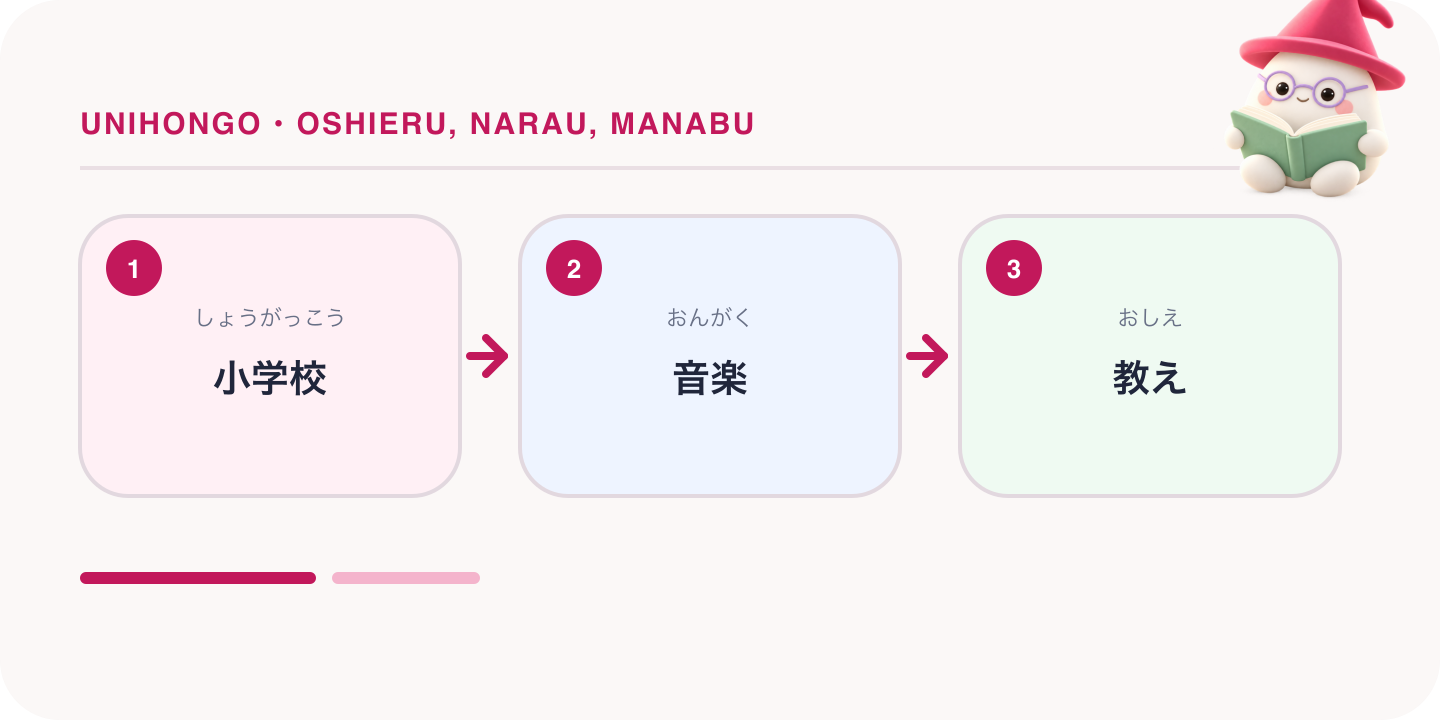
| 母は小学校で音楽を教えています。 | Haha wa shōgakkō de ongaku o oshiete imasu. | My mother teaches music at a primary school. |
| 先輩が仕事のやり方を教えてくれた。 | Senpai ga shigoto no yarikata o oshiete kureta. | A senior colleague taught me how to do the job. |
| 日本語を教えた経験があります。 | Nihongo o oshieta keiken ga arimasu. | I have experience teaching Japanese. |
| ギターを教えてあげようか。 | Gitā o oshiete ageyō ka. | Shall I teach you the guitar? |
| 教え方が上手な先生ですね。 | Oshiekata ga jōzu na sensei desu ne. | That teacher is good at explaining. |
Oshieru as tell: information you did not have
The second meaning is the one you will use most often. Oshieru means to tell someone a piece of information they lack: a name, a phone number, the way, the time, how something works. Michi o oshieru is to tell someone the way, and tsukaikata o oshiete kudasai asks how to use something. English speakers find it strange to be taught a phone number, but in Japanese the idea is simply that knowledge passes to you.
The contrast is with iu, to say, and tsutaeru, to convey. Iu is about the words; oshieru is about the listener gaining knowledge. Tsutaeru moves a message from one person to another. If you want a friend's address, ask jūsho o oshiete, not jūsho o itte. If you want someone to relay your thanks, that is tsutaete, not oshiete.
| Japanese | Romaji | Meaning |
|---|---|---|
| 駅までの道を教えてください。 | Eki made no michi o oshiete kudasai. | Please tell me the way to the station. |
| この機械の使い方を教えてもらえますか。 | Kono kikai no tsukaikata o oshiete moraemasu ka. | Could you show me how to use this machine? |
| おすすめの店を教えて。 | Osusume no mise o oshiete. | Tell me a shop you recommend. |
| メールアドレスを教えていただけますか。 | Mēru adoresu o oshiete itadakemasu ka. | Could you give me your email address? |
| 何時に始まるか教えてくれる? | Nanji ni hajimaru ka oshiete kureru? | Can you tell me what time it starts? |
Narau: learning from a teacher
Narau is to learn something by being taught. It implies a teacher, a class or a course, and the source is marked with ni or kara: sensei ni piano o narau, to learn piano from a teacher. It is the verb for lessons in the traditional sense: shodō o narau, calligraphy; sadō o narau, tea ceremony; jūdō o narau. Naraigoto is the noun for lessons taken outside school, such as swimming or English conversation.
Narau is also used for school subjects already covered: kono kanji wa mō naratta, we have already learned this kanji, meaning it was taught in class. The proverb narau yori nareru, get used to it rather than learn it, captures the structured feel of narau.
| Japanese | Romaji | Meaning |
|---|---|---|
| 子どものころ、ピアノを習っていました。 | Kodomo no koro, piano o naratte imashita. | I took piano lessons as a child. |
| 日本語は大学で習いました。 | Nihongo wa daigaku de naraimashita. | I learned Japanese at university. |
| この文法はまだ習っていません。 | Kono bunpō wa mada naratte imasen. | We haven't been taught this grammar yet. |
| 何か習い事をしていますか。 | Nani ka naraigoto o shite imasu ka. | Do you take any lessons? |
| 先生に茶道を習っています。 | Sensei ni sadō o naratte imasu. | I'm learning tea ceremony from a teacher. |
Manabu: learning from anything
Manabu is wider and a little more serious. It covers learning from a teacher, but also from books, experience, failure and other people's example. Shippai kara manabu, to learn from failure, has no teacher at all. Because it feels reflective, manabu is common in speeches, interviews and writing: kono shigoto de ōku no koto o manabimashita, I learned a great deal in this job.
In everyday speech, manabu can sound slightly formal compared with narau or benkyō suru, and a student talking about their week would say benkyō shita rather than mananda. Gakushū suru is a formal equivalent used in education and in software: kikai gakushū, machine learning.
| Japanese | Romaji | Meaning |
|---|---|---|
| 失敗から多くのことを学んだ。 | Shippai kara ōku no koto o mananda. | I learned a lot from failure. |
| 前の会社でチームワークの大切さを学びました。 | Mae no kaisha de chīmuwāku no taisetsusa o manabimashita. | At my previous company I learned the importance of teamwork. |
| 本から学べることは多い。 | Hon kara manaberu koto wa ōi. | There is a lot you can learn from books. |
| 日本の文化について学びたいです。 | Nihon no bunka ni tsuite manabitai desu. | I want to learn about Japanese culture. |
Benkyō suru, oboeru, minitsukeru, renshū suru
Benkyō suru is the labour of studying: hours at a desk, homework, exam preparation. It says nothing about success. Nihongo o benkyō shite imasu is the standard way to say you are studying Japanese. Benkyō ni naru, it is educational, is a polite reaction to something interesting, and ii benkyō ni natta is what people say after a mistake that taught them something.
Oboeru is to memorise and to remember. Tango o oboeru, to learn vocabulary; namae o oboeru, to remember a name. The -te form oboete iru means you still remember, and its opposite is wasureru, to forget. Oboeru is about holding information in the head, so it is the right verb for kanji, lines in a play and passwords, but not for skills.
Minitsukeru, literally to attach to the body, is to acquire a skill or habit so that it becomes part of you: Eigo o minitsukeru, to acquire English; manā o minitsukeru, to learn good manners. The intransitive minitsuku describes the skill settling in: yatto minitsuita, it finally stuck. Renshū suru is to practise, the repeated doing that gets you there: hatsuon o renshū suru, to practise pronunciation.
| Japanese | Romaji | Meaning |
|---|---|---|
| 毎日二時間、日本語を勉強しています。 | Mainichi nijikan, Nihongo o benkyō shite imasu. | I study Japanese for two hours every day. |
| 今日の話はとても勉強になりました。 | Kyō no hanashi wa totemo benkyō ni narimashita. | I learned a lot from today's talk. |
| 一日に十個の単語を覚えている。 | Ichinichi ni jukko no tango o oboete iru. | I'm memorising ten words a day. |
| 彼の名前を覚えていますか。 | Kare no namae o oboete imasu ka. | Do you remember his name? |
| 仕事で使える英語を身につけたい。 | Shigoto de tsukaeru Eigo o minitsuketai. | I want to acquire English I can use at work. |
| 発音を毎日練習しています。 | Hatsuon o mainichi renshū shite imasu. | I practise pronunciation every day. |
Which verb for which situation
The table lines up the verbs with the situation each one fits. Several verbs can describe the same activity from different angles: a piano student learns from a teacher with narau, practises at home with renshū suru, memorises the piece with oboeru, and acquires the technique over years with minitsukeru.
| Verb | Reading | Fits when |
|---|---|---|
| 教える | oshieru | Teaching a subject, or telling someone a fact or a way |
| 習う | narau | Learning from a teacher in lessons: piano, calligraphy, a language class |
| 学ぶ | manabu | Learning from anything, including experience; reflective and slightly formal |
| 勉強する | benkyō suru | The effort of studying: homework, exams, hours at a desk |
| 覚える | oboeru | Memorising and remembering: words, kanji, names, passwords |
| 身につける | minitsukeru | Acquiring a skill or habit so it becomes part of you |
| 練習する | renshū suru | Practising by repetition: pronunciation, a sport, an instrument |
| 復習する | fukushū suru | Reviewing what was already taught |
| 予習する | yoshū suru | Preparing a lesson before class |
| 伝える | tsutaeru | Passing a message or feeling on to someone |
| 知らせる | shiraseru | Informing someone of news or a change |
Fukushū and yoshū are worth knowing because teachers use them constantly: fukushū shite kudasai, please review.
Oshiete kudasai and its politeness levels
Oshiete kudasai is polite enough for strangers, shop staff and most colleagues. When you want to be softer, add moraemasu ka or itadakemasu ka: oshiete itadakemasu ka, could you possibly tell me. Oshiete itadakitai n desu ga trails off and leaves the other person room to respond. Between friends, oshiete or oshiete yo is enough.
In formal writing, go-kyōju kudasai, please instruct me, appears in requests to experts, and go-shidō go-bentatsu no hodo yoroshiku onegai itashimasu is a set phrase asking for guidance when you join a company.
- Oshiete: casual, friends and family
- Oshiete kudasai: polite, everyday
- Oshiete moraemasu ka: polite request, slightly softer
- Oshiete itadakemasu ka: respectful, for seniors and customers
- Oshiete itadakitai n desu ga: respectful and indirect, leaves room to refuse
- Go-kyōju kudasai: formal written request for instruction
Whatever the level, add a reason when the request is a big one: Nihongo o benkyō shite iru node, oshiete itadakemasu ka. Reasons make requests feel lighter.
Mistakes learners make with teaching and learning verbs
The biggest mistake is oshieru for let me know or keep me informed. Nani ka attara oshiete kudasai, tell me if anything comes up, is fine because a fact will be reported. But kekka o oshiete kudasai when you mean please inform me once the result is out sounds slightly off in business email; go-renraku kudasai or o-shirase kudasai are the natural forms. And when you want someone to pass your message on, the verb is tsutaeru: yoroshiku o-tsutae kudasai, never oshiete kudasai.
The second is narau for learning from experience. Shippai kara naratta is odd because failure does not give lessons; say shippai kara mananda. The third is oboeru for skills. Oyogu no o oboeta, I picked up swimming, is fine in casual speech, but oyogi o minitsuketa is the precise phrase for a skill that is now yours.
Finally, when a Japanese person asks you oshiete kudasai, they are asking for information, not offering to become your student. Answer with the fact, not with a lesson.
| Japanese | Romaji | Meaning |
|---|---|---|
| 結果が出たらご連絡ください。 | Kekka ga detara go-renraku kudasai. | Please contact me once the result is out. |
| 何か変更があれば知らせてください。 | Nani ka henkō ga areba shirasete kudasai. | Please let me know if anything changes. |
| 失敗から学びました。 | Shippai kara manabimashita. | I learned from my mistake. |
| やっと自転車の乗り方を身につけた。 | Yatto jitensha no norikata o minitsuketa. | I finally got the hang of riding a bike. |
| 教えてくれてありがとう。 | Oshiete kurete arigatō. | Thanks for telling me. |