
Honorifics are relationship markers
A Japanese suffix follows a name: Tanaka-san, Yamada-sensei, Miki-chan. It signals how the speaker frames the relationship at that moment. The same person might be Satō-sensei to students, Satō-san to a neighbour, and Haruka-chan to a childhood friend. Translation cannot preserve all of that information with Mr or Ms.
Names are also omitted frequently when context is clear. Japanese avoids the broad English you, often using a title, a name, or no subject at all. Learning honorifics therefore includes learning when not to force a name into every sentence.
The common suffixes at a glance
| Form | Typical use | Main caution |
|---|---|---|
| さん san | Neutral polite address for adults | Do not add it to yourself |
| さま sama | Customers, formal respect, written addressees | Too elevated for ordinary peers |
| くん kun | Often boys or male juniors; some workplace juniors | Not simply 'for all men' |
| ちゃん chan | Children, affection, close nicknames | Can patronise an adult |
| 先生 sensei | Teachers, doctors, recognised professional experts | A role title, not generic mastery |
| 先輩 senpai | Senior member in the same organisation | Relative to a shared group |
| 氏 shi | Formal third-person writing and reporting | Rare as everyday direct address |
| 殿 dono | Certain formal documents or stylised language | Not a more polite everyday sama |
San: the default worth trusting
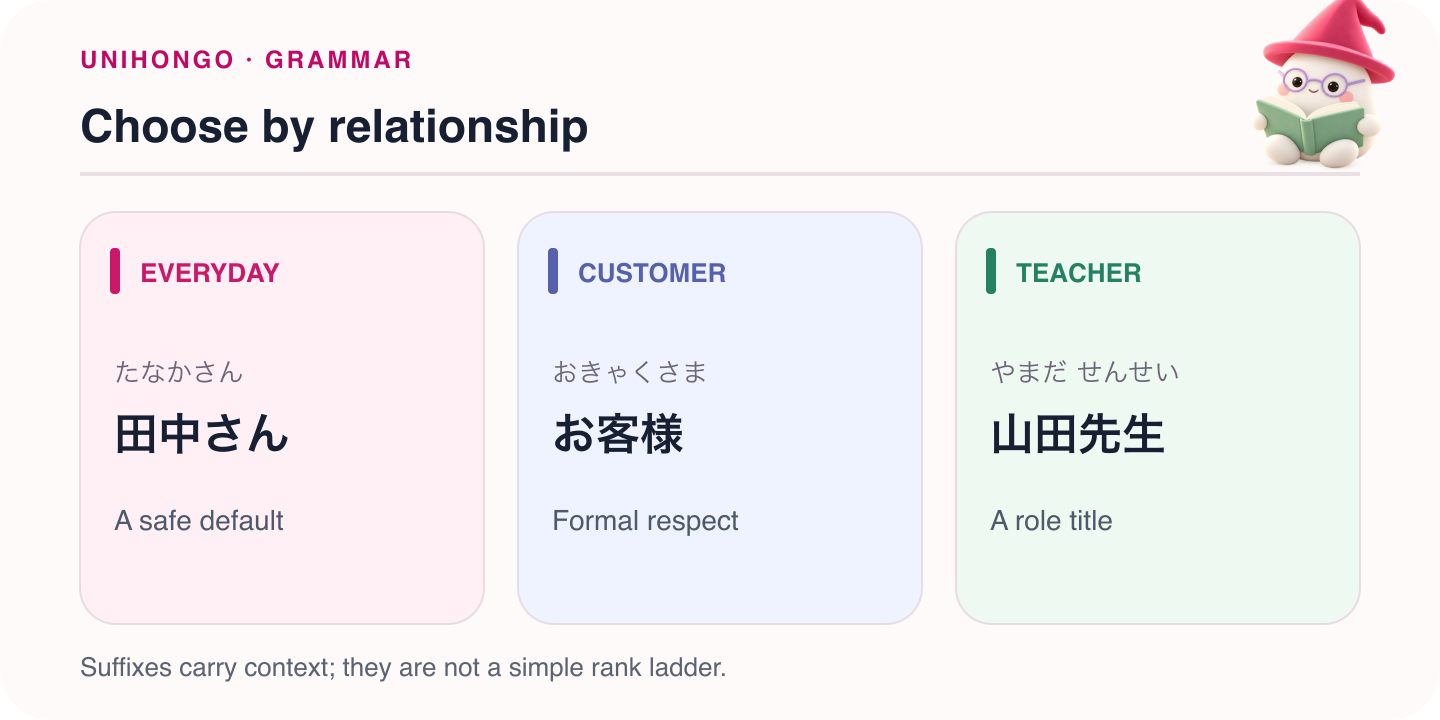
San works after family names and given names, for any gender, and in most neutral adult relationships. Use Suzuki-san with a colleague, neighbour, classmate, or new acquaintance unless the setting supplies a professional title. It is much safer than guessing a gendered English title.
San also attaches to some roles or businesses in friendly language, such as honya-san for a bookseller or bookstore and o-mawari-san for a police officer. These patterns are lexical and contextual. As a learner, name plus san gives you a dependable base while observation teaches local habits.
Sama: customers, letters, and elevated respect
Service staff commonly address a customer as okyakusama, and correspondence places sama after the recipient's name. Gods take kami-sama, and formal speech may use sama to elevate a respected person. The suffix creates more distance and deference than san.
Using sama with every manager or new friend sounds exaggerated, ironic, or submissive rather than safely polite. Choose it when the relationship or convention calls for customer-level respect, not as insurance against every social uncertainty.
Kun and chan depend on relationship
Kun is strongly associated with boys and younger men, but its range includes a senior addressing a junior and, in some organisations, women addressed as juniors. Because this usage reflects local culture and hierarchy, do not decide from gender alone. Follow the group's established practice.
Chan expresses affection, smallness, or a close nickname. It is common for young children and pets and among intimate friends. Adding chan to a new adult acquaintance can sound infantilising or presumptuous. A person may invite a chan nickname; let that permission come from the relationship.
Sensei and senpai are roles
| Japanese | Romaji | Meaning |
|---|---|---|
| 田中先生、おはようございます。 | Tanaka-sensei, ohayō gozaimasu. | Good morning, Professor/Teacher Tanaka. |
| 先生、質問があります。 | Sensei, shitsumon ga arimasu. | Teacher, I have a question. |
| 佐藤先輩に聞きました。 | Satō-senpai ni kikimashita. | I asked my senior Satō. |
| 先輩、お願いします。 | Senpai, onegaishimasu. | Senpai, please / I'm counting on you. |
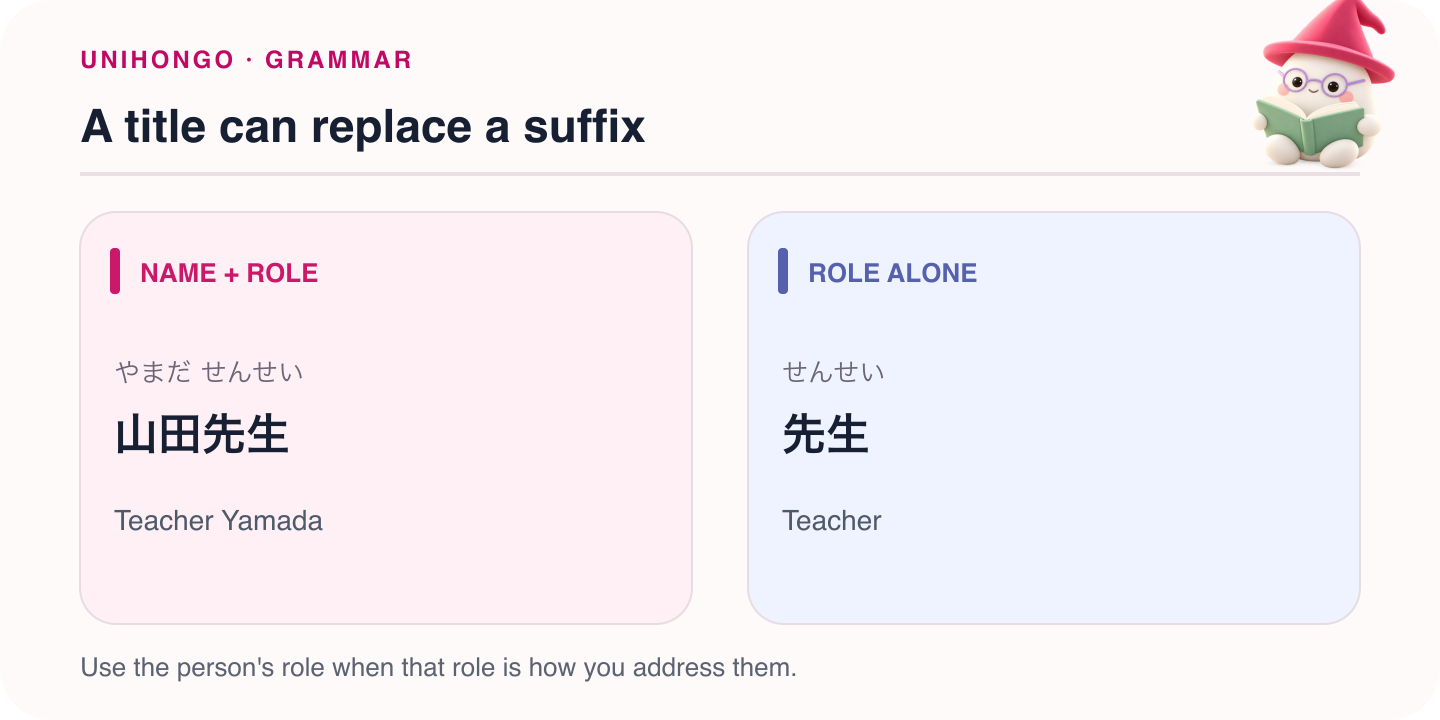
Sensei can stand alone as direct address and is used for schoolteachers, university instructors, physicians, lawyers, politicians, artists, and other recognised experts under particular conventions. Senpai is relational: someone is your senior within a school, club, or workplace. An older stranger is not automatically senpai.
Workplace inside and outside language
Inside a company, employees may use family name plus san, a job title such as buchō, or name plus title. When speaking to an external customer about your own colleague, Japanese often removes the colleague's honorific because your colleague belongs to your in-group. Tanaka-san wa ima orimasen becomes Tanaka wa tadaima seki o hazushite orimasu in outward-facing business speech.
This in-group/out-group pattern surprises learners who think san permanently belongs to a person's name. It does not license abrupt speech inside the office; it is a convention for humbly presenting your own side to the other side. Company culture varies, so listen before copying a hierarchy rule mechanically.
Family terms change with perspective
| Reference | Your own family | Someone else's / direct address |
|---|---|---|
| Mother | 母 haha | お母さん okāsan |
| Father | 父 chichi | お父さん otōsan |
| Older sister | 姉 ane | お姉さん onēsan |
| Older brother | 兄 ani | お兄さん onīsan |
Children and family members may directly call their own mother okāsan, while an adult describing her to an outsider typically says haha. The contrast reflects humble reference to one's own group and respectful reference to the listener's. Real families use names and nicknames too, but the textbook distinction remains useful.
When no suffix is appropriate
- Close friends, partners, and family may agree to use given names without suffixes.
- A senior may address a junior without a suffix in a hierarchy, though the tone can feel blunt.
- Public figures and authors may appear without suffixes in neutral reporting or reference writing.
- Your own name takes no honorific when you introduce or sign yourself.
- A name used inside a compound label may follow a different convention from direct address.
Dropping the suffix is called yobisute and often signals closeness, but assuming closeness creates the opposite effect. Wait until the other person suggests first-name use, observe peers, or ask onamae wa nan to yobeba ii desu ka—how should I address you? Respecting a stated preference is more natural than performing a memorised rule.