
The sai counter and the readings that trip people up
Age uses the counter sai, written 歳 in formal contexts and often simplified to 才 on forms and shop signs. It attaches to the Sino-Japanese numbers, so most ages are completely predictable: nisai, sansai, yonsai, gosai, rokusai, nanasai, kyūsai. The counters guide covers how this fits into the wider counter system; here you only need the three irregulars and the one exception.
The irregular points are one, eight and ten. Issai, hassai and jussai all shorten the number and double the s. Because compounds inherit the pattern, every decade boundary is irregular too: sanjussai, yonjussai, gojussai. You will also hear jissai instead of jussai from older speakers and in careful announcements, and both are correct.
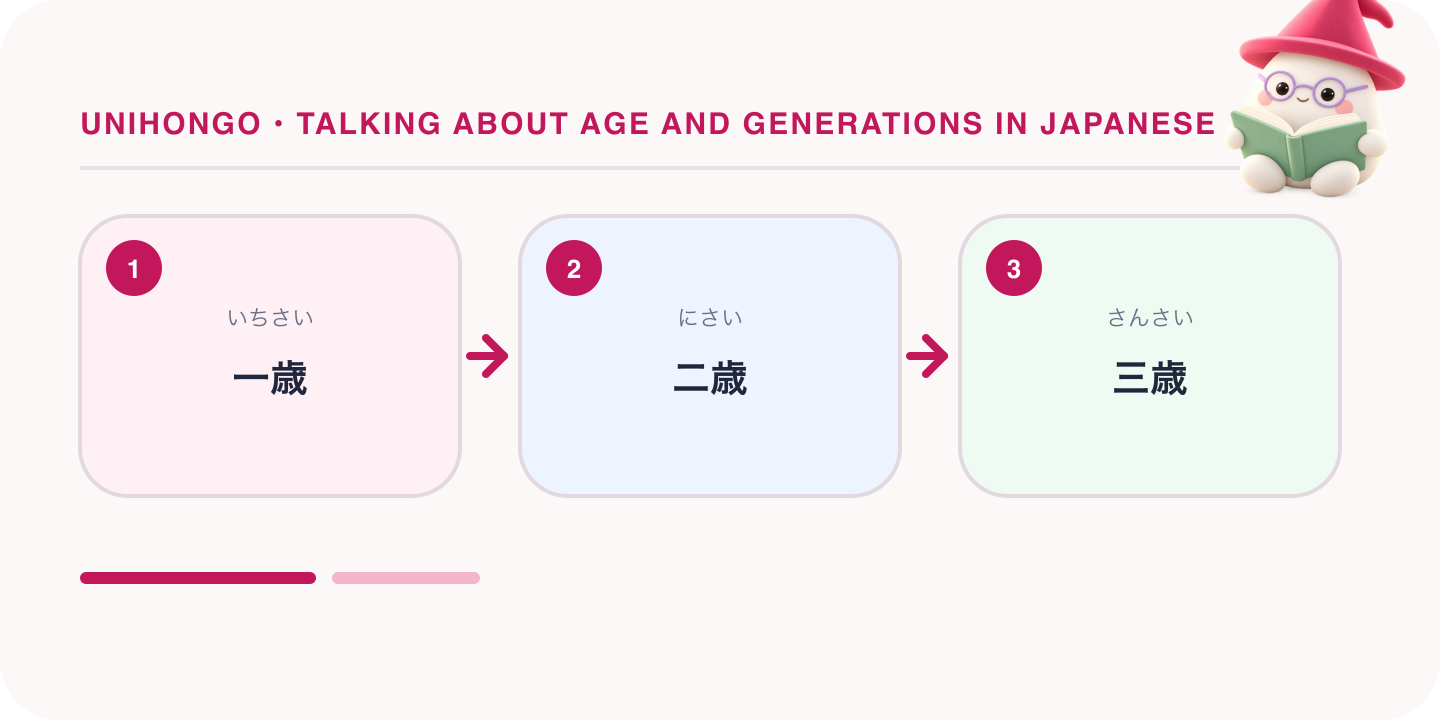
| Age | Japanese | Romaji | Note |
|---|---|---|---|
| 1 | 一歳 | issai | Irregular, doubled s |
| 2 | 二歳 | nisai | Regular |
| 3 | 三歳 | sansai | Regular |
| 4 | 四歳 | yonsai | Never shisai |
| 5 | 五歳 | gosai | Regular |
| 6 | 六歳 | rokusai | Regular |
| 7 | 七歳 | nanasai | Never shichisai |
| 8 | 八歳 | hassai | Irregular, doubled s |
| 9 | 九歳 | kyūsai | Never kusai |
| 10 | 十歳 | jussai | Also jissai |
| 11 | 十一歳 | jūissai | Inherits issai |
| 18 | 十八歳 | jūhassai | Inherits hassai |
| 19 | 十九歳 | jūkyūsai | Regular |
| 20 | 二十歳 | hatachi | Special word, not nijussai |
| 21 | 二十一歳 | nijūissai | Inherits issai |
| 28 | 二十八歳 | nijūhassai | Inherits hassai |
| 30 | 三十歳 | sanjussai | Also sanjissai |
| 40 | 四十歳 | yonjussai | Never shijussai |
| 50 | 五十歳 | gojussai | Also gojissai |
| 60 | 六十歳 | rokujussai | Also rokujissai |
| 70 | 七十歳 | nanajussai | Regular pattern |
| 80 | 八十歳 | hachijussai | Regular pattern |
| 90 | 九十歳 | kyūjussai | Regular pattern |
| 100 | 百歳 | hyakusai | No doubling |
| How old | 何歳 | nansai | Plain question word |
Hatachi and why twenty is different
Twenty is the one age that abandons the counter. In speech a twenty-year-old is hatachi, and you say hatachi desu with no sai attached. The regular form nijussai is not wrong, and you will see it in documents, medical intake and news writing, but using it about yourself in conversation sounds like reading from a form.
Hatachi carries a social weight beyond the number, because twenty has long been the age of adulthood in Japan and is still the age most people associate with the coming-of-age ceremony. The legal age of majority has been revised in recent years, so avoid stating rules about what a twenty-year-old may do and describe the ceremony instead.
| Japanese | Romaji | Meaning |
|---|---|---|
| 二十歳になりました。 | Hatachi ni narimashita. | I have turned twenty. |
| 来月二十歳です。 | Raigetsu hatachi desu. | I turn twenty next month. |
| 娘は二十歳になったばかりです。 | Musume wa hatachi ni natta bakari desu. | My daughter has only just turned twenty. |
| 書類には満二十歳と書いてください。 | Shorui ni wa man-nijussai to kaite kudasai. | Please write twenty years of age on the form. |
| 十九歳の時に日本に来ました。 | Jūkyūsai no toki ni Nihon ni kimashita. | I came to Japan when I was nineteen. |
Asking someone's age politely
There are three registers. Nansai desu ka is neutral and completely normal toward a child. O-ikutsu desu ka is the polite adult version, using the honorific o and the softer ikutsu, and it is what you should reach for with anyone you do not know well. Toshi wa is casual and belongs among friends of a similar age.
Whichever you choose, an adult question is usually cushioned. Shitsurei desu ga means excuse me for asking, and kiite mo ii desu ka asks permission before the question lands. If the other person deflects with himitsu desu or a laugh, take the answer and move on without repeating it.
| Japanese | Romaji | Meaning |
|---|---|---|
| 失礼ですが、おいくつですか。 | Shitsurei desu ga, o-ikutsu desu ka. | Excuse me for asking, but how old are you? |
| 年を聞いてもいいですか。 | Toshi o kiite mo ii desu ka. | Is it all right if I ask your age? |
| 何歳ですか。 | Nansai desu ka. | How old are you? |
| お子さんはおいくつですか。 | Okosan wa o-ikutsu desu ka. | How old is your child? |
| 同い年ですか。 | Onaidoshi desu ka. | Are we the same age? |
| 私より年上ですか、年下ですか。 | Watashi yori toshiue desu ka, toshishita desu ka. | Are you older or younger than me? |
| 何年生まれですか。 | Nannen umare desu ka. | What year were you born? |
| 秘密です。 | Himitsu desu. | That is a secret. (a common deflection) |
Answering about your own age
The plain answer is your number plus sai desu, and adding ni narimashita for a recent birthday makes it sound more like conversation than data. If you would rather not give the exact number, the decade answer is completely normal and not evasive: sanjūdai desu closes the question politely.
Two useful softeners are mō and mada. Mō sanjussai desu means I am already thirty, with a note of surprise at yourself, while mada nijūdai desu means I am still in my twenties. Learners often produce a flat number and miss the small feeling that a Japanese speaker would add.
| Japanese | Romaji | Meaning |
|---|---|---|
| 二十五歳です。 | Nijūgosai desu. | I am twenty-five. |
| 先週三十歳になりました。 | Senshū sanjussai ni narimashita. | I turned thirty last week. |
| もう四十歳です。早いですね。 | Mō yonjussai desu. Hayai desu ne. | I am forty already. Time flies. |
| まだ二十代です。 | Mada nijūdai desu. | I am still in my twenties. |
| 三十代前半です。 | Sanjūdai zenhan desu. | I am in my early thirties. |
| 四十代後半です。 | Yonjūdai kōhan desu. | I am in my late forties. |
| だいたい同じくらいですね。 | Daitai onaji kurai desu ne. | We are about the same age, then. |
| 年より若く見えますね。 | Toshi yori wakaku miemasu ne. | You look younger than your age. |
| ありがとうございます。よく言われます。 | Arigatō gozaimasu. Yoku iwaremasu. | Thank you. People often say that. |
Decades and generation words
The suffix dai after a round decade names the whole band, so jūdai is teenagers, nijūdai is people in their twenties, and rokujūdai is people in their sixties. Add zenhan, nakaba or kōhan to narrow it to the early, middle or late part. In casual speech you will also hear the borrowed set arasā and arafō, meaning around thirty and around forty, which are conversational and slightly playful rather than neutral.
Sedai means generation and appears in dōsedai, someone of your own generation, and in named cohorts such as dankai no sedai, yutori sedai and zetto sedai. Use named cohorts carefully, since they carry opinions attached; dōsedai is the safe, friendly word for shared references.
| Japanese | Romaji | English |
|---|---|---|
| 十代 | jūdai | Teens |
| 二十代 | nijūdai | In your twenties |
| 三十代 | sanjūdai | In your thirties |
| 四十代 | yonjūdai | In your forties |
| 五十代 | gojūdai | In your fifties |
| 六十代 | rokujūdai | In your sixties |
| 二十代前半 | nijūdai zenhan | Early twenties |
| 三十代半ば | sanjūdai nakaba | Mid thirties |
| 四十代後半 | yonjūdai kōhan | Late forties |
| 世代 | sedai | Generation |
| 同世代 | dōsedai | The same generation |
| 同い年 | onaidoshi | The same age |
| 年上 | toshiue | Older (person) |
| 年下 | toshishita | Younger (person) |
| 若者 | wakamono | Young people |
| 中年 | chūnen | Middle-aged |
| 高齢者 | kōreisha | Older people (formal) |
| お年寄り | otoshiyori | Elderly people (gentler) |
| 未成年 | miseinen | A minor |
| 成人 | seijin | An adult |
| 学年 | gakunen | School year |
| 同級生 | dōkyūsei | Classmate of the same year |
| 早生まれ | hayaumare | Born January to early April |
Hayaumare is worth knowing because Japanese school years start in April. Someone born in February is in the school year above the person born the following May, so two people the same age on paper can be a year apart at school, and that difference can still shape how they speak to each other years later.
Milestone ages and how they are marked
Several ages have their own celebrations. Shichi-go-san is a family visit to a shrine for children around three, five and seven, and families usually dress up and take photographs. Seijinshiki is the coming-of-age ceremony held in January for young adults, with formal clothing and a local ceremony. Practice varies by region and family, and plenty of people skip these entirely.
Later milestones have names taken from written characters. Kanreki at sixty marks a full cycle of the traditional calendar and is often celebrated with red items. Koki is seventy, kiju seventy-seven, beiju eighty-eight and hakuju ninety-nine. You do not need to produce these words, but recognising them helps when a colleague mentions a family party.
| Japanese | Romaji | Meaning |
|---|---|---|
| 来年は還暦のお祝いをします。 | Rainen wa kanreki no oiwai o shimasu. | Next year we are holding a sixtieth birthday celebration. |
| 成人式に出ましたか。 | Seijinshiki ni demashita ka. | Did you go to the coming-of-age ceremony? |
| 七五三の写真を撮りました。 | Shichi-go-san no shashin o torimashita. | We took photographs for the shichi-go-san celebration. |
| 祖母は米寿を迎えました。 | Sobo wa beiju o mukaemashita. | My grandmother reached her eighty-eighth birthday. |
| お誕生日おめでとうございます。 | O-tanjōbi omedetō gozaimasu. | Happy birthday. |
| いくつになったんですか。 | Ikutsu ni natta n desu ka. | How old have you turned? (casual and friendly) |
Age on forms and applications
Paperwork uses a small fixed vocabulary. Nenrei is the field labelled age, seinengappi is date of birth, and man-nenrei is your age counted the ordinary way, from your birthday. The older system kazoedoshi counted everyone up one at new year and now appears mainly in traditional contexts, so if a form says man, write the age you would say aloud.
Conditions are written with ijō for and above and miman for under, as in man-jūhassai ijō. Rules and thresholds change, so read the form rather than assuming, and ask the counter staff if the wording is unclear. The city hall procedures guide covers the wider paperwork conversation.
| Japanese | Romaji | Meaning |
|---|---|---|
| 年齢を書いてください。 | Nenrei o kaite kudasai. | Please write your age. |
| 生年月日はいつですか。 | Seinengappi wa itsu desu ka. | What is your date of birth? |
| 満年齢でお願いします。 | Man-nenrei de onegai shimasu. | Please use your age from your last birthday. |
| 十八歳以上ですか。 | Jūhassai ijō desu ka. | Are you eighteen or over? |
| 十二歳未満は無料です。 | Jūnisai miman wa muryō desu. | Children under twelve are free. (staff line) |
| すみません、ここは何を書きますか。 | Sumimasen, koko wa nani o kakimasu ka. | Excuse me, what do I write here? |
A child's age in years and months
For babies and toddlers, months matter more than years. Before the first birthday you say seigo plus the months, as in seigo rokkagetsu, six months old. After that the pattern is years plus months: issai sankagetsu is one year and three months. Han for half is very common in speech, so nisai han is two and a half.
The question is nankagetsu desu ka for months and nansai desu ka for years. A parent will often answer with both, and the small talk that follows is predictable enough to rehearse: kawaii desu ne, genki desu ne, and a comment about how fast they grow.
| Japanese | Romaji | Meaning |
|---|---|---|
| 生後六か月です。 | Seigo rokkagetsu desu. | The baby is six months old. |
| 一歳三か月です。 | Issai sankagetsu desu. | He is one year and three months. |
| 二歳半になりました。 | Nisai han ni narimashita. | She has turned two and a half. |
| 何か月ですか。 | Nankagetsu desu ka. | How many months old is the baby? |
| 上の子は五歳、下の子は三歳です。 | Ue no ko wa gosai, shita no ko wa sansai desu. | My older child is five and my younger one is three. |
| 大きくなるのが早いですね。 | Ōkiku naru no ga hayai desu ne. | They grow up so quickly. |
| もう小学生ですか。 | Mō shōgakusei desu ka. | Are they at primary school already? |
Age, senpai and how it changes your speech
Age in Japanese is not only information; it sets the default register. A person even a year toshiue is often addressed more politely, and the senpai and kōhai relationship at school and work is built on entry order, which usually tracks age. The dedicated senpai and kōhai post covers that hierarchy in detail, so here the point is narrower: knowing the age gap tells you whether to keep desu and masu or to relax.
The move to casual speech is negotiated, not assumed. Tameguchi de ii desu yo invites the other person to drop polite forms, and it is normally offered by the older or more senior person. Until it is offered, stay polite, even with someone your own age, and keep san on their name. The polite versus casual guide explains the forms themselves.
| Japanese | Romaji | Meaning |
|---|---|---|
| 一つ年上なんですね。 | Hitotsu toshiue nan desu ne. | So you are a year older than me. |
| 二つ年下です。 | Futatsu toshishita desu. | I am two years younger. |
| 同い年ですね。うれしいです。 | Onaidoshi desu ne. Ureshii desu. | We are the same age. That is nice. |
| 敬語じゃなくてもいいですよ。 | Keigo ja nakute mo ii desu yo. | You do not need to use polite language with me. |
| ため口でいいですよ。 | Tameguchi de ii desu yo. | Feel free to speak casually with me. |
| じゃあ、遠慮なく。 | Jā, enryo naku. | Then I will take you up on that. |
| 年上の方には敬語を使います。 | Toshiue no kata ni wa keigo o tsukaimasu. | I use polite language with people older than me. |
| 先輩は何年目ですか。 | Senpai wa nannenme desu ka. | How many years have you been here? |
Notice keigo ja nakute mo ii desu yo in the fifth row: the full form includes mo, and dropping it changes the sentence. Learners often hear the shortened casual version and reproduce it without mo, which sounds abrupt when said to someone you have just met.
Drills that make age vocabulary automatic
- Say the four broken forms every morning until they are reflexes: issai, hassai, jussai, hatachi.
- Count your family aloud with sai, then say the same list again with dai bands instead of exact numbers.
- Rehearse both halves of the exchange: shitsurei desu ga, o-ikutsu desu ka, and your own answer straight after.
- Practise one deflection you are comfortable with, such as sanjūdai desu, so a sensitive question never leaves you silent.
- Read any Japanese form you already have and say the nenrei and seinengappi fields out loud.
- Whenever you learn a new person's age in real life, say the toshiue or toshishita sentence about them in your head.