
Shōnen, shōjo, seinen, josei: readers, not genres
Manga in Japan usually appears first in a magazine, and every magazine has a target reader. A series that runs in a boys' magazine is a shōnen manga whatever its story is about. When it becomes an anime, the label travels with it. Bookshops sort their shelves the same way, so these four words are worth knowing before any genre name.
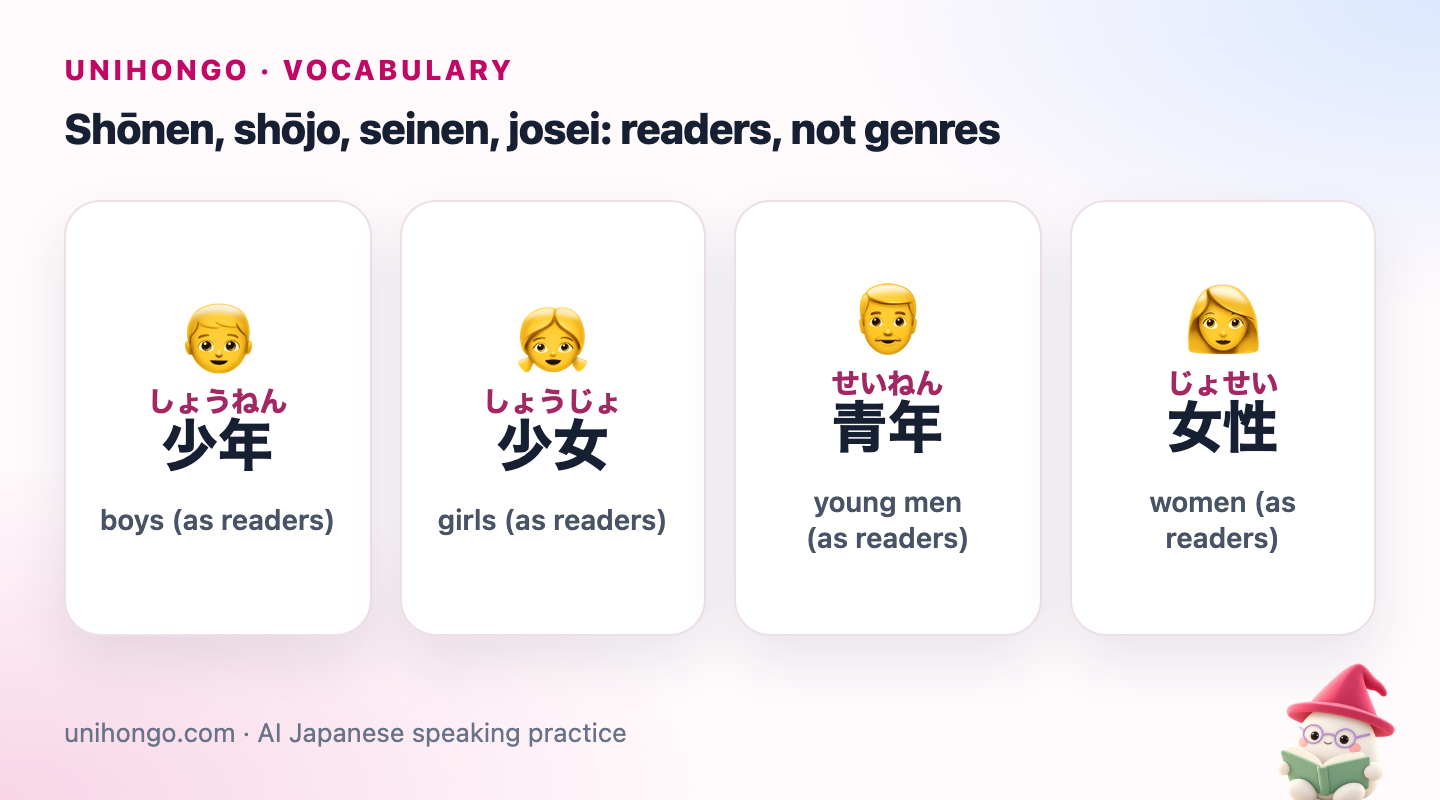
| Japanese | Romaji | Meaning |
|---|---|---|
| 少年 | shōnen | boys (as readers) |
| 少女 | shōjo | girls (as readers) |
| 青年 | seinen | young men (as readers) |
| 女性 | josei | women (as readers) |
| 少年漫画 | shōnen manga | manga from a boys' magazine |
| 少女漫画 | shōjo manga | manga from a girls' magazine |
| 女性向け | josei-muke | aimed at women |
The suffix muke (向け), aimed at, is the natural way to talk about audiences in conversation: kodomo-muke for children, otona-muke for adults. Japanese speakers say josei-muke far more often than josei alone when they describe a series.
What the kanji say
Shōnen (少年) is few plus years: a person of few years, a boy. Shōjo (少女) is few plus woman: a girl. Both contain a long ō, and that length matters. Shōjo with a long first vowel is girl; said with short vowels it becomes a different word, so hold the sound for two beats.
Seinen (青年) uses 青, blue or green, the colour of things that are still fresh, plus year: a youth, a young adult. Josei (女性) is simply the neutral, polite word for woman, the one printed on forms beside dansei (男性), man. None of the four is a special anime term. You will meet them in news articles and on signs.
Why an audience label is not a genre
Because the label comes from the magazine, it cuts across story types. The table shows what each word promises and what it leaves open.
| Label | Literal meaning | Magazine aimed at | What it does not tell you |
|---|---|---|---|
| Shōnen | Boy | Boys, roughly school age | Whether it is action, sports, comedy or romance |
| Shōjo | Girl | Girls, roughly school age | Whether it is romance, fantasy, horror or sports |
| Seinen | Young man | Adult men | Whether it is dark and violent or a quiet comedy |
| Josei | Woman | Adult women | Whether it is office drama, romance or history |
Readers ignore the labels freely. Plenty of adults read shōnen magazines, and many women follow series from boys' magazines. An original anime with no manga behind it has no magazine at all, so Japanese fans describe it by genre or with muke.
Isekai: reading 異世界
Isekai joins i (異), different, to sekai (世界), world. The hero ends up in another world, most often by being summoned or by dying and being reborn there. The second pattern has its own name, tensei (転生), reincarnation.
The kanji 異 is useful beyond anime. It appears in ibunka (異文化), a different culture, and ijō (異常), abnormal. Sekai is the everyday word for world, as in sekaijū (世界中), all over the world.
| Japanese | Romaji | Meaning |
|---|---|---|
| 異世界 | isekai | another world |
| 転生 | tensei | reincarnation |
| 異世界転生 | isekai tensei | reborn in another world |
| 異世界もの | isekai mono | isekai stories |
| 異文化 | ibunka | a different culture |
| 世界中 | sekaijū | all over the world |
Nichijō-kei, supokon, rabukome: how genre names are built
Japanese makes genre words in three ways. It clips long loanwords down to four beats: rabu komedi becomes rabukome. It blends a loanword with a kanji word: supokon is supōtsu, sports, plus konjō (根性), guts, for stories where athletes win through grit and brutal training. And it adds a suffix to an ordinary noun.
Two suffixes do most of the work. Mono (もの), thing, makes a loose category: gakuen mono, school stories. Kei (系), type, sounds a little more like a fan's label: nichijō-kei, the everyday-life type, is the standard word for slice of life.
Mecha comes from Japanese too. Meka (メカ) is clipped from mechanism or mechanical and covers machines in general; for giant robot series, robotto anime is the common phrase.
| Japanese | Romaji | Meaning |
|---|---|---|
| 日常系 | nichijōkei | slice of life |
| スポ根 | supokon | sports stories about grit |
| ラブコメ | rabukome | romantic comedy |
| メカ | meka | machines, mecha |
| ロボットアニメ | robotto anime | giant robot anime |
| 学園もの | gakuen mono | school stories |
| 根性 | konjō | guts, willpower |
More genre words from streaming menus
Most remaining genre names are loanwords, so the challenge is the katakana sound, not the meaning. A few are kanji words worth learning for everyday use.
| Japanese | Romaji | Meaning |
|---|---|---|
| ジャンル | janru | genre |
| バトル | batoru | battle, action |
| ファンタジー | fantajī | fantasy |
| ホラー | horā | horror |
| ミステリー | misuterī | mystery |
| 恋愛 | ren'ai | romance |
| 歴史 | rekishi | history |
| 魔法少女 | mahō shōjo | magical girl |
| 泣けるアニメ | nakeru anime | an anime that makes you cry |
Saying what you like and asking for recommendations
The pattern is simple: genre or title, then ga suki desu. Hamatte imasu, literally I have fallen in, means you are hooked right now. All the lines below are polite enough for a classmate, a colleague or a language exchange partner.
| Japanese | Romaji | Meaning |
|---|---|---|
| どんなアニメが好きですか。 | Donna anime ga suki desu ka. | What kind of anime do you like? |
| 異世界ものが好きです。 | Isekai mono ga suki desu. | I like isekai stories. |
| 最近、日常系にはまっています。 | Saikin, nichijōkei ni hamatte imasu. | Lately I'm hooked on slice of life. |
| ラブコメはあまり見ません。 | Rabukome wa amari mimasen. | I don't watch much romantic comedy. |
| おすすめは何ですか。 | Osusume wa nan desu ka. | What do you recommend? |
| 今期は何を見ていますか。 | Konki wa nani o mite imasu ka. | What are you watching this season? |
| まだ見ていません。 | Mada mite imasen. | I haven't watched it yet. |
| ネタバレはなしでお願いします。 | Netabare wa nashi de onegai shimasu. | No spoilers, please. |
| 一話から見てみます。 | Ichiwa kara mite mimasu. | I'll try it from episode one. |
With friends, drop desu and masu: isekai mono ga suki, saikin nani mite ru? Keep the polite forms with anyone you have just met.
Three words that make you sound like a fan
A few production words come up in every anime conversation. Gensaku (原作) is the original work, usually the manga or novel a series is based on. Anime-ka (アニメ化) is being made into an anime. Sakuhin (作品) is the neutral word for a title or a work, more natural than repeating anime every time.
| Japanese | Romaji | Meaning |
|---|---|---|
| 原作は読みましたか。 | Gensaku wa yomimashita ka. | Have you read the original? |
| アニメ化が決まりました。 | Anime-ka ga kimarimashita. | An anime adaptation has been announced. |
| 好きな作品は何ですか。 | Suki na sakuhin wa nan desu ka. | What is your favourite title? |