

What nandemo nai means
Nandemo nai is made of nan, what, demo, even or any, and nai, is not. Literally it means it is not anything, and in real use it means it's nothing, never mind or it doesn't matter. It is one of the most common short phrases in casual Japanese, and you will hear it in homes, classrooms, dramas and anime.
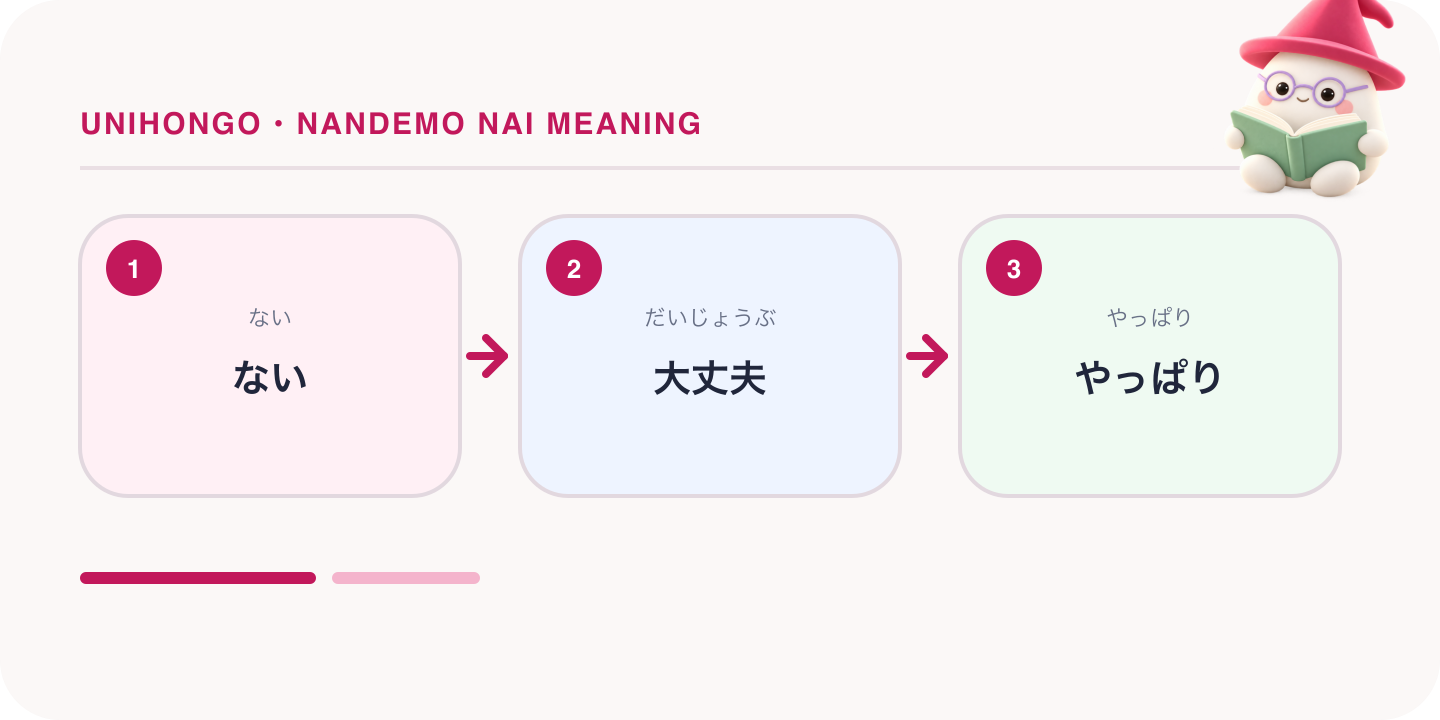
There are three typical situations. First, dismissing a small incident: you trip, someone asks if you are all right, and you say nandemo nai, daijōbu. Second, taking something back: you start to say something, change your mind, and add a, yappari nandemo nai, oh, actually, never mind. Third, hiding a feeling: someone asks what is wrong and you answer nandemo nai, meaning I don't want to talk about it.
| Japanese | Romaji | Meaning |
|---|---|---|
| 何でもない。 | Nandemo nai. | It's nothing. |
| 何でもないよ、大丈夫。 | Nandemo nai yo, daijōbu. | It's nothing, I'm fine. |
| あ、やっぱり何でもない。 | A, yappari nandemo nai. | Oh, actually, never mind. |
| 何でもないです。 | Nandemo nai desu. | It's nothing. (polite) |
| 何でもありません。 | Nandemo arimasen. | It's nothing. (more formal) |
| 何でもないことで怒らないで。 | Nandemo nai koto de okoranaide. | Don't get angry over nothing. |
When nandemo nai hides a feeling
As with it's nothing or I'm fine in English, the words of nandemo nai often say less than the voice does. A bright, relaxed nandemo nai yo with a smile usually means exactly that. A quick, flat nandemo nai, said while looking away, or a quiet betsu ni, nandemo nai, usually means something is wrong but the speaker does not want to discuss it now.
This matters in Japanese communication, where people often avoid stating negative feelings directly, especially in front of others. Friends, partners and family members learn to read the tone. Dramas use the line constantly for exactly this reason: a character says nandemo nai, and the audience knows it is not nothing at all.
- Relaxed and smiling: it really is nothing
- Quick, with a small laugh: embarrassed, change the subject
- Flat and short, eyes down: upset, not ready to talk
- Sharp, with betsu ni: annoyed, possibly with you
- Trailing off, nandemo nai kedo...: wants to talk, needs encouragement
How to respond to nandemo nai
If the tone suggests nandemo nai really means nothing, simply accept it: sō, yokatta, oh, good. If it sounds like a feeling is being hidden, pushing hard rarely helps. A gentle check, hontō ni? really? followed by an open door, nanka attara itsu demo itte ne, if anything's up, tell me any time, is kind and respects their space.
At work, a colleague who answers daijōbu desu or nandemo nai desu to your concern usually prefers not to discuss it there. Muri shinaide kudasai ne, don't overdo it, shows care without prying, and it is a phrase Japanese coworkers use with each other all the time.
| Japanese | Romaji | Meaning |
|---|---|---|
| 本当に? | Hontō ni? | Really? |
| そう、よかった。 | Sō, yokatta. | Oh, good. |
| 何かあったらいつでも言ってね。 | Nanka attara itsu demo itte ne. | If anything's up, tell me any time. |
| 話したくなったら聞くよ。 | Hanashitaku nattara kiku yo. | If you feel like talking, I'll listen. |
| 無理しないでくださいね。 | Muri shinaide kudasai ne. | Please don't overdo it. |
| どうしたの? | Dō shita no? | What's the matter? |
Nandemo: anything and everything
Nandemo on its own, with a positive verb, means anything or everything. Nandemo taberu, I'll eat anything, nandemo shitte iru, to know everything, and nandemo kiite kudasai, please ask me anything, are all everyday sentences. It belongs to a family of question word plus demo expressions: daredemo, anyone; itsudemo, any time; dokodemo, anywhere; dore demo, any of them.
Two useful fixed expressions come from it. Nandemo ari, anything goes, describes a situation with no rules. Nandemo kandemo means absolutely everything, often with a hint of excess: nandemo kandemo kau, to buy everything in sight.
| Japanese | Romaji | Meaning |
|---|---|---|
| 何でも食べます。 | Nandemo tabemasu. | I eat anything. |
| 何でも聞いてください。 | Nandemo kiite kudasai. | Please ask me anything. |
| 彼は何でも知っている。 | Kare wa nandemo shitte iru. | He knows everything. |
| 誰でも参加できます。 | Daredemo sanka dekimasu. | Anyone can take part. |
| いつでも連絡してね。 | Itsudemo renraku shite ne. | Get in touch any time. |
| 何でもかんでも買う。 | Nandemo kandemo kau. | To buy absolutely everything. |
Nandemo ii: anything is fine
Nandemo ii means anything is fine or I don't mind, and it is a common answer to questions such as nani tabetai? what do you want to eat? It is easy-going, but it can also sound indifferent, as if you do not care about the other person's effort. Many Japanese speakers, like many English speakers, find a constant nandemo ii a little frustrating when they are trying to plan.
Warmer alternatives exist. Nandemo daijōbu desu, anything is fine with me, sounds more considerate than nandemo ii desu. Nandemo ureshii, I'd be happy with anything, is a good reply when someone offers a gift. In restaurants, o-makase shimasu, I'll leave it to you, is the polite way to let the other person choose.
| Phrase | Nuance | When to use |
|---|---|---|
| 何でもいい nandemo ii | Anything's fine, can sound indifferent | Casual, close friends |
| 何でもいいです nandemo ii desu | Polite but a bit flat | Neutral situations |
| 何でも大丈夫です nandemo daijōbu desu | Anything works for me, considerate | Hosts, colleagues |
| 何でもうれしい nandemo ureshii | I'd be happy with anything | Gifts, treats |
| お任せします o-makase shimasu | I'll leave it to you | Restaurants, polite choices |
| 何でもいいわけじゃない nandemo ii wake ja nai | Not just anything will do | Being particular |
If you are asked for a preference and genuinely have none, a helpful reply adds one hint: nandemo daijōbu desu kedo, karai no wa chotto nigate desu, anything is fine, but I'm not great with spicy food.
Nani mo nai: nothing at all
Nani mo, what plus mo, works only with a negative verb and means nothing or not anything. Nani mo nai means there is nothing, nani mo tabete inai means I haven't eaten anything, and nani mo shiranai means I don't know anything. In casual speech it is often pronounced nannimo.
The difference from nandemo nai is structural as well as in meaning. Nani mo nai describes an absence: the fridge is empty, the town has nothing. Nandemo nai dismisses a matter: it's not important. So reizōko ni nani mo nai means there's nothing in the fridge, while nandemo nai means don't worry about it.
| Japanese | Romaji | Meaning |
|---|---|---|
| 冷蔵庫に何もない。 | Reizōko ni nani mo nai. | There's nothing in the fridge. |
| 何も食べていません。 | Nani mo tabete imasen. | I haven't eaten anything. |
| 何も知らない。 | Nani mo shiranai. | I don't know anything. |
| なんにもしたくない。 | Nannimo shitakunai. | I don't feel like doing anything. |
| 特に何もありません。 | Toku ni nani mo arimasen. | Nothing in particular. |
Nandemo, nani mo and nandemo nai compared
| Expression | Structure | Meaning |
|---|---|---|
| 何でも nandemo | With a positive verb | Anything, everything |
| 何でもいい nandemo ii | Fixed phrase | Anything is fine |
| 何でもない nandemo nai | Fixed phrase | It's nothing, never mind |
| 何も〜ない nani mo ... nai | With a negative verb | Nothing, not anything |
| 何か nanika | With any verb | Something |
| 何かある? nanika aru? | Question | Is something up? |
Nanika, something, completes the set. Nanika atta? did something happen? is the natural question that often gets nandemo nai as its answer, and nanika tabetai, I want to eat something, contrasts neatly with nani mo tabetakunai, I don't want to eat anything.
Common learner mistakes
- Saying nandemo tabemasen for I don't eat anything: use nani mo tabemasen
- Answering every preference question with nandemo ii: add a hint or use nandemo daijōbu desu
- Taking a flat nandemo nai at face value when the tone says otherwise
- Using nandemo nai at work when daijōbu desu would sound more natural
- Confusing nandemo nai koto, a trivial matter, with nani mo nai, there is nothing
The simplest rule: nandemo goes with positive verbs, nani mo with negative ones, and nandemo nai is a fixed phrase of its own.