
Toriaezu in four everyday lines
Every use of toriaezu shares one idea: a step taken now, without the full plan. Sometimes it is the first item in a sequence, like the first drink. Sometimes it is a temporary fix that will be replaced later. Sometimes it is the minimum you can do at this moment. Once you feel that idea, the English translation changes from sentence to sentence but the Japanese stays the same.
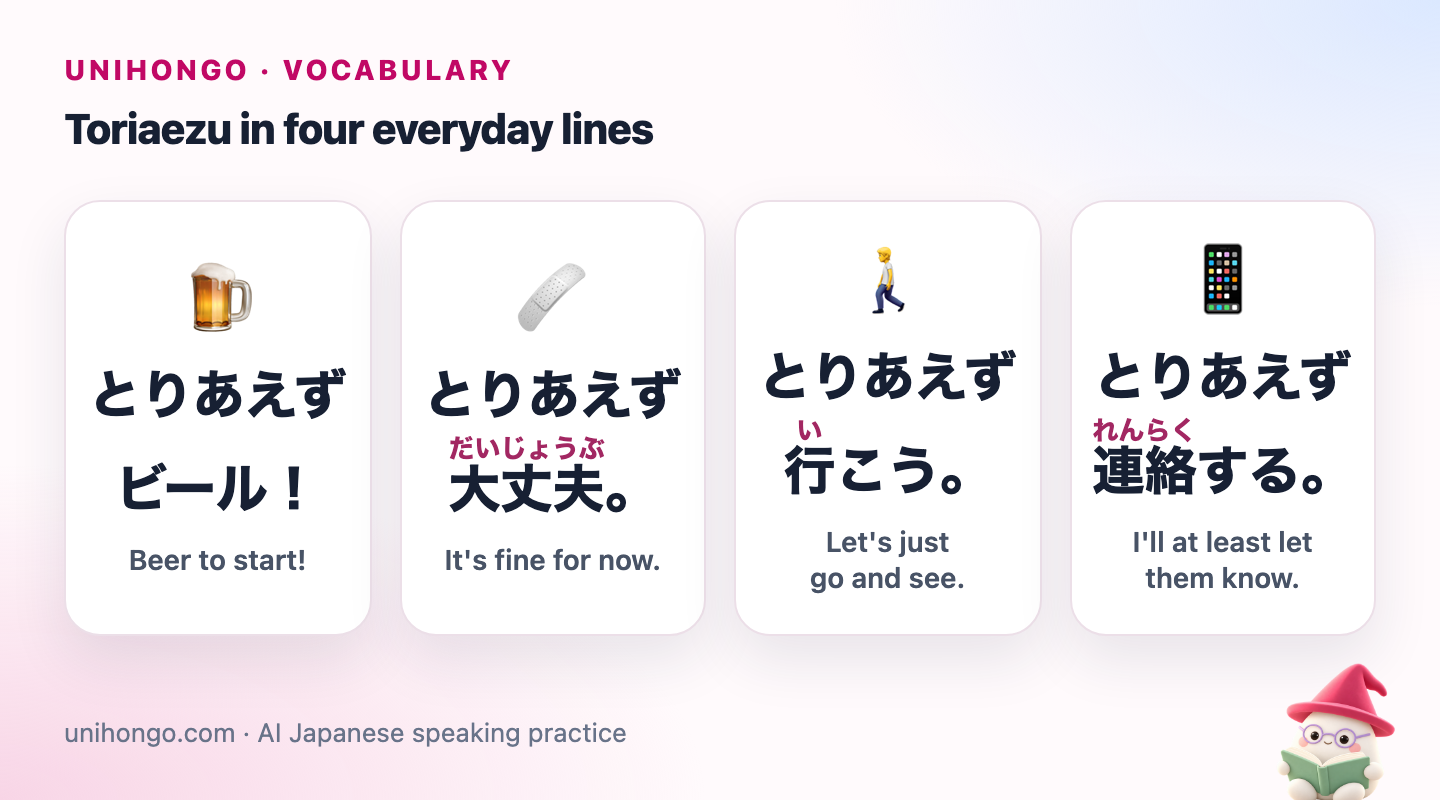
These four lines cover most of what you will hear. Notice that none of them makes a final decision: the beer is only the start, the fix is only for now, and the plan is only to go and see.
| Japanese | Romaji | Meaning |
|---|---|---|
| とりあえずビール! | Toriaezu biiru! | Beer to start! |
| とりあえず大丈夫。 | Toriaezu daijōbu. | It's fine for now. |
| とりあえず行こう。 | Toriaezu ikō. | Let's just go and see. |
| とりあえず連絡する。 | Toriaezu renraku suru. | I'll at least let them know. |
The kanji and where the word comes from
Toriaezu can be written 取り敢えず, but in everyday writing it is almost always in hiragana: とりあえず. You will see the kanji in older books and some formal writing; in messages, menus and manga, hiragana is the norm. 取る means to take, and 敢えて (aete) means boldly or deliberately. The negative ending -zu makes the original sense roughly 'without even having time to take things up properly'.
That older sense survives in a set expression, toru mono mo toriaezu, which means dropping everything and rushing somewhere, without even grabbing your things. It is a written, slightly literary phrase, but it shows why modern toriaezu feels like a quick first move rather than a careful plan.
| Japanese | Romaji | Meaning |
|---|---|---|
| 取るものも取りあえず駆けつけた。 | Toru mono mo toriaezu kaketsuketa. | I dropped everything and rushed over. |
| とりあえず、座ろうか。 | Toriaezu, suwarō ka. | Shall we sit down for now? |
| とりあえず、これでいい? | Toriaezu, kore de ii? | Is this okay for now? |
To start with: ordering and first steps
The most famous use is the first order at an izakaya. A group sits down, a staff member asks for drinks, and someone says toriaezu biiru or toriaezu nama, nama being short for namabiiru, draft beer. The word says: bring this now, and we will order food and more drinks after we have looked at the menu. It is quick, friendly and very casual.
Many people still start with beer, but the custom is looser than it once was. You will hear toriaezu haibōru (a highball), toriaezu ūroncha or simply each person ordering what they like. Saying toriaezu with a soft drink is perfectly natural; the word is about the first step, not about alcohol.
The same 'first step' sense works far beyond drinks. Toriaezu shawā abiru, 'I'll take a shower first', or toriaezu meeru dake miru, 'I'll just check my email to start with', both describe the first thing you do before the rest of the evening or the day.
| Japanese | Romaji | Meaning |
|---|---|---|
| とりあえず生、四つ。 | Toriaezu nama, yottsu. | Four draft beers to start. |
| とりあえず生を二つお願いします。 | Toriaezu nama o futatsu onegai shimasu. | Two draft beers to start, please. (polite) |
| 僕はとりあえずウーロン茶で。 | Boku wa toriaezu ūroncha de. | I'll start with oolong tea. |
| とりあえずシャワー浴びる。 | Toriaezu shawā abiru. | I'll take a shower first. |
| とりあえずメールだけ見るね。 | Toriaezu mēru dake miru ne. | I'll just check my email first. |
For now: temporary fixes and half-decisions
The second big use is a fix that holds for the moment. You cut your finger and put on a plaster: toriaezu kore de daijōbu, this will do for now. The train stops, so you message the office: toriaezu renraku shita, at least I let them know. Your laptop crashes before a deadline, so you borrow a friend's: toriaezu kore o tsukau. In each case the speaker knows a proper solution may come later.
Toriaezu is also how groups make decisions without committing. Toriaezu ashita jūji ni atsumarō means 'let's meet at ten tomorrow for now', and everyone understands the plan might shift. In a shop, toriaezu kore kudasai is 'I'll take this one for now', which sounds a little like you might come back for more.
| Japanese | Romaji | Meaning |
|---|---|---|
| とりあえず絆創膏を貼っておこう。 | Toriaezu bansōkō o hatte okō. | Let's put a plaster on it for now. |
| とりあえず会社に連絡した。 | Toriaezu kaisha ni renraku shita. | I at least let the office know. |
| とりあえず明日十時に集まろう。 | Toriaezu ashita jūji ni atsumarō. | Let's meet at ten tomorrow, for now. |
| とりあえずこれをください。 | Toriaezu kore o kudasai. | I'll take this one for now. |
| とりあえず様子を見よう。 | Toriaezu yōsu o miyō. | Let's wait and see for now. |
Yōsu o miru, to watch how things go, pairs naturally with toriaezu. Toriaezu yōsu o miyō is what a friend says when your cold is mild, your phone is acting strangely, or a plan has not been confirmed: do nothing big yet, keep an eye on it.
Toriaezu, tonikaku, ittan, hitomazu, mazu and ichiō
Several Japanese words overlap with toriaezu, and learners often swap them. The table shows the core feeling of each. The quickest test: toriaezu looks forward to a later, fuller step; tonikaku brushes everything else aside; ittan pauses something you will return to.
| Japanese | Romaji | Meaning |
|---|---|---|
| とにかく急ごう! | Tonikaku isogō! | Anyway, let's hurry! |
| 一旦休憩しましょう。 | Ittan kyūkei shimashō. | Let's take a short break. (polite) |
| ひとまず安心しました。 | Hitomazu anshin shimashita. | I'm relieved, at least for now. |
| まず資料を見てください。 | Mazu shiryō o mite kudasai. | First, please look at the handout. |
| Word | Core feeling | Typical use |
|---|---|---|
| toriaezu | First or temporary step, decide the rest later | Toriaezu biiru; toriaezu daijōbu |
| tonikaku | Anyway, whatever else is true | Tonikaku isogō: hurry, whatever happens |
| ittan | Once, for the moment, then come back | Ittan kyūkei shimashō: let's take a break |
| hitomazu | For the moment, a step completed | Hitomazu anshin: relieved for now |
| mazu | First, in order | Mazu shiryō o mite kudasai: first look at the handout |
| ichiō | Just in case, more or less | Ichiō kakunin shimasu: I'll double-check |
Toriaezu at work: when to choose another word
Colleagues say toriaezu to each other constantly: toriaezu kore de ikō, let's go with this for now. It is not rude. But because it can suggest 'I'll do the minimum and see', it may sound careless when you report to a manager or reply to a client. Imagine telling a customer that their problem is fixed toriaezu: it sounds as if it might break again tomorrow.
In polite speech, mazu (first) and hitomazu (for the moment) do the same job more carefully. In emails, the classic phrase is toriisogi, in haste: Toriisogi go-renraku made, 'just a quick note for now', is used when you acknowledge something and promise a full reply later. Some people find it a little abrupt for very formal mail, so many writers soften it with a line about following up.
| Japanese | Romaji | Meaning |
|---|---|---|
| まずは資料をお送りします。 | Mazu wa shiryō o ookuri shimasu. | First, I'll send you the materials. (polite) |
| ひとまず対応いたしました。 | Hitomazu taiō itashimashita. | We've dealt with it for the moment. (humble) |
| 取り急ぎご連絡まで。 | Toriisogi go-renraku made. | Just a quick note for now. (email) |
| とりあえずこれで進めよう。 | Toriaezu kore de susumeyō. | Let's go with this for now. (to colleagues) |
Mini dialogue: the first round at an izakaya
Here is the moment toriaezu was made for. A group of coworkers sits down after work, the staff member arrives with hot towels, and nobody has opened the menu yet. Listen for how fast the first order goes, and how the second order uses no toriaezu at all, because the 'first step' is over.
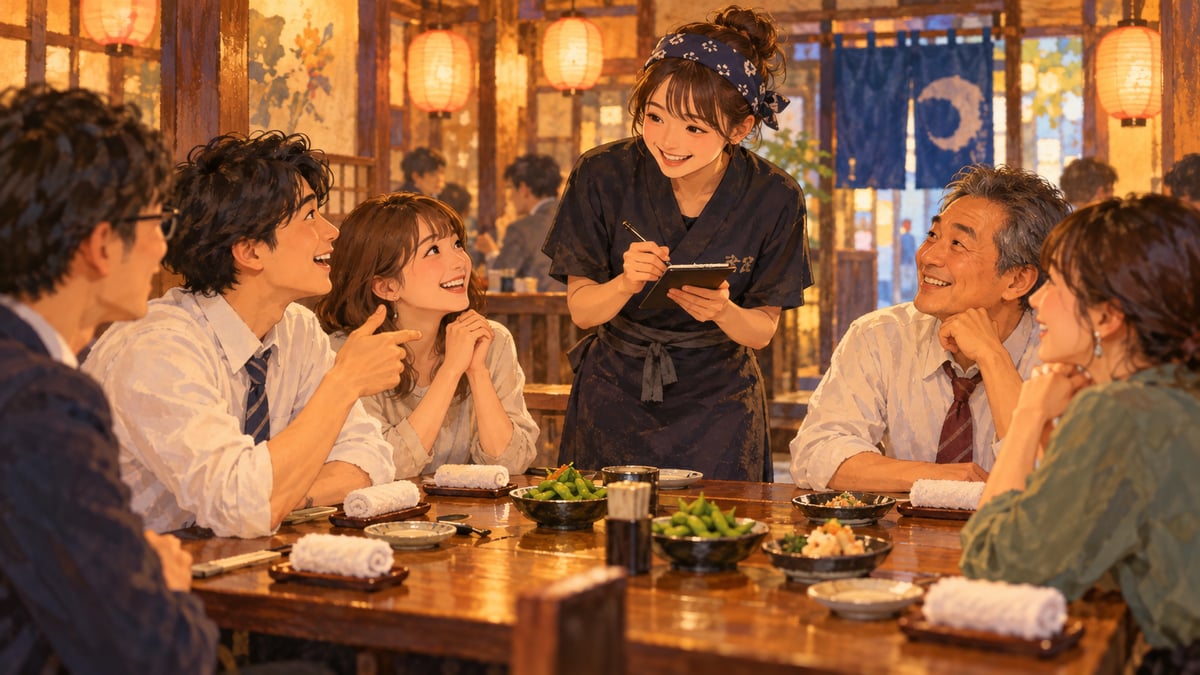
| Japanese | Romaji | Meaning |
|---|---|---|
| お飲み物はお決まりですか。 | Onomimono wa okimari desu ka. | Staff: Have you decided on drinks? |
| とりあえず生、三つで。 | Toriaezu nama, mittsu de. | Coworker: Three draft beers to start. |
| 私はとりあえずレモンサワーで。 | Watashi wa toriaezu remon sawā de. | You: A lemon sour for me to start. |
| かしこまりました。 | Kashikomarimashita. | Staff: Certainly. |
| 食べ物はどうする? | Tabemono wa dō suru? | Coworker: What shall we do about food? |
| 枝豆と唐揚げはどう? | Edamame to karaage wa dō? | You: How about edamame and fried chicken? |
The polite de at the end of toriaezu nama, mittsu de is a soft way to place an order: 'with three, please'. It is extremely common at restaurants and sounds natural even without kudasai.
Common learner mistakes with toriaezu
- Using it to mean 'anyway, back to the point'. To return to the main topic after a tangent, Japanese speakers use tonikaku or sore wa sate, not toriaezu.
- Translating every 'first' as toriaezu. For steps in a fixed order, such as instructions or a recipe, use mazu: Mazu, oyu o wakashimasu, first boil the water.
- Saying toriaezu to a customer about a fix. It can sound as if you only did the minimum. Hitomazu or a clear explanation of the next step is safer.
- Expecting it to sound decisive. Toriaezu always leaves the door open; if you want to sound firm, drop it and state the decision directly.
- Overusing it as a filler. Some speakers start many sentences with toriaezu, and it can make you sound vague. Keep it for real first steps and temporary fixes.
Five minutes a day with Mocchi on toriaezu
Open Mocchi and type: '/quiz toriaezu, tonikaku, ittan and mazu: give me ten situations and make me choose.' Mocchi writes short scenes, checks your answers, explains each mistake, and keeps a note of the pairs you confuse, so a later /review brings back exactly those.
When the choice feels easy, rehearse the real thing: ask AI Sensei, for example Ibuki-sensei, to play the staff member at a busy izakaya, place the first order with toriaezu, then order food without it. The session report afterwards lists your corrections and any words worth adding to your flashcards.