
Riajuu and its family in four lines
Riajū never travels alone. It comes with its opposite, a famous joke and a respectable everyday word hidden inside it. These four lines are the core vocabulary: the slang, the self-deprecating opposite, the teasing joke, and the normal word jūjitsu that you can use anywhere, even at work.
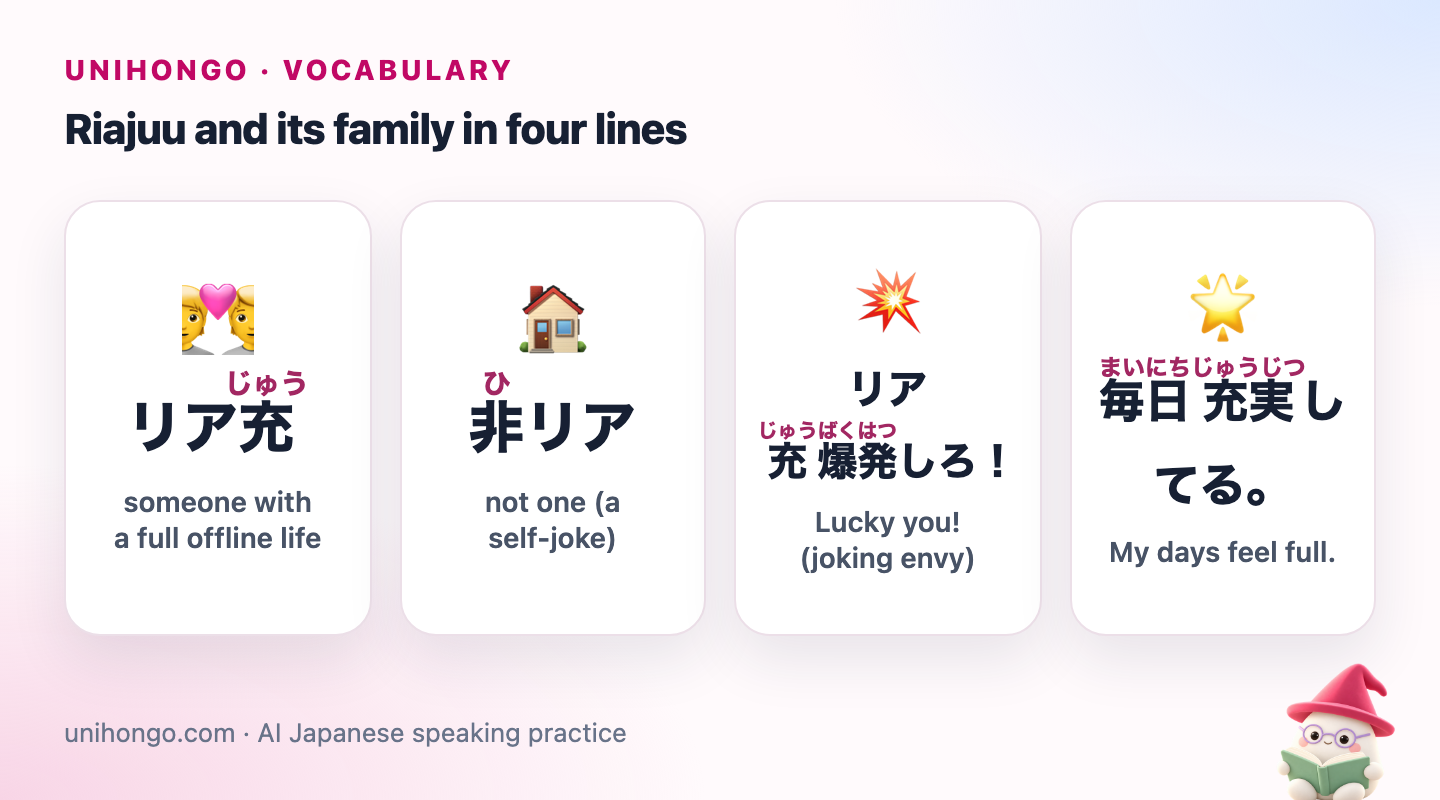
| Japanese | Romaji | Meaning |
|---|---|---|
| リア充 | riajū | someone with a full offline life |
| 非リア | hiria | not one (a self-joke) |
| リア充爆発しろ! | Riajū bakuhatsu shiro! | Lucky you! (joking envy) |
| 毎日充実してる。 | Mainichi jūjitsu shiteru. | My days feel full. |
Where riajuu comes from
The word was formed on Japanese internet forums, where users often contrasted the online world with riaru, the offline 'real life'. Someone whose offline life was full of friends, events and romance was described as riaru ga jūjitsu shite iru. Like many Japanese abbreviations, the phrase was clipped to the first part of each word: ria from riaru and jū from jūjitsu.
It is written in a mix of katakana and kanji: リア from the loanword riaru, and 充 from jūjitsu. The kanji 充 means to fill, as in jūden, charging a battery. That picture is useful: a riajū's real life is 'fully charged'.
From the internet, the word spread into everyday conversation among young people, and into manga, light novels, television and advertising. Its meaning widened too: today it can describe a person, a lifestyle, or a moment, like a sunny barbecue with friends.
| Japanese | Romaji | Meaning |
|---|---|---|
| リアルが充実している | riaru ga jūjitsu shite iru | their real life is fulfilling |
| スマホを充電する。 | Sumaho o jūden suru. | I'll charge my phone. |
| ネットとリアルは違う。 | Netto to riaru wa chigau. | Online and real life are different. |
Who counts as a riajū?
There is no fixed definition, and people argue about it for fun. For many, the strongest sign is having a partner, so a couple going on a date on Christmas Eve is the classic riajū image. For others it is about a busy social life: barbecues, trips, festivals, drinking parties, lots of friends in your photos. Some people use it for anyone who seems to be enjoying life offline, including someone absorbed in a hobby with a lively circle of friends.
Because the word is relative, people often use it to compare: kare wa riajū da kedo, boku wa chigau, he's a riajū but I'm not. It can be admiring, envious, teasing or a little bitter, depending on the speaker. The tone of voice and a smile do most of the work.
| Japanese | Romaji | Meaning |
|---|---|---|
| あの二人、リア充だね。 | Ano futari, riajū da ne. | Those two are living the dream. |
| 週末はいつもバーベキュー?リア充だなあ。 | Shūmatsu wa itsumo bābekyū? Riajū da nā. | Barbecues every weekend? What a life. |
| クリスマスはリア充のイベントだよね。 | Kurisumasu wa riajū no ibento da yo ne. | Christmas is an event for couples, right? (joking) |
| 最近リア充してるね。 | Saikin riajū shiteru ne. | You're having a great time lately. |
Riajū shiteru, using riajū as a verb with suru, is a playful, very casual pattern. It means you are currently living the full-life version of yourself.
Riajū bakuhatsu shiro: the joke and its limits
Riajū bakuhatsu shiro, literally 'riajū, explode!', is an internet joke aimed at happy couples and people showing off fun lives. It expresses exaggerated, comic envy, in the spirit of 'ugh, I hate you, lucky thing'. Nobody means it literally, and it is often said by people who are perfectly happy themselves.
Even so, it is a rough phrase. The imperative shiro is blunt, and the image is violent if you take it at face value. Use it only in writing or speech among friends who share the joke, and never to someone you do not know well, to a senior, or in a serious moment, for example when someone has just shared real news about their relationship. A softer, friendlier version is simply ii nā, 'I'm jealous, lucky you'.
| Japanese | Romaji | Meaning |
|---|---|---|
| リア充爆発しろ(笑) | Riajū bakuhatsu shiro (wara) | Lucky you, explode! (lol, online joke) |
| いいなあ、うらやましい! | Ii nā, urayamashii! | Lucky you, I'm so jealous! |
| 楽しそうだね! | Tanoshisō da ne! | Looks like fun! |
Hiria, botchi, yōkya and inkya
Riajū belongs to a small group of social slang words. They are casual and can sting if used about other people, so the safest use for most of them is about yourself, as a joke. The table shows the common ones.
| Japanese | Romaji | Meaning |
|---|---|---|
| 私は完全に非リアです。 | Watashi wa kanzen ni hiria desu. | I'm totally not a riajū. (joking) |
| 今日もぼっちランチ。 | Kyō mo botchi ranchi. | Lunch alone again today. (self-joke) |
| 彼は陽キャだから、すぐ友達ができる。 | Kare wa yōkya da kara, sugu tomodachi ga dekiru. | He's outgoing, so he makes friends fast. |
| Word | Meaning | How it is used |
|---|---|---|
| riajū | Full, happy offline life | Teasing or envious, about others |
| hiria | Not a riajū | Mostly a self-deprecating joke |
| botchi | Alone, a loner | Self-joke; can hurt if aimed at others |
| yōkya | Outgoing, cheerful type | Fairly neutral, sometimes teasing |
| inkya | Quiet, introverted type | Often negative; use about yourself only |
| paripi | Party people | Playful, a little mocking |
How to reply when you are called a riajū
If a friend sees your photos and says riajū da ne, it is usually friendly teasing, half a compliment. Japanese conversation often favours a modest reply rather than a proud yes. A light denial, a laugh, and a quick return to the other person's life is the natural rhythm.

| Japanese | Romaji | Meaning |
|---|---|---|
| いやいや、そんなことないよ。 | Iya iya, sonna koto nai yo. | No, no, not at all. |
| たまたまだよ。 | Tamatama da yo. | It just happened this time. |
| 普段は家でゴロゴロしてるよ。 | Fudan wa ie de gorogoro shiteru yo. | Usually I just laze around at home. |
| そっちこそ、週末何してたの? | Sotchi koso, shūmatsu nani shiteta no? | What about you, what did you do? |
Answering un, riajū da yo, 'yes, I am', is possible with close friends as a cheeky joke, but it can sound like bragging if the tone is wrong. The modest version is safer when you are not sure.
Mini dialogue: the Christmas plans question
In December, plans for Christmas Eve are a classic topic for riajū jokes, because in Japan the evening is often treated as a date night for couples, while Christmas is not usually a family holiday in the way it is in many Western countries. Customs vary, and plenty of people spend it with friends or family, but the joke is everywhere. Here two university friends talk over lunch.
Notice how the teasing goes both ways, and how the speaker who is called a riajū plays it down, then turns the question back. Nobody is really envious; the slang is a way of being playful.
| Japanese | Romaji | Meaning |
|---|---|---|
| クリスマス、何するの? | Kurisumasu, nani suru no? | Ken: What are you doing for Christmas? |
| 彼女とイルミネーション見に行く。 | Kanojo to iruminēshon mi ni iku. | Leo: Going to see the lights with my girlfriend. |
| 出た、リア充! | Deta, riajū! | Ken: There it is, Mr Perfect Life! |
| いやいや、普通だよ。ケンは? | Iya iya, futsū da yo. Ken wa? | Leo: Come on, it's normal. And you, Ken? |
| 僕は家でゲーム。完全に非リア。 | Boku wa ie de gēmu. Kanzen ni hiria. | Ken: Gaming at home. Totally not a riajū. |
| じゃあ、イブの前にみんなで鍋しようよ。 | Jā, ibu no mae ni minna de nabe shiyō yo. | Leo: Then let's all have hot pot before Christmas Eve. |
Deta, literally 'it came out', is a casual way of saying 'there it is!' when someone says exactly what you expected. It is friendly teasing, the same register as riajū itself.
When not to use riajū
- At work or with people above you. It is internet slang and sounds unprofessional; if you want to comment, use the ordinary word, as in jūjitsu shita shūmatsu deshita ne, or simply ask about their weekend.
- About someone's relationship in a serious moment. If a friend tells you they are getting married, say omedetō, not riajū.
- As a label for people who are not in the joke. Calling a stranger hiria or inkya is rude; these words are much safer used about yourself.
- Expecting it to sound fresh. Many people now hear it as slightly dated slang, so do not use it to sound current.
- Reading riaru as really. Here riaru means offline life; elsewhere in Japanese it often means realistic, as in riaru na e, a realistic picture, not the English adverb really.
Build a slang deck with Mocchi
Slang sticks best with a picture and a context. Ask Mocchi: '/create-flashcards riajū, hiria, botchi, yōkya, jūjitsu, with one example sentence each and a note on who I can say it to.' Pick a photo for each card, and Mocchi reviews them with you through /review-flashcards, bringing the words you hesitate on back sooner.
Then take the deck into Mocchi Flight on the games page and guide Mocchi through the right word gates using your own cards. Ten minutes of that, and the difference between a teasing word and a respectable one feels automatic.