
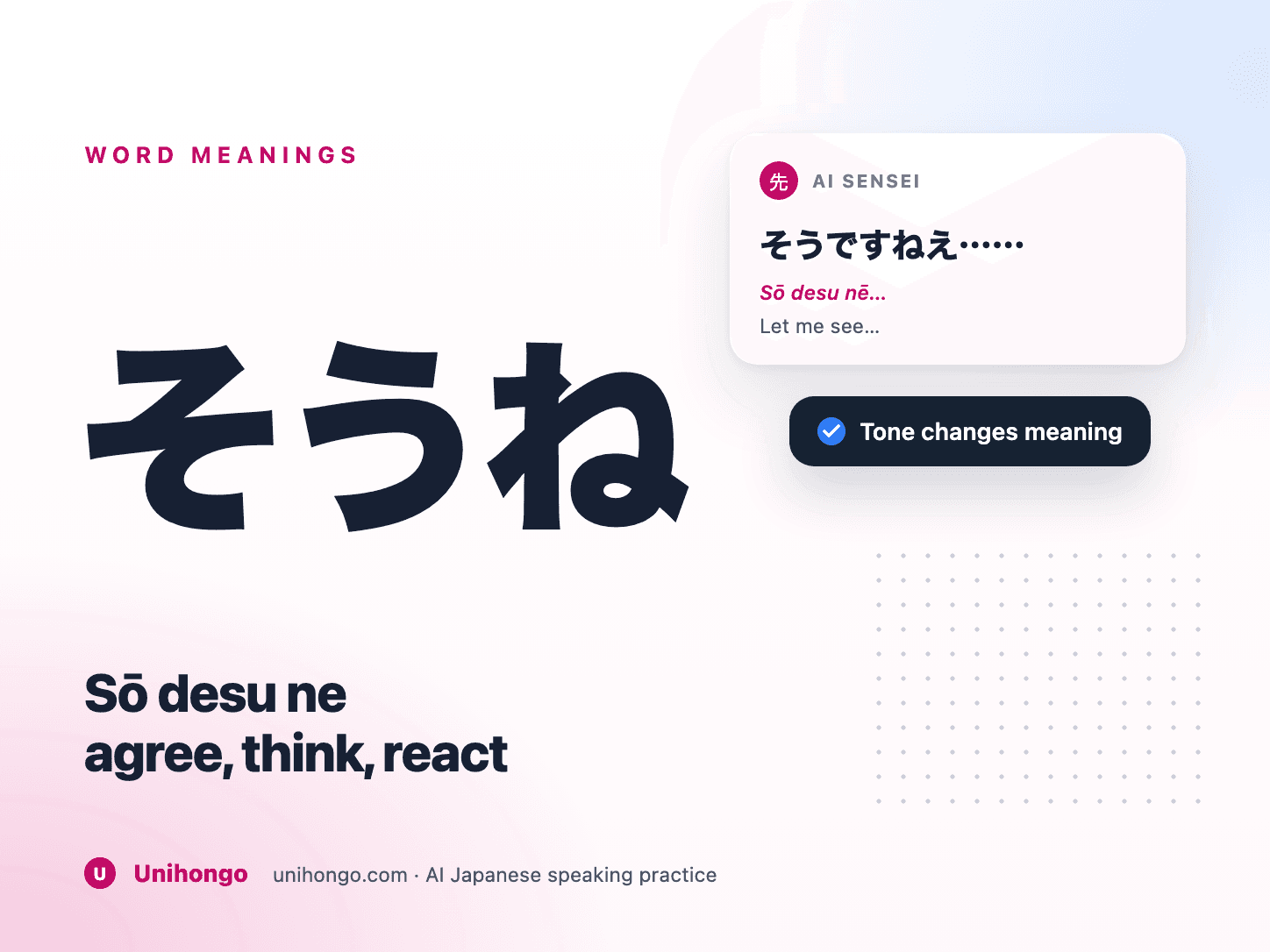
Three jobs in one phrase
The particle ne invites agreement: it presents something as shared ground between the speakers. That is why sō desu ne fits so naturally as a reply to comments about weather, food, tiredness and anything else both people can feel.
The same shape stretched out becomes a thinking sound, and said with warmth it becomes a way of sharing a feeling rather than confirming a fact.
| Japanese | Romaji | Meaning |
|---|---|---|
| 暑いですね。 | Atsui desu ne. | It's hot, isn't it? |
| そうですね。 | Sō desu ne. | It really is: agreeing |
| そうですねえ…… | Sō desu nē… | Let me see…: thinking |
| 本当に、そうですね。 | Hontō ni, sō desu ne. | Truly, it is: sharing the feeling |
Ka, ne and yo change everything
Swapping the final particle changes who holds the information. With ka, the information is new to you. With ne, it is shared. With yo, you are telling the other person something you know and they may not.
Learners often use sō desu ne when sō desu ka is needed, which sounds as though you already knew what you were just told.
| Japanese | Romaji | Meaning |
|---|---|---|
| そうですか。 | Sō desu ka. | I see, is that so: new information |
| そうなんですか。 | Sō nan desu ka. | Oh, really?: new and interesting |
| そうですね。 | Sō desu ne. | Yes, that's right: shared view |
| そうですよ。 | Sō desu yo. | That's right, I'm telling you: you know better |
| They say | Best reply | Why |
|---|---|---|
| I moved here last month | Oh, is that so | The fact is new to you |
| This ramen is great, isn't it | It really is | You are both eating it |
| Is the station this way | Yes, it is, I promise | You know and they do not |
| The train was so crowded today | It really was | You shared the experience |
Intonation carries the meaning
The same three words can be agreement, hesitation or a question depending entirely on pitch and length. Listening for the shape is more reliable than listening for the words.
- Short and falling: I agree.
- Long, flat and trailing: let me think.
- Rising at the end: is that right? checking with the listener.
- Soft and slow with a sigh: sharing a feeling, often tiredness or sympathy.
- Clipped and fast: a quick yes before moving on.
Buying time before you answer
Japanese speakers rarely fire an opinion straight back. Starting with a thinking sō desu ne shows you are taking the question seriously, and it gives you a second or two to build your sentence, which is exactly what learners need.
It pairs well with the other thinking sounds, but it is the most polite of them and works in almost any setting.
| Japanese | Romaji | Meaning |
|---|---|---|
| 好きな食べ物は何ですか。 | Suki na tabemono wa nan desu ka. | What's your favourite food? |
| そうですね、やっぱりラーメンです。 | Sō desu ne, yappari rāmen desu. | Let me think, ramen after all |
| えっと…… | Etto… | Um…: casual thinking sound |
| うーん、そうですねえ。 | Ūn, sō desu nē. | Hmm, let me see |
Casual versions
Among friends the desu disappears and the phrase splits into several forms with slightly different tones. Sō da ne is neutral, sō ne is softer, and sokka is the casual cousin of sō desu ka.
| Japanese | Romaji | Meaning |
|---|---|---|
| そうだね。 | Sō da ne. | Yeah, that's right: neutral casual |
| そうね。 | Sō ne. | Mm, true: soft |
| そうだよね。 | Sō da yo ne. | Right? That's what I think too |
| だよね。 | Da yo ne. | Totally: very casual agreement |
| そっか。 | Sokka. | Oh, I see: casual form of sō desu ka |
When it is the wrong reply
Because sō desu ne agrees, it goes wrong when agreeing would be arrogant or misleading. The classic case is a compliment: replying sō desu ne to praise of your Japanese sounds like yes, I am rather good.
It also misleads when you do not actually agree. A polite sō desu ne followed by silence can be taken as agreement to a plan you had doubts about, so add a softened concern if you have one.
| Japanese | Romaji | Meaning |
|---|---|---|
| 日本語が上手ですね。 | Nihongo ga jōzu desu ne. | Your Japanese is good |
| いえいえ、まだまだです。 | Ie ie, mada mada desu. | Oh no, I still have a long way to go |
| そうですね、ただ少し心配なのは…… | Sō desu ne, tada sukoshi shinpai na no wa… | True, but one thing I'm a little worried about is… |