

Breaking down the word kintsugi
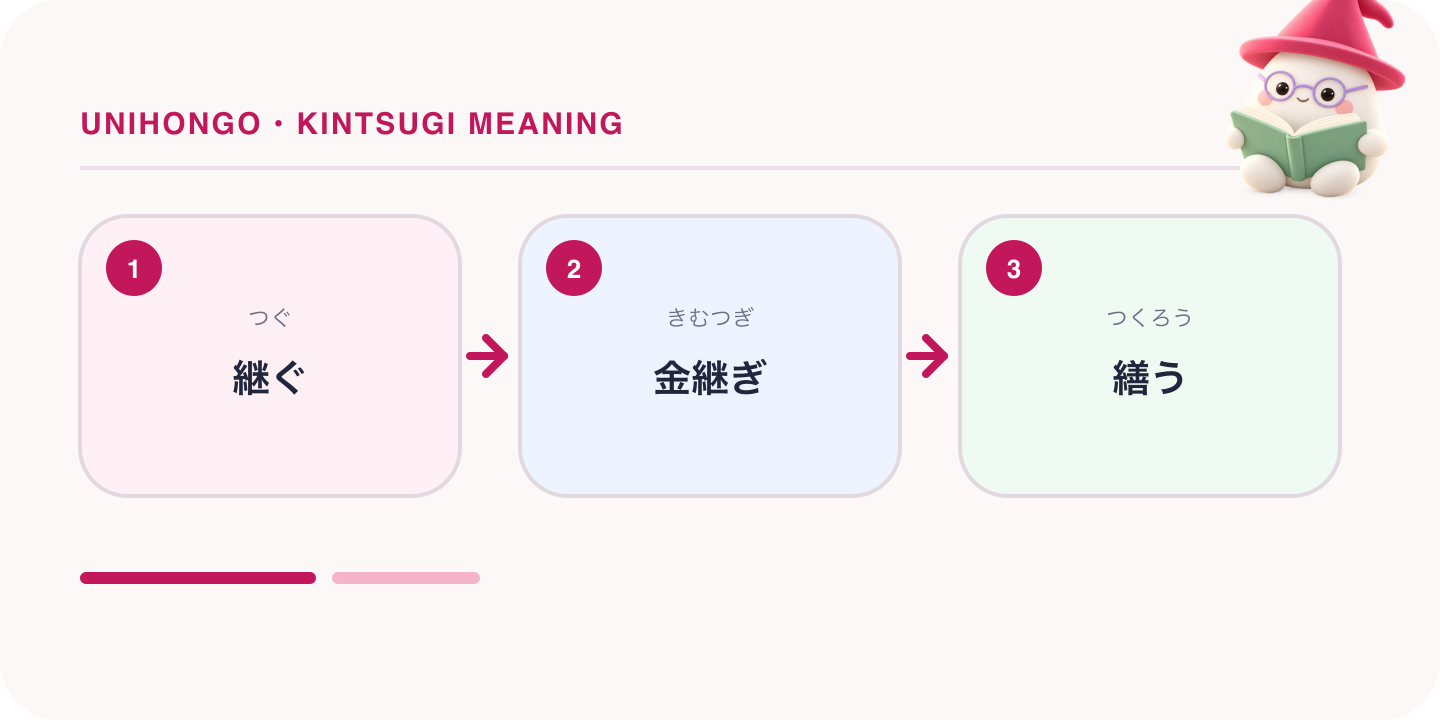
Kintsugi is written 金継ぎ. Kin is gold, the same kanji as in kin'yōbi, Friday, and okane, money. Tsugi is the noun form of tsugu, to join, connect or patch, the verb used for grafting plants and splicing things together. The t of tsugi stays unvoiced, so it is kintsugi, not kinzugi.
You will also see kintsukuroi, written 金繕い, which uses tsukurou, to mend or patch clothes and objects. Both refer to the same craft. In Japan kintsugi is the more common word today, while kintsukuroi often appears in English writing about the practice.
| Word | Reading | Meaning |
|---|---|---|
| 金 | kin | Gold |
| 継ぐ | tsugu | To join, connect, succeed to |
| 金継ぎ | kintsugi | Repair with lacquer and gold |
| 繕う | tsukurou | To mend, to patch up |
| 金繕い | kintsukuroi | Another name for kintsugi |
| 漆 | urushi | Natural lacquer from the lacquer tree |
How the craft works
Traditional kintsugi relies on urushi, the sap of the lacquer tree, which hardens into a very durable coating. The broken pieces are glued with a paste of lacquer and flour, gaps and chips are filled with a lacquer putty, and the surface is built up, sanded and coated in several thin layers. Finally, the joins are painted with lacquer and gold powder is sprinkled on while it is still tacky.
Urushi does not simply dry; it cures by reacting with moisture in the air, so work is left in a warm, humid cabinet between steps. That is why traditional kintsugi takes patience. Raw urushi can also cause a skin rash, called urushi kabure, which is why teachers insist on gloves.
Details vary between teachers and schools, but most traditional processes follow the same broad order.
- Clean and fit the pieces together without glue to plan the repair.
- Glue the pieces with mugi-urushi, a paste of lacquer and wheat flour.
- Fill chips and gaps with sabi-urushi, a putty of lacquer and powdered clay or stone.
- Sand and apply thin layers of lacquer, curing each layer in a humid box.
- Paint the final line in lacquer and sprinkle gold powder onto it, a step often called funmaki.
- Polish once fully cured.
The vocabulary of breaks, chips and cracks
Kintsugi introduces a useful set of everyday words for damage. These are the same words you would use if a plate breaks at home, a phone screen cracks or you return a damaged item to a shop.
| Japanese | Romaji | Meaning |
|---|---|---|
| お皿が割れた。 | O-sara ga wareta. | The plate broke. |
| 縁が少し欠けています。 | Fuchi ga sukoshi kakete imasu. | The rim is a little chipped. |
| ひびが入っている。 | Hibi ga haitte iru. | It has a crack in it. |
| 粉々になった。 | Konagona ni natta. | It smashed to pieces. |
| 破片を集めておいてください。 | Hahen o atsumete oite kudasai. | Please keep the broken pieces. |
| 金継ぎで直したいです。 | Kintsugi de naoshitai desu. | I'd like to repair it with kintsugi. |
| 直してもらえますか。 | Naoshite moraemasu ka. | Could you repair it for me? |
Note the difference between wareru, to break into pieces, kakeru, to chip, and hibi ga hairu, to crack without separating. Each suggests a different kind of kintsugi repair.
Kintsugi terms you will meet in a class
If you join a kintsugi class in Japan, these are the words the teacher is likely to use. Knowing them in advance lets you follow instructions rather than just copying hand movements.
| Term | Reading | Meaning |
|---|---|---|
| 麦漆 | mugi-urushi | Lacquer and wheat flour glue |
| 錆漆 | sabi-urushi | Lacquer putty for filling gaps |
| 金粉 | kinpun | Gold powder |
| 銀継ぎ | gintsugi | Repair finished in silver |
| 呼び継ぎ | yobitsugi | Filling a gap with a shard from a different piece |
| 漆室 | urushi-buro | Humid cabinet where lacquer cures |
| 漆かぶれ | urushi kabure | Skin rash from raw lacquer |
| 金継ぎ教室 | kintsugi kyōshitsu | Kintsugi class or workshop |
Where kintsugi comes from
Lacquer has been used in Japan for thousands of years, and repairing ceramics with it is an old practice. Kintsugi as an appreciated art developed alongside the tea ceremony, where old and repaired tea bowls were valued for their history and character rather than thrown away.
A well-known story says that a shogun sent a cracked Chinese tea bowl away for repair, disliked the metal staples it came back with, and prompted Japanese craftsmen to find a more beautiful method. It is told often, but it is a story rather than documented fact, so treat it as legend.
What is clear is that kintsugi fits the same aesthetic world as wabi-sabi: the idea that age, use and even damage can add depth to an object.
- Urushi: an ancient material in Japanese craft.
- Tea ceremony: where repaired bowls became valued objects.
- Wabi-sabi: the aesthetic that appreciates age and imperfection.
- Mottainai: the feeling that it is a waste to throw away something still useful.
The metaphor, abroad and in Japan
In English, kintsugi has become a popular metaphor for resilience: our breaks and scars are not something to hide, and recovering from them can make us more beautiful. You find it in therapy books, song lyrics, tattoos and wedding speeches.
Japanese speakers recognise this idea and sometimes use it, particularly in essays, interviews, art exhibitions and self-improvement writing, often via the English-language popularity of the concept. In day-to-day conversation, though, kintsugi usually means the actual craft: someone's new hobby, a class they took, or a bowl their grandmother loved that they had repaired.
So using the metaphor in Japanese is fine, but it sounds literary. Framing it with an explicit comparison, like a kintsugi repair, keeps it clear.
| Japanese | Romaji | Meaning |
|---|---|---|
| 金継ぎのように、傷も自分の一部です。 | Kintsugi no yō ni, kizu mo jibun no ichibu desu. | Like kintsugi, my scars are part of me. |
| 壊れたものにも価値がある。 | Kowareta mono ni mo kachi ga aru. | Broken things have value too. |
| 傷があるからこそ美しい。 | Kizu ga aru kara koso utsukushii. | It is beautiful precisely because of its scars. |
| もったいないから直して使う。 | Mottainai kara naoshite tsukau. | It's a waste to throw it away, so I'll fix it and use it. |
Talking about kintsugi in conversation
Kintsugi is a friendly topic in Japanese conversation because it connects hobbies, family objects and tradition. Saying you want to try it, or asking someone about a repaired piece, usually leads to stories.
When admiring a piece, aji ga aru, it has character, and kirei ni naotte imasu ne, it has been beautifully repaired, are natural compliments.
| Japanese | Romaji | Meaning |
|---|---|---|
| 金継ぎに興味があります。 | Kintsugi ni kyōmi ga arimasu. | I'm interested in kintsugi. |
| 最近、金継ぎを習い始めました。 | Saikin, kintsugi o naraihajimemashita. | I recently started learning kintsugi. |
| この器は金継ぎですか。 | Kono utsuwa wa kintsugi desu ka. | Is this piece repaired with kintsugi? |
| きれいに直っていますね。 | Kirei ni naotte imasu ne. | It's been beautifully repaired. |
| 祖母の大切な茶碗を金継ぎしてもらいました。 | Sobo no taisetsu na chawan o kintsugi shite moraimashita. | I had my grandmother's treasured bowl repaired with kintsugi. |
| 乾くまでどのくらいかかりますか。 | Kawaku made dono kurai kakarimasu ka. | How long does it take to dry? |