
What a kanyōku actually is
A kanyōku is a fixed combination of words whose meaning cannot be worked out by adding up the parts. Mimi ga itai looks like a complaint about earache, but it means that a criticism has landed and you know it is fair. The words never move: you cannot say mimi ga totemo itai in that sense, and swapping mimi for atama destroys it. That rigidity is the reason idioms are learnable as single vocabulary items rather than as grammar.
The important practical difference is between an idiom and a proverb. A proverb is quoted as advice and stands alone as a complete statement, which is why quoting one can sound like a lecture. An idiom slots into your own sentence and carries tense, politeness and negation like any other predicate, so kata no ni ga orimashita and kata no ni ga orimasen deshita are both perfectly ordinary. Everything in this guide belongs to that second group: language people use rather than language people cite.
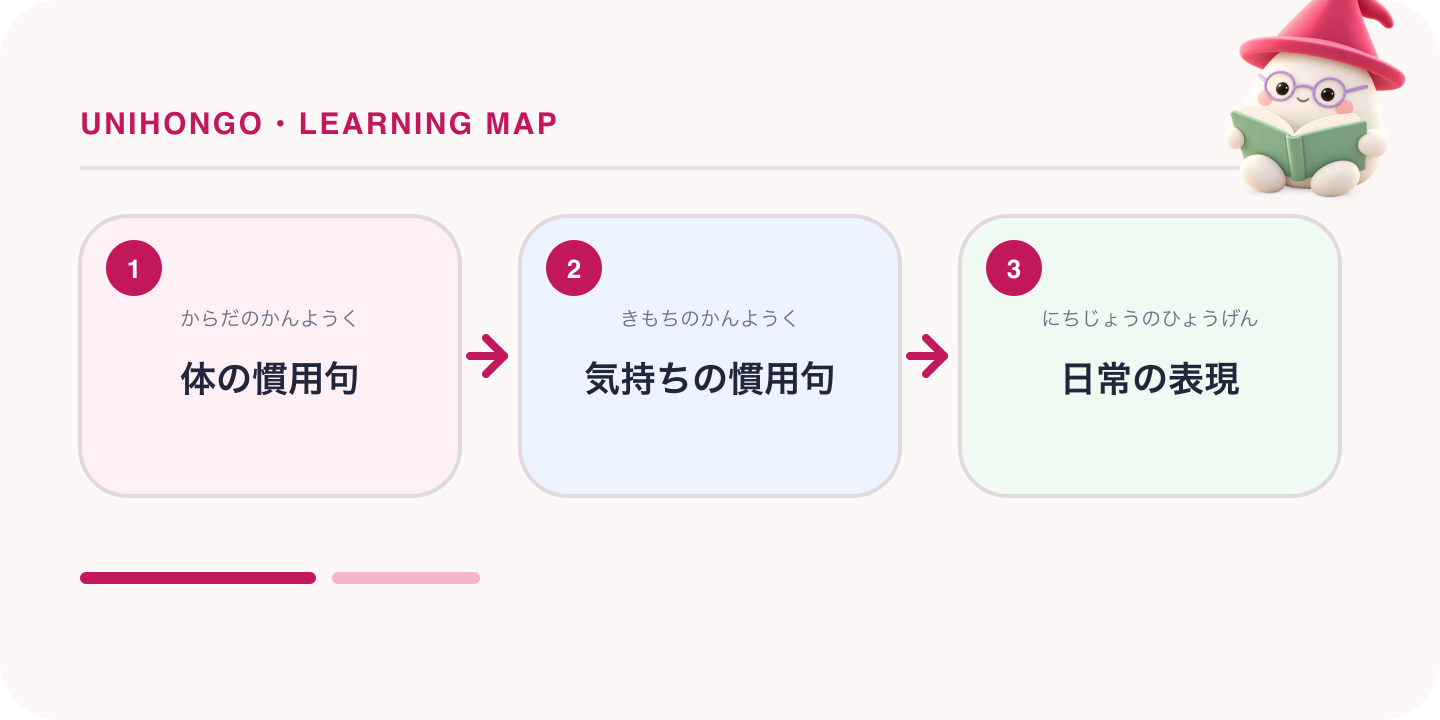
Why body parts carry so much of the meaning
Japanese locates a surprising amount of feeling and behaviour in the body. Anger rises in the belly and reaches the head, discretion lives in the mouth, availability lives in the hands, and responsibility sits on the shoulders as a load. Once you notice the pattern, dozens of expressions stop being arbitrary. Hara ga tatsu is anger standing up inside you; atama ni kuru is that same anger reaching your head, which is why it sounds more explosive and more casual.
The pattern also predicts the grammar. Most body idioms are built as noun plus ga plus an intransitive predicate describing a state you are in, such as te ga hanasenai or kuchi ga karui. A smaller group uses o plus a transitive verb for something you deliberately do, such as me o tōsu or atama o sageru. Knowing which half an idiom belongs to tells you immediately whether you can command it, apologise with it, or only report it.
Head, face and pride
Atama ga ii is the standard way to call someone clever and is safe about anyone but yourself. Atama ni kuru is the opposite pole of the same body part, and it is distinctly casual, so keep it for friends or for describing a situation rather than a person in front of you. Kao ga hiroi is one of the most useful compliments in working Japanese, because it credits a colleague's network without flattering them personally.
| Japanese | Romaji | Meaning |
|---|---|---|
| 田中さんは頭がいいから、すぐ答えが出ますよ。 | Tanaka-san wa atama ga ii kara, sugu kotae ga demasu yo. | Tanaka is sharp, so she will have an answer straight away. |
| あの言い方には本当に頭に来ました。 | Ano iikata ni wa hontō ni atama ni kimashita. | That way of putting it really made me angry. |
| 部長は顔が広いので、紹介してもらえると思います。 | Buchō wa kao ga hiroi node, shōkai shite moraeru to omoimasu. | The manager knows everyone, so I think he can introduce us. |
| 少しだけ顔を出して、すぐ帰ります。 | Sukoshi dake kao o dashite, sugu kaerimasu. | I will look in briefly and then head home. |
| 息子が合格して、鼻が高いです。 | Musuko ga gōkaku shite, hana ga takai desu. | My son passed, and I am very proud. |
| 恥ずかしくて顔から火が出そうでした。 | Hazukashikute kao kara hi ga desō deshita. | I was so embarrassed my face was burning. |
Mouth, eyes and ears
This group covers discretion, taste and criticism, and it contains the two idioms most worth having ready at work. Me o tōsu is the polite verb for skimming a document and appears constantly in email and in meetings. Mimi ga itai is the graceful way to accept a fair criticism, because it admits the point without arguing or grovelling. The pair kuchi ga karui and kuchi ga katai describe how safe a person is with information, and only the second one is safe to say aloud about a colleague.
| Japanese | Romaji | Meaning |
|---|---|---|
| 彼は口が軽いから、まだ言わないでください。 | Kare wa kuchi ga karui kara, mada iwanaide kudasai. | He cannot keep a secret, so please do not tell him yet. |
| 田中さんは口が堅いので安心です。 | Tanaka-san wa kuchi ga katai node anshin desu. | Tanaka is discreet, so we can relax. |
| つい口が滑ってしまいました。 | Tsui kuchi ga subette shimaimashita. | It just slipped out before I could stop myself. |
| 甘いものには目がないんです。 | Amai mono ni wa me ga nai n desu. | I have a real weakness for sweet things. |
| この資料に目を通していただけますか。 | Kono shiryō ni me o tōshite itadakemasu ka. | Could you look over these documents? |
| その話は耳が痛いです。 | Sono hanashi wa mimi ga itai desu. | That is hard to hear, because it is true. |
| 彼女の日本語には舌を巻きました。 | Kanojo no nihongo ni wa shita o makimashita. | Her Japanese left me lost in admiration. |
Notice the particles. Me ga nai takes ni for the thing you love, so it is amai mono ni wa me ga nai and never amai mono ga me ga nai. Me o tōsu takes ni for the document you skim, which is why shiryō ni me o tōsu is correct while shiryō o me o tōsu is not. Idioms carry their own particle habits, so store the whole frame rather than the two content words on their own.
Hands, arms, feet and shoulders
These are the idioms of availability and effort, and they are the safest group at work. Te ga hanasenai is the standard way to say you cannot come to the phone or leave your desk, and it sounds far better than isogashii desu because it explains that the state is temporary. Kata no ni ga oriru describes the specific relief of a responsibility ending, not general happiness, so it fits after a presentation, a deadline or a handover.
| Japanese | Romaji | Meaning |
|---|---|---|
| 今ちょっと手が離せないので、後で折り返します。 | Ima chotto te ga hanasenai node, ato de orikaeshimasu. | I cannot step away right now, so I will call you back later. |
| 手が空いたら手伝ってください。 | Te ga aitara tetsudatte kudasai. | Please give me a hand when you are free. |
| 困ったときは手を貸しますよ。 | Komatta toki wa te o kashimasu yo. | I will lend a hand if you get stuck. |
| 最近、料理の腕が上がりましたね。 | Saikin, ryōri no ude ga agarimashita ne. | Your cooking has really improved lately. |
| 思ったより費用がかかって、足が出ました。 | Omotta yori hiyō ga kakatte, ashi ga demashita. | It cost more than expected, so we went over budget. |
| 足を引っ張ってすみません。 | Ashi o hippatte sumimasen. | I am sorry for holding the team back. |
| あの態度には腹が立ちました。 | Ano taido ni wa hara ga tachimashita. | That attitude made me angry. |
| 発表が終わって、肩の荷が下りました。 | Happyō ga owatte, kata no ni ga orimashita. | Now the presentation is over, a weight is off my shoulders. |
| この作業はかなり骨が折れます。 | Kono sagyō wa kanari hone ga oremasu. | This job is really hard going. |
Animals that stand in for people
Animal idioms are warmer and more casual than the body group, and most of them belong to relaxed conversation rather than to a report. Neko no te mo karitai is the one you will hear most: so busy that even a cat's paws would help. Uma ga au describes chemistry between two people and is not about agreement, so you can disagree with someone you get on with. Saba o yomu, counting mackerel, means quietly adjusting a number in your favour, most often an age or a weight, and it is teasing rather than accusatory.
| Japanese | Romaji | Meaning |
|---|---|---|
| 今週は猫の手も借りたいくらい忙しいです。 | Konshū wa neko no te mo karitai kurai isogashii desu. | This week I am so busy I would take help from anyone. |
| 彼とは馬が合うんです。 | Kare to wa uma ga au n desu. | He and I just click. |
| あの人は少しサバを読んでいるかもしれません。 | Ano hito wa sukoshi saba o yonde iru kamoshiremasen. | He may be shaving a year or two off his stated age. |
| ボーナスは雀の涙でした。 | Bōnasu wa suzume no namida deshita. | The bonus was next to nothing. |
| あの二人は犬猿の仲です。 | Ano futari wa ken'en no naka desu. | Those two cannot stand each other. |
| 初対面のときは猫をかぶっていました。 | Shotaimen no toki wa neko o kabutte imashita. | She was on her very best behaviour when we first met. |
| 弟は借りてきた猫のように静かでした。 | Otōto wa karite kita neko no yō ni shizuka deshita. | My brother was as meek as anything there. |
| そんな虫のいい話はありませんよ。 | Sonna mushi no ii hanashi wa arimasen yo. | There is no deal that convenient. |
| ネットの情報を鵜呑みにしないでください。 | Netto no jōhō o unomi ni shinaide kudasai. | Please do not swallow what you read online without checking. |
Two of these change form when they modify a noun. Mushi ga ii becomes mushi no ii hanashi, because ga inside a modifying clause commonly turns into no. Karite kita neko is already a noun phrase, so it usually appears with no yō ni, as in karite kita neko no yō ni. Suzume no namida works the same way and behaves like an ordinary noun: suzume no namida hodo no kyūryō means a salary about as big as a sparrow's tears.
Water, fire and weather
Nature idioms tend to describe the shape of a situation rather than a person, which makes them comparatively safe. Mizu ni nagasu, letting something flow away downstream, is the standard way to propose forgiving an old dispute. Tōge o kosu, crossing the mountain pass, describes getting past the hardest stretch of an illness, a project or a busy season, and it is completely acceptable in a meeting. Nami ni noru is the positive counterpart: things are running with you rather than against you.
| Japanese | Romaji | Meaning |
|---|---|---|
| 昔のことは水に流しましょう。 | Mukashi no koto wa mizu ni nagashimashō. | Let us let the past go. |
| その一言が火に油を注ぎました。 | Sono hitokoto ga hi ni abura o sosogimashita. | That one remark poured oil on the fire. |
| ようやく峠を越しました。 | Yōyaku tōge o koshimashita. | We are finally over the worst of it. |
| 今、仕事が波に乗っています。 | Ima, shigoto ga nami ni notte imasu. | Work is really on a roll at the moment. |
| 雲をつかむような話ですね。 | Kumo o tsukamu yō na hanashi desu ne. | That sounds hopelessly vague. |
| 自分のことは棚に上げていますね。 | Jibun no koto wa tana ni agete imasu ne. | You are conveniently leaving your own part out of it. |
| 油を売っていないで、早く戻ってください。 | Abura o utte inaide, hayaku modotte kudasai. | Stop dawdling and get back here. |
Objects from the kitchen and the workshop
The last big source of idioms is ordinary household and workplace objects: paper, nails, spoons, seals and tea. This group is where the most useful office idioms live. Hakushi ni modosu means a plan goes back to a blank sheet, kugi o sasu means warning someone in advance so they cannot claim they were not told, and taikoban o osu means putting your own name behind a recommendation. Ocha o nigosu, muddying the tea, is what someone does when they answer without answering.
| Japanese | Romaji | Meaning |
|---|---|---|
| 計画を白紙に戻すことになりました。 | Keikaku o hakushi ni modosu koto ni narimashita. | It has been decided that the plan goes back to square one. |
| 念のため釘を刺しておきました。 | Nen no tame kugi o sashite okimashita. | I gave them a word of warning just in case. |
| この品質には太鼓判を押します。 | Kono hinshitsu ni wa taikoban o oshimasu. | I can vouch completely for this quality. |
| はっきり答えず、お茶を濁しました。 | Hakkiri kotaezu, ocha o nigoshimashita. | He fobbed us off instead of answering clearly. |
| 先生も匙を投げたそうです。 | Sensei mo saji o nageta sō desu. | Apparently even the teacher gave up on it. |
| ゴマをするのは苦手です。 | Goma o suru no wa nigate desu. | I am no good at flattering people. |
| 一度頭を下げたほうがいいと思います。 | Ichido atama o sageta hō ga ii to omoimasu. | I think you should go and apologise once. |
The idiom reference table
| Idiom | Literal image | What it means | Register |
|---|---|---|---|
| 頭がいい atama ga ii | The head is good | Clever, quick-thinking | Neutral, safe about others |
| 頭に来る atama ni kuru | It comes to the head | To get angry | Casual, avoid about a client |
| 顔が広い kao ga hiroi | The face is wide | Well connected | Neutral, a compliment at work |
| 顔を出す kao o dasu | To show one's face | To drop in briefly | Neutral |
| 顔から火が出る kao kara hi ga deru | Fire comes out of the face | To burn with embarrassment | Casual |
| 鼻が高い hana ga takai | The nose is high | Proud of someone close to you | Neutral |
| 口が軽い kuchi ga karui | The mouth is light | Unable to keep a secret | Casual and critical |
| 口が堅い kuchi ga katai | The mouth is hard | Discreet and trustworthy | Neutral, safe at work |
| 口が滑る kuchi ga suberu | The mouth slips | To let something slip out | Neutral |
| 目がない me ga nai | To have no eyes for it | To have a weakness for it | Casual and warm |
| 目を通す me o tōsu | To pass the eyes through | To look over a document | Neutral, standard at work |
| 耳が痛い mimi ga itai | The ears hurt | The criticism hits home | Neutral, best about yourself |
| 舌を巻く shita o maku | To roll up the tongue | To be lost in admiration | Slightly literary |
| 手が離せない te ga hanasenai | The hands cannot be freed | Tied up, unable to step away | Neutral, very useful at work |
| 手が空く te ga aku | The hands become empty | To become free | Neutral |
| 手を貸す te o kasu | To lend a hand | To help someone out | Neutral |
| 腕が上がる ude ga agaru | The arm rises | Skill improves | Neutral, a compliment |
| 足が出る ashi ga deru | The foot sticks out | To go over budget | Casual |
| 足を引っ張る ashi o hipparu | To pull someone's leg | To hold the group back | Harsh about others |
| 腹が立つ hara ga tatsu | The belly stands up | To get angry | Neutral about a situation |
| 肩の荷が下りる kata no ni ga oriru | The load leaves the shoulders | Relief when a duty ends | Neutral |
| 腰が低い koshi ga hikui | The waist is low | Modest and courteous | Neutral, a compliment |
| 骨が折れる hone ga oreru | A bone breaks | Laborious, hard going | Neutral |
| 頭を下げる atama o sageru | To lower the head | To apologise or ask a favour | Neutral |
| 猫の手も借りたい neko no te mo karitai | Wanting even a cat's paws | Desperately busy | Casual, very common |
| 猫をかぶる neko o kaburu | To put a cat on | To act demure and harmless | Casual, teasing |
| 借りてきた猫 karite kita neko | A borrowed cat | Unusually quiet in a new place | Casual |
| 馬が合う uma ga au | The horses match | To get on naturally with someone | Casual and friendly |
| 鯖を読む saba o yomu | To count mackerel | To fudge a number in your favour | Casual, teasing |
| 雀の涙 suzume no namida | A sparrow's tears | A tiny amount, usually money | Casual, self-deprecating |
| 犬猿の仲 ken'en no naka | A dog-and-monkey relationship | Two people who cannot stand each other | Casual gossip |
| 虫がいい mushi ga ii | The insect is good | Selfishly convenient | Casual and critical |
| 鵜呑みにする unomi ni suru | To swallow like a cormorant | To accept without checking | Neutral, safe at work |
| 虎の子 tora no ko | A tiger cub | A treasured reserve you protect | Neutral |
| 水に流す mizu ni nagasu | To let it flow into the water | To forgive and move on | Neutral |
| 油を売る abura o uru | To sell oil | To slack off chatting | Casual and critical |
| 火に油を注ぐ hi ni abura o sosogu | To pour oil on the fire | To make a bad situation worse | Neutral |
| 棚に上げる tana ni ageru | To put it up on the shelf | To ignore your own faults | Casual and critical |
| 匙を投げる saji o nageru | To throw the spoon | To give up as hopeless | Neutral |
| 峠を越す tōge o kosu | To cross the mountain pass | To get past the worst part | Neutral, safe at work |
| 波に乗る nami ni noru | To ride the wave | To be on a roll | Neutral |
| 雲をつかむよう kumo o tsukamu yō | Like grabbing a cloud | Hopelessly vague | Neutral |
| 白紙に戻す hakushi ni modosu | To return it to blank paper | To start again from nothing | Neutral, common at work |
| 釘を刺す kugi o sasu | To drive in a nail | To warn someone in advance | Neutral, slightly senior |
| 太鼓判を押す taikoban o osu | To press the big drum seal | To vouch for something | Neutral |
| お茶を濁す ocha o nigosu | To muddy the tea | To fob someone off vaguely | Neutral |
| ゴマをする goma o suru | To grind sesame | To flatter, to suck up | Casual and critical |
Read the register column before the meaning column. An idiom that judges a person, such as kuchi ga karui or goma o suru, is not dangerous because it is rude in itself; it is dangerous because a learner tends to deliver it flatly, without the softening laugh or the ne that a native speaker would add. The safest habit is to use critical idioms about yourself and complimentary idioms about everyone else.
Using one without sounding like a textbook
The commonest way an idiom goes wrong is density. One kanyōku in a two-minute stretch of speech sounds fluent; three sounds like a vocabulary demonstration. Native speakers reach for an idiom at a specific moment, usually when the plain description would be flat or slightly rude, and then go back to ordinary words. So the goal is not to insert idioms but to have a handful ready for the situations that recur in your life.
The second thing that gives learners away is delivery. Idioms are so familiar that they are spoken quickly, as one unit, with no pause inside them. Kata no ni ga orimashita should come out as a single run, not as four separate words. If you have to assemble it while speaking, it will sound quoted rather than said, so drill each idiom until you can produce the whole phrase in one breath.
- Choose five idioms that match your actual week and ignore the rest for now.
- Say each one inside a complete sentence with a real subject, never as a bare phrase.
- Practise the polite past too: kata no ni ga orimashita, hara ga tachimashita.
- Keep critical idioms in the first person until you know the listener well.
- Say the whole idiom in one breath, with no pause between the noun and the verb.
- When you hear one in a drama or at work, write down the situation, not just the words.
Mistakes learners make with idioms
Translating the image instead of learning the frame is the first trap. Te o kasu means to help, but you cannot extend it to te o karimasu for every kind of borrowing, and ashi ga deru is only about money, never about a foot appearing. An idiom is a closed unit and does not accept new nouns, adverbs or metaphors, so treat any variation you have not heard as wrong until you meet it in real speech.
The second trap is register drift in the other direction: choosing an idiom that is too vivid for the setting. Atama ni kimashita in front of a customer, or ashi o hippatte imasu about a colleague, will land badly however politely you conjugate it, because the masu ending does not soften the content. When in doubt, use the plain description with a hedge, and save the idiom for the people you already joke with.