
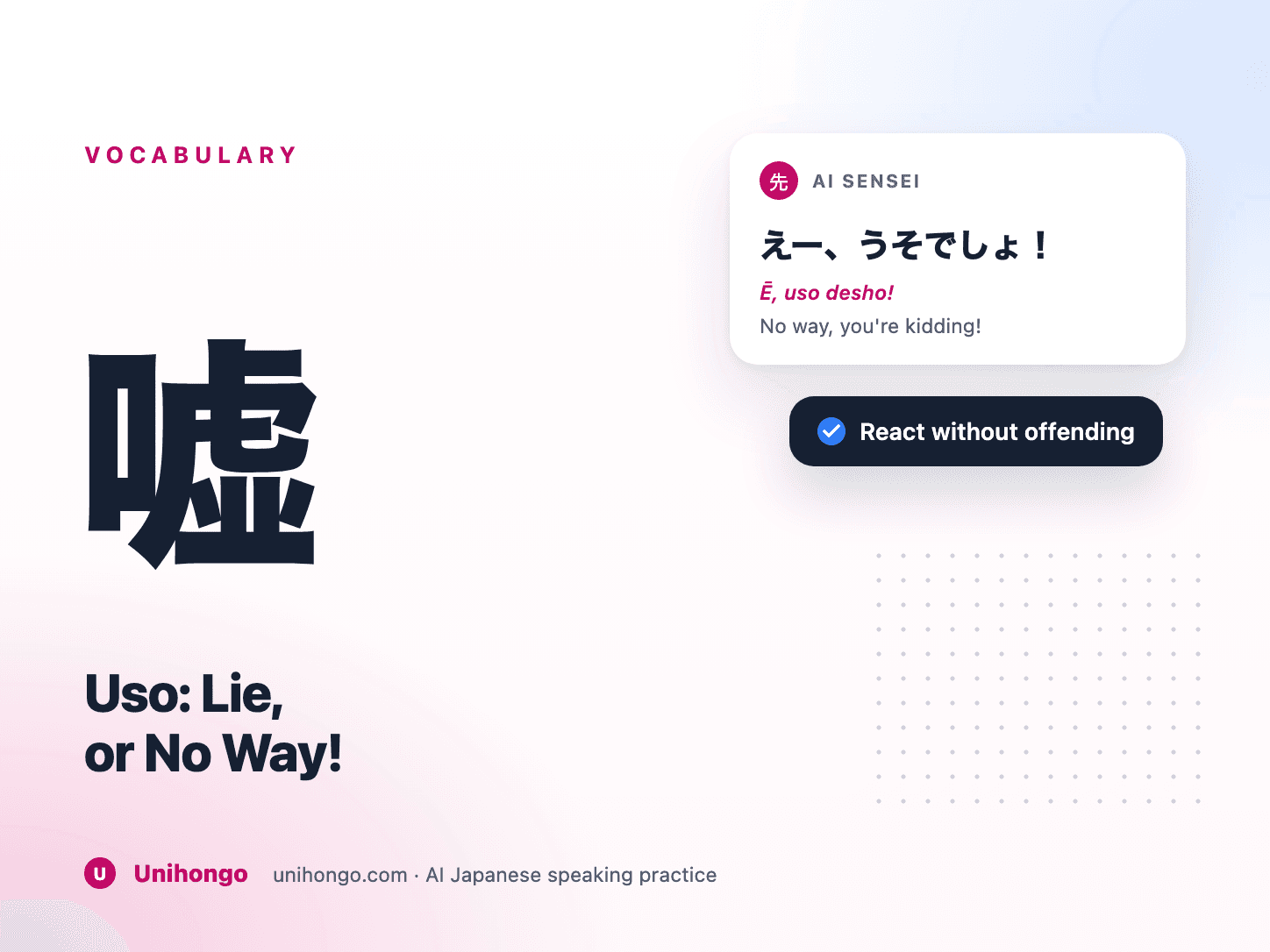
Uso as a noun: a lie
The dictionary meaning of uso is a lie or an untruth. In this sense it behaves like any noun. You tell a lie with the verb tsuku, a lie can be obvious or small, and you can say that something is a lie with uso da.
The standard verb phrase is uso o tsuku. Uso o iu (to say something untrue) is also heard, but tsuku is the pairing to learn first. The past form uso o tsuita means "I lied" or "they lied", and the negative uso wa tsukanai is a common promise of honesty.
Japanese also has the well-known expression uso mo hōben, roughly "a lie can be a useful means", the idea that a small untruth is sometimes kinder. It comes up when people discuss white lies.
| Japanese | Romaji | Meaning |
|---|---|---|
| 嘘をつく | uso o tsuku | To tell a lie |
| 嘘をついてごめん。 | Uso o tsuite gomen. | Sorry I lied. |
| 嘘はつかないよ。 | Uso wa tsukanai yo. | I won't lie to you. |
| それは嘘です。 | Sore wa uso desu. | That is not true. |
| 嘘も方便 | uso mo hōben | Sometimes a lie is the kind option |
| 真っ赤な嘘 | makka na uso | A barefaced lie (literally, a bright red lie) |
Uso! as a reaction: no way!
In conversation, uso! is overwhelmingly used as an exclamation of surprise. If a friend says they are getting married, have quit their job, or saw a famous actor at the station, uso! means "no way!" or "seriously?". You are not calling them a liar; you are showing that the news is surprising enough to be hard to believe.
It is often stretched and combined with other sounds: ē, uso! or usoo! Sometimes people repeat it, uso, uso, uso, to show that they are genuinely stunned. The friend usually replies with hontō (it's true) or maji de (seriously).
Because it is a reaction, it works best as a quick response right after the news. Leaving a long pause and then saying uso in a flat tone changes the meaning towards real doubt.
| Japanese | Romaji | Meaning |
|---|---|---|
| えー、うそ! | Ē, uso! | What? No way! |
| うそ、本当に? | Uso, hontō ni? | No way, really? |
| うそでしょ! | Uso desho! | You're kidding! |
| うそ、全然知らなかった。 | Uso, zenzen shiranakatta. | Seriously? I had no idea. |
| ほんとだって! | Honto da tte! | I'm telling you, it's true! |
If you want to follow the reaction with a question, see the guide to hontō ni, which covers the whole family of "really?" responses in more detail.
Uso deshō, uso darō and uso mitai
Uso deshō (often shortened to uso desho) adds conjecture: "surely that's a lie" or "you can't be serious". It is stronger than plain uso and can express shock, disappointment or delighted disbelief. With a rising intonation it becomes a request for confirmation. The rougher uso darō is used mostly by men in casual speech, and can sound blunt.
Uso mitai means "it's like a lie" or "it seems unreal". It is softer and often positive: a dream-like view, an unbelievably lucky result, a moment that feels too good to be true. It also appears in song lyrics and emotional writing.
Another expression, uso ja nai, means "it's not a lie" or "it's true", and is often used to insist. Uso tsuke, the command form, is a rough "don't lie to me" or "yeah, right", best kept for close male friends or avoided entirely.
| Expression | Nuance | Who uses it |
|---|---|---|
| うそ! | No way! Surprise | Friends, family, peers |
| うそでしょ? | You can't be serious | Casual, very common |
| うそだろ | No way, blunt | Mostly men, casual |
| うそみたい | It feels unreal | Emotional, often positive |
| うそじゃないよ | It's true, I promise | Insisting on the truth |
| うそつけ | Yeah, right; rough | Close friends only, if at all |
Usotsuki and other lie words
Usotsuki is a liar, from uso plus tsuki, the noun form of tsuku. Children say it constantly, and friends use it jokingly when someone breaks a small promise. Said seriously to an adult, especially in anger, it is a harsh accusation.
Related words include uso happyaku, a long string of lies (literally eight hundred lies), and dema, an unfounded rumour, often used online. Formal writing and news use words such as kyogi (falsehood) and itsuwari (deception), which you will rarely say in casual talk.
| Japanese | Romaji | Meaning |
|---|---|---|
| うそつき! | Usotsuki! | Liar! (often playful) |
| 来るって言ったのに、うそつき。 | Kuru tte itta noni, usotsuki. | You said you'd come. Liar. |
| 嘘八百を並べる | uso happyaku o naraberu | To tell a pack of lies |
| それ、デマだよ。 | Sore, dema da yo. | That's a false rumour. |
| 偽りの言葉 | itsuwari no kotoba | Deceitful words (literary) |
How intonation changes the meaning
The same word can sound delighted, shocked or suspicious depending on pitch and speed. A bright, high, fast uso! with wide eyes signals surprise. A drawn-out uso... with a falling tone sounds disappointed or crushed, for example when you hear a favourite shop has closed.
A low, flat uso da, especially with direct eye contact, sounds like real doubt: "that's a lie". This is the version that can offend, because it questions the speaker's honesty rather than reacting to the news.
When practising, exaggerate the surprise version. Japanese reactions tend to be more audible than in many languages, and a quiet uso can be misheard as scepticism.
| Delivery | How it sounds | Typical situation |
|---|---|---|
| High, quick, rising | Excited surprise | Friend shares good news |
| Long, falling | Disappointed disbelief | Hearing bad news |
| Low, flat, deliberate | Real doubt or accusation | You think they are lying |
| Laughing, repeated | Playful teasing | A friend's tall story |
Politer reactions for work and strangers
Uso is casual. With a manager, a teacher, a client or an older neighbour, it can sound childish, and in the wrong tone it can suggest you do not believe them. In these settings, Japanese speakers usually switch to hontō desu ka, sō nan desu ka or a phrase that names the surprise directly.
These alternatives still show emotion, which matters because a reaction that is too flat can seem uninterested. Adding e (eh?) at the start keeps the natural surprise while the rest stays polite.
| Japanese | Romaji | Meaning |
|---|---|---|
| えっ、本当ですか。 | E, hontō desu ka. | Oh, really? |
| そうなんですか。 | Sō nan desu ka. | Is that so? / I didn't know that. |
| それは驚きました。 | Sore wa odorokimashita. | That's a surprise. |
| 信じられないですね。 | Shinjirarenai desu ne. | That's hard to believe. |
| まさか! | Masaka! | Surely not! (casual to neutral) |
Masaka is a useful middle ground. It expresses disbelief without the word for lie, and sounds natural in most informal settings, though with a boss you may still prefer hontō desu ka.
Common learner mistakes
The biggest mistake is avoiding uso entirely out of fear of rudeness. With friends, reacting with sō desu ka to exciting news can sound strangely cold, while uso! shows you share the moment.
The opposite mistake is using uso deshō with a customer or superior. Even with a smile, it can sound like "I don't believe you". Save it for friends and family.
Another trap is translating "you're lying" into anata wa uso o tsuite imasu. It is grammatical, but so direct that it sounds like an accusation in a dispute. If you genuinely think something is wrong, question the information instead of the person: sore wa hontō desu ka or chotto chigau ki ga shimasu.
Finally, remember that uso as a reaction is not always positive. Uso... in a falling tone after hearing that a friend is leaving Japan expresses sadness, and people will hear it that way.
| Japanese | Romaji | Meaning |
|---|---|---|
| ちょっと違う気がします。 | Chotto chigau ki ga shimasu. | I have a feeling that's not quite right. |
| それは確かですか。 | Sore wa tashika desu ka. | Is that certain? |
| うそ…寂しくなるね。 | Uso... sabishiku naru ne. | Oh no... I'm going to miss you. |