
I am interested in Japanese: the four key phrases
These four phrases cover general interest, something catching your eye, a hobby you are hooked on, and serious interest in an issue or a job.
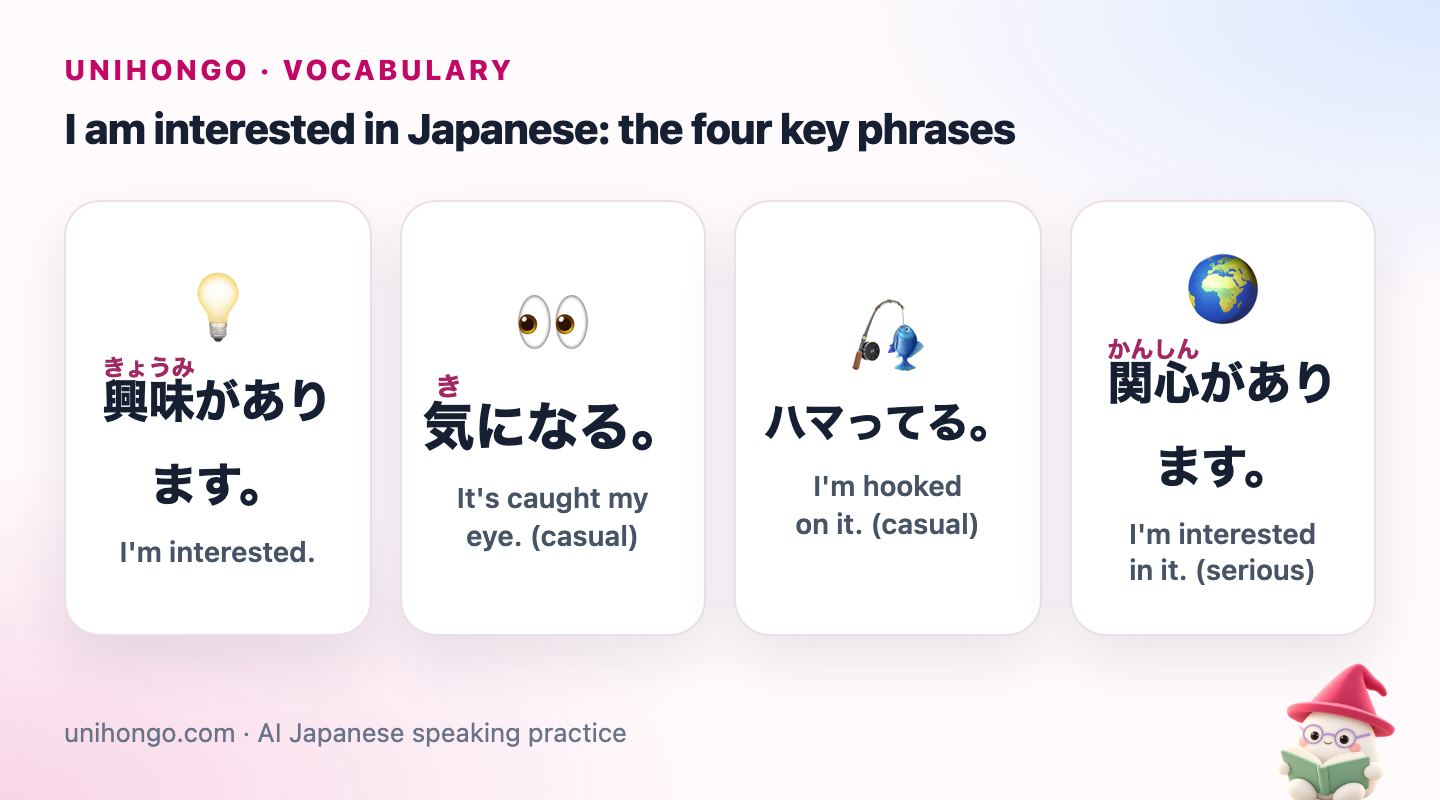
| Japanese | Romaji | Meaning |
|---|---|---|
| 興味があります。 | Kyōmi ga arimasu. | I'm interested. |
| 気になる。 | Ki ni naru. | It's caught my eye. (casual) |
| ハマってる。 | Hamatteru. | I'm hooked on it. (casual) |
| 関心があります。 | Kanshin ga arimasu. | I'm interested in it. (serious) |
Kyōmi ga aru: the standard phrase
Kyōmi (興味) means interest, and kyōmi ga aru literally says interest exists. The thing you are interested in takes the particle ni: nihon no rekishi ni kyōmi ga arimasu. Casually, the particles drop away: anime, kyōmi aru? are you into anime?
Kyōmi o motsu, to take an interest, describes the start of an interest: kodomo no koro kara nihongo ni kyōmi o motte imasu, I have been interested in Japanese since I was a child. Kyōmi ga nai, not interested, is blunt; amari kyōmi ga nai desu, I'm not very interested, is softer, and chotto kyōmi nai kana, not really my thing, is the gentle casual version.
Kyōmibukai (興味深い) means fascinating or very interesting and describes the thing, not you. Omoshiroi, interesting or funny, is the everyday word for that.
| Japanese | Romaji | Meaning |
|---|---|---|
| 日本の歴史に興味があります。 | Nihon no rekishi ni kyōmi ga arimasu. | I'm interested in Japanese history. |
| 子どものころから日本語に興味を持っています。 | Kodomo no koro kara nihongo ni kyōmi o motte imasu. | I've been interested in Japanese since I was a child. |
| アニメ、興味ある? | Anime, kyōmi aru? | Are you into anime? (casual) |
| あまり興味がないです。 | Amari kyōmi ga nai desu. | I'm not very interested. |
| それは興味深いですね。 | Sore wa kyōmibukai desu ne. | That's fascinating. |
Ki ni naru: when something catches your eye
Ki ni naru describes curiosity that keeps pulling at you: a new restaurant you keep walking past, a book you want to read, how a story ends. Ki ni natte iru adds that it has been on your mind for a while. It is lighter and more conversational than kyōmi ga aru.
Be aware that ki ni naru can also mean something bothers you. Oto ga ki ni naru, the noise bothers me, is a complaint, not curiosity. The context makes it clear, but it is worth knowing both sides.
| Japanese | Romaji | Meaning |
|---|---|---|
| 駅前の新しいパン屋、気になる。 | Ekimae no atarashii pan'ya, ki ni naru. | I'm curious about the new bakery by the station. |
| ずっと気になっている本があります。 | Zutto ki ni natte iru hon ga arimasu. | There's a book I've been wanting to read. |
| 続きが気になります。 | Tsuzuki ga ki ni narimasu. | I can't wait to find out what happens next. |
| 隣の音が気になります。 | Tonari no oto ga ki ni narimasu. | The noise next door bothers me. |
Hamatte iru: hooked on a hobby
Hamaru (はまる, often written ハマる) means to fit into something, and by extension to get hooked on it. ~ ni hamatte iru, I'm really into ~, is the natural way to talk about a hobby, a series, a food or a game you cannot stop thinking about. It is casual to neutral; hamatte imasu is fine with colleagues.
Ima nani ni hamatteru? what are you into right now? is one of the best questions for getting a conversation going, because almost everyone has an answer.
| Japanese | Romaji | Meaning |
|---|---|---|
| 最近、キャンプにハマっています。 | Saikin, kyanpu ni hamatte imasu. | I've been really into camping lately. |
| 今、何にハマってる? | Ima, nani ni hamatteru? | What are you into right now? (casual) |
| 韓国ドラマにどハマりしてる。 | Kankoku dorama ni dohamari shiteru. | I'm totally hooked on Korean dramas. (slang) |
Interest in a job or a serious topic
For work and serious subjects, kanshin (関心) is often the better word. Kankyō mondai ni kanshin ga arimasu, I'm interested in environmental issues, sounds thoughtful. In a job application or interview, onsha no ~ ni tsuyoi kanshin ga arimasu, I have a strong interest in your company's ~, is a standard opening, and kyōmi o mochimashita, it caught my interest, explains why you applied.
When you contact someone about a job or an event, ~ ni kyōmi ga atte, go-renraku shimashita, I'm getting in touch because I'm interested in ~, is polite and clear.
| Japanese | Romaji | Meaning |
|---|---|---|
| 環境問題に関心があります。 | Kankyō mondai ni kanshin ga arimasu. | I'm interested in environmental issues. |
| 御社の海外事業に強い関心があります。 | Onsha no kaigai jigyō ni tsuyoi kanshin ga arimasu. | I have a strong interest in your overseas business. |
| この求人に興味があって、ご連絡しました。 | Kono kyūjin ni kyōmi ga atte, go-renraku shimashita. | I'm contacting you because I'm interested in this job opening. |
Talking about hobbies with new friends
Interests are the easiest way into a conversation with someone new. Ask, answer with a phrase from this guide, add one detail, and ask back. If the other person mentions something new to you, kyōmi arimasu, yatte mitai desu, I'm interested, I'd like to try it, is a friendly way to show curiosity. Kondo oshiete kudasai, please teach me sometime, keeps the door open.
If you are not interested, there is no need to say so directly. Sō nan desu ne, is that so, followed by a question about the other person's hobby is enough to stay friendly, and it moves the conversation on without a flat kyōmi nai.

| Japanese | Romaji | Meaning |
|---|---|---|
| 趣味は何ですか。 | Shumi wa nan desu ka. | Friend: What are your hobbies? |
| 写真に興味があって、週末によく撮りに行きます。 | Shashin ni kyōmi ga atte, shūmatsu ni yoku tori ni ikimasu. | You: I'm into photography, and I often go out shooting at weekends. |
| へえ、私もちょっと興味あります。 | Hē, watashi mo chotto kyōmi arimasu. | Friend: Oh, I'm a bit interested in that too. |
| 今度一緒に行きませんか。 | Kondo issho ni ikimasen ka. | You: Want to come along next time? |
Interest in a person: be gentle
Saying kyōmi ga aru about a person sounds oddly clinical, as if you were studying them. The usual way to talk about being drawn to someone is ki ni naru: ki ni naru hito ga iru, there's someone I'm interested in. Said to the person directly, ~-san no koto ga ki ni natte iru is close to a confession, so it is a big step in Japanese.
Habits differ a lot between people, and many prefer to show interest through actions and invitations rather than words. Motto hanashitai, I'd like to talk more, or mata aitai na, I'd like to see you again, are lighter signals.
| Japanese | Romaji | Meaning |
|---|---|---|
| 気になる人がいるんだ。 | Ki ni naru hito ga iru n da. | There's someone I'm interested in. (casual) |
| もっと話したいな。 | Motto hanashitai na. | I'd like to talk more. |
| また会いたいな。 | Mata aitai na. | I'd like to see you again. |
Common mistakes
- Watashi wa kyōmibukai desu means I am fascinating. Say watashi wa ~ ni kyōmi ga arimasu.
- Watashi wa omoshiroi desu means I'm funny or interesting. The thing is omoshiroi; you are interested.
- Using o or ga before kyōmi ga aru for the topic: the topic takes ni, as in ongaku ni kyōmi ga aru.
- Kanshin ga aru for a fun hobby sounds stiff; use kyōmi or hamatte iru.
- Kyōmi nai to a friend's suggestion is blunt. Chotto kyōmi nai kana sounds kinder.