
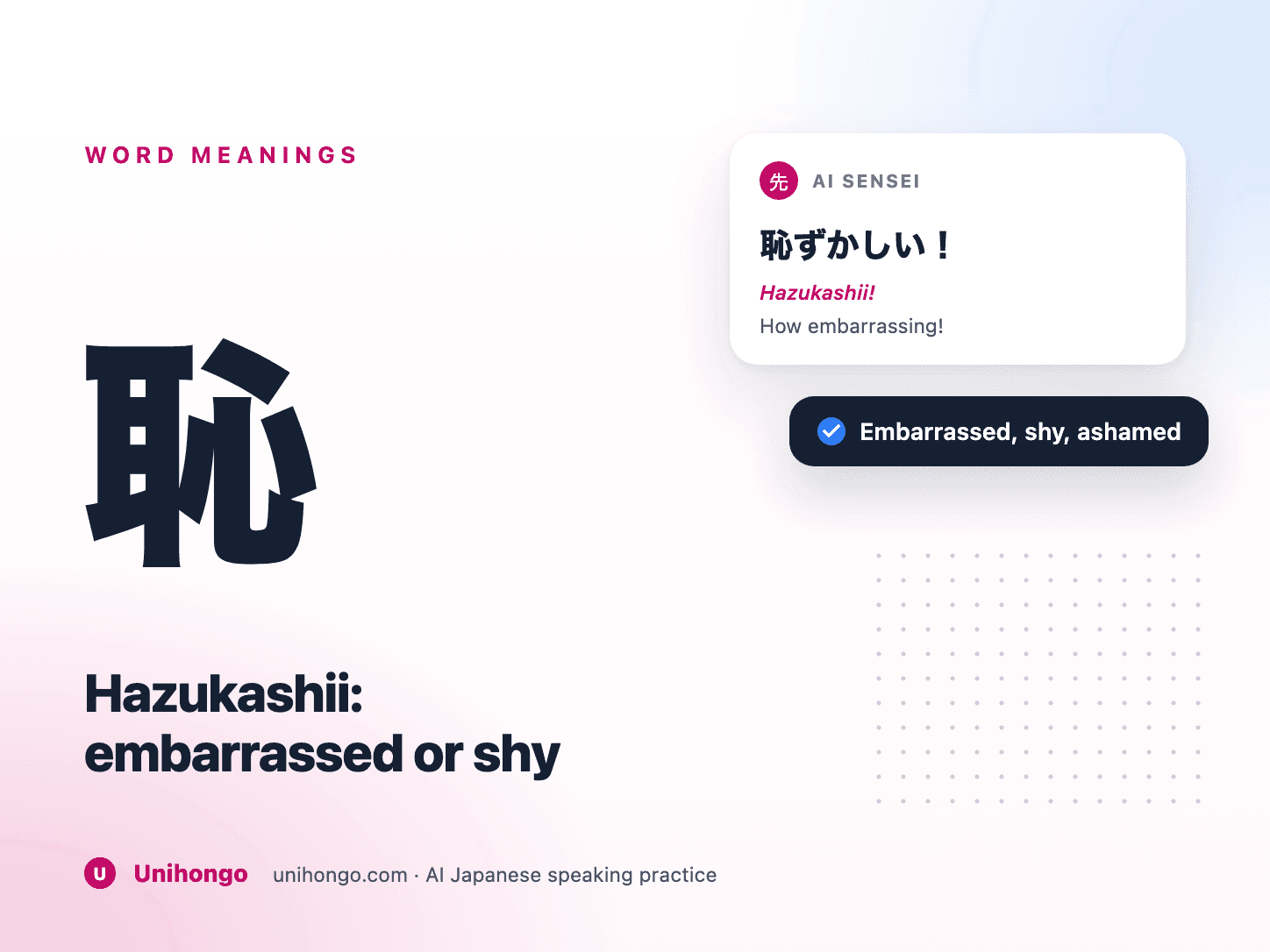
One word, three feelings
Hazukashii, written 恥ずかしい, starts from haji, shame, but everyday use is usually much lighter. Tripping on the stairs, being praised in public or singing badly at karaoke can all be hazukashii.
The heavier sense of real shame is still there, and a serious tone or context brings it out. For learners, the light reaction is by far the most common use.
| Japanese | Romaji | Meaning |
|---|---|---|
| 恥ずかしいです。 | Hazukashii desu. | I'm embarrassed. |
| 人前で話すのは恥ずかしい。 | Hitomae de hanasu no wa hazukashii. | Speaking in front of people is embarrassing. |
| 恥ずかしくて、何も言えませんでした。 | Hazukashikute, nani mo iemasen deshita. | I was too shy to say anything. |
| あんなことをして、恥ずかしいです。 | Anna koto o shite, hazukashii desu. | I'm ashamed of doing that. |
Hazukashii! as a reaction
On its own, hazukashii! is a quick, often laughing reaction: when you realise your shirt is inside out, when a friend shows an old photo, or when someone praises you too much.
Said with a smile, it invites sympathy rather than concern. The casual contracted form hazui is youth slang you will hear but do not need to use.
| Japanese | Romaji | Meaning |
|---|---|---|
| わ、恥ずかしい! | Wa, hazukashii! | Oh no, how embarrassing! |
| 恥ずかしいからやめて。 | Hazukashii kara yamete. | Stop, you're embarrassing me. (casual) |
| その写真、恥ずかしい! | Sono shashin, hazukashii! | That photo is so embarrassing! |
| はずい。 | Hazui. | So embarrassing. (youth slang) |
Shy: hazukashigariya and hitomishiri
To describe a shy personality, Japanese uses hazukashigariya, someone who gets embarrassed easily. Hitomishiri is narrower: shy with strangers, often relaxed once they know you.
Both are gentle and common in introductions. Saying hitomishiri nan desu about yourself at a party often lowers the pressure for everyone.
| Japanese | Romaji | Meaning |
|---|---|---|
| 恥ずかしがり屋です。 | Hazukashigariya desu. | I'm a shy person. |
| 人見知りなんです。 | Hitomishiri nan desu. | I'm shy with new people. |
| 慣れると、よく話します。 | Nareru to, yoku hanashimasu. | Once I get used to people, I talk a lot. |
| 照れ屋ですね。 | Tereya desu ne. | You're a bashful one. |
Ashamed: haji and public embarrassment
The noun haji means shame. Haji o kaku, literally to break out in shame, describes embarrassment in front of others, such as a mistake in a meeting.
The strongest forms belong to drama. Haji o shire, know shame, is a harsh rebuke that you will hear in historical shows more than in daily life.
| Japanese | Romaji | Meaning |
|---|---|---|
| 会議で恥をかきました。 | Kaigi de haji o kakimashita. | I embarrassed myself in the meeting. |
| 恥ずかしいことをしました。 | Hazukashii koto o shimashita. | I did something shameful. |
| 恥を知れ! | Haji o shire! | Have you no shame! (harsh, dramatic) |
Talking about someone else
Feeling adjectives describe the speaker's own feelings, so kare wa hazukashii sounds wrong. Use the appearance form hazukashisō or the verb hazukashigaru.
This is a very common learner error and one that native speakers rarely correct, so it is worth fixing deliberately.
| Japanese | Romaji | Meaning |
|---|---|---|
| 彼は恥ずかしそうでした。 | Kare wa hazukashisō deshita. | He looked embarrassed. |
| 娘が恥ずかしがっています。 | Musume ga hazukashigatte imasu. | My daughter is being shy. |
| 恥ずかしがらないで。 | Hazukashigaranaide. | Don't be shy. (casual) |
Nearby words that fit better
Hazukashii is broad, and sometimes a more precise word says what you mean. These four come up constantly.
| Japanese | Romaji | Meaning |
|---|---|---|
| 褒められると照れくさいです。 | Homerareru to terekusai desu. | I feel bashful when I'm praised. |
| ちょっと気まずかった。 | Chotto kimazukatta. | It was a bit awkward. |
| 自分が情けないです。 | Jibun ga nasakenai desu. | I'm disappointed in myself. |
| Word | Meaning | Typical moment |
|---|---|---|
| Terekusai | Bashful, a little awkward | Being thanked or praised |
| Kimazui | Awkward between people | Silence after an argument |
| Nasakenai | Pathetic, disappointed in yourself | Failing at something easy |
| Hazukashii | Embarrassed, shy, ashamed | Almost any of the above |
Making it natural
The fastest way to own hazukashii is to use it about real moments from your own life, because the feeling is easy to recall and the story gives it a shape.
Telling those stories in a conversation adds the reactions and follow-up questions that make the word stick, and the vocabulary in Unihongo's session report is a good place to collect terekusai and kimazui as they come up.
- Use hazukashii! as a light reaction, with a smile.
- Say hitomishiri nan desu when meeting new people.
- Use hazukashisō for other people.
- Apologise rather than describe shame after a serious mistake.