
The field and the nine positions
Every position has two names in Japanese, and this is the first thing that trips up a fan who learned the sport elsewhere. The katakana forms are borrowed and shortened, so the outfielders are refuto, sentā and raito rather than the full English phrases. Alongside them sit native compounds built on the character for hand, shu, meaning the person who does the job: tōshu for the one who throws, hoshu for the one who catches.
The compounds are the forms you meet in print and in formal commentary, and two of them are worth extra attention because they are not transparent. Yūgekishu, the shortstop, contains no idea of shortness, and chūkenshu, the centre fielder, uses a compound you will not meet elsewhere. The field itself divides into naiya, the infield, and gaiya, the outfield, and the bases are counted with rui: ichirui, nirui, sanrui and honrui for home.
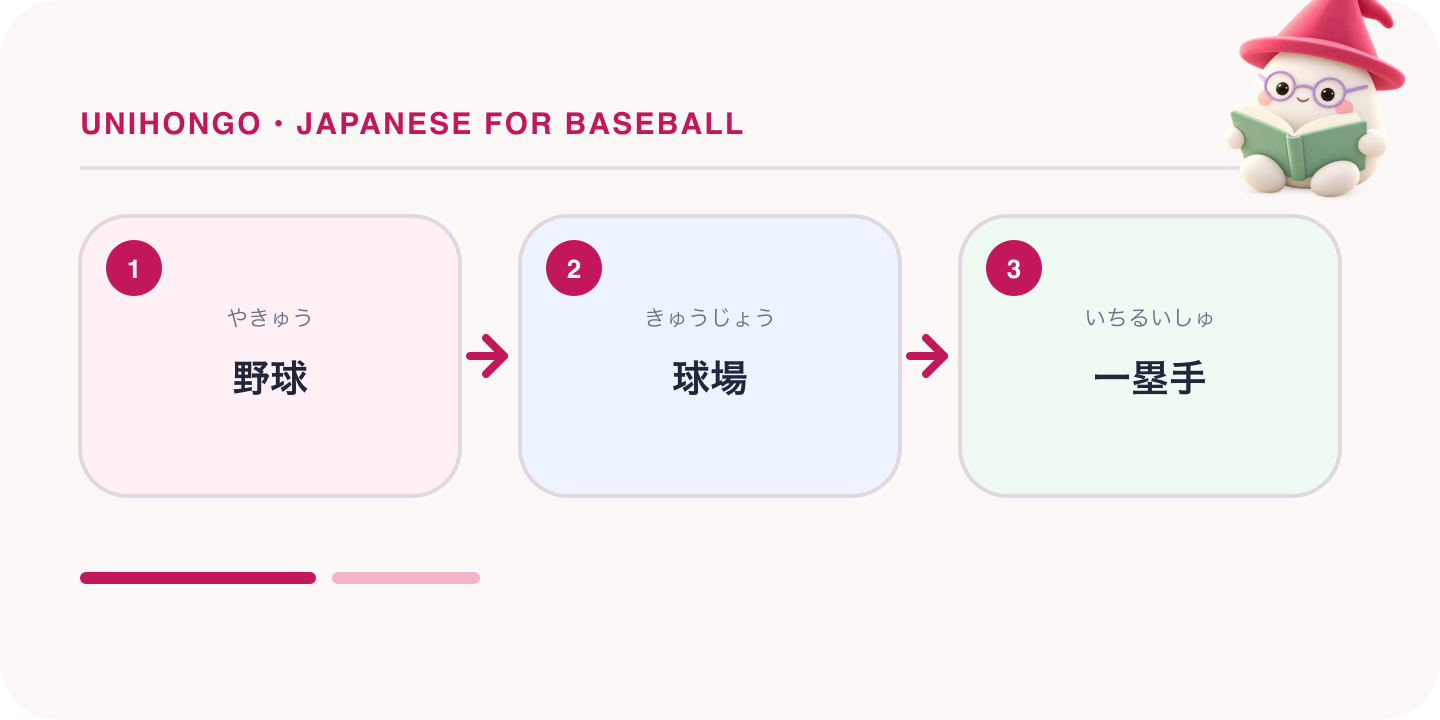
| Japanese | Romaji | English |
|---|---|---|
| 野球 | Yakyū | Baseball |
| 球場 | Kyūjō | Ballpark, stadium |
| 投手 / ピッチャー | Tōshu / pitchā | Pitcher |
| 捕手 / キャッチャー | Hoshu / kyatchā | Catcher |
| 一塁手 | Ichiruishu | First baseman |
| 二塁手 | Niruishu | Second baseman |
| 三塁手 | Sanruishu | Third baseman |
| 遊撃手 / ショート | Yūgekishu / shōto | Shortstop |
| 左翼手 / レフト | Sayokushu / refuto | Left fielder |
| 中堅手 / センター | Chūkenshu / sentā | Centre fielder |
| 右翼手 / ライト | Uyokushu / raito | Right fielder |
| 打者 / バッター | Dasha / battā | Batter |
| 走者 / ランナー | Sōsha / rannā | Runner |
| 代打 | Daida | Pinch hitter |
| 先発 | Senpatsu | Starting pitcher |
| 抑え | Osae | Closer |
| 監督 | Kantoku | Manager |
| 審判 | Shinpan | Umpire |
| 内野 | Naiya | Infield |
| 外野 | Gaiya | Outfield |
| 一塁 | Ichirui | First base |
| 本塁 / ホームベース | Honrui / hōmu bēsu | Home plate |
| マウンド | Maundo | The mound |
| ベンチ | Benchi | The dugout |
Innings, attack, defence and the scoreboard
An innings is a kai, counted with ordinary numbers: ikkai, nikai, sankai, up to kyūkai. Each one splits into omote and ura, the top and bottom halves. The side batting is doing kōgeki, attack, and the side in the field is doing shubi, defence, which is a much more transparent way of describing the sport than the English words are. Senkō means batting first and kōkō means batting second.
The scoreboard, sukoa bōdo or tokutenban, shows runs by innings, and a few compound words appear on it or in the commentary around it. Tokuten is a run scored, dōten means the scores are level, gyakuten means a lead has been overturned, and tsuikaten is an insurance run. If nine innings end level the game may go to enchōsen, extra innings, and the rules for how long that lasts vary by competition and by season, so check the notice at the ground rather than assuming.
| Japanese | Romaji | Meaning |
|---|---|---|
| 一回表です。 | Ikkai omote desu. | It is the top of the first. |
| 九回裏、二死満塁。 | Kyūkai ura, nishi manrui. | Bottom of the ninth, two out, bases loaded. (commentary) |
| 今、何回ですか? | Ima, nankai desu ka? | What innings is it now? |
| 三対二で勝っています。 | San tai ni de katte imasu. | They are winning three to two. |
| 同点になりました。 | Dōten ni narimashita. | The scores are level now. |
| 逆転しました。 | Gyakuten shimashita. | They have taken the lead back. |
| 延長戦に入ります。 | Enchōsen ni hairimasu. | We go to extra innings. |
| まだ点が入っていません。 | Mada ten ga haitte imasen. | No runs have been scored yet. |
The count and what the umpire calls
Calls at the plate are loanwords delivered at volume: sutoraiku, bōru, auto, sēfu. The umpire's gesture tells you the meaning even if the syllables blur, which makes this the easiest listening in the stadium. The count is kaunto, and these days it is usually given with strikes first, so a two-and-one count is read tsū sutoraiku, wan bōru. Furu kaunto is a full count.
Two ways of striking out are distinguished and you will hear both. Karaburi sanshin is a swinging strikeout, from karaburi meaning a swing that hits nothing, and minogashi sanshin is a called third strike, from minogasu, to let something pass. Shikyū, written with the character for four, is a walk, and fans and players alike also say fōa bōru.
| Japanese | Romaji | Meaning |
|---|---|---|
| ストライク! | Sutoraiku! | Strike. (the umpire's call) |
| ボール。 | Bōru. | Ball. (the umpire) |
| アウト! | Auto! | Out. (the umpire's call) |
| セーフ! | Sēfu! | Safe. (the umpire's call) |
| カウントはツーストライク、ワンボールです。 | Kaunto wa tsū sutoraiku, wan bōru desu. | The count is two strikes and one ball. |
| フルカウントになりました。 | Furu kaunto ni narimashita. | It has gone to a full count. |
| 空振り三振です。 | Karaburi sanshin desu. | He struck out swinging. |
| 見逃し三振でした。 | Minogashi sanshin deshita. | He was called out on strikes. |
| 四球で出塁しました。 | Shikyū de shutsurui shimashita. | He reached first on a walk. |
| デッドボールです。 | Deddo bōru desu. | He has been hit by the pitch. |
Hits, home runs and errors
The words for what the bat produces are the ones a fan repeats most, and again they come in pairs. Anda and hitto both mean a hit; honruida and hōmuran both mean a home run. The compounds are built logically from the base reached, so a double is niruida and a triple is sanruida, and a grand slam is manrui honruida, a home run with the bases full.
On the defensive side, shissaku or erā is an error, and heisatsu or daburu purē is a double play. A ball hit along the ground is a goro, a ball hit in the air is a furai, and a hard low line drive is a rainā. Learning these six shapes matters more than it looks, because commentary names the shape of the ball before it names the result.
| Japanese | Romaji | English |
|---|---|---|
| 安打 / ヒット | Anda / hitto | A hit |
| 二塁打 | Niruida | Double |
| 三塁打 | Sanruida | Triple |
| 本塁打 / ホームラン | Honruida / hōmuran | Home run |
| 満塁本塁打 | Manrui honruida | Grand slam |
| 三振 | Sanshin | Strikeout |
| 四球 / フォアボール | Shikyū / fōa bōru | Walk |
| 失策 / エラー | Shissaku / erā | Error |
| 併殺 / ダブルプレー | Heisatsu / daburu purē | Double play |
| 盗塁 | Tōrui | Stolen base |
| 送りバント | Okuri banto | Sacrifice bunt |
| 犠牲フライ | Gisei furai | Sacrifice fly |
| 適時打 | Tekijida | A timely, run-scoring hit |
| ゴロ | Goro | Ground ball |
| フライ | Furai | Fly ball |
| ライナー | Rainā | Line drive |
| ファウル | Fauru | Foul ball |
| 直球 | Chokkyū | Fastball, a straight pitch |
| 変化球 | Henkakyū | Breaking ball |
| 球速 | Kyūsoku | Pitch speed |
| 打点 | Daten | Runs batted in |
| 打率 | Daritsu | Batting average |
| ファインプレー | Fain purē | An outstanding defensive play |
| 完封 | Kanpū | A shutout |
The play-by-play sentences that repeat
Broadcast Japanese uses a small stock of sentences and recycles them all afternoon, which is exactly what a learner wants. The pattern is usually direction plus result: refuto-mae hitto, a hit in front of the left fielder; shōto goro, a grounder to shortstop. Once you hear that the location comes first, the sentences stop sounding like a wall of sound and start sounding like slots being filled.
Notice the tense. Commentators narrate in the plain past for completed actions, uchimashita, hairimashita, because the action has just finished, and switch to desu for a state, sanshin desu. Learners tend to narrate everything in the present, which is why their own commentary sounds flat. Copy the past-tense endings and you sound immediately more natural.
| Japanese | Romaji | Meaning |
|---|---|---|
| ピッチャー、振りかぶって投げました。 | Pitchā, furikabutte nagemashita. | The pitcher winds up and delivers. (commentary) |
| 打ちました! | Uchimashita! | He has hit it. (commentary) |
| 大きい、大きい、入りました。 | Ōkii, ōkii, hairimashita. | It is big, it is big, and it is gone. (commentary) |
| レフト前ヒットです。 | Refuto-mae hitto desu. | A single in front of the left fielder. |
| ショートゴロ、アウトです。 | Shōto goro, auto desu. | A grounder to short, and he is out. |
| センターフライに終わりました。 | Sentā furai ni owarimashita. | It ends in a fly ball to centre. |
| 一塁ランナーが走りました。 | Ichirui rannā ga hashirimashita. | The runner on first is going. |
| 逆転のチャンスです。 | Gyakuten no chansu desu. | This is a chance to take the lead. |
| 試合が動きました。 | Shiai ga ugokimashita. | The game has come alive. |
| これで二死です。 | Kore de nishi desu. | That makes two out. |
Buying a ticket and finding your seat
Seating is described by where you sit relative to the field. Naiya seki is behind the infield, gaiya seki is out beyond it, and each side of the ground is named for the base in front of it, so sanruigawa is the third-base side. Seats are either shiteiseki, reserved with a specific number, or jiyūseki, unreserved within an area. Prices, availability and the rules on re-entry vary by ground and by fixture, so ask rather than assume.
At the window, the polite request pattern does almost all the work: what you want, then onegai shimasu. Staff will answer with a short question about quantity or area, and the answer is usually one word. Keep your hanken, the ticket stub, because re-entry, if it is allowed at all, normally depends on it.
| Japanese | Romaji | Meaning |
|---|---|---|
| チケットを一枚お願いします。 | Chiketto o ichi-mai onegai shimasu. | One ticket, please. |
| 当日券はまだありますか? | Tōjitsuken wa mada arimasu ka? | Are there still tickets for today? |
| 内野の指定席はありますか? | Naiya no shiteiseki wa arimasu ka? | Do you have reserved infield seats? |
| 外野の自由席でお願いします。 | Gaiya no jiyūseki de onegai shimasu. | Unreserved outfield seating, please. |
| 三塁側の席がいいです。 | Sanruigawa no seki ga ii desu. | I would like a seat on the third-base side. |
| 何番ゲートから入りますか? | Nan-ban gēto kara hairimasu ka? | Which gate do I go in by? |
| この席はどこですか? | Kono seki wa doko desu ka? | Where is this seat? |
| 通路側をお願いします。 | Tsūrogawa o onegai shimasu. | An aisle seat, please. |
| 半券は捨てないでください。 | Hanken wa sutenaide kudasai. | Please do not throw away your stub. (staff) |
| 再入場はできますか? | Sainyūjō wa dekimasu ka? | Can I go out and come back in? |
| 試合は何時からですか? | Shiai wa nanji kara desu ka? | What time does the game start? |
Food and drink in the stands
Much of the catering comes to you. Uriko, vendors carrying a keg or a tray, work the aisles throughout the game, and you order by catching an eye and holding up fingers rather than by shouting a full sentence. Sumimasen plus the item plus onegai shimasu is all you need, and the number goes in with the native counters hitotsu, futatsu, mittsu.
The stands also have counters selling bentō, yakisoba, karaage and soft drinks, usually behind the seating on the concourse. Payment methods differ by ground and some vendors are cash only, so it is worth asking before you order rather than after. Rubbish is normally separated into marked bins at the exits.
| Japanese | Romaji | Meaning |
|---|---|---|
| すみません、生ビールを一つお願いします。 | Sumimasen, nama-bīru o hitotsu onegai shimasu. | Excuse me, one draught beer, please. |
| 二つください。 | Futatsu kudasai. | Two, please. |
| おいくらですか? | Oikura desu ka? | How much is it? |
| 現金でお願いします。 | Genkin de onegai shimasu. | Cash, please. |
| カードは使えますか? | Kādo wa tsukaemasu ka? | Can I pay by card? |
| 冷たいの、ありますよ。 | Tsumetai no, arimasu yo. | I have cold ones here. (vendor) |
| お弁当はどこで買えますか? | O-bentō wa doko de kaemasu ka? | Where can I buy a lunch box? |
| 焼きそばを二つお願いします。 | Yakisoba o futatsu onegai shimasu. | Two portions of yakisoba, please. |
| ゴミはこちらにお願いします。 | Gomi wa kochira ni onegai shimasu. | Rubbish goes here, please. (staff) |
Organised cheering and how to join in
Supporting in Japan is generally organised rather than spontaneous. An ōendan, a cheering section, sits together with drums and trumpets and leads the surrounding stand, and there is usually a separate chant, an ōenka, for each batter, started by a leader with a whistle or a raised hand. The rhythm is steady and the words are short, which is why newcomers pick them up within an innings by copying rather than by studying.
A few customs are widely observed. Supporters of each side sit in their own area, so buy your seat accordingly; cheering is generally done while your side is batting rather than fielding; and many grounds have a lucky seventh moment, rakkī sebun, before the seventh-innings attack. Balloon releases and other rituals differ between stadiums and change over time, so watch what the people around you do first. Nobody is obliged to join, and simply clapping is entirely normal.
| Japanese | Romaji | Meaning |
|---|---|---|
| がんばれ! | Ganbare! | Come on, keep going. |
| いけー! | Ikē! | Go, go. |
| ナイスバッティング! | Naisu battingu! | Nice hitting. |
| 応援団の近くに座りたいです。 | Ōendan no chikaku ni suwaritai desu. | I would like to sit near the cheering section. |
| 応援歌を覚えました。 | Ōenka o oboemashita. | I have learned the cheering song. |
| 一緒に応援しましょう。 | Issho ni ōen shimashō. | Let us cheer together. |
| 立って応援してもいいですか? | Tatte ōen shite mo ii desu ka? | Is it all right to stand while cheering? |
| 隣の人に合わせれば大丈夫ですよ。 | Tonari no hito ni awasereba daijōbu desu yo. | Just follow the person next to you and you will be fine. |
| メガホンはどこで買えますか? | Megahon wa doko de kaemasu ka? | Where can I buy a megaphone? |
| ラッキーセブンです。 | Rakkī sebun desu. | It is the lucky seventh. |
Talking about the game the next day
This is where the vocabulary pays for itself, because a game is an easy, low-risk topic with a colleague and it gives you a shared subject that neither person has to invent. The opening move is almost always the same question: kinō no shiai, mimashita ka. From there, the score, the turning point and one adjective carry the whole conversation.
Two reactions are worth having ready. Oshikatta desu ne, that was a close one, is what you say when a side lost narrowly, and it is the standard sympathetic response. Sugoi shiai deshita ne, that was quite a game, works for anything dramatic. If you do not follow the sport, saying so honestly and asking a question is better received than bluffing, and it usually earns you a patient explanation.
| Japanese | Romaji | Meaning |
|---|---|---|
| 昨日の試合、見ましたか? | Kinō no shiai, mimashita ka? | Did you watch the game yesterday? |
| 何対何でしたか? | Nan-tai-nan deshita ka? | What was the score? |
| 三対二で勝ちました。 | San tai ni de kachimashita. | They won three to two. |
| 九回に逆転しました。 | Kyūkai ni gyakuten shimashita. | They came back to win it in the ninth. |
| 惜しかったですね。 | Oshikatta desu ne. | That was close, wasn't it. |
| すごい試合でしたね。 | Sugoi shiai deshita ne. | That was quite a game. |
| 最後まで見ましたか? | Saigo made mimashita ka? | Did you watch it to the end? |
| 延長までいきました。 | Enchō made ikimashita. | It went to extra innings. |
| 野球はよく見ますか? | Yakyū wa yoku mimasu ka? | Do you watch baseball much? |
| ルールはまだよく分かりません。 | Rūru wa mada yoku wakarimasen. | I still do not really understand the rules. |
| 今度、一緒に見に行きませんか? | Kondo, issho ni mi ni ikimasen ka? | Shall we go and watch one together some time? |
| 球場で見るのは初めてです。 | Kyūjō de miru no wa hajimete desu. | It will be my first time watching at a ground. |
A listening routine built around one game
- First pass: watch an innings and say only the outcome word for each pitch, sutoraiku, bōru, fauru, auto.
- Second pass: add the location, so shōto goro and refuto-mae rather than just a hit.
- Third pass: narrate a complete at-bat in past-tense sentences, ending with the result.
- Write down every word you did not catch, then check whether it was a loanword or a native compound; the two need different memory work.
- Learn one position compound a day and pair it with its katakana twin so you can recognise both.
- Finish by telling somebody about the game in three sentences: who played, what the score was, and what the turning point was.