

Writing tools
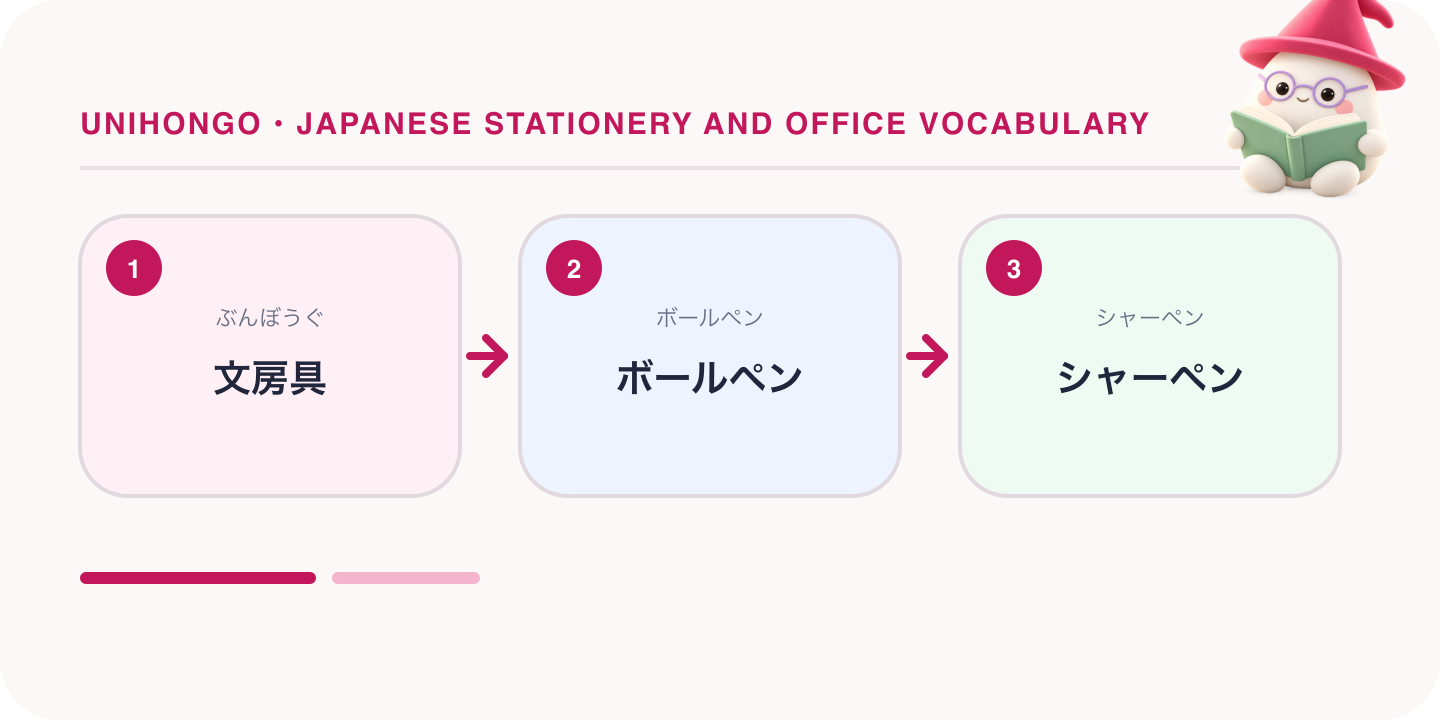
Start with the things you write with. Most pen names are loanwords, but the Japanese versions are shortened or combined in ways English speakers do not expect. Bōrupen, from ballpoint pen, is the default pen, and shāpen, short for shāpu penshiru, is a mechanical pencil. The name is usually traced to an early product name rather than to the English phrase mechanical pencil.
Erasers are keshigomu, literally rubber for erasing, and correction tape is shūsei tēpu. Highlighters are keikō pen, fluorescent pens, though you will also hear mākā for markers in general.
| Word | Reading | Meaning |
|---|---|---|
| 文房具 | bunbōgu | Stationery |
| ボールペン | bōrupen | Ballpoint pen |
| シャーペン | shāpen | Mechanical pencil |
| 鉛筆 | enpitsu | Pencil |
| 消しゴム | keshigomu | Eraser |
| 蛍光ペン | keikō pen | Highlighter |
| マーカー | mākā | Marker pen |
| 修正テープ | shūsei tēpu | Correction tape |
| 筆箱 / ペンケース | fudebako / penkēsu | Pencil case |
| 替え芯 | kaeshin | Refill (ink or lead) |
Paper, notebooks and filing
Japanese offices still handle a lot of paper, and the words for it are worth knowing. Nōto is a notebook, not a note; techō is a pocket diary or planner; and memochō is a memo pad. Shorui means documents in general, while shiryō means materials prepared for a meeting or class, such as handouts.
The humble kuria fairu, clear file, deserves its own mention. It is a thin plastic sleeve open on two sides, and it is how documents travel in Japan: between desks, into bags and across counters at city halls. When someone says fairu ni irete oite kudasai, they usually mean put it in a clear file, not a computer file.
| Japanese | Romaji | Meaning |
|---|---|---|
| 付箋を貼っておきました。 | Fusen o hatte okimashita. | I've put a sticky note on it. |
| 資料をクリアファイルに入れておきます。 | Shiryō o kuria fairu ni irete okimasu. | I'll put the handouts in a clear file. |
| この用紙に記入してください。 | Kono yōshi ni kinyū shite kudasai. | Please fill in this form. |
| Word | Reading | Meaning |
|---|---|---|
| ノート | nōto | Notebook |
| 手帳 | techō | Planner, pocket diary |
| メモ帳 | memochō | Memo pad |
| 付箋 | fusen | Sticky note |
| クリアファイル | kuria fairu | Clear plastic file |
| ファイル | fairu | File folder, binder |
| 封筒 | fūtō | Envelope |
| 書類 | shorui | Documents, paperwork |
| 資料 | shiryō | Materials, handouts |
| 用紙 | yōshi | Form, sheet of paper for a purpose |
| コピー用紙 | kopī yōshi | Printer paper |
Desk tools: stapler, scissors and tape
The tools on a Japanese desk are mostly loanwords or simple native words. The one that trips up nearly everyone is the stapler: it is hotchikisu, not sutēpurā. Staples are hotchikisu no hari, needles, or shin, and a staple remover is often just called a rimūbā.
Tape has several everyday names. Serotēpu is clear sticky tape, gamutēpu is packing tape, and masking tape is masukingu tēpu. Glue is nori, the same sound as the seaweed, and context always makes the meaning clear.
| Word | Reading | Meaning |
|---|---|---|
| ホッチキス | hotchikisu | Stapler |
| ホッチキスの針 | hotchikisu no hari | Staples |
| はさみ | hasami | Scissors |
| カッター | kattā | Utility knife, box cutter |
| のり | nori | Glue, glue stick |
| セロテープ | serotēpu | Clear sticky tape |
| ガムテープ | gamutēpu | Packing tape |
| クリップ | kurippu | Paper clip |
| 輪ゴム | wagomu | Rubber band |
| 定規 | jōgi | Ruler |
| 穴あけパンチ | anaake panchi | Hole punch |
| 電卓 | dentaku | Calculator |
Office machines follow the same pattern: kopīki is the copier, fukugōki is a multifunction printer, and shureddā is the shredder. Kopī shite kudasai, please make a copy, is one of the first requests a new employee hears.
Hanko and inkan: the name seal
A hanko or inkan is a small seal carved with your family name, pressed in red ink onto documents where other countries might use a signature. Many workplaces have moved towards digital approval, and many procedures now accept a signature instead, but you will still meet hanko on delivery slips, some contracts, internal forms and bank or city hall paperwork. Whether a signature is accepted instead depends on the organisation and the document, so ask.
There are several kinds. A mitomein is an everyday seal for low-stakes things like receiving parcels. A jitsuin is a seal officially registered with your local government and used for important contracts. A ginkōin is registered with a bank. The red ink pad is shuniku, and a spot marked with 印 on a form is where the seal goes.
| Japanese | Romaji | Meaning |
|---|---|---|
| こちらにはんこをお願いします。 | Kochira ni hanko o onegai shimasu. | Please put your seal here. |
| サインでもいいですか。 | Sain demo ii desu ka. | Is a signature all right instead? |
| 印鑑を忘れてしまいました。 | Inkan o wasurete shimaimashita. | I've forgotten my seal. |
| Word | Reading | Meaning |
|---|---|---|
| はんこ | hanko | Name seal, stamp |
| 印鑑 | inkan | Name seal, seal impression |
| 認印 | mitomein | Everyday unregistered seal |
| 実印 | jitsuin | Officially registered seal |
| 銀行印 | ginkōin | Seal registered with a bank |
| 朱肉 | shuniku | Red ink pad |
| 押印 | ōin | Affixing a seal (formal) |
| 署名 | shomei | Signature (formal) |
| サイン | sain | Signature (everyday) |
Borrowing and lending at work or school
The key pair here is kasu, to lend, and kariru, to borrow. Learners often mix them up, so fix the direction: the owner kasu, the person who receives kariru. To ask someone to lend you something, the smoothest pattern is kashite moraemasu ka, could you lend me, or the slightly softer kashite itadakemasu ka for a senior colleague or teacher.
Karite mo ii desu ka, may I borrow, is also natural, especially when the item is on a shared desk. Start with sumimasen or chotto ii desu ka to get attention, and when you return the item, say arigatō gozaimashita in the past tense, because the favour is finished.
| Japanese | Romaji | Meaning |
|---|---|---|
| すみません、ペンを貸してもらえますか。 | Sumimasen, pen o kashite moraemasu ka. | Excuse me, could you lend me a pen? |
| ホッチキス、お借りしてもいいですか。 | Hotchikisu, o-kari shite mo ii desu ka. | May I borrow the stapler? |
| 付箋を何枚かいただけますか。 | Fusen o nanmai ka itadakemasu ka. | Could I have a few sticky notes? |
| ちょっと消しゴム貸して。 | Chotto keshigomu kashite. | Lend me your eraser a sec. (casual) |
| どうぞ、使ってください。 | Dōzo, tsukatte kudasai. | Here you are, go ahead and use it. |
| ありがとうございました。お返しします。 | Arigatō gozaimashita. O-kaeshi shimasu. | Thank you. I'm returning it. |
| はさみはどこにありますか。 | Hasami wa doko ni arimasu ka. | Where are the scissors? |
For consumables like sticky notes or paper, you are not really borrowing, because you will not give them back. Use morau or itadaku, to receive, instead of kariru, as in the third example.
Counting stationery
Stationery is a good way to practise counters, because the items fall neatly into shape categories. Long, thin things such as pens and pencils use hon; bound things such as notebooks and planners use satsu; flat things such as sheets, envelopes and clear files use mai; and small or general objects such as a stapler or an eraser use ko or the native hitotsu, futatsu.
Watch the sound changes with hon: ippon, nihon, sanbon. Satsu becomes issatsu for one, and mai stays regular: ichimai, nimai, sanmai.
| Japanese | Romaji | Meaning |
|---|---|---|
| ボールペンを二本ください。 | Bōrupen o nihon kudasai. | Two ballpoint pens, please. |
| ノートを三冊買いました。 | Nōto o sansatsu kaimashita. | I bought three notebooks. |
| クリアファイルを一枚もらえますか。 | Kuria fairu o ichimai moraemasu ka. | Could I have one clear file? |
| 消しゴムを一つ貸してください。 | Keshigomu o hitotsu kashite kudasai. | Please lend me an eraser. |
| コピーを十部お願いします。 | Kopī o jūbu onegai shimasu. | Ten copies, please. |
Common mistakes with stationery words
- Saying sutēpurā for a stapler. It may be understood, but the everyday word is hotchikisu.
- Using nōto for a note. Nōto is a notebook; a note or memo is memo.
- Calling a mechanical pencil a penshiru. Penshiru is not used on its own; say shāpen, and enpitsu for a wooden pencil.
- Mixing up kasu and kariru. Kashite means lend me; karite means borrow. Kariru o kudasai is not Japanese.
- Assuming fairu means a computer file. In an office it often means a physical folder or binder, and kuria fairu is the plastic sleeve.
- Using sain on formal paperwork. It is fine in speech, but forms tend to say shomei, and some still ask for a seal, 印, instead.
- Counting all items with ko. It works in a pinch, but pens with hon and notebooks with satsu sound far more natural.
Review the words with Unihongo's learning games
Stationery vocabulary sticks best when you see it, say it and use it in short bursts. Unihongo's free learning games are built for exactly this kind of themed review: match the word to its meaning, recognise the katakana loanwords at speed, and test yourself on the kanji compounds such as 付箋, 封筒 and 印鑑 until you can read them on a real form.
A good routine is to play one short round before work or class, then pick three words from the round and use them the same day. Borrow a pen, ask for a clear file or name the stapler on your desk aloud. The words you actually use in context are the ones you remember next week.
- Round one: katakana loanwords such as bōrupen, hotchikisu, kuria fairu and serotēpu.
- Round two: kanji compounds such as bunbōgu, keshigomu, fusen, fūtō and inkan.
- Round three: counters, pairing each item with hon, satsu, mai or ko.