

Agaru and ageru: prices, temperature, grades and speed
Agaru is a level going up by itself: nedan ga agaru, the price rises; kion ga agaru, the temperature rises; seiseki ga agaru, grades improve; sokudo ga agaru, the speed increases. The subject takes ga and there is no agent. Ageru is someone pushing that level up: nedan o ageru, raise prices; ondo o ageru, turn up the heat; sokudo o ageru, speed up. The object takes o. Agaru is a u-verb, agarimasu, agatte, agatta; ageru is a ru-verb, agemasu, agete, ageta.
The pair is everywhere in the news and at work. Kyūryō ga agatta, my salary went up, and kaisha ga kyūryō o ageta, the company raised salaries, describe the same event from two sides. Uriage ga agaru, sales rise, and uriage o ageru, increase sales, are the daily vocabulary of a sales meeting. Netsu ga agaru is a fever rising.
Japanese speakers reach for agaru more than English speakers expect: even if you raised your own grade by studying, seiseki ga agatta sounds more natural than seiseki o ageta.
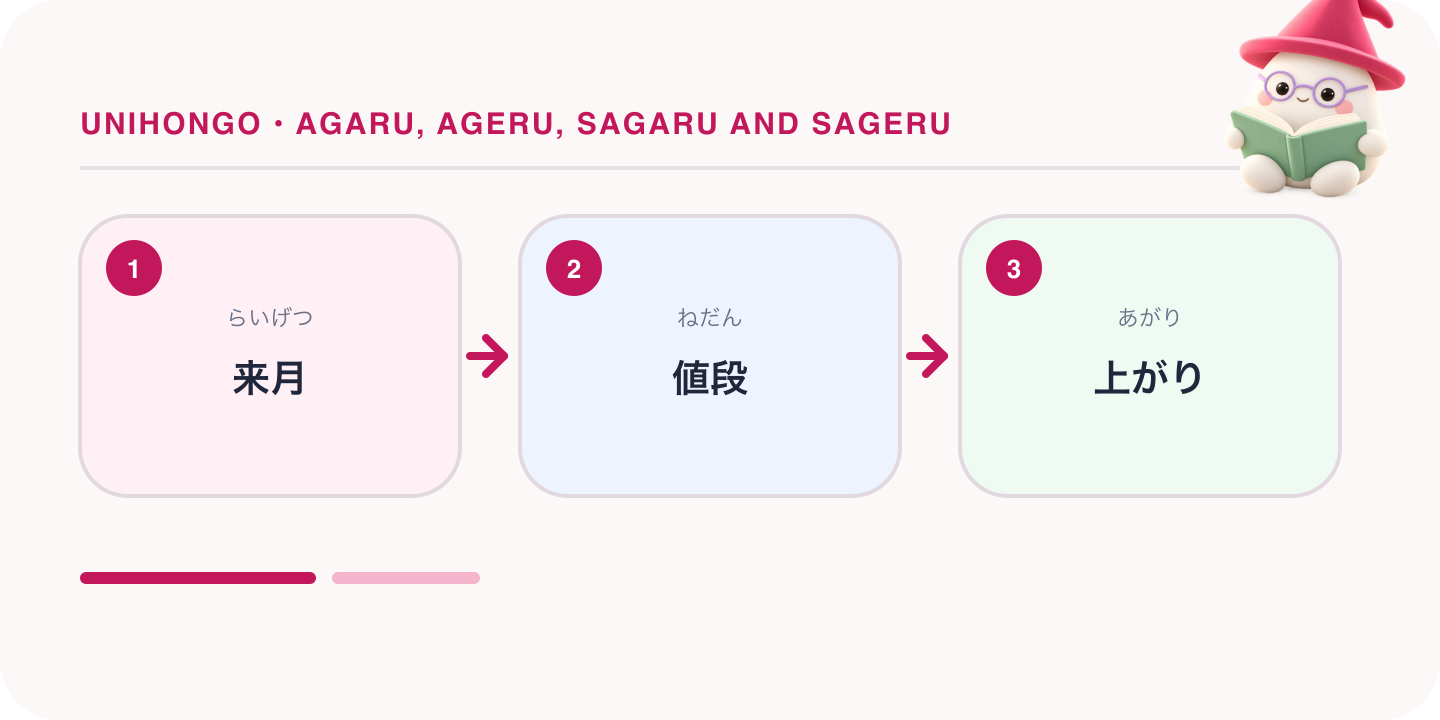
| Japanese | Romaji | Meaning |
|---|---|---|
| 来月から値段が上がります。 | Raigetsu kara nedan ga agarimasu. | Prices will go up from next month. |
| 午後は気温が三十度まで上がるそうです。 | Gogo wa kion ga sanjūdo made agaru sō desu. | They say the temperature will reach thirty degrees this afternoon. |
| 成績が上がって、うれしいです。 | Seiseki ga agatte, ureshii desu. | My grades went up, so I'm happy. |
| エアコンの温度を少し上げてください。 | Eakon no ondo o sukoshi agete kudasai. | Please turn the air conditioner up a little. |
| 会社が給料を上げてくれました。 | Kaisha ga kyūryō o agete kuremashita. | The company gave us a pay rise. |
Sagaru and sageru: falling, lowering and cutting
Sagaru is a level going down by itself: nedan ga sagaru, prices fall; kion ga sagaru, the temperature drops; netsu ga sagaru, the fever comes down; seiseki ga sagaru, grades slip. Sageru is someone bringing it down: nedan o sageru, lower the price; ondo o sageru, turn the heat down; onryō o sageru, turn the volume down; mokuhyō o sageru, lower the target. Sagaru is a u-verb, sagarimasu, sagatte, sagatta; sageru is a ru-verb, sagemasu, sagete, sageta.
Sageru has fixed physical uses. Atama o sageru is to bow your head, and it also means to apologise or to ask humbly. Waiters use sageru for clearing: o-sara o o-sage shite mo yoroshii desu ka, may I clear your plate.
Sagaru also describes people. Ippo sagaru is to step back one pace, and the platform announcement kiiroi sen no uchigawa made o-sagari kudasai asks you to stand back behind the yellow line. Ketsuatsu ga sagaru, blood pressure falls, follows the level pattern.
| Japanese | Romaji | Meaning |
|---|---|---|
| 熱が下がりました。 | Netsu ga sagarimashita. | The fever has come down. |
| 夜は気温がかなり下がります。 | Yoru wa kion ga kanari sagarimasu. | The temperature drops quite a lot at night. |
| 少し値段を下げてもらえませんか。 | Sukoshi nedan o sagete moraemasen ka. | Could you lower the price a little? |
| テレビの音を下げてください。 | Terebi no oto o sagete kudasai. | Please turn the TV down. |
| 黄色い線の内側までお下がりください。 | Kiiroi sen no uchigawa made o-sagari kudasai. | Please stand back behind the yellow line. |
| お皿をお下げしてもよろしいですか。 | O-sara o o-sage shite mo yoroshii desu ka. | May I clear your plate? |
Agaru for entering a house and going on stage
Japanese homes have a raised floor above the entrance, so entering is literally stepping up. The host's invitation is dōzo o-agari kudasai, please come in. You reply o-jama shimasu, take your shoes off in the genkan, and step up. Dōzo agatte is the plainer form between friends.
Agaru is also going up onto a platform. Butai ni agaru is going on stage, nikai ni agaru is going up to the first floor in British terms, the second in Japanese counting, and yane ni agaru is getting onto the roof. Ame ga agaru, the rain lets up, and yu kara agaru, getting out of the bath, are two more fixed uses you hear at home.
| Japanese | Romaji | Meaning |
|---|---|---|
| どうぞお上がりください。 | Dōzo o-agari kudasai. | Please come in. |
| お邪魔します。 | O-jama shimasu. | Excuse me for intruding. |
| 靴を脱いで上がってください。 | Kutsu o nuide agatte kudasai. | Please take off your shoes and come up. |
| 次の人、舞台に上がってください。 | Tsugi no hito, butai ni agatte kudasai. | Next person, please come up on stage. |
| 二階に上がってもいいですか。 | Nikai ni agatte mo ii desu ka. | May I go upstairs? |
| やっと雨が上がりましたね。 | Yatto ame ga agarimashita ne. | The rain has finally stopped, hasn't it? |
Nerves, finishing and other fixed uses of agaru
Agaru without an object often means to get nervous, as if your blood has risen: hito no mae de hanasu to agatte shimau, I get stage fright when I speak in front of people. Agarishō is a person prone to nerves, and the calming opposite is ochitsuku.
Agaru also means to be finished: shigoto ga agatta, work is done, and o-saki ni agarimasu, I'm finishing before you, are common in kitchens and shops. Dekiagaru is to be completed, and kaki-ageru is to finish writing.
- Agaru: to get nervous or freeze in front of people
- Shigoto ga agaru: work is finished for the day
- Ame ga agaru: the rain stops
- Yu kara agaru: to get out of the bath
- Dekiagaru: to be completed, as a dish or a document
- Kaki-ageru: to finish writing something
- Tenshon ga agaru: to get excited, used with the loanword tenshon
Tenshon ga agaru is a casual phrase for getting hyped, and tenshon ga sagaru means to feel deflated; neither has anything to do with the English word tension.
Ageru and sageru with the body: hands, heads and voices
Ageru and sageru do most of the body language of a Japanese classroom and office. Te o ageru is to raise your hand, and the teacher says wakaru hito wa te o agete kudasai. Atama o sageru is to bow your head, which shades into apologising: atama o sagete ayamaru is to apologise with a bow. Koe o ageru is to raise your voice, and koe o sageru is to lower it.
The intransitive partners describe the body without an actor: ude ga agaranai, my arm will not go up, is what you tell a doctor about a stiff shoulder; atama ga agaranai, I cannot lift my head, is a fixed expression meaning I am in someone's debt. Ude ga agaru means your skill has improved, and it is a warm compliment.
| Japanese | Romaji | Meaning |
|---|---|---|
| 分かる人は手を上げてください。 | Wakaru hito wa te o agete kudasai. | If you know, please raise your hand. |
| 頭を下げて謝りました。 | Atama o sagete ayamarimashita. | I bowed and apologised. |
| 肩が痛くて腕が上がりません。 | Kata ga itakute ude ga agarimasen. | My shoulder hurts and I can't lift my arm. |
| 先輩には頭が上がりません。 | Senpai ni wa atama ga agarimasen. | I owe my senior so much I can't hold my head up. |
| 料理の腕が上がりましたね。 | Ryōri no ude ga agarimashita ne. | Your cooking has really improved. |
| もう少し声を下げてください。 | Mō sukoshi koe o sagete kudasai. | Please lower your voice a little. |
The four verbs and their relatives in one table
The table sets the four core verbs beside noboru, oriru and the compounds you meet on signs and in the news.
| Verb | Reading | Type and meaning |
|---|---|---|
| 上がる | agaru | Intransitive; a level rises, a person steps up or gets nervous |
| 上げる | ageru | Transitive; raise a price, a hand, a voice or the heat |
| 下がる | sagaru | Intransitive; a level falls, a person steps back |
| 下げる | sageru | Transitive; lower a price, a volume, a target or your head |
| 登る | noboru | Climb a mountain, a tree or stairs with your body |
| 上る | noboru | Go up stairs or a slope; the sun rises |
| 降りる | oriru | Get off a train or bus; come down from a height |
| 下りる | oriru | Go down stairs, a slope or a mountain |
| 値上げ | neage | A price rise by the seller |
| 値下げ | nesage | A price cut by the seller |
| 上昇 | jōshō | Rise, formal, as in temperatures or shares |
| 低下 | teika | Decline, formal, as in quality or blood pressure |
Noboru and oriru take 登 and 降 for a climb or descent and 上 and 下 for a simple up and down; in kana they are fine either way.
Agaru versus noboru, sagaru versus oriru
Noboru is climbing: you use your legs, a ladder or a road, and the route takes o. Yama o noboru, climb a mountain; kaidan o noboru, climb the stairs; ki ni noboru, climb a tree, with ni for the goal. Agaru is a change of level or a short step up, and the destination takes ni: nikai ni agaru, butai ni agaru. Nikai ni agaru and kaidan o noboru describe the same trip, but agaru is about arriving on the upper level and noboru is about the climb.
Going down splits the same way. Oriru is descending with your body or leaving a vehicle: yama o oriru, kaidan o oriru, densha o oriru, get off the train. Sagaru is a level dropping or a person stepping back, never getting off a train; densha o sagaru does not exist. The sun rises with hi ga noboru and sets with hi ga shizumu.
| Japanese | Romaji | Meaning |
|---|---|---|
| 週末に富士山に登ります。 | Shūmatsu ni Fujisan ni noborimasu. | I'm climbing Mount Fuji at the weekend. |
| 階段を上って右です。 | Kaidan o nobotte migi desu. | Go up the stairs and it's on the right. |
| 次の駅で降ります。 | Tsugi no eki de orimasu. | I'm getting off at the next station. |
| 山を下りるときは気をつけてください。 | Yama o oriru toki wa ki o tsukete kudasai. | Be careful when you come down the mountain. |
| 一歩下がって待ちましょう。 | Ippo sagatte machimashō. | Let's step back and wait. |
Learner mistakes and how to fix them
The first mistake is the particle: nedan o agaru and nedan ga ageru are both wrong. Chant the pairs, ga agaru, o ageru, ga sagaru, o sageru, until the rhythm is automatic. The second is the transitive verb for something that happened by itself: if the price went up, say nedan ga agatta, because nedan o ageta accuses someone. The third is sagaru for getting off a train; the verb is oriru. The fourth is noboru for entering a house or going on stage; it is agaru, a step up rather than a climb.
Two more come from ageru. Learners mix up ageru meaning give with ageru meaning raise; notice the object: prices, hands and voices are raised, presents are given. And o-agari kudasai is not an order to climb but an invitation, so answer o-jama shimasu and step up.
| Japanese | Romaji | Meaning |
|---|---|---|
| 値段が上がってしまいました。 | Nedan ga agatte shimaimashita. | The price has gone up, unfortunately. |
| 店が値段を上げました。 | Mise ga nedan o agemashita. | The shop raised its prices. |
| バスを降りて、すぐ左です。 | Basu o orite, sugu hidari desu. | Get off the bus and it's immediately on your left. |
| 家に上がってお茶を飲みませんか。 | Uchi ni agatte o-cha o nomimasen ka. | Won't you come in and have some tea? |
| 緊張して声が上がってしまいました。 | Kinchō shite koe ga agatte shimaimashita. | I was nervous and my voice went high. |