

How a Japanese menu is organised
Most Japanese menus, from an izakaya board to a hotel dinner card, use the same set of section headings. Many end in mono, thing, or rui, kind, so once you recognise the first kanji you know what the section holds. Yakimono is grilled things, agemono is deep-fried things, nimono is simmered things, mushimono is steamed things, gohanmono is rice dishes and menrui is noodles. The sections are usually in eating order: light starters, then salads and sashimi, then cooked dishes, then rice and noodles to finish, then dessert and drinks.
Izakaya menus often add a few more headings: otsumami or ichihin for small plates to share, and shime, the closing carbohydrate. Teishoku shops skip the sections altogether and simply list sets.
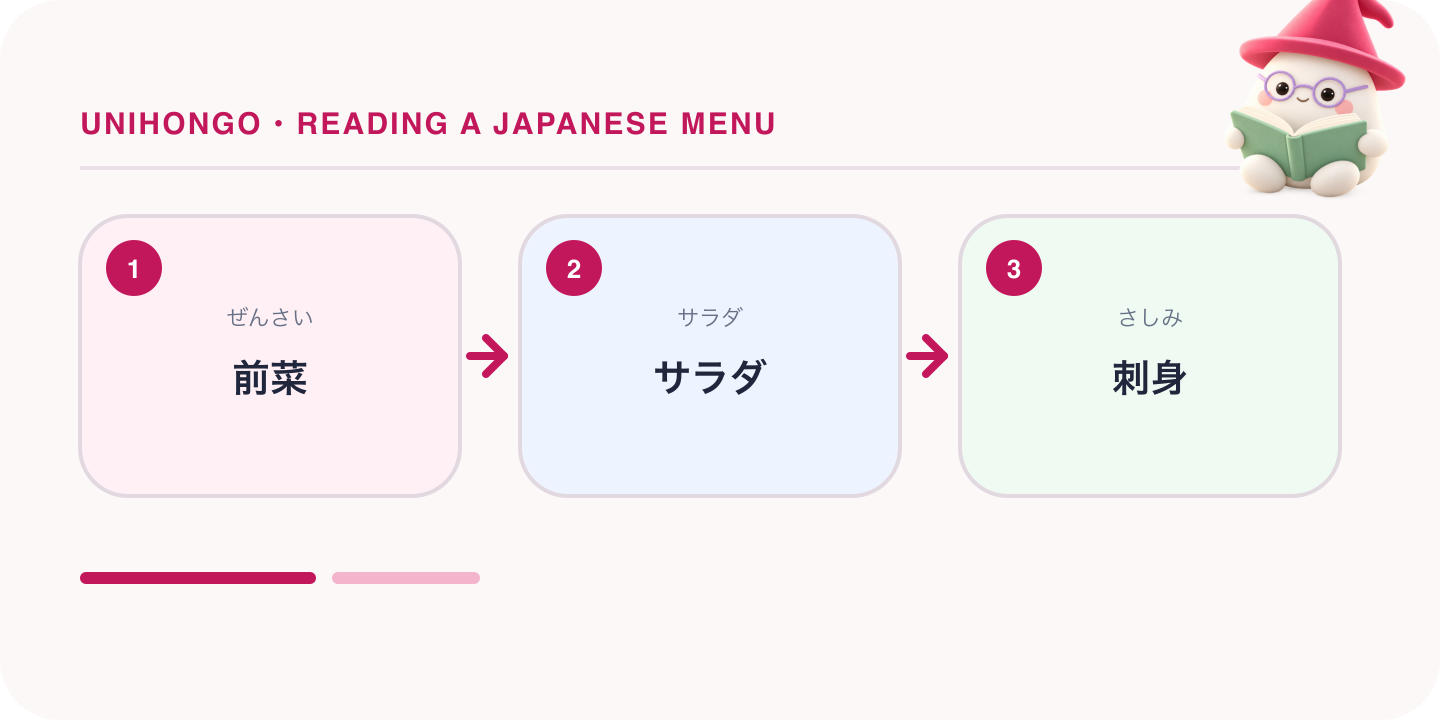
| Section | Reading | What it holds |
|---|---|---|
| 前菜 | zensai | starters, small first dishes |
| サラダ | sarada | salads |
| 刺身 | sashimi | raw sliced fish |
| 焼き物 | yakimono | grilled dishes |
| 揚げ物 | agemono | deep-fried dishes |
| 煮物 | nimono | simmered dishes |
| 蒸し物 | mushimono | steamed dishes |
| ご飯物 | gohanmono | rice dishes |
| 麺類 | menrui | noodles |
| デザート | dezāto | desserts |
| 飲み物 | nomimono | drinks |
| 一品料理 | ippin ryōri | single dishes, à la carte |
Two headings look alike. Gohanmono is a rice dish, such as a donburi, while gohan on its own is a plain bowl of rice ordered as a side.
Cooking-method kanji inside dish names
The second key is the handful of kanji that describe how a dish is cooked. They usually come at the end of the dish name, after the ingredient: ingredient, then no, then method. Once you can spot them, an unknown dish stops being a mystery. Saba no shioyaki is mackerel, salt-grilled. Nasu no agebitashi is aubergine, deep-fried and soaked. Buta no kakuni is pork, simmered in cubes. Chawanmushi is a savoury steamed egg custard in a cup.
Yaki is the most flexible, because it covers grilling, pan-frying and baking: yakitori, yakizakana and okonomiyaki all use it. Age always means deep-fried, and karaage, tempura and tonkatsu live in that section. Ni is simmering in dashi, soy and mirin, the home-cooking method behind nikujaga. Mushi is steaming. Nama means raw or fresh: namabīru is draught beer and nama harumaki is an uncooked spring roll.
| Kanji | Reading | Cooking method |
|---|---|---|
| 焼き | yaki | grilled, pan-fried or baked |
| 揚げ | age | deep-fried |
| 煮 | ni | simmered in seasoned liquid |
| 蒸し | mushi | steamed |
| 生 | nama | raw, fresh, draught |
| 炒め | itame | stir-fried |
| 和え | ae | dressed, tossed in a sauce |
| 漬け | zuke | marinated or pickled |
| 天 | ten | tempura, in dish names |
| 塩 | shio | salt-seasoned |
Set meals, rice and pickles
Teishoku is the word that unlocks lunch in Japan. It is a set built around a main dish, with rice, miso soup and a small plate of tsukemono, pickles, and sometimes a side of vegetables. The menu usually lists the main dish plus teishoku, so karaage teishoku is fried chicken with those sides. Setto is the katakana equivalent from cafés and Western-style restaurants: a curry setto might add a salad and a drink instead of soup and pickles.
Rice has its own vocabulary. Gohan ōmori is a large portion of rice, often free or a small extra charge, and sukuname is a smaller portion. Okawari is a refill, and okawari jiyū means free refills. Some shops offer a choice of shiro gohan, plain white rice, or zakkoku mai, mixed grains. Miso shiru is miso soup, and tonjiru is the heartier pork and vegetable version that sometimes costs extra.
| Japanese | Romaji | Meaning |
|---|---|---|
| 日替わり定食は何ですか。 | Higawari teishoku wa nan desu ka. | What is today's set meal? |
| ご飯は大盛りにできますか。 | Gohan wa ōmori ni dekimasu ka. | Can I have a large portion of rice? |
| ご飯のおかわりは無料ですか。 | Gohan no okawari wa muryō desu ka. | Are rice refills free? |
| 定食にはお味噌汁がつきますか。 | Teishoku ni wa o-misoshiru ga tsukimasu ka. | Does the set come with miso soup? |
| 漬物は何が入っていますか。 | Tsukemono wa nani ga haitte imasu ka. | What is in the pickles? |
| セットの飲み物は何が選べますか。 | Setto no nomimono wa nani ga erabemasu ka. | What drinks can I choose with the set? |
Noodles, portions and sizes
The menrui section lists soba, udon and ramen, usually with the broth or topping as the first word: kake soba is plain soba in hot broth, tempura udon is udon with a tempura topping, and shōyu rāmen is soy-based ramen. Cold noodles have their own words: zaru soba comes on a bamboo tray with dipping sauce, and hiyashi chūka is a cold ramen salad that appears in summer.
Portion words matter at noodle shops because the sizes are fixed. Nami is a regular portion, ōmori is large and tokumori is extra large. Ramen shops often sell kaedama, a second serving of noodles for the same bowl. Elsewhere you will see hāfu saizu, half size, and ninmae, a serving for one person, so ni-san ninmae on an izakaya menu means enough for two or three people.
| Japanese | Romaji | Meaning |
|---|---|---|
| 並と大盛りはいくら違いますか。 | Nami to ōmori wa ikura chigaimasu ka. | What is the price difference between regular and large? |
| 替え玉はありますか。 | Kaedama wa arimasu ka. | Do you have extra noodles? |
| これは何人前ですか。 | Kore wa nan-ninmae desu ka. | How many people is this for? |
| ハーフサイズはありますか。 | Hāfu saizu wa arimasu ka. | Is there a half size? |
| 温かいのと冷たいの、どちらですか。 | Atatakai no to tsumetai no, dochira desu ka. | Is it hot or cold? |
Reading the drink menu
Nomimono, drinks, usually comes last and is split into alcoholic and soft drinks. Beer is bīru, and namabīru is draught, sold by mug size: chū is medium, dai is large and shō is small. Nihonshu is sake, sold in a glass or a small flask, ichigō. Shōchū is the distilled spirit, served with water, mizuwari, hot water, oyuwari, or soda. Chūhai and sawā are shōchū with soda and fruit, and haibōru is whisky and soda.
Soft drinks are sofuto dorinku. Ūroncha, oolong tea, is the default soft drink at izakaya. Ocha or mizu is often free at teishoku and noodle shops, in which case it is not on the menu at all; you simply ask.
- Namabīru chū: standard draught beer mug; dai and shō for large and small
- Nihonshu ichigō: sake by the flask; reishu is chilled, atsukan is hot
- Shōchū mizuwari, oyuwari, sodawari: shōchū with water, hot water or soda
- Chūhai, sawā, haibōru: shōchū or whisky mixed with soda
- Ūroncha, ryokucha, orenjijūsu: the usual soft drinks
- Nomihōdai: all-you-can-drink; check the time limit and the last order
- Ohiya: a glass of cold water, free when you ask
Read the small print under nomihōdai. It usually states the time limit, the last order, and that every person at the table must take it. These conditions vary by shop, so ask if the print is unclear.
Allergen icons and dietary notes
Chain restaurants and larger menus increasingly print allergen information as a row of small icons or a separate table. The heading is arerugī, and the items you will see most are komugi, wheat; tamago, egg; nyū, milk; ebi, shrimp; kani, crab; rakkasei, peanut; soba, buckwheat; and kurumi, walnut. A circle or tick under a dish means the allergen is present. Small independent restaurants usually have no such table.
Vegetarian and vegan marks are still uncommon outside tourist areas, and dashi made from bonito is in most soups and sauces, so a dish with no visible meat can still contain fish. If it matters, ask about dashi directly.
| Japanese | Romaji | Meaning |
|---|---|---|
| アレルギー表はありますか。 | Arerugī-hyō wa arimasu ka. | Do you have an allergen table? |
| これに小麦は入っていますか。 | Kore ni komugi wa haitte imasu ka. | Does this contain wheat? |
| えびとかにが食べられません。 | Ebi to kani ga taberaremasen. | I can't eat shrimp or crab. |
| だしはかつおですか。 | Dashi wa katsuo desu ka. | Is the stock made from bonito? |
| 肉と魚を使っていない料理はありますか。 | Niku to sakana o tsukatte inai ryōri wa arimasu ka. | Do you have dishes without meat or fish? |
Prices, tax and the small print
The price line has its own vocabulary. Zeikomi, tax included, means the printed figure is what you pay; zeinuki or zeibetsu, tax excluded, means consumption tax is added at the till. Menus are required to show the total, but layouts vary, so check whether the large number or the small number in brackets is the zeikomi figure. Jikagaku or jika, market price, appears next to seasonal fish and means you should ask the price before ordering.
At izakaya and bars, a note at the bottom often mentions otōshi, the small appetiser served automatically with a seat charge, sometimes written as sekiryō or chāji. Sābisuryō is a service charge, more common at hotels and formal restaurants. Rasuto ōdā is the last order time, and tabehōdai, all-you-can-eat, comes with a time limit. None of these charges are fixed across Japan, so check the menu in front of you or ask.
| Japanese | Romaji | Meaning |
|---|---|---|
| この値段は税込みですか。 | Kono nedan wa zeikomi desu ka. | Is this price tax included? |
| お通しはいくらですか。 | Otōshi wa ikura desu ka. | How much is the appetiser charge? |
| 時価と書いてありますが、今日はいくらですか。 | Jika to kaite arimasu ga, kyō wa ikura desu ka. | It says market price; how much is it today? |
| サービス料はかかりますか。 | Sābisuryō wa kakarimasu ka. | Is there a service charge? |
| ラストオーダーは何時ですか。 | Rasuto ōdā wa nan-ji desu ka. | What time is the last order? |
When you cannot read a dish name
Even with the sections and cooking kanji, some names will defeat you: a regional fish, a house special written in a flourish. The solution is one short question. Point at the line and ask kore wa nan desu ka, what is this. Staff will usually answer with the ingredient and the cooking method, which are exactly the two pieces you already know how to hear.
If the answer is still unclear, narrow it with a yes-or-no question: sakana desu ka, is it fish; karai desu ka, is it spicy. Osusume wa nan desu ka, what do you recommend, is always safe. The mistake to avoid is guessing from a single kanji: nama on a beer means draught, but nama on a chicken dish means raw, and yakimeshi is fried rice rather than anything grilled.
| Japanese | Romaji | Meaning |
|---|---|---|
| すみません、これは何ですか。 | Sumimasen, kore wa nan desu ka. | Excuse me, what is this? |
| これはどういう料理ですか。 | Kore wa dō iu ryōri desu ka. | What kind of dish is this? |
| 魚ですか、肉ですか。 | Sakana desu ka, niku desu ka. | Is it fish or meat? |
| 辛いですか。 | Karai desu ka. | Is it spicy? |
| おすすめは何ですか。 | Osusume wa nan desu ka. | What do you recommend? |
| この字は何と読みますか。 | Kono ji wa nan to yomimasu ka. | How do you read this character? |