
Kagu: the word for furniture and its family
家具 (kagu) is the general word for furniture. It combines 家, house, and 具, tool or utensil. You hear it in shop names, delivery forms and apartment adverts: 家具付き (kagu tsuki) means furnished, a common feature of short-term flats and share houses.
Two other words help when you talk about a room. 収納 (shūnō) means storage, built in or not, and is a big topic in small Japanese homes. インテリア (interia) covers furniture, lighting and decoration together, as in interia ga suki, I love interior design.
| Japanese | Romaji | Meaning |
|---|---|---|
| 家具を選ぶ | kagu o erabu | choosing furniture |
| 家具 | kagu | furniture |
| 家具付き | kagu tsuki | furnished (flat, room) |
| 収納 | shūnō | storage, storage space |
| インテリア | interia | interior design, furnishings |
| 家具屋 | kaguya | furniture shop (casual) |
The big four in most rooms
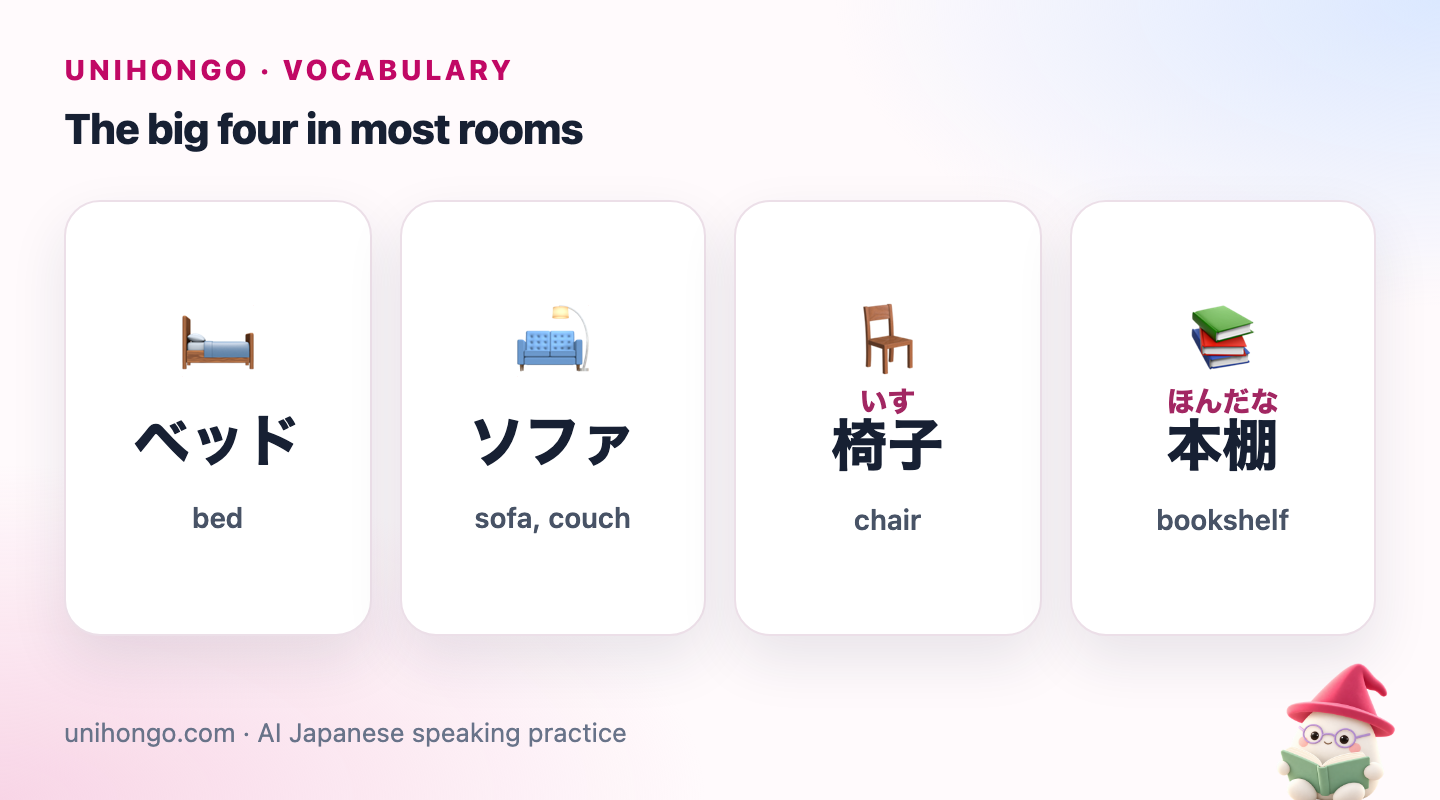
These are the pieces you will name most often. Notice the mix: bed and sofa are loanwords, while chair and bookshelf are native words with kanji.
| Japanese | Romaji | Meaning |
|---|---|---|
| ベッド | beddo | bed |
| ソファ | sofa | sofa, couch |
| 椅子 | isu | chair |
| 本棚 | hondana | bookshelf |
| 机 | tsukue | desk |
| テーブル | tēburu | table (dining, coffee table) |
| 棚 | tana | shelf |
| タンス | tansu | chest of drawers, wardrobe |
| 引き出し | hikidashi | drawer |
| クローゼット | kurōzetto | built-in wardrobe, closet |
| カーテン | kāten | curtain |
| 照明 | shōmei | lighting, light fitting |
| 鏡 | kagami | mirror |
| ラグ | ragu | rug |
ソファ is also written ソファー (sofā); both are common. Tansu is the traditional word for a chest of drawers or a wardrobe-style cabinet, and many people still use it for any clothes storage. Stores may call the same item チェスト (chesuto). The ceiling light in many Japanese rooms plugs into a standard fitting, so 照明 is often something tenants buy themselves when they move in.
Japanese-style furniture for floor living
Many homes have at least one room where people sit on the floor, whether on tatami or on a carpet. The furniture is low, and some of it is put away during the day. Even in fully Western-style flats, you will find floor chairs and low tables, because many people like to relax close to the floor.
| Japanese | Romaji | Meaning |
|---|---|---|
| 座卓 | zataku | low table for sitting on the floor |
| 座椅子 | zaisu | legless floor chair with a backrest |
| 座布団 | zabuton | floor cushion |
| 布団 | futon | futon bedding |
| 押し入れ | oshiire | deep built-in cupboard for futons |
| こたつ | kotatsu | heated low table with a quilt |
| ちゃぶ台 | chabudai | small round low table (old-fashioned) |
| 布団を敷く | futon o shiku | to lay out the futon |
| 布団をたたむ | futon o tatamu | to fold the futon away |
A futon in Japan is the bedding itself, laid on the floor at night and folded into the oshiire in the morning, not a sofa bed. Chabudai sounds nostalgic and appears in old family dramas; for a modern low table, people say zataku or rō tēburu. Some homes also have a 仏壇 (butsudan), a small Buddhist family altar, which is treated with respect rather than as furniture to put things on.
Where is it? Position words
Japanese describes position with a pattern: thing A の position に thing B があります, there is B at the position of A. Use あります (arimasu) for furniture and objects, and います (imasu) only for people and animals.
| Japanese | Romaji | Meaning |
|---|---|---|
| 机の上にパソコンがあります。 | Tsukue no ue ni pasokon ga arimasu. | There's a computer on the desk. |
| ベッドの下に箱があります。 | Beddo no shita ni hako ga arimasu. | There's a box under the bed. |
| ソファの横にランプがあります。 | Sofa no yoko ni ranpu ga arimasu. | There's a lamp beside the sofa. |
| 本棚は窓と机の間です。 | Hondana wa mado to tsukue no aida desu. | The bookshelf is between the window and the desk. |
| 猫はソファの後ろにいます。 | Neko wa sofa no ushiro ni imasu. | The cat is behind the sofa. |
| 部屋の隅に植物を置きました。 | Heya no sumi ni shokubutsu o okimashita. | I put a plant in the corner of the room. |
| Position word | Meaning | Example in English |
|---|---|---|
| 上 (ue) | on, above | On the desk |
| 下 (shita) | under, below | Under the bed |
| 横 (yoko) | beside, at the side of | Beside the sofa |
| 隣 (tonari) | next to (two similar things) | Next to the bookshelf |
| 前 (mae) / 後ろ (ushiro) | in front of / behind | Behind the door |
| 間 (aida) | between | Between the bed and the window |
| 奥 (oku) | at the back, deep inside | At the back of the cupboard |
| 隅 (sumi) | in the corner | In the corner of the room |
Moving, assembling and rearranging
Small rooms mean that furniture is constantly moved, swapped and rearranged. These verbs cover most of it. Flat-pack furniture is very common, so you will also need 組み立てる (kumitateru), to assemble, and its noun 組み立て (kumitate).
| Japanese | Romaji | Meaning |
|---|---|---|
| 置く | oku | to put, to place |
| 動かす | ugokasu | to move (an object) |
| 運ぶ | hakobu | to carry |
| 組み立てる | kumitateru | to assemble |
| 片付ける | katazukeru | to tidy up, put away |
| 捨てる | suteru | to throw away |
| 模様替え | moyōgae | rearranging a room |
| 週末、部屋の模様替えをしました。 | Shūmatsu, heya no moyōgae o shimashita. | I rearranged my room at the weekend. |
| このソファ、一緒に動かしてくれる? | Kono sofa, issho ni ugokashite kureru? | Can you help me move this sofa? (casual) |
| せーの! | Sēno! | One, two, three, lift! |
Sēno is what two people say to time a lift together, the Japanese one, two, three. Throwing away large furniture is its own topic: in most towns a sofa or a bed is 粗大ごみ (sodai gomi), oversized rubbish, which you book and pay for through the local office rather than leaving at the normal collection point.
Buying furniture and delivery day
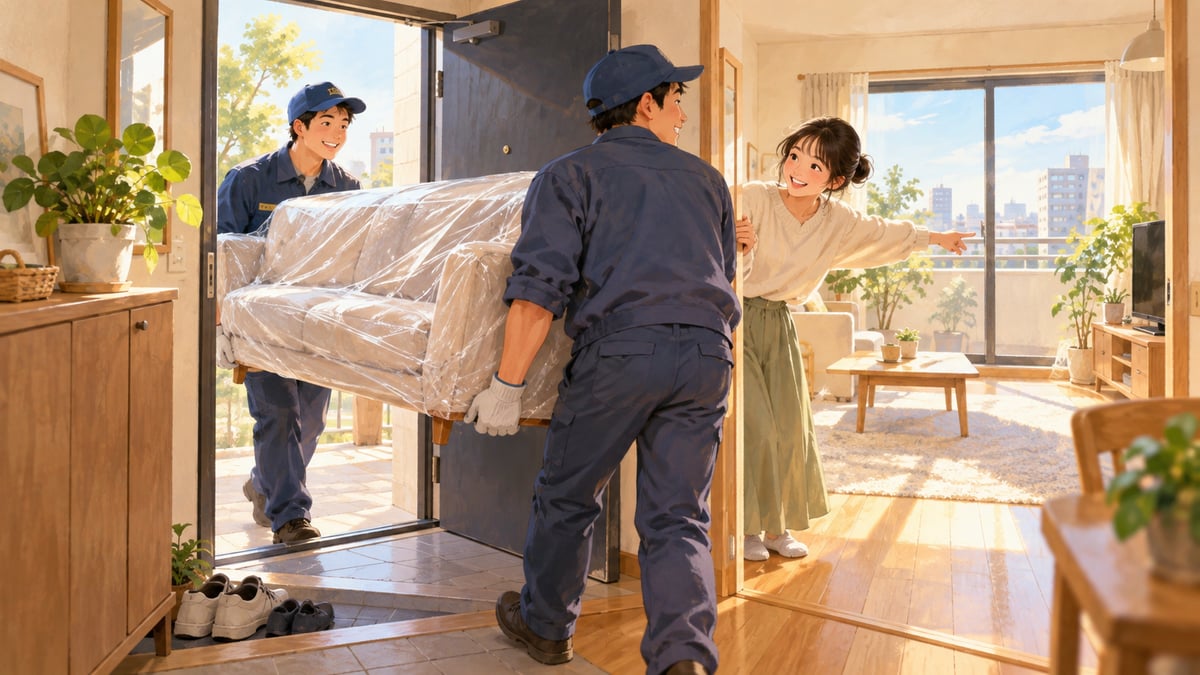
At a furniture store, the key questions are size, delivery and assembly. Staff will ask your address, your floor and whether there is a lift, because a sofa that does not fit the stairs is a common problem. Measure your doors and the space before you go.
| Japanese | Romaji | Meaning |
|---|---|---|
| このソファの幅は何センチですか。 | Kono sofa no haba wa nan senchi desu ka. | You: How wide is this sofa in centimetres? |
| 配達はいつになりますか。 | Haitatsu wa itsu ni narimasu ka. | You: When can it be delivered? |
| 組み立てもお願いできますか。 | Kumitate mo onegai dekimasu ka. | You: Could you assemble it too? |
| エレベーターはありますか。 | Erebētā wa arimasu ka. | Staff: Is there a lift? |
| 三階で、エレベーターはありません。 | Sangai de, erebētā wa arimasen. | You: It's on the third floor, with no lift. |
| どちらに置きましょうか。 | Dochira ni okimashō ka. | Delivery staff: Where shall we put it? |
| 窓の前にお願いします。 | Mado no mae ni onegai shimasu. | You: In front of the window, please. |
Dochira ni okimashō ka is the polite question you will almost certainly hear on delivery day. Point, give one position word and add onegai shimasu. If something is damaged, say Koko ni kizu ga arimasu, there is a scratch here, before you sign.
Turn your own room into a vocabulary lesson
Type /correct to Mocchi, then paste a short description of your room in Japanese, even three sentences. Mocchi fixes the particles and position words, explains why, and keeps a note of the mistakes you tend to repeat, such as arimasu versus imasu, so a later quiz can target them.
Then open Sentence Builder on the games page and put the chunks of sentences like tsukue no ue ni pasokon ga arimasu in the right order. Position sentences are all about word order, and building them by hand makes the pattern automatic.
Common learner mistakes
- Calling a dining table a tsukue. A tsukue is a desk; for eating, say tēburu or shokutaku (食卓).
- Using imasu for furniture. Objects take arimasu; only people and animals take imasu.
- Thinking a futon is a sofa bed. In Japan it is the bedding you lay on the floor.
- Putting the position before the thing: ue no tsukue means the desk above, not on the desk. Say tsukue no ue.
- Leaving an old sofa at the rubbish point. Large furniture is sodai gomi and needs a booking.