
Sekkaku in four patterns
Sekkaku almost never appears alone. It sits at the front of a sentence and colours what follows: a plan to use a chance, a precious thing, a wasted effort or a polite refusal. Learn these four shapes and you can handle nearly every sekkaku you hear.
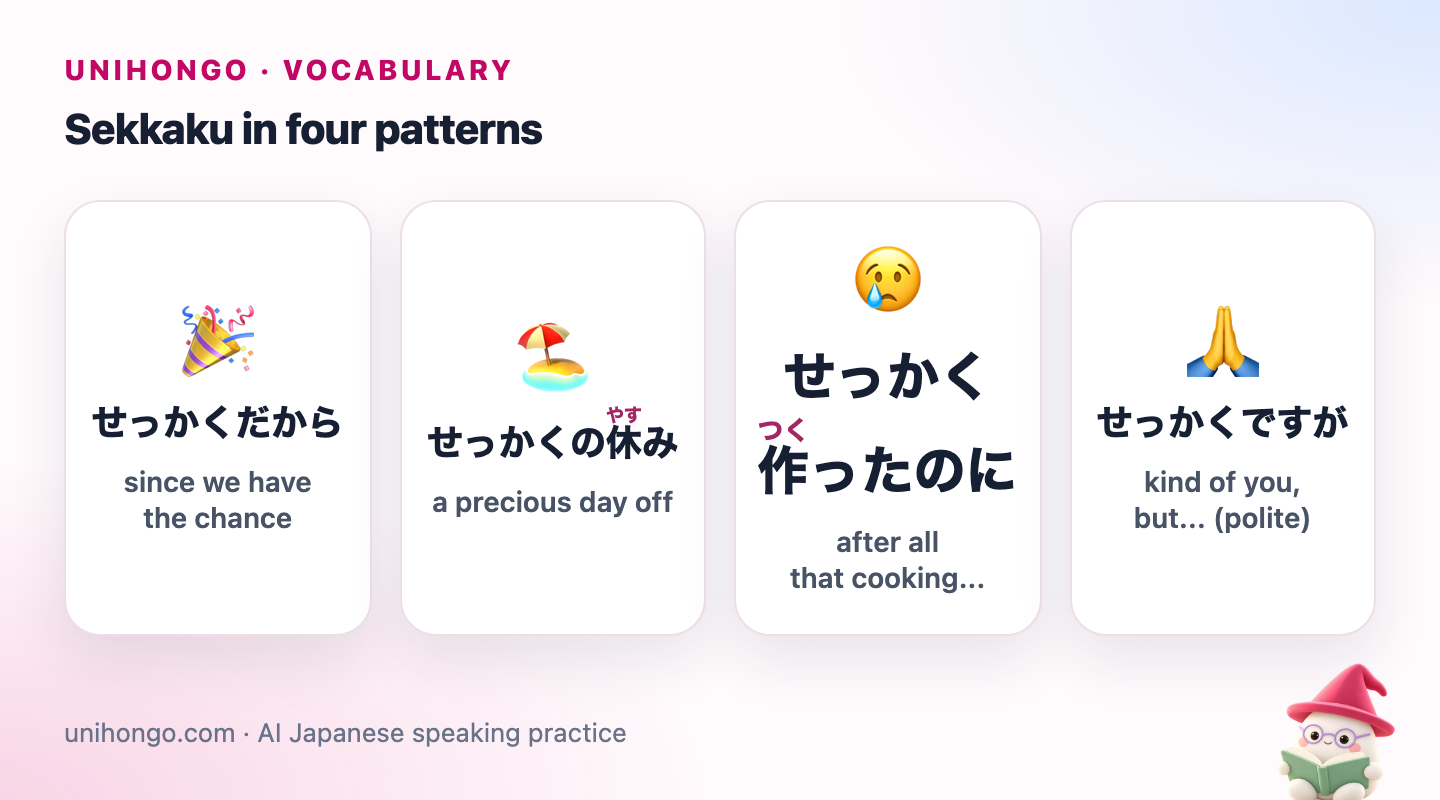
| Japanese | Romaji | Meaning |
|---|---|---|
| せっかくだから | sekkaku dakara | since we have the chance |
| せっかくの休み | sekkaku no yasumi | a precious day off |
| せっかく作ったのに | sekkaku tsukutta noni | after all that cooking... |
| せっかくですが | sekkaku desu ga | kind of you, but... (polite) |
What sekkaku really means
The idea behind every sekkaku is value that should not slip away. The value can come from effort, yours or someone else's, or from rarity: a trip you seldom take, a day off, a friend you rarely see, an invitation. Sekkaku puts that value on the table and then asks what to do with it.
Because it highlights value, sekkaku usually carries feeling: excitement when the chance is in front of you, disappointment when it slips away. That is why the same word sounds cheerful in sekkaku dakara and wistful in sekkaku ... noni.
The word is normally written in hiragana. The kanji spelling 折角 exists and appears in older or formal writing, but you rarely need it. It is a neutral word, used by everyone, and its politeness comes from the rest of the sentence.
| Japanese | Romaji | Meaning |
|---|---|---|
| せっかく | sekkaku | with effort, a rare chance |
| 折角 | sekkaku | the same word in kanji (rare) |
| せっかく会えたのに、もう帰るの? | Sekkaku aeta noni, mō kaeru no? | We finally got to meet, and you're leaving already? |
Making the most of it: sekkaku dakara and sekkaku no
Sekkaku dakara, or in polite speech sekkaku na node or sekkaku desu kara, introduces a suggestion: since we have this chance, let's do something good with it. It is a favourite on trips. You can also put a full reason in front: sekkaku ... n da kara.
Sekkaku no + noun marks something as precious, often just before it gets spoiled: sekkaku no yasumi ga ame, my precious day off and it rains. It also appears in polite phrases such as sekkaku no kikai, a rare opportunity.
| Japanese | Romaji | Meaning |
|---|---|---|
| せっかく京都に来たんだから、お寺を見に行こう。 | Sekkaku Kyōto ni kita n da kara, otera o mi ni ikō. | Since we came all the way to Kyoto, let's see the temples. |
| せっかくだから、写真撮ろう。 | Sekkaku dakara, shashin torō. | Since we're here, let's take a photo. (casual) |
| せっかくなので、いただきます。 | Sekkaku na node, itadakimasu. | Since you offered, I'll gladly have some. (polite) |
| せっかくの休みが雨だった。 | Sekkaku no yasumi ga ame datta. | It rained on my precious day off. |
| せっかくの機会なので、参加します。 | Sekkaku no kikai na node, sanka shimasu. | It's a rare chance, so I'll take part. |
Wasted effort: sekkaku ... noni
When the wasted effort was someone else's, sekkaku ... noni shows sympathy: sekkaku junbi shite kureta noni, after you went to all that trouble preparing. It makes clear you value what they did, even though the plan fell through.
Combine sekkaku with noni, even though, and you get one of the most common complaints in Japanese: I made the effort, and it was wasted. It sounds regretful rather than angry, and it is also used kindly about other people's effort, for example when a friend came to visit and you were out.
| Japanese | Romaji | Meaning |
|---|---|---|
| せっかく作ったのに、誰も食べなかった。 | Sekkaku tsukutta noni, dare mo tabenakatta. | I cooked it specially, and nobody ate it. |
| せっかく早起きしたのに、電車が止まった。 | Sekkaku hayaoki shita noni, densha ga tomatta. | I got up early for nothing: the trains stopped. |
| せっかく来てくれたのに、留守にしてごめんね。 | Sekkaku kite kureta noni, rusu ni shite gomen ne. | You came all this way and I was out. Sorry. (casual) |
| せっかく覚えたのに、忘れちゃった。 | Sekkaku oboeta noni, wasurechatta. | I worked hard to memorise it, and I forgot. (casual) |
Refusing kindly: sekkaku desu ga
When a coworker, neighbour or acquaintance invites you somewhere and you cannot go, sekkaku desu ga is the polite opener. It acknowledges the kindness of the offer before the refusal. Add a short reason, often left unfinished with ...te or ...node, and end with a line that keeps the door open. Many Japanese speakers prefer this soft, incomplete style to a direct no.
With friends, the casual version sekkaku dakedo or sekkaku sasotte kureta noni gomen works the same way.
If you can go, sekkaku works for accepting too: sekkaku na node, zehi, since you kindly asked, I'd love to. It treats the invitation as a gift, which sounds warm.

| Japanese | Romaji | Meaning |
|---|---|---|
| 今晩、みんなで飲みに行くんだけど、どう? | Konban, minna de nomi ni iku n da kedo, dō? | Coworker: We're all going for drinks tonight. Want to come? |
| せっかくですが、今日は先約がありまして。 | Sekkaku desu ga, kyō wa sen'yaku ga arimashite. | That's kind of you, but I already have plans today. |
| せっかくのお誘いですが、今回は遠慮します。 | Sekkaku no osasoi desu ga, konkai wa enryo shimasu. | Thank you for asking, but I'll pass this time. (polite) |
| また誘ってください。 | Mata sasotte kudasai. | Please ask me again. |
| せっかくなので、ぜひ。 | Sekkaku na node, zehi. | Since you asked, I'd love to. |
| せっかく誘ってくれたのに、ごめんね。 | Sekkaku sasotte kureta noni, gomen ne. | Sorry, after you were kind enough to ask. (casual) |
Sekkaku, wazawaza and mottainai
These three often appear in the same conversations, and they overlap. The key difference is what they focus on.
| Japanese | Romaji | Meaning |
|---|---|---|
| わざわざ来てくれてありがとう。 | Wazawaza kite kurete arigatō. | Thanks for coming all this way. (casual) |
| 捨てるのはもったいない。 | Suteru no wa mottainai. | It would be a waste to throw it away. |
| せっかくだから、使ってみよう。 | Sekkaku dakara, tsukatte miyō. | Since we have it, let's try using it. |
| Word | Focus | Typical sentence |
|---|---|---|
| sekkaku | The value of a chance or effort | Since we're here, let's... |
| wazawaza | Someone going out of their way | Thanks for coming all this way |
| mottainai | Waste of something valuable | What a waste to throw it away |
Wazawaza can also be slightly negative, as in wazawaza sonna koto shinakute ii, you didn't need to go to that trouble, while sekkaku rarely criticises anyone.
Mini dialogue: a weekend in Kanazawa
| Japanese | Romaji | Meaning |
|---|---|---|
| せっかく金沢まで来たんだから、何か有名なもの食べたいね。 | Sekkaku Kanazawa made kita n da kara, nanika yūmei na mono tabetai ne. | Friend: Since we came all the way to Kanazawa, let's eat something famous. |
| いいね。市場で海鮮丼はどう? | Ii ne. Ichiba de kaisendon wa dō? | You: Good idea. How about a seafood bowl at the market? |
| 賛成!せっかくの旅行だし、ちょっと贅沢しよう。 | Sansei! Sekkaku no ryokō da shi, chotto zeitaku shiyō. | Friend: Agreed! It's a special trip, let's treat ourselves. |
| じゃあ、早めに行こう。せっかく行って売り切れだったら悲しいから。 | Jā, hayame ni ikō. Sekkaku itte urikire dattara kanashii kara. | You: Then let's go early. It'd be sad to go and find it sold out. |
Rehearse an invitation with Mocchi first
Write a polite refusal to a dinner invitation and send it to Mocchi with /correct. Mocchi checks your sekkaku desu ga line, tells you whether the reason sounds too blunt, and remembers your favourite patterns so it can suggest a new one next time. Ask it for a casual version for friends too.
Then say it out loud: open AI Sensei, pick Yamada-sensei and ask him to play a coworker who invites you for drinks on Friday. Accept once with sekkaku na node and decline once with sekkaku desu ga, then read the session report for corrections.
Common learner mistakes
- Using sekkaku for something ordinary. It needs real value: a rare chance, a special effort, a precious day.
- Saying sekkaku desu ga and then a long blunt reason. Keep the reason short and soft, and close warmly.
- Confusing sekkaku dakara with wazawaza. Thank someone for making the trip with wazawaza, not sekkaku.
- Leaving out noni when you mean the effort was wasted. Sekkaku tsukutta, dare mo tabenakatta sounds incomplete.
- Writing the kanji 折角 in everyday messages. Most people use hiragana.