
It depends in Japanese: four ways to say it
These four lines cover nearly every it depends you will need, from the polite general answer to the casual comment about taste and the shidai pattern for a deciding factor.
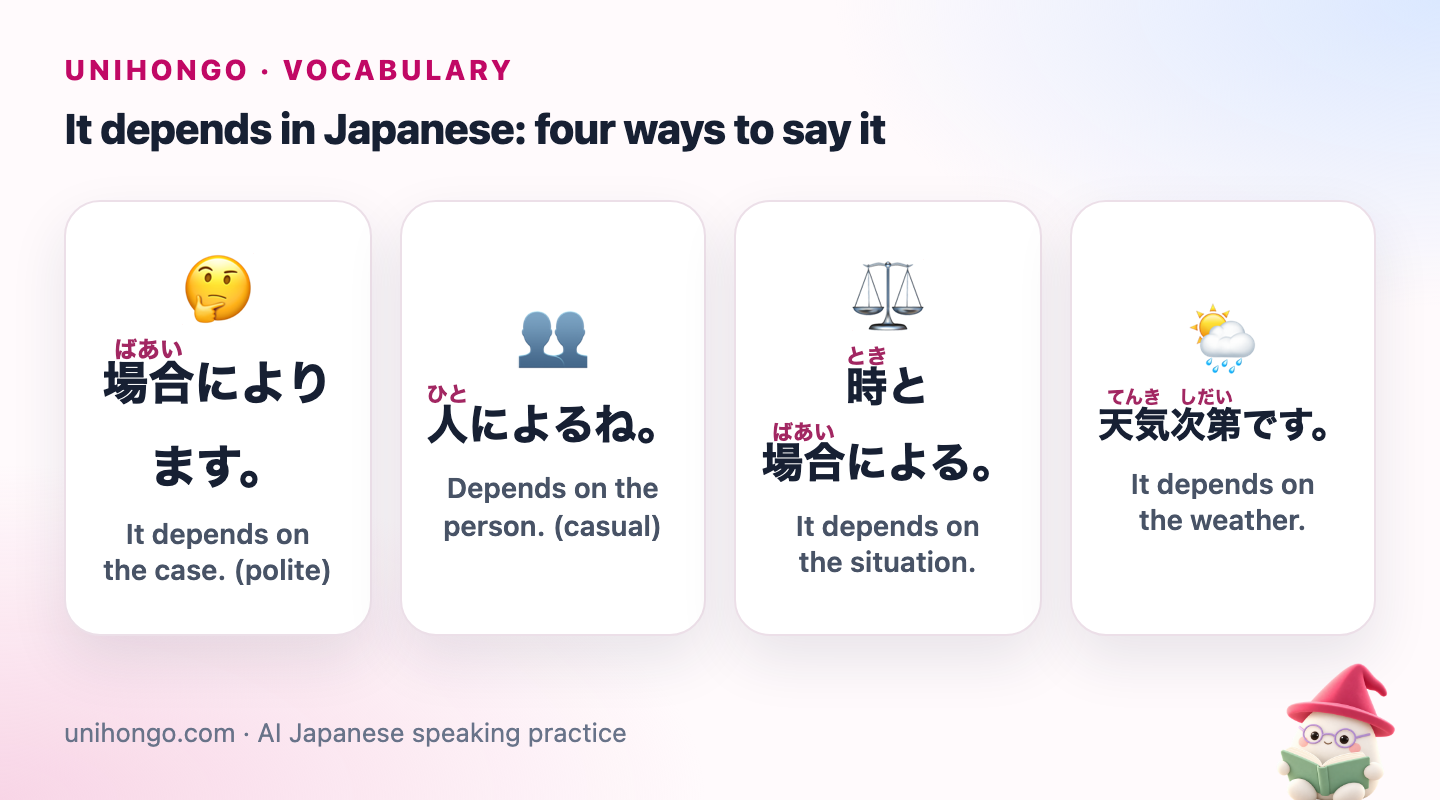
| Japanese | Romaji | Meaning |
|---|---|---|
| 場合によります。 | Baai ni yorimasu. | It depends on the case. (polite) |
| 人によるね。 | Hito ni yoru ne. | Depends on the person. (casual) |
| 時と場合による。 | Toki to baai ni yoru. | It depends on the situation. |
| 天気次第です。 | Tenki shidai desu. | It depends on the weather. |
~ ni yoru: the core pattern
Yoru (よる, often written 依る or 因る but usually in hiragana) means to depend on or to be based on. Put a noun and the particle ni in front of it: hi ni yoru, it depends on the day; mise ni yoru, it depends on the shop. Ni yorimasu is the polite form.
When the result is that something varies, use ni yotte: mise ni yotte chigaimasu, it differs from shop to shop; kisetsu ni yotte nedan ga kawarimasu, the price changes with the season. This is how you describe variation rather than just answering a question.
To make a question the factor, put ka or ka dō ka before ni yoru: nanji ni owaru ka ni yorimasu, it depends on what time it finishes; iku ka dō ka wa tenki ni yorimasu, whether I go depends on the weather.
| Japanese | Romaji | Meaning |
|---|---|---|
| 日によります。 | Hi ni yorimasu. | It depends on the day. |
| 店によって違います。 | Mise ni yotte chigaimasu. | It differs from shop to shop. |
| 季節によって値段が変わります。 | Kisetsu ni yotte nedan ga kawarimasu. | The price changes with the season. |
| 何時に終わるかによります。 | Nanji ni owaru ka ni yorimasu. | It depends on what time it finishes. |
| 行くかどうかは天気によります。 | Iku ka dō ka wa tenki ni yorimasu. | Whether I go depends on the weather. |
~ shidai: it's up to, it all comes down to
Shidai (次第) after a noun means the outcome is decided by that factor. Anata shidai desu, it's up to you, hands the decision to the other person. Yosan shidai desu, it all comes down to the budget, names the deciding factor. It sounds a little firmer and more formal than ni yoru and is very common at work.
Shidai de works as a connector: tenki shidai de, chūshi ni naru ka mo shiremasen, depending on the weather, it may be cancelled. In business, jōkyō shidai de, depending on how things go, is a useful phrase.
Do not confuse this with the verb-stem shidai, which means as soon as. Wakari shidai go-renraku shimasu means I will contact you as soon as I know. The kanji is the same, but the meaning is different, and it is one of the most common phrases in business emails.
| Japanese | Romaji | Meaning |
|---|---|---|
| あなた次第です。 | Anata shidai desu. | It's up to you. |
| 予算次第です。 | Yosan shidai desu. | It all comes down to the budget. |
| 天気次第で、中止になるかもしれません。 | Tenki shidai de, chūshi ni naru ka mo shiremasen. | Depending on the weather, it may be cancelled. |
| わかり次第、ご連絡します。 | Wakari shidai, go-renraku shimasu. | I'll let you know as soon as I find out. |
Baai ni yorimasu, toki to baai ni yoru and keesu bai keesu
Baai (場合) means case or situation, so baai ni yorimasu is the general, polite it depends. Toki to baai ni yoru, time and situation, is a set phrase with the same meaning that sounds a little more conversational. Both can stand alone as an answer.
Baai ni yotte wa means in some cases, and it introduces an exception: baai ni yotte wa, ryōkin ga kakarimasu, in some cases there is a charge. Keesu bai keesu, from English case by case, is common in speech and at work and is fine at most levels of politeness.
| Japanese | Romaji | Meaning |
|---|---|---|
| 時と場合によりますね。 | Toki to baai ni yorimasu ne. | It depends on the situation. |
| 場合によっては、料金がかかります。 | Baai ni yotte wa, ryōkin ga kakarimasu. | In some cases, there's a charge. |
| ケースバイケースですね。 | Keesu bai keesu desu ne. | It's case by case. |
| 一概には言えません。 | Ichigai ni wa iemasen. | I can't make a general statement. |
Hito ni yoru: when people differ
Hito ni yoru, it depends on the person, is the natural answer to questions about taste and personality: is natto tasty, are Japanese people shy, do people work late. It is honest and keeps you away from generalisations. Hito sorezore, everyone is different, is a close relative that sounds a little more accepting.
Konomi ni yoru, it depends on taste, is handy for food and style. A natural conversation follows it with your own experience: hito ni yoru kedo, watashi wa suki, it depends on the person, but I like it.
| Japanese | Romaji | Meaning |
|---|---|---|
| 人によると思います。 | Hito ni yoru to omoimasu. | I think it depends on the person. |
| 人それぞれですね。 | Hito sorezore desu ne. | Everyone's different. |
| 好みによります。 | Konomi ni yorimasu. | It depends on your taste. |
| 人によるけど、私は好き。 | Hito ni yoru kedo, watashi wa suki. | Depends on the person, but I like it. (casual) |
Answering vague questions politely
A bare baai ni yorimasu can sound like you do not want to help. The polite habit is to give the it depends and then either a rough answer or a question back. Basho ni yorimasu ga, daitai hachiman-en kurai desu, it depends on the area, but it is about eighty thousand yen, is helpful. Dono hen o sagashite imasu ka, which area are you looking in, keeps the conversation going.
At work, it depends is often followed by a promise to check: naiyō ni yorimasu node, kakunin shite kara go-renraku shimasu, it depends on the details, so I will check and get back to you.
| Japanese | Romaji | Meaning |
|---|---|---|
| 場所によりますが、だいたい八万円くらいです。 | Basho ni yorimasu ga, daitai hachiman-en kurai desu. | It depends on the area, but it's about 80,000 yen. |
| どの辺を探していますか。 | Dono hen o sagashite imasu ka. | Which area are you looking in? |
| 内容によりますので、確認してからご連絡します。 | Naiyō ni yorimasu node, kakunin shite kara go-renraku shimasu. | It depends on the details, so I'll check and get back to you. |
Mini dialogue and common mistakes
| Japanese | Romaji | Meaning |
|---|---|---|
| 日本語って、どのくらいで話せるようになる? | Nihongo tte, dono kurai de hanaseru yō ni naru? | Friend: How long does it take to be able to speak Japanese? |
| 人によるけど、毎日話せば早いよ。 | Hito ni yoru kedo, mainichi hanaseba hayai yo. | You: It depends on the person, but it's faster if you speak every day. |
| じゃあ、週末だけだと? | Jā, shūmatsu dake da to? | Friend: So what if it's only weekends? |
| それは目標次第かな。 | Sore wa mokuhyō shidai ka na. | You: That probably comes down to your goal. |
- Izon shimasu for it depends: izon means reliance or addiction.
- Tayorimasu for it depends: tayoru means to rely on a person, as in you can count on me.
- Forgetting ni: hito yoru is wrong; say hito ni yoru.
- Confusing noun shidai (it depends on) with verb-stem shidai (as soon as).
- Stopping at baai ni yorimasu: add an example or a question so it does not sound evasive.