
Okagesama de in four sentences
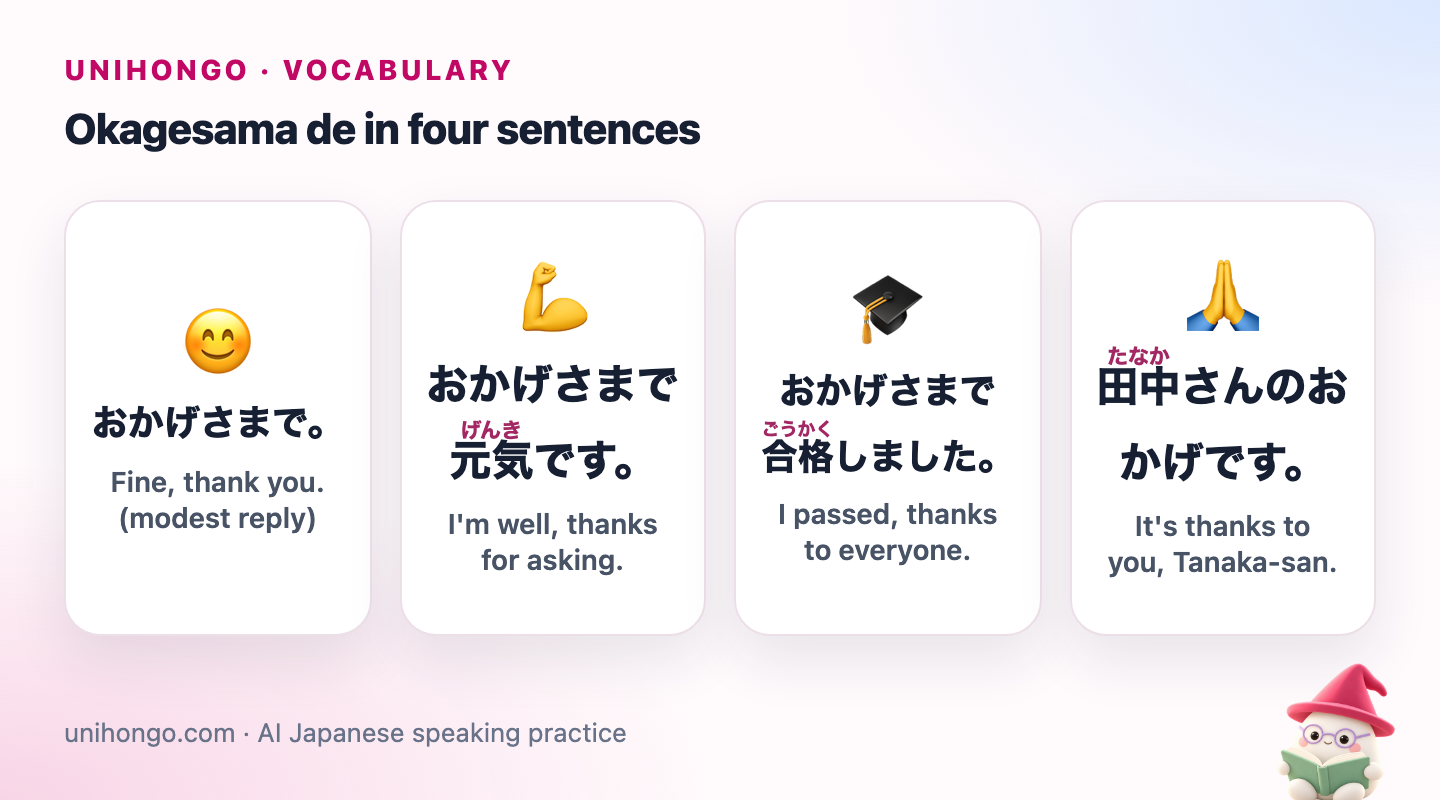
Okagesama de usually comes at the start of a sentence, followed by the good news. The four lines below cover most of what you will hear: the short answer to how are you, an answer about health, an answer about a result, and the specific version that names the person who helped.
The rhythm is always the same. Someone shows concern or asks after you, you open with okagesama de, and then you give the news briefly. The phrase works like a small bow in words before the news itself.
| Japanese | Romaji | Meaning |
|---|---|---|
| おかげさまで。 | Okagesama de. | Fine, thank you. (modest reply) |
| おかげさまで元気です。 | Okagesama de genki desu. | I'm well, thanks for asking. |
| おかげさまで合格しました。 | Okagesama de gōkaku shimashita. | I passed, thanks to everyone. |
| 田中さんのおかげです。 | Tanaka san no okage desu. | It's thanks to you, Tanaka-san. |
What the word is made of
The kanji form is お陰様で, though it is usually written in hiragana. 陰 (kage) means shade or shadow. Japanese dictionaries explain okage as help or a blessing received, a sense that goes back to the protection of gods and buddhas. Over time it came to cover the help of people too, and the honorific o in front and sama after it turned it into a respectful set phrase.
This history explains the feeling of the word. You are not saying you personally did this for me. You are saying that you are grateful to the people and circumstances around you, the listener included. That is why it fits so well with health, safety and the end of a long year, things nobody achieves entirely alone.
| Japanese | Romaji | Meaning |
|---|---|---|
| お陰様で | okagesama de | thanks to you (kanji spelling, rare in daily writing) |
| 陰 | kage | shade, shadow |
| おかげ | okage | help, benefit received |
Every everyday use, with examples
You will meet okagesama de in at least five situations. The first is the answer to how have you been, especially from someone you have not seen in a while. The second is health, your own or your family's. The third is results: exams, a job offer, a safe birth. The fourth is life news such as settling into a new home. The fifth is business, where a company says that, thanks to its customers, it is doing well or celebrating an anniversary.
In each case okagesama de comes first and the news follows. The register stays polite, so the rest of the sentence normally ends in desu or masu.
| Japanese | Romaji | Meaning |
|---|---|---|
| おかげさまで、母も退院しました。 | Okagesama de, haha mo taiin shimashita. | My mother has left hospital, thank you. |
| おかげさまで、無事に引っ越しが終わりました。 | Okagesama de, buji ni hikkoshi ga owarimashita. | The move went smoothly, thank you. |
| おかげさまで、仕事にも慣れてきました。 | Okagesama de, shigoto ni mo narete kimashita. | I'm getting used to the job, thank you. |
| おかげさまで、元気な男の子が生まれました。 | Okagesama de, genki na otoko no ko ga umaremashita. | We had a healthy baby boy, thank you. |
| おかげさまで、今年も無事に終わりそうです。 | Okagesama de, kotoshi mo buji ni owarisō desu. | Thanks to everyone, this year is ending safely. |
| おかげさまで創業三十周年を迎えました。 | Okagesama de sōgyō sanjū shūnen o mukaemashita. | Thanks to you, we have reached our 30th year. (company) |
Okagesama de or no okage de?
This is the distinction learners most often blur. Okagesama de is general and modest: it does not name anyone. X no okage de names a specific cause, a person or a thing, and gives it the credit. If a friend really helped you prepare for the JLPT, say kimi no okage de or Sato-san no okage de, not just okagesama de.
Both are about good results. For bad results, Japanese uses sei de, because of, which carries blame. Mixing them up is where sarcasm creeps in, so it is worth learning all three side by side.
| Japanese | Romaji | Meaning |
|---|---|---|
| 佐藤さんのおかげで、合格できました。 | Satō san no okage de, gōkaku dekimashita. | Thanks to you, Sato-san, I passed. |
| 雨のせいで、試合が中止になった。 | Ame no sei de, shiai ga chūshi ni natta. | The match was cancelled because of the rain. |
| この薬のおかげで、よく眠れた。 | Kono kusuri no okage de, yoku nemureta. | Thanks to this medicine, I slept well. |
| Expression | What it does | Register | Example use |
|---|---|---|---|
| Okagesama de | Thanks everyone, modestly, for good news | Polite set phrase | Answering how are you or sharing results |
| X no okage de | Credits a specific person or thing | Neutral; polite with desu | Thanking the friend who helped you study |
| Okage de (alone) | Thanks to that; casual | Casual | Talking with friends |
| X no sei de | Blames a specific cause for a bad result | Neutral | The train delay that made you late |
When it sounds wrong
Okagesama de is easy to overuse once you like it. Keep it for your own good news, or your family's or company's. Using it about the listener's good news makes no sense, because the gratitude would point back at them. Using it with bad news turns it into irony. And with very close friends, it can feel a little stiff: a cheerful un, genki da yo is more natural.
There is also a sarcastic use you should recognise. People sometimes say okage de or even okagesama de with a flat tone to mean thanks a lot, as in thanks to you, I missed the train. You will hear it in dramas and between siblings. Understand it, but do not try it until you can control the tone.
| Japanese | Romaji | Meaning |
|---|---|---|
| おかげさまで、風邪をひきました。 | Okagesama de, kaze o hikimashita. | Wrong: sounds like thanks a lot for my cold. |
| 誰かさんのおかげで、遅刻したよ。 | Darekasan no okage de, chikoku shita yo. | Sarcastic: Thanks to a certain someone, I was late. |
| うん、元気だよ。 | Un, genki da yo. | Yeah, I'm good. (natural with close friends) |
Okagesama de at the end of the year
December is the season of okagesama de. When people look back on the year, in a last chat with a neighbour, a call to a relative or the final meeting with a client, they tend to sum it up modestly: thanks to everyone, we got through it safely. The word buji, safely or without trouble, appears again and again in these lines, and it pairs naturally with okagesama de.
In business, the same idea becomes a fixed part of year-end greetings and emails, where a company thanks its customers for a good year. In private, it often follows a question such as how was this year for you? The answer does not need to be long. One sentence with okagesama de, then a wish for next year, is the whole pattern.
| Japanese | Romaji | Meaning |
|---|---|---|
| 今年はどうでしたか。 | Kotoshi wa dō deshita ka. | Friend: How was this year for you? |
| おかげさまで、いい一年でした。 | Okagesama de, ii ichinen deshita. | It was a good year, thank you. |
| おかげさまで、家族みんな元気に過ごせました。 | Okagesama de, kazoku minna genki ni sugosemashita. | Thankfully, the whole family stayed well. |
| 来年もいい年になるといいですね。 | Rainen mo ii toshi ni naru to ii desu ne. | Let's hope next year is good too. |
Mini dialogue: a neighbour asks after your family
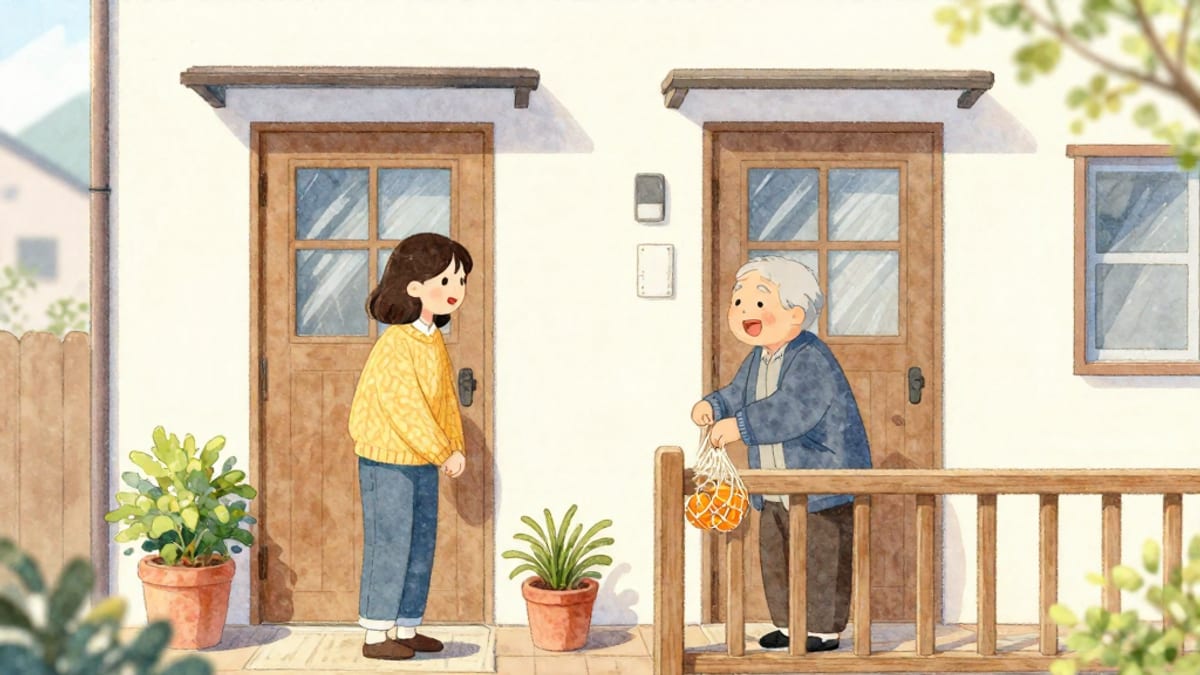
Neighbours who have known you for a while often ask about your family, especially around the end of the year when people catch up. Here a learner meets the older woman next door, who heard that the learner's father was ill. Notice how okagesama de opens the good news and how the neighbour answers it.
| Japanese | Romaji | Meaning |
|---|---|---|
| お父さん、その後いかがですか。 | Otōsan, sono go ikaga desu ka. | Neighbour: How has your father been since then? |
| おかげさまで、もうすっかり元気です。 | Okagesama de, mō sukkari genki desu. | You: He's completely well now, thank you. |
| それはよかったですね。 | Sore wa yokatta desu ne. | Neighbour: Oh, I'm so glad to hear that. |
| ご心配いただいて、ありがとうございます。 | Goshinpai itadaite, arigatō gozaimasu. | You: Thank you for your concern. |
| いえいえ。寒いから、気をつけてね。 | Ieie. Samui kara, ki o tsukete ne. | Neighbour: Not at all. It's cold, so take care. |
| はい、ありがとうございます。 | Hai, arigatō gozaimasu. | You: I will, thank you. |
Common learner mistakes
- Using okagesama de to thank someone for one specific favour. Name the person instead: X-san no okage de.
- Saying it about the listener's news. If your friend got a job, say omedetō, not okagesama de.
- Pairing it with bad news, which sounds sarcastic. Use sei de, or just state the fact.
- Writing 御陰様 or other old kanji in emails. Hiragana おかげさまで is standard and friendly.
- Forgetting to respond when someone else says it. A quick yokatta desu ne keeps the warmth flowing.
Turn your year's good news into practice
- Open Mocchi and type: /explain おかげさまで、今年も無事に終わりそうです。 Mocchi splits the sentence, names each part, and explains why okagesama de fits here.
- Write three okagesama de sentences about your own year and send them with /correct. Mocchi fixes them, explains any nuance slip, and notes the ones you got wrong.
- Ask Mocchi for a short /quiz on okagesama de, no okage de and sei de. Mocchi remembers which of the three you mix up and folds that point into your plan.
- When you are ready to say it aloud, ask AI Sensei, for example Sakura-sensei, to play a neighbour who asks how your family is.