
Four words you hear on any golf day
Golf talk in Japanese starts with a compliment and ends with the green. Naisu shotto is the all-purpose praise, said after any good shot, by friends and business partners alike. The uchippanashi is where most people practise, the bankā is where many rounds go wrong, and the gurīn is where they end.
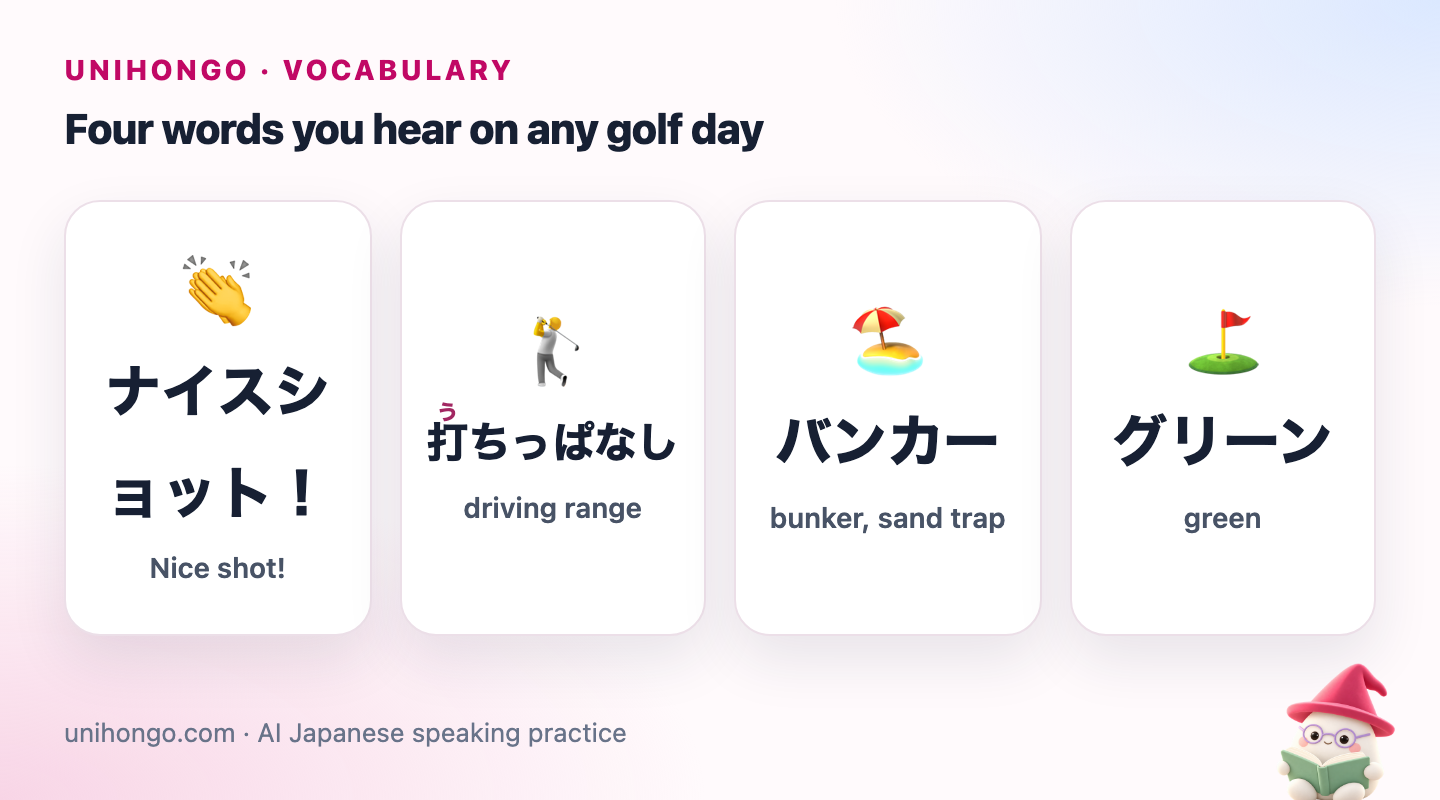
| Japanese | Romaji | Meaning |
|---|---|---|
| ナイスショット! | Naisu shotto! | Nice shot! |
| 打ちっぱなし | uchippanashi | driving range |
| バンカー | bankā | bunker, sand trap |
| グリーン | gurīn | green |
| ゴルフ場 | gorufujō | golf course (the facility) |
| 一緒に回りませんか。 | Issho ni mawarimasen ka. | Would you like to play a round together? |
Mawaru, to go around, is the verb for playing a round: wan raundo mawaru, to play eighteen holes. Gorufujō is the facility, while kōsu is the course itself, and people use both.
At the driving range
City driving ranges often have several floors of bays, called daseki, and you pay for balls by the basket, by the number of balls or by time, depending on the range. Many use a prepaid card or a machine. Some have teaching pros, resson puro, offering short lessons. The first floor is often busiest, and an upper floor bay may be free sooner.
Range manners are simple: stay inside your bay, do not walk forward onto the hitting area to collect balls, and keep practice swings away from the people next to you. If a ball rolls into the next bay, wait until the player has finished their shot before you ask for it, or simply leave it. Many ranges are open late into the evening, and after-work practice is a common routine for golfers in the city.
| Japanese | Romaji | Meaning |
|---|---|---|
| 打席は空いていますか。 | Daseki wa aite imasu ka. | Is there a free bay? |
| どのぐらい待ちますか。 | Dono gurai machimasu ka. | How long is the wait? |
| ボールはどうやって買いますか。 | Bōru wa dō yatte kaimasu ka. | How do I buy balls? |
| クラブを借りられますか。 | Kurabu o kariraremasu ka. | Can I rent clubs? |
| 初心者向けのレッスンはありますか。 | Shoshinsha muke no ressun wa arimasu ka. | Are there lessons for beginners? |
Clubs and parts of the course
Clubs are katakana: doraibā, aian, wejji and patā. Irons are counted with ban, number: nanaban aian or simply nanaban for a 7-iron. A golf bag is usually called a kyadī baggu in Japan. The course areas are the same as in English, plus a few native words such as ike, pond.
| Japanese | Romaji | Meaning |
|---|---|---|
| ドライバー | doraibā | driver |
| 七番アイアン | nanaban aian | 7-iron |
| パター | patā | putter |
| キャディーバッグ | kyadī baggu | golf bag |
| 池に入っちゃった。 | Ike ni haitchatta. | It went in the pond. (casual) |
| ラフから打ちます。 | Rafu kara uchimasu. | I'm hitting from the rough. |
| English | Japanese | Note |
|---|---|---|
| Tee area | tīingu eria, often tī | Older players say tī guraundo |
| Fairway | feawei | The short grass between tee and green |
| Rough | rafu | Longer grass at the side |
| Out of bounds | ōbī | Usually written OB |
| Hole, cup | kappu | The hole on the green |
| Pond | ike | Native word; balls in the pond are a common joke |
Saying your score
Hole scores use the English terms in katakana: pā, bādī, īguru, bogī, daburu bogī. A total score is reported with de mawarimashita, I went around in: hyaku jū de mawarimashita, I shot 110. A round is often split into two halves of nine holes, zenhan and kōhan, and people compare the two.
Japanese golfers talk about score goals in round hundreds. Hyakugiri is breaking 100, and the next goals are kyūjūgiri and hachijūgiri, breaking 90 and 80.
| Japanese | Romaji | Meaning |
|---|---|---|
| パー | pā | par |
| ボギー | bogī | bogey |
| バーディー | bādī | birdie |
| ダボ | dabo | double bogey (casual short form) |
| 百十で回りました。 | Hyaku jū de mawarimashita. | I shot 110. |
| 前半は五十二でした。 | Zenhan wa gojūni deshita. | I shot 52 on the front nine. |
| 百切りが目標です。 | Hyakugiri ga mokuhyō desu. | My goal is to break 100. |
Dabo is the everyday short form of daburu bogī, and very common in casual conversation. With clients or seniors, saying the full form is fine, but dabo will not offend anyone.
Calls and courtesy on the course
The most important call is a safety call. If your ball heads toward other people, shout fā!, the Japanese version of fore. On the green, the player farthest from the hole usually putts first, and if you finish a short putt out of turn, the polite line is osaki ni shitsurei shimasu, excuse me for going first.
Compliments are frequent and expected. Besides naisu shotto, you will hear naisu on for a ball that reaches the green, naisu pā for a par, and oshii! for a putt that just misses.
| Japanese | Romaji | Meaning |
|---|---|---|
| ファー! | Fā! | Fore! (safety warning) |
| ナイスオン! | Naisu on! | Nice, it's on the green! |
| 惜しい! | Oshii! | So close! |
| お先に失礼します。 | Osaki ni shitsurei shimasu. | Excuse me for going first. |
| お先にどうぞ。 | Osaki ni dōzo. | Please go ahead. |
| 遅くなってすみません。 | Osoku natte sumimasen. | Sorry for holding you up. |
A company golf day
Company golf competitions, konpe, and rounds with clients, settai gorufu, are part of working life for some people in Japan, though fewer than in the past. The atmosphere is usually friendly, but the language around the game follows business manners: polite greetings, thanks to the organiser, and modest answers to compliments. Nobody expects you to play well; being on time, keeping up and being pleasant company matter most.
Lunch after the first nine holes and the bath after the round are good chances for conversation. Topics are light: the course, the weather, hobbies, and who played well.

| Japanese | Romaji | Meaning |
|---|---|---|
| 本日はよろしくお願いいたします。 | Honjitsu wa yoroshiku onegai itashimasu. | Thank you for having me today. (morning greeting) |
| ご一緒させていただきます。 | Goissho sasete itadakimasu. | I'll be joining your group. (humble) |
| お上手ですね。 | Ojōzu desu ne. | You play very well. |
| いえいえ、まだまだです。 | Ie ie, madamada desu. | Oh no, I still have a long way to go. |
| 本日はありがとうございました。 | Honjitsu wa arigatō gozaimashita. | Thank you very much for today. |
Mini dialogue: lunch at the clubhouse
| Japanese | Romaji | Meaning |
|---|---|---|
| 前半、どうでした? | Zenhan, dō deshita? | Colleague: How was your front nine? |
| 五十五でした。バンカーで苦労しました。 | Gojūgo deshita. Bankā de kurō shimashita. | You: Fifty-five. I struggled in the bunkers. |
| 三番のパー、ナイスでしたよ。 | Sanban no pā, naisu deshita yo. | Colleague: That par on the third was great. |
| ありがとうございます。たまたまです。 | Arigatō gozaimasu. Tamatama desu. | You: Thank you. It was luck. |
| 後半も頑張りましょう。 | Kōhan mo ganbarimashō. | Colleague: Let's do our best in the back nine too. |
Tamatama desu, it was just chance, is a modest way to accept praise without sounding proud. Holes are counted with ban like clubs: sanban hōru, the third hole, or just sanban.
Rehearse the round before you tee off
Tell Mocchi you have a company golf day coming and ask for a short plan: /plan two weeks of golf Japanese for a company golf day. Mocchi folds small daily tasks into your plan, such as the score words one day and the polite greetings the next, and keeps track of the phrases you keep forgetting.
For the speaking part, open AI Sensei, choose Yamada-sensei and ask for the role of a senior colleague at the clubhouse lunch. Practise reporting your front-nine score, answering a compliment modestly and making light small talk in polite Japanese. The session report shows where your keigo slipped.
Common learner mistakes
- Saying gorufu o suru for playing a round. It is understood, but gorufu o mawaru or wan raundo mawaru sounds natural.
- Calling a golf bag gorufu baggu. Most Japanese golfers say kyadī baggu.
- Staying silent when your ball flies toward another group. Shout fā! loudly.
- Accepting compliments with a plain arigatō in a business round. Add a modest line like madamada desu.
- Bragging about your score with clients or seniors. Modesty is safer, even after a great round.