
Why your own failures are the best source
A frequency list is a prediction about which words a general learner will need. Your own speaking failures are evidence about which words you needed, in your life, this week. The second is a much better basis for a deck.
There is also a memory advantage. A word you reached for and could not find is already attached to a situation, an emotion and a conversation, and it goes into memory far more readily than the same word encountered on a list.
The one thing a personal deck cannot do is cover the basics efficiently, which is why pre-made decks are the right tool for the first couple of thousand words and the wrong one after that.
Capturing without derailing the conversation
The capture has to be cheap or it will not happen. Stopping a conversation to write a full note is not sustainable, and trying to remember everything until afterwards fails because you were concentrating.
Two or three words per conversation is the right target. Learners who try to capture everything end up capturing nothing, and a deck of two hundred untouched cards is worse than one of twenty reviewed.
- Note the word in your own language, in two or three words, mid-conversation.
- Note the situation, not the definition; the situation is what triggers recall.
- Cap it at three per conversation.
- Write the actual card within the day, while you remember what you meant.
- Discard anything you cannot remember the context for; it was not important.
Writing a card that tests production
Most cards fail because they test the wrong direction. Japanese on the front and your language on the back tests recognition, which is the skill you already have, and which was never the reason the sentence failed.
The card that works puts the situation on the front and the Japanese sentence on the back. It forces retrieval under conditions closer to speech, and the situation is a better prompt than a definition.
| Japanese | Romaji | Meaning |
|---|---|---|
| 同僚に締め切りの延長を頼む | Dōryō ni shimekiri no enchō o tanomu | Front: asking a colleague to extend a deadline |
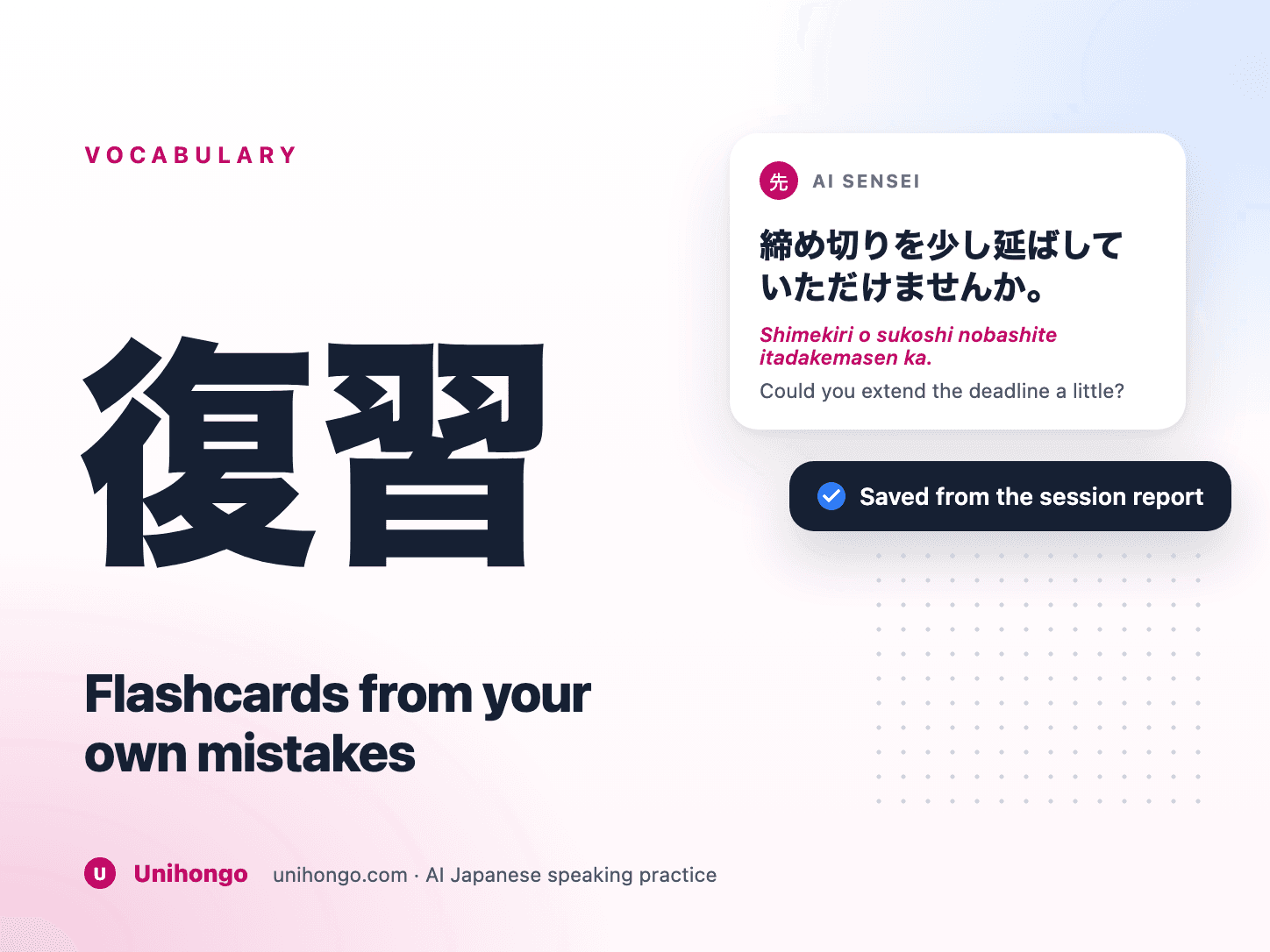
| 締め切りを少し延ばしていただけませんか。 | Shimekiri o sukoshi nobashite itadakemasen ka. | Back: the full sentence |
| 店で袋がいらないと言う | Mise de fukuro ga iranai to iu | Front: declining a bag at a shop |
| 袋は大丈夫です。 | Fukuro wa daijōbu desu. | Back: the natural version |
| 体調が悪いと伝える | Taichō ga warui to tsutaeru | Front: saying you are unwell |
| ちょっと体調を崩してしまって。 | Chotto taichō o kuzushite shimatte. | Back: the full sentence |
Notice that every back is a sentence. A bare noun tells you nothing about the particles or the verb it goes with, which is what you actually need to speak.
What not to add
A deck dies from size. Every card added is a small permanent tax on every future review session, and the most common failure mode is a deck that grew until reviewing became a chore and was then abandoned entirely.
Being selective is therefore not laziness; it is what keeps the deck alive. Most words you meet do not deserve a card.
| Candidate | Add it? | Why |
|---|---|---|
| A word you failed to say | Yes | Proven need |
| A correction you received | Yes | Proven error |
| A word you met three times | Yes | It keeps recurring |
| A word from a list | Only early on | Unproven need |
| A word you met once in a novel | No | May never recur |
| A word you already recognise | No | Recognition is not the gap |
The bottom row catches a lot of learners. Adding words you already understand feels productive and adds review load without adding capability.
Reviewing so the words reach your speech
A card reviewed silently trains silent recall. If the goal is speech, the review has to be spoken, which is a small change with a large effect and which most learners skip because it is inconvenient.
Say the whole sentence aloud, at speaking speed, and count a card as failed if you produced it slowly. Slow and correct is stage one; the target is available.
- Say every answer aloud, in a full sentence.
- Count a slow answer as a failure; speed is the point.
- Review daily, briefly; the schedule matters more than the session length.
- Delete cards that keep failing for the same reason and rewrite them.
- Retire a card once you have used the word in a real conversation.
Closing the loop with your speaking
The whole system depends on capture, and capture is where it usually breaks. In a real conversation you are concentrating, and the words you failed to say are gone by the evening along with the situations that would have made them memorable.
This is where practice that keeps its own record changes things. A spoken session with your AI Sensei in Unihongo's immersive 3D classroom produces a session report showing what you said and the corrected version, and words from it can be saved as flashcards directly, so the deck builds itself from your own gaps rather than depending on what you managed to note down mid-conversation.
The other end of the loop is using the words. A card is finished when the word has appeared in an unrehearsed conversation, and deliberately trying to use this week's cards in the next session is what moves them from your deck into your speech.
Track cards used in conversation rather than cards reviewed. It is a much smaller number and a far better predictor of whether the deck is working.