

Yokatta as relief: the first word after a worry ends
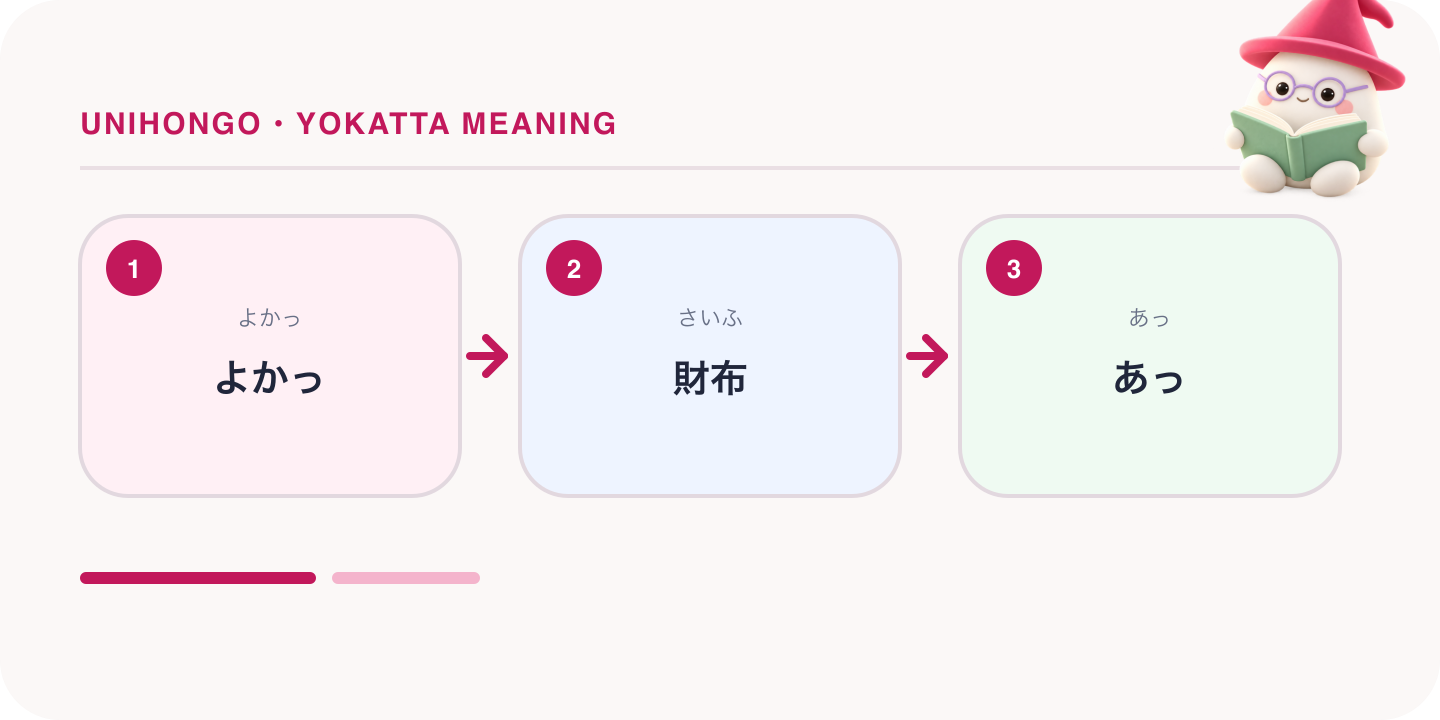
The most common yokatta is the one that escapes when a worry disappears. You thought you had left your keys in the taxi, then you find them in your coat pocket: yokatta. The doctor says the test is clear: yokatta. A friend who was late texts that they are on the train: yokatta. In these moments the word is closer to thank goodness or phew than to good.
Notice that the timing is what makes it natural. Yokatta is said the instant the relief arrives, often with a long breath, and often on its own, without a subject or any other words. Learners sometimes wait to construct a full sentence, but the native pattern is to react first and explain afterwards, if at all.
| Japanese | Romaji | Meaning |
|---|---|---|
| ああ、よかった。 | Aa, yokatta. | Oh, thank goodness. |
| 財布があった。よかった。 | Saifu ga atta. Yokatta. | My wallet was there. What a relief. |
| 間に合ってよかった。 | Maniatte yokatta. | I'm glad we made it in time. |
| 無事でよかった。 | Buji de yokatta. | I'm glad you're safe. |
| 何もなくてよかった。 | Nani mo nakute yokatta. | I'm glad nothing happened. |
| 本当によかった。 | Hontō ni yokatta. | I'm really glad. |
Yokatta ne and yokatta desu ne: replying to good news
When the good news belongs to someone else, yokatta on its own can sound as if you are relieved for your own sake. Adding ne turns the feeling outwards: yokatta ne means I'm glad for you, or that's good, isn't it. It is the natural reply when a friend tells you they passed an exam, got the job, or finally recovered from a cold.
With people you speak politely to, the same reply becomes yokatta desu ne, and very often sore wa yokatta desu ne, with sore wa, as for that, pointing at what they just said. This is the form you use with a colleague, a client or a neighbour, and it fits almost any piece of good news from a successful presentation to a child's recovery.
| Japanese | Romaji | Meaning |
|---|---|---|
| 合格したの?よかったね。 | Gōkaku shita no? Yokatta ne. | You passed? That's great. |
| それはよかったですね。 | Sore wa yokatta desu ne. | I'm glad to hear that. |
| 風邪、治ったんですね。よかったです。 | Kaze, naotta n desu ne. Yokatta desu. | So your cold is better. I'm glad. |
| お気に召したようで何よりです。 | O-ki ni meshita yō de nani yori desu. | I'm very glad you liked it. |
| うまくいってよかったですね。 | Umaku itte yokatta desu ne. | I'm glad it went well. |
| よかったじゃない。 | Yokatta ja nai. | Well, that's good, isn't it. |
Te yokatta: I'm glad I did that
Attach yokatta to the te form of a verb and you get one of the most useful patterns in spoken Japanese: I'm glad that I did, or it was a good thing that. Kite yokatta, I'm glad I came. Kiite oite yokatta, I'm glad I asked beforehand. Yamete yokatta, I'm glad I quit. The pattern can also describe someone else's action or a state: ame ga yande yokatta, I'm glad the rain stopped.
The te form does not have to be a verb. Adjectives and nouns work too: yasukute yokatta, I'm glad it was cheap; kirei de yokatta, I'm glad it was clean; nichiyōbi de yokatta, it's a good thing it was a Sunday. Adjectives ending in i use kute, and nouns and na adjectives use de.
To make any of these polite, add desu at the end: kite yokatta desu. To say I'm glad I did not, use the negative te form: ikanakute yokatta, I'm glad I didn't go.
| Japanese | Romaji | Meaning |
|---|---|---|
| 来てよかった。 | Kite yokatta. | I'm glad I came. |
| 早めに予約しておいてよかった。 | Hayame ni yoyaku shite oite yokatta. | I'm glad I booked early. |
| 先生に聞いてよかったです。 | Sensei ni kiite yokatta desu. | I'm glad I asked the teacher. |
| 雨が止んでよかったね。 | Ame ga yande yokatta ne. | I'm glad the rain stopped. |
| 安くてよかった。 | Yasukute yokatta. | I'm glad it was cheap. |
| 行かなくてよかった。 | Ikanakute yokatta. | I'm glad I didn't go. |
| あなたに会えてよかった。 | Anata ni aete yokatta. | I'm glad I got to meet you. |
The grammar: yokatta as the past tense of ii and yoi
The adjective for good has two dictionary forms, ii and yoi. Ii is the everyday spoken form, yoi is older and more formal, and every changed form is built from yoi. That is why the past tense is yokatta and not ikatta, a form that simply does not exist. The same goes for the negative, yokunai, and the adverb, yoku.
Once you see the family together, the pattern is easy to remember. Because yokatta is a normal past adjective, it can sit inside a sentence and describe something as having been good: eiga wa yokatta, the film was good; tenki ga yokatta, the weather was good. Context tells you whether a speaker means was good or I'm glad, and in practice the two shade into each other.
| Form | Reading | Meaning and use |
|---|---|---|
| いい / 良い | ii / yoi | good (present; ii is spoken, yoi is formal) |
| よかった | yokatta | was good; I'm glad (casual) |
| よかったです | yokatta desu | was good; I'm glad (polite) |
| よくない | yokunai | not good |
| よくなかった | yokunakatta | was not good |
| よくありません | yoku arimasen | not good (formal polite) |
| よく | yoku | well; often (adverb) |
| よければ | yokereba | if it is all right; if you like |
| よくて | yokute | being good, and (te form) |
| よかったら | yokattara | if you like; if it suits you |
| よかったね | yokatta ne | I'm glad for you (casual reply) |
| それはよかったですね | sore wa yokatta desu ne | I'm glad to hear that (polite reply) |
Yokattara, if you like, deserves a mention because it looks like yokatta but works as a softener for invitations: yokattara, issho ni ikimasen ka, if you like, shall we go together? It uses the same stem but has nothing to do with relief.
Casual, polite and formal: choosing the right version
The meaning of yokatta does not change with politeness, but the ending does. With friends, family and children, bare yokatta and yokatta ne are perfect. With colleagues, teachers, clients and people you have just met, add desu: yokatta desu, sore wa yokatta desu ne. In business emails and formal speech, the same feeling is often expressed with a different word altogether: anshin shimashita, I'm relieved, or nani yori desu, I'm very glad.
One thing to watch is the exclamation on its own. Saying a bare yokatta to a client when their shipment arrives is not rude exactly, but it sounds like a private reaction that slipped out. Sore wa yokatta desu, or yokatta desu ne, keeps the warmth and adds the courtesy.
| Japanese | Romaji | Meaning |
|---|---|---|
| よかった! | Yokatta! | Yes! What a relief! (to friends) |
| よかったですね。 | Yokatta desu ne. | I'm glad to hear it. (polite) |
| ご無事で何よりです。 | Go-buji de nani yori desu. | I'm very glad you are safe. (formal) |
| 安心しました。 | Anshin shimashita. | I'm relieved. (polite) |
| 問題なく届いてよかったです。 | Mondai naku todoite yokatta desu. | I'm glad it arrived without any problems. |
| それはよろしゅうございました。 | Sore wa yoroshū gozaimashita. | I'm glad to hear that. (very formal, older style) |
Situations where yokatta is the natural reaction
Because yokatta covers both relief and gladness, it fits a wide range of moments. The list below gathers the ones learners meet most often, with the version that sounds right in each.
- A friend passes an exam or interview: yokatta ne, or omedetō, yokatta ne
- A lost item turns up: atta, yokatta, it was there, thank goodness
- You arrive just in time: maniatte yokatta
- A meal or gift is a success: kuchi ni atte yokatta, I'm glad it suited your taste
- Someone is safe after an earthquake or storm: buji de yokatta
- A plan works out at work: umaku itte yokatta desu
- You are glad you met someone: aete yokatta, said at farewells
Aete yokatta, I'm glad I met you, is the standard warm sentence at the end of a trip or a first meeting that went well.
Yokatta and its neighbours: ii, yoshi, tasukatta and ba yokatta
Yokatta sits among several words that learners mix up. Ii is the present form and means good, fine or okay, so ii desu ne is that sounds good about a plan, while yokatta desu ne is I'm glad that happened. Yoshi is a cheer to yourself before or after an effort, all right, here goes, and it does not express gladness for someone else. Tasukatta means I was saved, and it is what you say when someone rescues you from a problem.
One more relative is the regret pattern ba yokatta. Attach yokatta to a verb's ba form and the meaning flips: ikeba yokatta means I should have gone, I wish I had gone. The word is the same, but the ba form points at something that did not happen. This guide keeps to the gladness side of yokatta; the regret pattern has its own guide on this blog, which walks through the ba and nakereba forms in detail.
| Japanese | Romaji | Meaning |
|---|---|---|
| いいですね。 | Ii desu ne. | That sounds good. (about a plan) |
| よかったですね。 | Yokatta desu ne. | I'm glad that happened. (about a result) |
| よし、やろう。 | Yoshi, yarō. | Right, let's do it. |
| 手伝ってくれて助かった。 | Tetsudatte kurete tasukatta. | You really saved me by helping. |
| 早く来ればよかった。 | Hayaku kureba yokatta. | I should have come earlier. (regret) |
Common mistakes with yokatta
The first mistake is the invented form ikatta. Japanese speakers will understand you, but it marks you as a beginner instantly. Always go through yoi: yokatta.
The second is using yokatta desu for a plan rather than a result. If a colleague suggests meeting at ten, the answer is ii desu ne, that sounds good. Yokatta desu ne would suggest the meeting has already happened and went well. The past tense is doing real work here, so match it to something that is already settled.
The third is forgetting the ne when the good news is someone else's; yokatta ne hands the feeling to them. Finally, take care with te yokatta and ba yokatta: itte yokatta means I'm glad I went, while ikeba yokatta means I wish I had gone. One small syllable turns gladness into regret.
| Japanese | Romaji | Meaning |
|---|---|---|
| 天気がよかった。 | Tenki ga yokatta. | The weather was good. (never ikatta) |
| 十時でいいですね。 | Jū-ji de ii desu ne. | Ten o'clock sounds good. (a plan) |
| 仕事が決まったの?よかったね。 | Shigoto ga kimatta no? Yokatta ne. | You got the job? I'm so glad for you. |
| 行ってよかった。 | Itte yokatta. | I'm glad I went. |