
Where the word points
In English the adjective lands on you: I am nostalgic. In Japanese it lands on the trigger. Natsukashii is an i-adjective that describes something as evoking a fond past, so the grammatical subject is the song, the photo, the taste, or the street. That is why a speaker can say it with no subject at all, the way English speakers say lovely or delicious, and everyone understands that the thing in front of them is what is natsukashii.
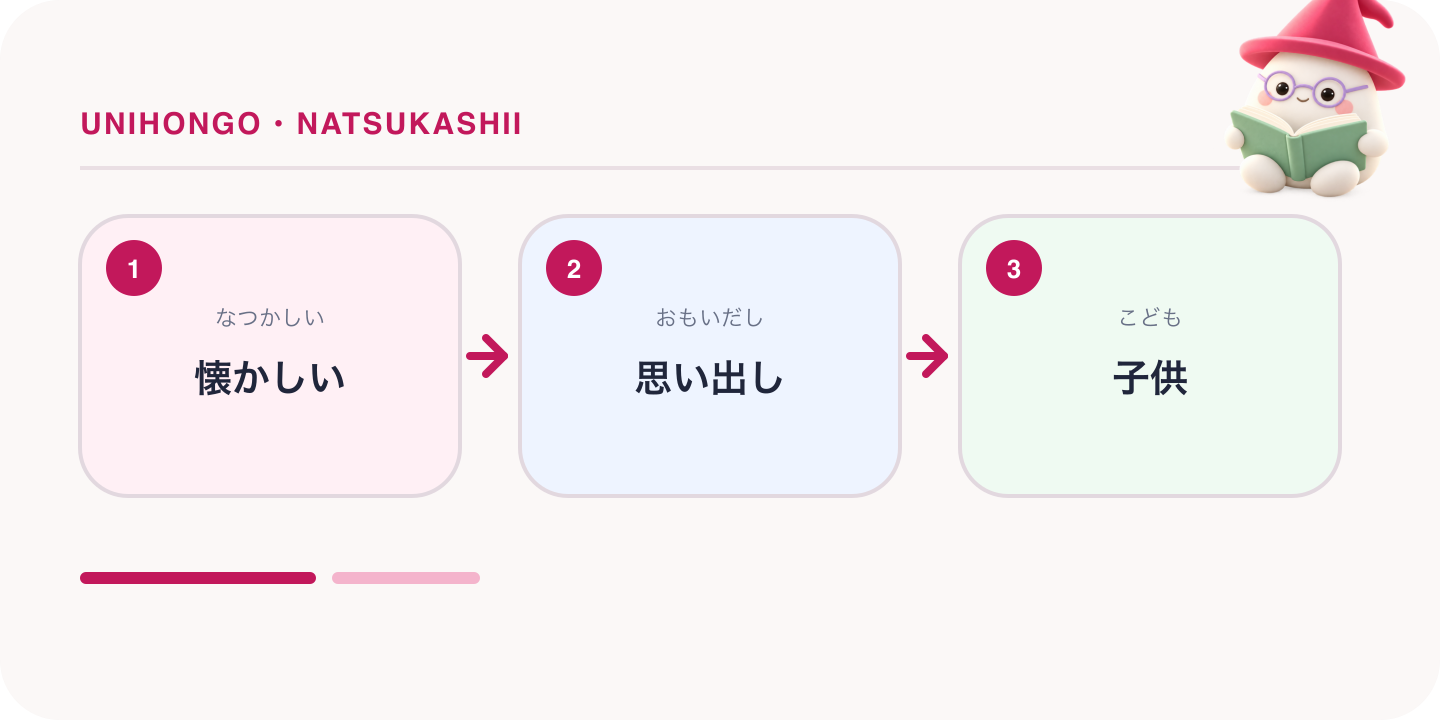
This changes the sentence you build. Instead of translating I feel nostalgic when I hear this song, say kono uta wa natsukashii desu, meaning this song brings the old days back. If you truly want to describe your own act of remembering, Japanese uses a verb: omoidashimasu, I recall, or mukashi o omoidashimashita, I remembered the old days. Keep the adjective for the trigger and the verb for yourself.
| Japanese | Romaji | Meaning |
|---|---|---|
| この歌は懐かしいです。 | Kono uta wa natsukashii desu. | This song brings the old days back. |
| 懐かしい。 | Natsukashii. | Ah, that takes me back. (casual, on its own) |
| 懐かしいですね。 | Natsukashii desu ne. | That takes you back, does it not. |
| 昔を思い出しました。 | Mukashi o omoidashimashita. | I remembered the old days. |
| 子供の頃を思い出します。 | Kodomo no koro o omoidashimasu. | It reminds me of when I was a child. |
The tone is warm, not wistful
English nostalgia often carries a soft ache. Natsukashii usually carries pleasure. Someone finding an old school badge in a drawer says it with a rising, delighted voice, and a group of former classmates will say it over each other while laughing. Treat it as a happy reaction word first. Because of that tone, it fits comfortably in cheerful small talk, and you can say it to a stranger about a shared reference such as an old television programme without making the conversation heavy.
| Japanese | Romaji | Meaning |
|---|---|---|
| うわ、懐かしい。 | Uwa, natsukashii. | Oh wow, that takes me back. (casual) |
| すごく懐かしいです。 | Sugoku natsukashii desu. | That really takes me back. |
| 懐かしいなあ。 | Natsukashii nā. | Ah, those were the days. (casual, drawn out) |
| 懐かしい話ですね。 | Natsukashii hanashi desu ne. | That is a story from the old days. |
| 懐かしくなりました。 | Natsukashiku narimashita. | It made me think of the past. |
The forms you actually need
| Form | Romaji | When you use it |
|---|---|---|
| 懐かしい | Natsukashii | Plain present, and the one-word exclamation |
| 懐かしいです | Natsukashii desu | Polite, the default with people you do not know well |
| 懐かしかったです | Natsukashikatta desu | Looking back on the moment afterwards |
| 懐かしくないです | Natsukashikunai desu | Denying it, often jokingly |
| 懐かしくなる | Natsukashiku naru | It starts to feel like the old days |
| 懐かしい写真 | Natsukashii shashin | Directly modifying a noun |
| 懐かしさ | Natsukashisa | The noun, the quality itself, mostly written |
| 懐かしむ | Natsukashimu | The verb, to look back fondly on, formal or written |
The exclamation on its own is the form you will hear most. It is a complete utterance, so nothing needs to follow it, and adding ne invites the other person to agree. Natsukashimu is a real verb but it belongs to writing and speeches, as in gakusei jidai o natsukashimu, to look back fondly on one's student years. In ordinary conversation, stay with the adjective.
The five triggers and what to say
| Trigger | Japanese | Romaji | English |
|---|---|---|---|
| An old photo | この写真、懐かしいですね。 | Kono shashin, natsukashii desu ne. | This photo really takes me back. |
| A childhood food | 懐かしい味がします。 | Natsukashii aji ga shimasu. | It tastes like childhood. |
| Meeting after years | お久しぶりです。懐かしいですね。 | O-hisashiburi desu. Natsukashii desu ne. | It has been a long time. Good to see you again. |
| Revisiting a place | 十年ぶりに来ました。懐かしいです。 | Jū-nen buri ni kimashita. Natsukashii desu. | I am here for the first time in ten years. It takes me back. |
| Hearing a song | この曲、懐かしい。 | Kono kyoku, natsukashii. | This track, wow, that takes me back. |
Notice the comma pattern in three of these. Japanese speakers often name the trigger, pause, then react: kono shashin, natsukashii. That short pause does the work English does with the word oh. It also gives you thinking time, which makes the line easy to produce at speed.
Photos, objects and old things
Objects are the easiest trigger to practise because you can hold them. Build the sentence in two parts: identify the object, then react, then add one dating detail such as when it is from or how old you were. That third part is what turns a single adjective into a conversation, and it uses the same time words you already know from talking about dates and years.
| Japanese | Romaji | Meaning |
|---|---|---|
| これ、小学校の時のです。 | Kore, shōgakkō no toki no desu. | This is from my primary school days. |
| 二十年前の写真です。 | Nijū-nen mae no shashin desu. | It is a photo from twenty years ago. |
| まだ持っているんですか。懐かしいですね。 | Mada motte iru n desu ka. Natsukashii desu ne. | You still have it? That takes me back. |
| 昔よく使いました。 | Mukashi yoku tsukaimashita. | I used it a lot back then. |
| どこで見つけたんですか。 | Doko de mitsuketa n desu ka. | Where did you find it? |
Food that tastes like the past
Food is where natsukashii is most useful abroad and most misused. The sentence natsukashii aji ga shimasu, it has a taste that takes me back, is the natural one, and haha no aji, my mother's cooking, is the standard phrase for home flavours. Avoid saying watashi wa haha no ryōri ga natsukashii desu with wa on yourself; put the dish first. If what you mean is that you want to eat it again right now, tabetai desu is the honest sentence.
| Japanese | Romaji | Meaning |
|---|---|---|
| 懐かしい味がします。 | Natsukashii aji ga shimasu. | It has a taste that takes me back. |
| 母の味です。 | Haha no aji desu. | It tastes like my mother's cooking. |
| 子供の頃よく食べました。 | Kodomo no koro yoku tabemashita. | I ate this a lot as a child. |
| 給食を思い出します。 | Kyūshoku o omoidashimasu. | It reminds me of school lunches. |
| また食べたいです。 | Mata tabetai desu. | I want to eat it again. |
Seeing someone after years
When you meet an old friend, natsukashii is aimed at the meeting and the shared past, not at the person as an object. Pair it with hisashiburi, which handles the passage of time, and with kawatte imasen ne, you have not changed, which is a standard warm remark rather than a comment on appearance. Saying anata wa natsukashii desu about a person sounds odd, as if they were a museum piece; keep the adjective on the situation.
| Japanese | Romaji | Meaning |
|---|---|---|
| お久しぶりです。 | O-hisashiburi desu. | It has been a long time. |
| 十年ぶりですね。 | Jū-nen buri desu ne. | It has been ten years, has it not. |
| お会いできて懐かしいです。 | O-ai dekite natsukashii desu. | Seeing you brings it all back. |
| 全然変わっていませんね。 | Zenzen kawatte imasen ne. | You have not changed at all. |
| あの頃は楽しかったですね。 | Ano koro wa tanoshikatta desu ne. | Those days were fun, were they not. |
Places and songs
A place triggers natsukashii through detail, so name what has stayed and what has gone. Mukashi wa yoku koko de asobimashita, I used to play here a lot, is the workhorse sentence, and buri is the counter phrase for gaps of time: san-nen buri, five days buri, and so on. With music, people react before the first chorus ends, and the follow-up is almost always when you listened to it rather than who made it.
| Japanese | Romaji | Meaning |
|---|---|---|
| 昔はよくここで遊びました。 | Mukashi wa yoku koko de asobimashita. | I used to play here a lot. |
| この道、変わりましたね。 | Kono michi, kawarimashita ne. | This street has changed, has it not. |
| 久しぶりに来ました。 | Hisashiburi ni kimashita. | It has been a while since I came here. |
| 高校の時よく聞きました。 | Kōkō no toki yoku kikimashita. | I listened to this a lot in high school. |
| 懐かしい曲ですね。 | Natsukashii kyoku desu ne. | That is a song from back then. |
| この曲を聞くと思い出します。 | Kono kyoku o kiku to omoidashimasu. | Hearing this song brings it back. |
When the feeling is not warm
If your feeling is loss rather than pleasure, natsukashii is the wrong word and can sound oddly cheerful. Sabishii describes your own lonely state and takes wa on you: sabishii desu. Koishii describes something you long for and takes ga on the thing: kuni ga koishii desu, I miss my country. Aitai is for people you want to see. A useful rule of thumb is that natsukashii looks back with a smile, koishii reaches forward with a want, and sabishii sits in the present with an absence.
| Japanese | Romaji | Meaning |
|---|---|---|
| 国が恋しいです。 | Kuni ga koishii desu. | I miss my home country. |
| 日本の食べ物が恋しいです。 | Nihon no tabemono ga koishii desu. | I miss Japanese food. |
| 一人で寂しいです。 | Hitori de sabishii desu. | I am lonely on my own. |
| 家族に会いたいです。 | Kazoku ni aitai desu. | I want to see my family. |
| 友達に会えなくて寂しいです。 | Tomodachi ni aenakute sabishii desu. | I am sad that I cannot see my friends. |
A full reminiscing exchange
| Japanese | Romaji | Meaning |
|---|---|---|
| ねえ、これ見てください。 | Nē, kore mite kudasai. | Hey, have a look at this. |
| わあ、懐かしいですね。 | Wā, natsukashii desu ne. | Oh, that really takes me back. |
| 高校の卒業式の写真です。 | Kōkō no sotsugyōshiki no shashin desu. | It is a photo from our high school graduation. |
| 何年前ですか。 | Nan-nen mae desu ka. | How many years ago is that? |
| もう十五年前です。 | Mō jūgo-nen mae desu. | Fifteen years ago already. |
| 早いですね。 | Hayai desu ne. | Time goes quickly, does it not. |
| この人、覚えていますか。 | Kono hito, oboete imasu ka. | Do you remember this person? |
| もちろん覚えています。 | Mochiron oboete imasu. | Of course I remember. |
| 今どうしているんでしょうね。 | Ima dō shite iru n deshō ne. | I wonder what they are doing now. |
| あの頃はよく一緒に帰りましたね。 | Ano koro wa yoku issho ni kaerimashita ne. | We used to walk home together back then. |
| 懐かしいなあ。また会いたいですね。 | Natsukashii nā. Mata aitai desu ne. | Those were the days. I would like to see everyone again. |
| 今度みんなで集まりましょう。 | Kondo minna de atsumarimashō. | Let us all get together sometime. |
Read the exchange twice, once as each speaker. The pattern to internalise is trigger, reaction, detail, question. Learners usually stop after the reaction, which leaves the other person carrying the conversation. One dating detail and one question is enough to keep it running for several turns.
Common mistakes to fix now
- Do not use watashi wa as the subject of natsukashii; name the photo, song or taste instead.
- Do not reach for natsukashii when you mean you miss a person; use aitai desu.
- Do not add a heavy sad tone; the default delivery is bright and slightly surprised.
- Do not use natsukashimu in speech; it belongs to writing and formal talks.
- Do not forget ne when you are with someone who shares the memory, since it invites agreement.
- Do not stop at the adjective; add when it is from so the topic can continue.