
Three patterns carry every body word
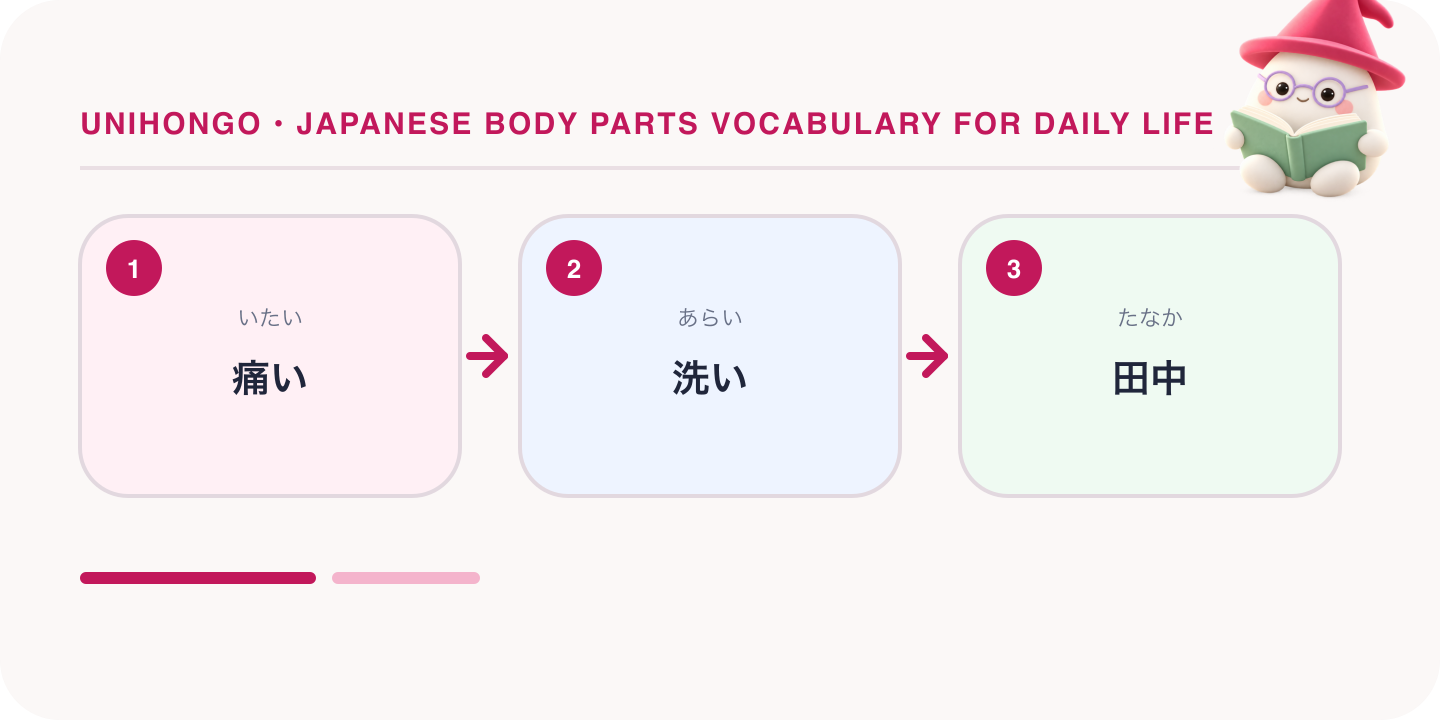
Most body vocabulary sits inside one of three frames, and learning the frames first makes the words fall into place. Pain and sensation use the body part as a subject with ga: atama ga itai desu, me ga kayui desu. Actions you do to a body part, including injuries, use o with a verb: te o araimasu, yubi o kirimashita. Descriptions hang the body part off a person with a double-subject structure: Tanaka-san wa me ga ōkii desu, where Tanaka is the topic and the eyes are what is being described.
The mistake almost every learner makes is importing English possession. Watashi no atama ga itai desu is grammatical, but native speakers drop watashi no because a pain complaint is obviously about the speaker. The same goes for descriptions: kare wa se ga takai desu, not kare no se wa takai desu. Say the person, then the part, then the adjective, and let the particles do the possession for you.
| Japanese | Romaji | Meaning |
|---|---|---|
| 頭が痛いです。 | Atama ga itai desu. | My head hurts. |
| 手を洗います。 | Te o araimasu. | I wash my hands. |
| 田中さんは目が大きいです。 | Tanaka-san wa me ga ōkii desu. | Tanaka has big eyes. |
| 目がかゆいです。 | Me ga kayui desu. | My eyes are itchy. |
The reference table by region
| Region | Japanese | Romaji | English |
|---|---|---|---|
| Head | 頭 | atama | head |
| Head | 顔 | kao | face |
| Head | 髪 | kami | hair |
| Head | おでこ | odeko | forehead |
| Head | 目 | me | eye |
| Head | 耳 | mimi | ear |
| Head | 鼻 | hana | nose |
| Head | 口 | kuchi | mouth |
| Head | 唇 | kuchibiru | lips |
| Head | 歯 | ha | tooth, teeth |
| Head | のど | nodo | throat |
| Head | 首 | kubi | neck |
| Torso | 肩 | kata | shoulder |
| Torso | 胸 | mune | chest |
| Torso | お腹 | onaka | stomach, belly |
| Torso | 背中 | senaka | back |
| Torso | 腰 | koshi | lower back, hips |
| Arms | 腕 | ude | arm |
| Arms | 肘 | hiji | elbow |
| Arms | 手 | te | hand |
| Arms | 手首 | tekubi | wrist |
| Arms | 指 | yubi | finger |
| Arms | 爪 | tsume | nail |
| Legs | 足 | ashi | leg, foot |
| Legs | 太もも | futomomo | thigh |
| Legs | 膝 | hiza | knee |
| Legs | 足首 | ashikubi | ankle |
| Legs | かかと | kakato | heel |
| Legs | 足の指 | ashi no yubi | toe |
| Inside | 心臓 | shinzō | heart |
| Inside | 肺 | hai | lungs |
| Inside | 胃 | i | stomach (organ) |
| Inside | 腸 | chō | intestines |
| Inside | 骨 | hone | bone |
| Inside | 血 | chi | blood |
| Inside | 筋肉 | kinniku | muscle |
| Inside | 肌 | hada | skin |
Two words do double duty. Ashi is the whole lower limb, so ashi ga itai is ambiguous until you add a part such as ashikubi or ashi no ura, the sole. Te is the hand, but in casual speech it reaches up the arm, which is why te o furimasu describes waving the whole arm. Notice also that onaka is the belly you point at, while i is the organ a doctor names; both translate as stomach, and the split between them runs through the whole table.
Head and face in everyday sentences
The head and face words appear most often in small complaints and daily routines rather than emergencies, so learn them with the verbs that go with them. Kami takes kiru for a haircut and arau for washing; ha takes migaku for brushing; me takes tsukareru when a screen has worn them out. Nodo is the odd one: nodo ga itai is a sore throat, but nodo ga kawaku, literally the throat dries, is simply how you say you are thirsty, and no Japanese speaker hears it as a symptom.
Pronunciation matters more here than anywhere else in the set, because two of the most common words are homophones. Hana is both nose and flower, and kami is both hair and paper, distinguished by pitch and context. Nobody will misunderstand hana ga tsumatte imasu, since flowers do not get blocked, and the verb usually settles kami as well: you cut hair and buy paper. The pitch difference is still worth copying from a native speaker, since both words come up constantly.
| Japanese | Romaji | Meaning |
|---|---|---|
| 鼻が詰まっています。 | Hana ga tsumatte imasu. | My nose is blocked. |
| のどが渇きました。 | Nodo ga kawakimashita. | I am thirsty. |
| 目が疲れました。 | Me ga tsukaremashita. | My eyes are tired. |
| 歯を磨いてから寝ます。 | Ha o migaite kara nemasu. | I brush my teeth and then go to bed. |
| 昨日、髪を切りました。 | Kinō, kami o kirimashita. | I had my hair cut yesterday. |
| 首が回りません。 | Kubi ga mawarimasen. | I cannot turn my neck. |
Pain with ga itai, injuries with o and te imasu
Pain is a state, so it takes the adjective itai with ga, and you can put any body part in the slot. The reply you will hear is a question narrowing it down: doko ga itai desu ka, dono atari desu ka, or itsu kara desu ka. Practise answering those three with a hand on the place, because pointing plus koko, here, is what most people do even in their own language. The full clinic conversation, from reception to pharmacy, is covered in the separate guide to Japanese at the doctor.
An injury is an event, so it takes o and a verb in the past tense: yubi o kirimashita, ashikubi o hinerimashita, atama o uchimashita. Then the current state comes back in te imasu: harete imasu, it is swollen; chi ga dete imasu, it is bleeding. Learners tend to say ashi ga itai for everything, which gets sympathy but no useful help. Event first, state second, and the listener knows what to do.
| Japanese | Romaji | Meaning |
|---|---|---|
| 腰が痛いです。 | Koshi ga itai desu. | My lower back hurts. |
| どのあたりが痛いですか? | Dono atari ga itai desu ka? | Roughly where does it hurt? |
| ここです。押すと痛いです。 | Koko desu. Osu to itai desu. | Here. It hurts when I press it. |
| 足首をひねりました。 | Ashikubi o hinerimashita. | I twisted my ankle. |
| 指を切って、血が出ています。 | Yubi o kitte, chi ga dete imasu. | I cut my finger and it is bleeding. |
| 膝が腫れています。 | Hiza ga harete imasu. | My knee is swollen. |
| 頭を打ちました。 | Atama o uchimashita. | I hit my head. |
| 腕を骨折しました。 | Ude o kossetsu shimashita. | I broke my arm. |
Body words inside everyday idioms
Japanese uses body parts to describe character and situations so often that many of these expressions do not feel like idioms to native speakers at all. Atama ga ii is simply the normal way to say someone is clever, and kao ga hiroi, a wide face, means well connected. Te ga hanasenai, I cannot let go of my hands, is the standard way to say you are busy right now, and you will hear it in offices every day as chotto ima te ga hanasenai. Ashi ga hayai is fast on foot, with the same phrase doing service for a runner and for fresh fish that goes off quickly.
The trap is that several of them are also literal. Mimi ga itai means an ear hurts at the clinic and that hits a nerve in conversation, so a doctor will take it literally and a friend who has just criticised you will take it as an admission. Say them with the idiom's normal intonation and context and there is rarely confusion, but do not translate them word by word in your head, or hara ga tatsu will always sound like a standing stomach rather than anger.
| Japanese | Romaji | Meaning |
|---|---|---|
| 妹は頭がいいです。 | Imōto wa atama ga ii desu. | My younger sister is clever. |
| 部長は顔が広いですね。 | Buchō wa kao ga hiroi desu ne. | The manager knows everyone, doesn't he? |
| すみません、今ちょっと手が離せません。 | Sumimasen, ima chotto te ga hanasemasen. | Sorry, I am tied up right now. |
| 今、手が離せない。 | Ima, te ga hanasenai. | I am tied up right now. (casual) |
| 彼は足が速いです。 | Kare wa ashi ga hayai desu. | He is a fast runner. |
| 田中さんは口が堅いです。 | Tanaka-san wa kuchi ga katai desu. | Tanaka can keep a secret. |
| 耳が痛いです。 | Mimi ga itai desu. | That hits a nerve. / My ear hurts. |
| 甘いものに目がないです。 | Amai mono ni me ga nai desu. | I have a weakness for sweets. |
| 本当に腹が立ちました。 | Hontō ni hara ga tachimashita. | I was really angry. |
Two verbs hide body words too. Tetsudau, to help, is literally to attach a hand, and the everyday request chotto tetsudatte kuremasen ka is where most learners meet it. Kubi ni naru, to become a neck, means to be fired, and while you may never need to say it, you will hear it on television and in office gossip.
Describing someone's appearance politely
Descriptions use the person as topic and the body part as subject: Yamada-san wa se ga takai desu. Note that height uses se, the back as a measure of stature, not senaka, and that kami ga nagai and megane o kakete imasu are the two details Japanese speakers reach for first when identifying somebody in a crowd. String them together with the te-form of the adjective: kami ga mijikakute, se ga takai hito desu, a tall person with short hair.
What you leave out matters as much as what you say. Weight is not a safe topic, and remarks about a large nose or short legs are insults rather than descriptions. Compliments that land well are about skin, eyes and height: hada ga kirei desu ne is a standard compliment among women, and se ga takai desu ne is fine for anyone. Be careful with futoi, thick, which describes an arm or a neck but never a person; the adjective for a person is futotte iru, and you should not be saying it to their face.
| Japanese | Romaji | Meaning |
|---|---|---|
| 山田さんは背が高いです。 | Yamada-san wa se ga takai desu. | Yamada is tall. |
| 髪が短くて、眼鏡をかけている人です。 | Kami ga mijikakute, megane o kakete iru hito desu. | It is the person with short hair and glasses. |
| 目が大きくて、かわいいですね。 | Me ga ōkikute, kawaii desu ne. | She has big eyes and is very cute. |
| 肌がきれいですね。 | Hada ga kirei desu ne. | You have lovely skin. |
| お父さんに顔が似ていますね。 | Otōsan ni kao ga nite imasu ne. | You look like your father. |
| どんな人ですか? | Donna hito desu ka? | What is the person like? |
At the hairdresser, the gym and the massage table
The hairdresser needs a finer vocabulary than the clinic. Maegami is the fringe, eriashi the hair at the nape, momiage the sideburns and kesaki the ends, and the instructions are built on the adverb form of the adjective plus suru: mijikaku shite kudasai, make it shorter. Give a number with senchi and the stylist will show you the length with two fingers before cutting, so your job is to say hai or mō sukoshi. At a gym, ashi no hi, leg day, is written with 脚, and the routine words are compounds: udetatefuse for press-ups, fukkin for sit-ups or the abdominal muscles themselves, and kinnikutsū for the soreness afterwards.
At a massage the standard opener is kata ga kotte imasu, my shoulders are stiff, with koru being the verb that only ever seems to apply to shoulders and necks. The therapist will ask chikara kagen wa ikaga desu ka, how is the pressure, and the two answers you need are mō sukoshi tsuyoku and mō sukoshi yowaku. Say itai desu without hesitation if it hurts; nobody expects a client to endure it.
| Japanese | Romaji | Meaning |
|---|---|---|
| 前髪を短くしてください。 | Maegami o mijikaku shite kudasai. | Please make the fringe shorter. |
| 全体に三センチくらい切ってください。 | Zentai ni san-senchi kurai kitte kudasai. | Please take about three centimetres off all over. |
| 毛先を揃えるだけでお願いします。 | Kesaki o soroeru dake de onegai shimasu. | Just a trim on the ends, please. |
| 今日は脚を鍛えます。 | Kyō wa ashi o kitaemasu. | Today I am training legs. |
| 昨日の筋トレで筋肉痛です。 | Kinō no kintore de kinnikutsū desu. | I am sore from yesterday's workout. |
| 肩が凝っています。 | Kata ga kotte imasu. | My shoulders are stiff. |
| 力加減はいかがですか? | Chikara kagen wa ikaga desu ka? | How is the pressure? |
| 腰を中心にお願いします。 | Koshi o chūshin ni onegai shimasu. | Please focus on my lower back. |
| もう少し強くしてください。 | Mō sukoshi tsuyoku shite kudasai. | A little firmer, please. |
The doctor's words versus your words
Japanese medical language runs on Sino-Japanese compounds, while everyday speech runs on native words, and the two rarely overlap. You say onaka; the chart says fukubu. You say hone ga oremashita; the doctor says kossetsu. This is the same split as English tummy against abdomen, except that it covers almost every part, so a diagnosis can sound like a different language even when you know the body word. Learn the pairs for recognition only, and keep answering in your own words; a doctor will never expect a patient to say fukubu.
The clinic names follow the same compounds, which is why the pairs are worth a look before you choose a door: ganka for eyes, jibika for ears and nose, seikei geka for bones and joints, hifuka for skin. The everyday word tells you where it hurts; the compound tells you which department to book.
| Japanese | Romaji | Meaning |
|---|---|---|
| 捻挫ですね。 | Nenza desu ne. | It is a sprain. |
| 骨は折れていません。 | Hone wa orete imasen. | The bone is not broken. |
| 頭痛はいつからですか? | Zutsū wa itsu kara desu ka? | Since when have you had the headache? |
| 三日前からです。 | Mikka mae kara desu. | Since three days ago. |
| Everyday word | Clinical word | Meaning |
|---|---|---|
| お腹 onaka | 腹部 fukubu | abdomen |
| 頭 atama | 頭部 tōbu | head |
| 目 me | 眼 gan, 眼科 ganka | eye, eye clinic |
| 歯 ha | 歯科 shika | teeth, dental clinic |
| 耳・鼻 mimi, hana | 耳鼻科 jibika | ear and nose clinic |
| 肌 hada | 皮膚 hifu, 皮膚科 hifuka | skin, dermatology |
| 骨が折れた hone ga oreta | 骨折 kossetsu | fracture |
| 足首をひねった ashikubi o hinetta | 捻挫 nenza | sprain |
| 血 chi | 血液 ketsueki | blood |
| 頭が痛い atama ga itai | 頭痛 zutsū | headache |
| お腹が痛い onaka ga itai | 腹痛 fukutsū | stomach ache |
| 腰が痛い koshi ga itai | 腰痛 yōtsū | lower back pain |
A routine that keeps the words in your mouth
- Name ten body parts from head to foot while touching each one, once a day for a week, then add the pain sentence to each.
- Take three idioms a week, say each with its literal and idiomatic meaning, and use one in a real conversation before the week is out.
- Describe three people you know using only height, hair and glasses, then say the same sentences about a stranger in a photo.
- Script your next haircut in Japanese before you go, with lengths in senchi, and say it to the stylist even if they answer in English.
- When you learn a clinical word, pair it with the everyday word on the same card so recognition and production stay linked.