

Sport names: loanwords and native words
The general word for sport is supōtsu, and most individual sports are katakana loanwords: sakkā, tenisu, basukettobōru, shortened to basuke, and barēbōru, shortened to barē. Learners can guess these, but the pronunciation shifts are worth practising, because sakkā with a long a and gorufu with a u on the end are what a Japanese listener expects to hear.
A smaller group of sports has native names. Swimming is suiei, table tennis is takkyū, and athletics is rikujō, short for rikujō kyōgi. Martial arts keep their Japanese names, jūdō, kendō, karate and aikidō, and sumo is sumō. Baseball is yakyū, a native word, even though most of its technical terms are English loanwords. The dedicated baseball post on the site covers those terms, and the sumo post covers the ranks and rituals, so this guide keeps to the words that work across sports.
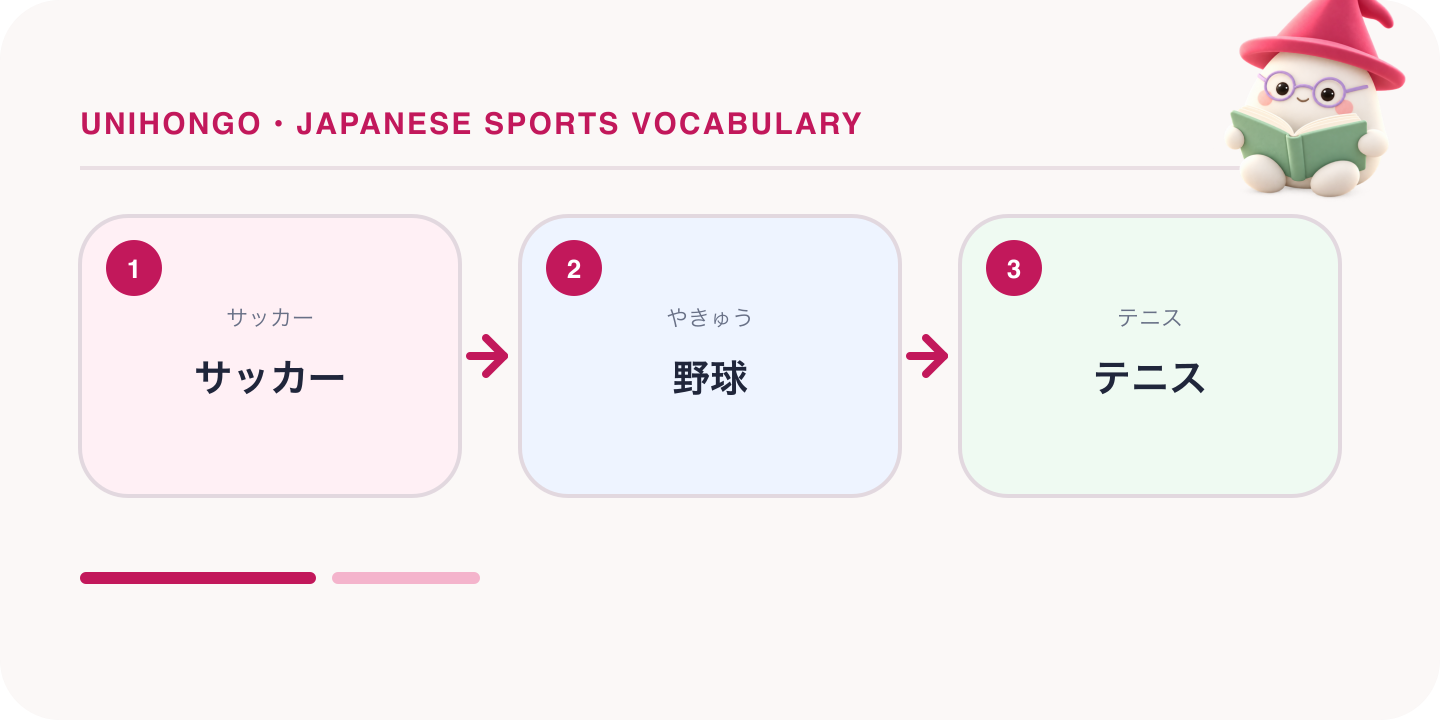
| Word | Reading | Meaning |
|---|---|---|
| サッカー | sakkā | Football (soccer) |
| 野球 | yakyū | Baseball |
| テニス | tenisu | Tennis |
| バスケ | basuke | Basketball |
| バレー | barē | Volleyball |
| 水泳 | suiei | Swimming |
| 卓球 | takkyū | Table tennis |
| 陸上 | rikujō | Athletics |
| ゴルフ | gorufu | Golf |
| ラグビー | ragubī | Rugby |
| 柔道 | jūdō | Judo |
| スキー | sukī | Skiing |
Watch for the short forms. Nobody says basukettobōru in conversation; basuke is the word. Barēbōru becomes barē, and futsal, popular for casual weekend games, is futtosaru.
Playing verbs: suru, yaru and the exceptions
The default verb for any sport is suru, to do: sakkā o suru, tenisu o suru. In casual speech yaru replaces it with no change in meaning, and yatte iru is the normal way to say you play regularly. English speakers reach for asobu because it translates play, but asobu means to hang out or to play like a child, so sakkā o asobu sounds like toddlers kicking a ball around.
A few sports take their own verb. Swimming is oyogu, and suiei o suru sounds like a school subject rather than a hobby. Running is hashiru, or the loanword ranningu o suru, and jogging is jogingu o suru. Skiing and snowboarding can take suru or their own verbs, sukī o suberu, to slide. Martial arts are learned as much as done, so jūdō o narau, to learn judo, and jūdō o yaru both appear, and once you have a grade you say jūdō o yatte imasu. Cycling is jitensha ni noru, to ride a bicycle, and climbing is yama ni noboru, to climb a mountain.
| Japanese | Romaji | Meaning |
|---|---|---|
| 週末はサッカーをしています。 | Shūmatsu wa sakkā o shite imasu. | I play football at the weekends. |
| 学生のときはバスケをやっていました。 | Gakusei no toki wa basuke o yatte imashita. | I played basketball when I was a student. |
| 毎朝五キロ走ります。 | Maiasa go-kiro hashirimasu. | I run five kilometres every morning. |
| 夏はよく海で泳ぎます。 | Natsu wa yoku umi de oyogimasu. | In summer I often swim in the sea. |
| 柔道を三年習っています。 | Jūdō o san-nen naratte imasu. | I have been learning judo for three years. |
| 何かスポーツをしていますか。 | Nanika supōtsu o shite imasu ka. | Do you do any sport? |
| 見るのは好きですが、するのは苦手です。 | Miru no wa suki desu ga, suru no wa nigate desu. | I like watching, but I am not good at playing. |
Teams, positions and people
A team is chīmu, a player is senshu, and a coach is kōchi or kantoku, the latter being the manager or head coach. A teammate is chīmumeito, an opponent is aite, and the opposing team is aite chīmu. A supporter is fan or sapōtā, the second word being standard in football. A captain is kyaputen and the substitutes are the kōho or benchi.
Position names are loanwords in most sports: kīpā for goalkeeper, difendā, middofirudā, fowādo, and in volleyball and basketball setā, ribero, gādo and sentā. Describing your position is a natural follow-up to saying you play. Level words also come up: shoshinsha is a beginner, keikensha has experience, and jōkyūsha is advanced. Clubs describe their level with these, so knowing them helps you find the right group.
| Japanese | Romaji | Meaning |
|---|---|---|
| ポジションはキーパーです。 | Pojishon wa kīpā desu. | My position is goalkeeper. |
| チームは十一人います。 | Chīmu wa jūichi-nin imasu. | The team has eleven people. |
| 相手チームはとても強かったです。 | Aite chīmu wa totemo tsuyokatta desu. | The other team was very strong. |
| 監督が交代を決めました。 | Kantoku ga kōtai o kimemashita. | The manager decided on a substitution. |
| 私は初心者なので、優しく教えてください。 | Watashi wa shoshinsha na node, yasashiku oshiete kudasai. | I am a beginner, so please go easy on me. |
| どのチームを応援していますか。 | Dono chīmu o ōen shite imasu ka. | Which team do you support? |
Results, scores and describing a match
Wins and losses use katsu, to win, and makeru, to lose, with the opponent marked by ni: Nihon ga Burajiru ni kachimashita, Japan beat Brazil. A draw is hikiwake, and to draw is hikiwakeru. A score is read with tai between the numbers, so san tai ni is three to two. Goals are gōru, points in most other sports are ten or pointo, and a set in tennis or volleyball is setto.
Describing the match itself needs a few more words. Shiai is a match or game, and taikai is a tournament. The first half is zenhan and the second half is kōhan; extra time is enchōsen and a penalty shoot-out is PK-sen. Gyakuten is a comeback, when the losing side overturns the result, and it is one of the most exciting words in Japanese sport commentary. A close match is sessen and an easy win is asshō.
| Word | Reading | Meaning |
|---|---|---|
| 試合 | shiai | Match, game |
| 大会 | taikai | Tournament, competition |
| 勝つ | katsu | To win |
| 負ける | makeru | To lose |
| 引き分け | hikiwake | Draw |
| 得点 | tokuten | Score, points scored |
| 逆転 | gyakuten | Comeback, reversal |
| 前半 | zenhan | First half |
| 後半 | kōhan | Second half |
| 延長戦 | enchōsen | Extra time, overtime |
| 優勝 | yūshō | Championship, first place |
Yūshō is the word for winning the whole tournament, not just a match, so yūshō shimashita means we became champions. Second place is junyūshō.
Watching and cheering
Watching a match live is kansen, and watching on television is terebi de miru. Tickets are chiketto, the stadium is sutajiamu, and the seats are seki. A sports bar showing the game is a supōtsu bā.
Cheering is ōen suru. The shouts are simple: ganbare, keep going; ike, go; mamore, defend; and yatta after a goal. Supporters in football sing chants called chanto and wave flags, hata. Between plays people comment with oshii, so close, when a shot just misses, and abunai, that was dangerous, when the other side nearly scores. After the final whistle, otsukare sama for the players, and if your team lost, kuyashii, frustrating, sums it up.
| Japanese | Romaji | Meaning |
|---|---|---|
| 今夜の試合、一緒に見ませんか。 | Kon'ya no shiai, issho ni mimasen ka. | Shall we watch tonight's match together? |
| スタジアムで観戦したことがありますか。 | Sutajiamu de kansen shita koto ga arimasu ka. | Have you ever watched a match at the stadium? |
| 惜しい!もう少しで入ってた。 | Oshii! Mō sukoshi de haitteta. | So close! It nearly went in. |
| 後半、逆転しました。 | Kōhan, gyakuten shimashita. | They came back in the second half. |
| 昨日の試合、見ましたか。 | Kinō no shiai, mimashita ka. | Did you see yesterday's match? |
| 三対一で負けました。悔しいです。 | San tai ichi de makemashita. Kuyashii desu. | We lost three to one. It is frustrating. |
Joining a club or a casual group
At school and university, sport happens in a bu, a club, so the football club is sakkā-bu and joining it is nyūbu suru. A casual, less demanding club is a sākuru. Outside education, adults join a chīmu, a kurabu or a weekly practice, renshū, and local sports centres, supōtsu sentā, run classes.
When you ask to join, the useful questions cover the schedule, the level, the fees and what to bring. Fees vary from nothing to a monthly membership, so ask kaihi wa ikura desu ka and check whether there is an entry fee, nyūkaihi. Kit is uea, shoes are shūzu, and a uniform is yunifōmu. A trial session is taiken, and most groups will let you try one before committing.
- Renshū wa itsu desu ka: when is practice?
- Shoshinsha demo daijōbu desu ka: is it all right for beginners?
- Kaihi wa ikura desu ka: how much are the fees?
- Nani o motte ikeba ii desu ka: what should I bring?
- Taiken wa dekimasu ka: can I try a session?
- Nannin gurai imasu ka: about how many people are there?
Bring these questions to the first message or phone call. Groups often reply with a schedule and a place, so listen for the day of the week, the time and whether the venue is a taiikukan, a gymnasium, or a gurando, an outdoor ground.
Talking about sport in conversation
Sport small talk follows a pattern. Someone asks what you do, you answer with a sport and how often, they ask how long you have been doing it, and the conversation drifts to teams and last weekend. The frequency words shū ni ikkai, once a week, and tsuki ni nikai, twice a month, do a lot of work here. Kyōmi ga arimasu, I am interested, is a gentle way to keep the topic going even if you do not play.
Describing your ability uses jōzu and heta, but the polite habit is to talk yourself down: mada heta desu, I am still bad at it, and mā mā desu, so-so. Praising someone else is jōzu desu ne.
| Japanese | Romaji | Meaning |
|---|---|---|
| 週に一回、フットサルをやっています。 | Shū ni ikkai, futtosaru o yatte imasu. | I play futsal once a week. |
| いつからテニスをやっていますか。 | Itsu kara tenisu o yatte imasu ka. | How long have you been playing tennis? |
| 高校のときから続けています。 | Kōkō no toki kara tsuzukete imasu. | I have kept it up since high school. |
| まだ下手ですが、楽しいです。 | Mada heta desu ga, tanoshii desu. | I am still bad at it, but it is fun. |
| 今度一緒にやりませんか。 | Kondo issho ni yarimasen ka. | Shall we play together some time? |
Mistakes to avoid
The biggest error is asobu for play, which makes any sport sound like a game of tag. The second is suru with sports that have their own verb: suiei o shimasu is understood but stiff, and oyogimasu is what people say. Third is the particle after the opponent: you win ni someone, not o someone, so Nihon ni kachimashita means we beat Japan.
Scores go wrong when you copy English order. Say the winner's score first, then tai, then the loser's, and end with de kachimashita or de makemashita. Finally, do not confuse shiai, a match, with gēmu, which in Japanese usually means a video game or one game within a tennis set. If you invite someone to watch a gēmu, they may expect a console.
| Japanese | Romaji | Meaning |
|---|---|---|
| サッカーをします。遊びません。 | Sakkā o shimasu. Asobimasen. | I play football. Not asobu. |
| 泳ぐのが好きです。 | Oyogu no ga suki desu. | I like swimming. |
| うちのチームが二対〇で勝ちました。 | Uchi no chīmu ga ni tai zero de kachimashita. | Our team won two nil. |
| 試合は何時からですか。 | Shiai wa nan-ji kara desu ka. | What time does the match start? |