
Two kinds of Japanese in one session
When you play in Japanese you are reading one language and speaking another. The screen gives you compressed noun labels: sōbi, kōnyū, nan'ido, saikai. These almost never appear as full sentences, and they repeat so often that a single evening of play will show you the same twenty words dozens of times. That repetition is why interface vocabulary sticks faster than almost any other word set.
The other half is what you type or say to the people you are playing with. That language is short but socially careful. Strangers online usually keep to polite forms, open with a set greeting, and close with a set thank you. Learning ten fixed lines covers most of it, and using them well makes you a person others are happy to be matched with again.
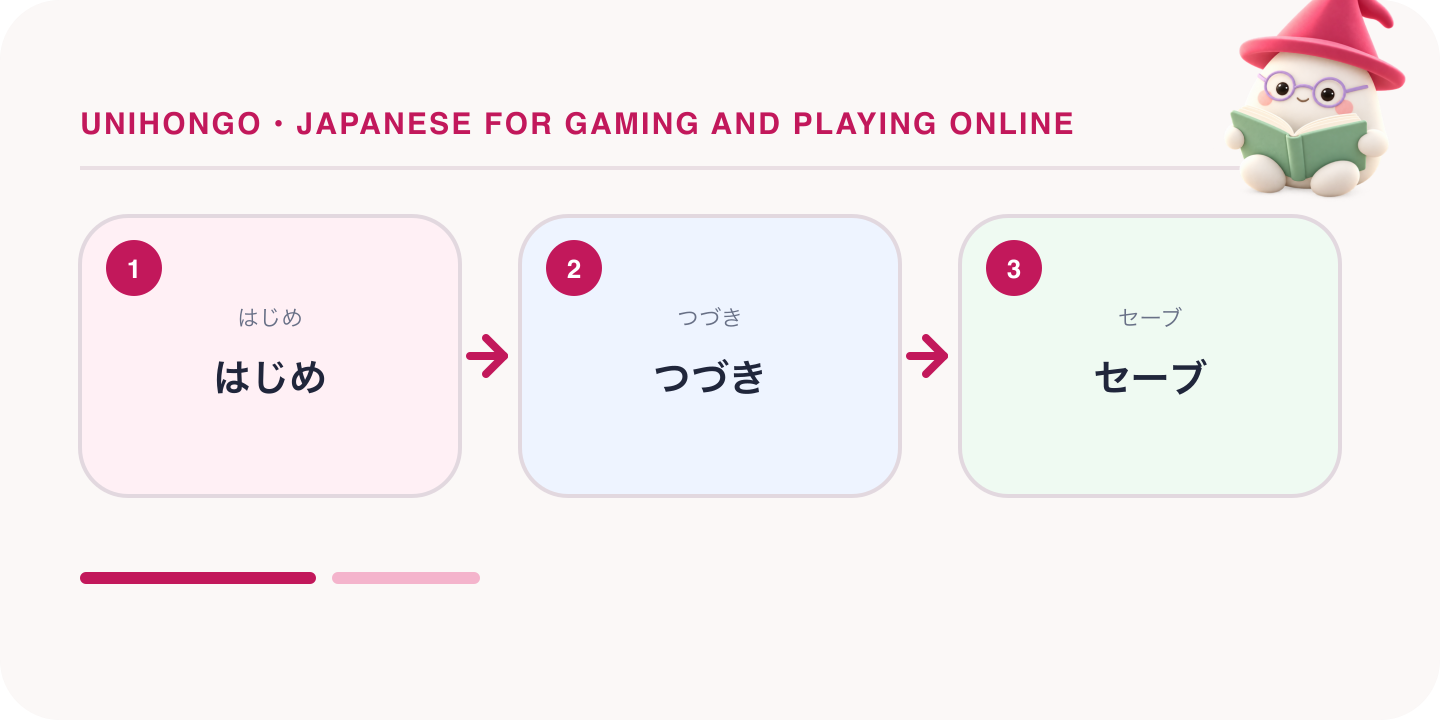
The title screen and the save system
The first screen you meet is the most consistent across games. Hajime kara starts a new run and tsuzuki kara continues an old one. Save and load are usually written in katakana as sēbu and rōdo, though some games use the kanji forms hozon for saving and yomikomi for loading. Chūdan means suspending your progress so you can stop, and saikai means picking it up again.
| Japanese | Romaji | Meaning |
|---|---|---|
| はじめから | Hajime kara | New game (from the beginning) |
| つづきから | Tsuzuki kara | Continue |
| セーブしますか? | Sēbu shimasu ka? | Do you want to save? |
| データを読み込んでいます。 | Dēta o yomikonde imasu. | Loading data. |
| 上書きしますか? | Uwagaki shimasu ka? | Overwrite this file? |
| 中断してやめます。 | Chūdan shite yamemasu. | I will suspend and stop here. |
| 続きからやりましょう。 | Tsuzuki kara yarimashō. | Let us carry on from where we left off. |
| セーブしてから寝ます。 | Sēbu shite kara nemasu. | I will save and then go to bed. |
Menu and interface words at a glance
| Japanese | Reading | Meaning |
|---|---|---|
| 設定 | settei | Settings |
| 操作方法 | sōsa hōhō | Controls |
| 音量 | onryō | Volume |
| 難易度 | nan'ido | Difficulty |
| やさしい | yasashii | Easy |
| ふつう | futsū | Normal |
| むずかしい | muzukashii | Hard |
| 決定 | kettei | Confirm |
| 戻る | modoru | Back |
| 終了 | shūryō | Quit |
| 一時停止 | ichiji teishi | Pause |
| 持ち物 | mochimono | Inventory |
| 装備 | sōbi | Equipment |
| 武器 | buki | Weapon |
| 防具 | bōgu | Armour |
| 道具 | dōgu | Items |
| 技 | waza | Skill or move |
| 経験値 | keikenchi | Experience points |
| 体力 | tairyoku | Health |
| 回復 | kaifuku | Recovery or healing |
| 地図 | chizu | Map |
| 現在地 | genzaichi | Current location |
| 目的地 | mokutekichi | Destination |
| 依頼 | irai | Request or quest |
| 任務 | ninmu | Mission |
| 報酬 | hōshū | Reward |
| 購入 | kōnyū | Buy |
| 売却 | baikyaku | Sell |
| 所持金 | shojikin | Money held |
| 実績 | jisseki | Achievements |
| 通信 | tsūshin | Online or networked play |
| 対戦 | taisen | Versus match |
| 協力 | kyōryoku | Co-operative play |
| 部屋 | heya | Room or lobby |
| 募集 | boshū | Recruiting players |
| 参加 | sanka | Join |
| 準備完了 | junbi kanryō | Ready |
| 再戦 | saisen | Rematch |
Notice how many of these are compound kanji nouns that also live outside games. Genzaichi is written on station maps, boshū appears in job adverts, hōshū means payment for work, and sanka is what you write on an invitation reply. Interface vocabulary is unusually transferable, which is one honest argument for reading menus rather than skipping them.
To turn a label into speech, add the missing grammar back. Kōnyū on a button becomes kaimasu when you talk about it, and sōbi becomes sōbi shimasu. The compressed form is for the screen; the verb form is for your mouth.
Settings, difficulty, and controls
The settings menu is a safe place to practise reading because nothing there can lose your progress. Work through it slowly once and you will have met the vocabulary of volume, brightness, subtitles, and control layout in one sitting. Jimaku means subtitles, kandō means sensitivity, and hantensuru is what an inverted camera axis does.
| Japanese | Romaji | Meaning |
|---|---|---|
| 難易度をふつうにします。 | Nan'ido o futsū ni shimasu. | I will set the difficulty to normal. |
| 音量を下げてもいいですか? | Onryō o sagete mo ii desu ka? | May I turn the volume down? |
| 字幕を表示します。 | Jimaku o hyōji shimasu. | I will display the subtitles. |
| 操作方法を確認します。 | Sōsa hōhō o kakunin shimasu. | I will check the controls. |
| 設定に戻ってもいいですか? | Settei ni modotte mo ii desu ka? | May I go back to the settings? |
| 難しすぎるので、やさしいにします。 | Muzukashi-sugiru node, yasashii ni shimasu. | It is too hard, so I will switch to easy. |
Battle and match words
Combat vocabulary is the second-densest set after the main menu. Kōgeki is to attack, bōgyo is to defend, and nigeru is to run away. Damage is usually written in katakana as damēji, and a critical hit as kaishin no ichigeki in older-style games. Match outcomes are kachi, make, and hikiwake, and the neutral way to describe a close game is setsen deshita.
| Japanese | Romaji | Meaning |
|---|---|---|
| 攻撃します。 | Kōgeki shimasu. | I will attack. |
| 防御してください。 | Bōgyo shite kudasai. | Please defend. |
| 体力が減っています。 | Tairyoku ga hette imasu. | My health is dropping. |
| 回復してもらえますか? | Kaifuku shite moraemasu ka? | Could you heal me? |
| 敵が強いです。 | Teki ga tsuyoi desu. | The enemy is strong. |
| 一度逃げましょう。 | Ichido nigemashō. | Let us retreat once. |
| 勝ちました。 | Kachimashita. | We won. |
| 負けましたが、接戦でした。 | Makemashita ga, sessen deshita. | We lost, but it was a close game. |
| 引き分けですね。 | Hikiwake desu ne. | It is a draw, then. |
| もう一回お願いできますか? | Mō ikkai onegai dekimasu ka? | Could we have one more round, please? |
The shop, the map, and the quest log
Shops use retail language that is identical to the language of a real counter, which makes them quietly useful. Irasshaimase greets you, kōnyū and baikyaku are the two buttons, and shojikin tells you what you can afford. The map screen uses genzaichi for where you are and mokutekichi for where you are going, both of which appear on real signage and satellite navigation.
| Japanese | Romaji | Meaning |
|---|---|---|
| これを買います。 | Kore o kaimasu. | I will buy this. |
| 所持金が足りません。 | Shojikin ga tarimasen. | I do not have enough money. |
| 武器を売ってもいいですか? | Buki o utte mo ii desu ka? | Is it all right if I sell the weapon? |
| この依頼を受けます。 | Kono irai o ukemasu. | I will take on this request. |
| 報酬は何ですか? | Hōshū wa nan desu ka? | What is the reward? |
| 目的地はどこですか? | Mokutekichi wa doko desu ka? | Where is the destination? |
| 地図で現在地を確認します。 | Chizu de genzaichi o kakunin shimasu. | I will check my current position on the map. |
| 先に道具を買っておきます。 | Saki ni dōgu o katte okimasu. | I will buy items in advance. |
Opening and closing an online session
Online play with Japanese speakers has a light ritual at each end. At the start, yoroshiku onegaishimasu covers everything English would need several sentences for: hello, thanks for having me, and let us have a good game. It is not formal in a stiff way, it is simply the normal opener, and it works in text chat and in voice.
At the end, otsukaresama deshita thanks everyone for the effort. It is the same word used when colleagues finish a shift, and it fits a match perfectly. Arigatō gozaimashita works too, and many players use both. If you only ever learn two lines of gaming Japanese, learn these two.
| Japanese | Romaji | Meaning |
|---|---|---|
| よろしくお願いします。 | Yoroshiku onegaishimasu. | Nice to play with you. / Let us have a good game. |
| こちらこそよろしくお願いします。 | Kochira koso yoroshiku onegaishimasu. | Likewise, glad to be playing with you. (reply) |
| 初めてなので、教えてください。 | Hajimete na node, oshiete kudasai. | It is my first time, so please show me how. |
| 日本語は少しだけ話せます。 | Nihongo wa sukoshi dake hanasemasu. | I can speak only a little Japanese. |
| ゆっくり話してもらえますか? | Yukkuri hanashite moraemasu ka? | Could you speak slowly, please? |
| お疲れさまでした。 | Otsukaresama deshita. | Thanks for the game. (closing) |
| ありがとうございました。楽しかったです。 | Arigatō gozaimashita. Tanoshikatta desu. | Thank you. That was fun. |
| また遊びましょう。 | Mata asobimashō. | Let us play again some time. |
Quick chat that stays polite
| Japanese | Reading | When to send it |
|---|---|---|
| よろしくお願いします | yoroshiku onegaishimasu | At the start of a match |
| ありがとうございます | arigatō gozaimasu | Someone helped or revived you |
| 助かりました | tasukarimashita | That save really mattered |
| すみません | sumimasen | Small mistake, or squeezing past |
| ごめんなさい | gomen nasai | A clearer apology to a teammate |
| ナイスです | naisu desu | Praising a good play |
| おみごとです | omigoto desu | Praising a very good play |
| どんまい | don mai | Never mind, shake it off (casual, friendly) |
| こっちです | kotchi desu | Come this way |
| 待ってください | matte kudasai | Please wait for me |
| 行きましょう | ikimashō | Let us go |
| 回復お願いします | kaifuku onegaishimasu | Requesting a heal |
| 少し離れます | sukoshi hanaremasu | Stepping away briefly |
| 戻りました | modorimashita | I am back |
| 回線が悪いです | kaisen ga warui desu | My connection is poor |
| 落ちたらすみません | ochitara sumimasen | Sorry in advance if I disconnect |
| 次で最後にします | tsugi de saigo ni shimasu | This will be my last round |
| お疲れさまでした | otsukaresama deshita | At the end of the session |
Almost everything here is short on purpose. Quick chat has to be readable in a second, so keep to fixed phrases rather than building original sentences mid-match. Don mai is the one casual item on the list; it is friendly and widely used between teammates, but it is not something to say to a superior anywhere else.
If you are using voice rather than text, the same lines work unchanged. The only difference is that you can add ne or a softening deshō at the end when you are checking a shared feeling, as in muzukashii desu ne.
Apologising for a mistake in a team game
Mistakes in co-operative play are where politeness earns its keep. The Japanese pattern is short and forward-looking: name the mistake in a few words, apologise once, and say what you will do next. Repeating an apology several times can make teammates uncomfortable, because it shifts the focus onto your feelings rather than the next round.
Sumimasen is the everyday all-purpose apology and is enough for a small slip. Gomen nasai is warmer and slightly more personal, which suits a teammate you have been playing with for a while. Mōshiwake arimasen is heavy and belongs at work, so it will sound out of place in a match.
| Japanese | Romaji | Meaning |
|---|---|---|
| すみません、間違えました。 | Sumimasen, machigaemashita. | Sorry, I made a mistake. |
| 私のミスです。 | Watashi no misu desu. | That one was my fault. |
| 操作を間違えました。 | Sōsa o machigaemashita. | I pressed the wrong thing. |
| 次は気をつけます。 | Tsugi wa ki o tsukemasu. | I will be careful next time. |
| ご迷惑をおかけしました。 | Go-meiwaku o okake shimashita. | Sorry for the trouble I caused. |
| 大丈夫ですよ。気にしないでください。 | Daijōbu desu yo. Ki ni shinaide kudasai. | It is fine. Please do not worry about it. (reply) |
| ありがとうございます。助かります。 | Arigatō gozaimasu. Tasukarimasu. | Thank you. That helps. |
| もう一度挑戦しましょう。 | Mō ichido chōsen shimashō. | Let us try it once more. |
What not to copy from game dialogue
Character dialogue is written for effect. A rival speaks roughly, a villain uses archaic endings, a small companion character uses cute sentence-final particles, and none of it is a model for a learner talking to a real person. The blunt second-person words omae and temē, the plain command form of verbs such as ike, and abrupt endings such as da yo can carry a real edge when they come from a stranger.
The safe rule is to take nouns freely and verbs cautiously. Buki, kaifuku, and genzaichi are ordinary vocabulary. Ike and yaru na are performance. When you want to say the same thing to a person, rebuild it in polite form: ikimashō for let us go, sugoi desu ne for that was impressive.
- Keep nouns from the game, but re-say the verbs in masu form before using them with people.
- Do not use omae or temē with anyone, including in chat with players you do not know.
- Treat plain commands such as ike, mate, and yamero as character speech, not instructions you give.
- Watch for role language: exaggerated endings such as wa yo or ze mark a character type rather than natural speech.
- If a line felt cool, ask a teacher or a fluent friend how it would land in real conversation before reusing it.
A full polite online exchange
| Japanese | Romaji | Meaning |
|---|---|---|
| よろしくお願いします。 | Yoroshiku onegaishimasu. | You, joining the lobby. |
| よろしくお願いします。初めてですか? | Yoroshiku onegaishimasu. Hajimete desu ka? | Other player: Likewise. Is this your first time? |
| はい、まだ慣れていません。 | Hai, mada narete imasen. | Yes, I am not used to it yet. |
| 大丈夫です。一緒にやりましょう。 | Daijōbu desu. Issho ni yarimashō. | Other player: No problem. Let us play together. |
| すみません、日本語がまだ下手です。 | Sumimasen, nihongo ga mada heta desu. | Sorry, my Japanese is still poor. |
| ゆっくり話しますね。 | Yukkuri hanashimasu ne. | Other player: I will speak slowly, then. |
| ありがとうございます。助かります。 | Arigatō gozaimasu. Tasukarimasu. | Thank you. That is a great help. |
| 準備できましたか? | Junbi dekimashita ka? | Other player: Are you ready? |
| はい、準備完了です。 | Hai, junbi kanryō desu. | Yes, I am ready. |
| すみません、私のミスです。 | Sumimasen, watashi no misu desu. | Sorry, that was my mistake. |
| 気にしないでください。次、行きましょう。 | Ki ni shinaide kudasai. Tsugi, ikimashō. | Other player: Do not worry about it. On to the next one. |
| 回復ありがとうございました。 | Kaifuku arigatō gozaimashita. | Thank you for the heal. |
| 勝ちましたね。おみごとです。 | Kachimashita ne. Omigoto desu. | We won. That was well played. |
| そろそろ落ちます。 | Sorosoro ochimasu. | I will be logging off soon. |
| お疲れさまでした。楽しかったです。 | Otsukaresama deshita. Tanoshikatta desu. | Thanks for the session. I enjoyed it. |
| こちらこそ。またよろしくお願いします。 | Kochira koso. Mata yoroshiku onegaishimasu. | Other player: Same here. Let us play again. |
Read this exchange aloud in both roles until neither side needs thinking time. Sixteen lines is roughly one real session, and once they are automatic you can spend your attention on the game rather than on assembling sentences.