
Why online Japanese looks nothing like a textbook
Written Japanese online is not sloppy Japanese. It is a separate register with its own conventions, developed to do in text what a face and a voice do in person. A plain sentence carries no tone, so writers put the tone back with katakana, stretched vowels, particles, and small pictures. Seen that way, a comment thread stops looking like broken grammar and starts looking like a system.
The second force is speed. Typing on a phone rewards anything shorter, so long set phrases get clipped to their first syllables, and kanji is often left as hiragana because converting it costs a keystroke. The result is a written language you can decode only after learning what the full forms were. That is the order to study it in: full form first, abbreviation second.
The mechanics behind the mess
- Clipping to the first syllables of each word, so akemashite omedetō becomes akeome.
- Katakana on ordinary words to add a louder, more casual, or ironic tone.
- Kanji dropped in favour of hiragana for speed, even where kanji is standard.
- Stretched vowels and small kana that write the sound of a voice, not the spelling.
- Repeated w for laughter, measured by how long the row is rather than by words.
- Sentence-ending particles carrying the emotion a face would carry in person.
- Emoji and kaomoji placed where punctuation goes, softening a blunt sentence.
Every one of these is reversible. If a word looks unfamiliar, expand it: guess the full phrase, then check whether that phrase exists. Most online vocabulary is not new vocabulary at all, but ordinary Japanese with syllables missing.
Common online forms and what to say instead
| Written form | Reading | What it means | Safe spoken equivalent |
|---|---|---|---|
| www | warai | Laughter, like haha in a message | 面白いですね omoshiroi desu ne |
| 草 | kusa | That is funny, from the shape of wwww | 笑いました waraimashita |
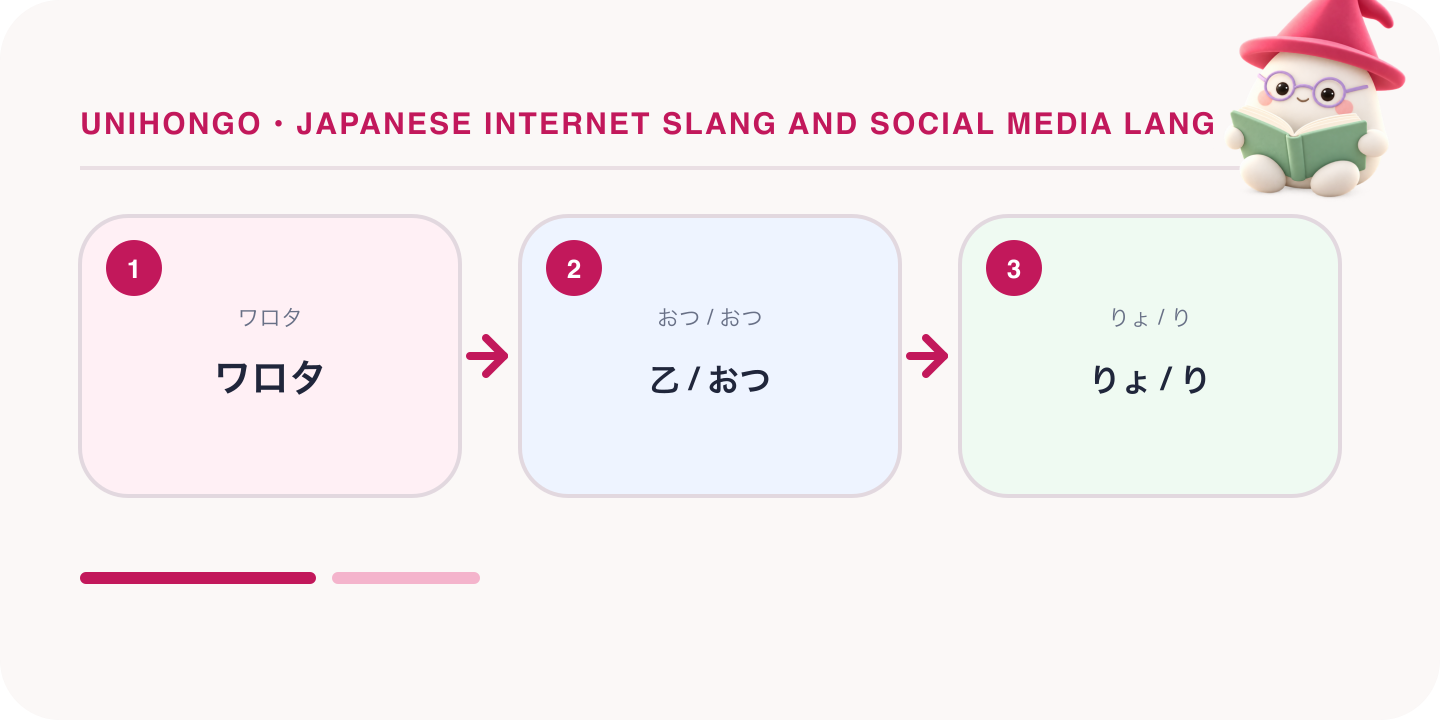
| ワロタ | warota | I laughed, in an older forum style | 面白かったです omoshirokatta desu |
| 乙 / おつ | otsu | Thanks for your effort, that is a wrap | お疲れさまです otsukaresama desu |
| りょ / り | ryo | Got it, very casual and short-lived | 了解です ryōkai desu with peers |
| おけ / おk | oke | Fine, no problem | 大丈夫です daijōbu desu |
| とりま | torima | Anyway, for the moment | とりあえず toriaezu |
| ワンチャン | wanchan | There is a chance, possibly | もしかしたら moshikashitara |
| あざす | azasu | Thanks, clipped and blunt | ありがとうございます arigatō gozaimasu |
| エモい | emoi | Moving in a way that is hard to name | 感動しました kandō shimashita |
| 神 | kami | Outstanding, the best | 素晴らしいです subarashii desu |
| あけおめ | akeome | Happy New Year, clipped | あけましておめでとうございます akemashite omedetō gozaimasu |
The right-hand column is not a translation, it is a replacement. None of the left-hand forms become polite by adding desu, because their whole point is to signal that you are among equals with no distance to maintain. When you need the meaning in a message to somebody senior, use the full expression and let the shortness go.
Laughter, w, and grass
Laughter is the most visible feature of Japanese online writing. A single w, from warai, ends a sentence the way a light haha would. More w means more laughter, and a long row of them, wwww, resembles blades of grass, which is how kusa, the word for grass, came to mean that something is funny. Kusa is common enough that friends say it aloud, though it stays firmly casual.
| Japanese | Romaji | Meaning |
|---|---|---|
| それは草。 | Sore wa kusa. | That is hilarious. (casual, online) |
| それ、めっちゃ笑った。 | Sore, meccha waratta. | That really made me laugh. (casual) |
| 笑ってしまいました。 | Waratte shimaimashita. | I could not help laughing. |
| 面白いですね。 | Omoshiroi desu ne. | That is funny. |
| ツボです。 | Tsubo desu. | That is exactly my kind of funny. |
Warota, from waratta, belongs to an older forum era and now sounds dated rather than rude, so using it reads as deliberately retro. The spoken equivalents are ordinary: omoshiroi desu ne in polite company, or meccha waratta among friends. The usual mistake is saying kusa in a work setting because it looked harmless in a comment.
Katakana for tone, hiragana for speed
Katakana carries tone. Writing yabai as ヤバい rather than やばい makes it louder and more theatrical, and the same trick turns an ordinary word into a knowing aside. Kanji works the other way: dropping it makes a message look softer and quicker, which is why arigatō is rarely written with its kanji online. Neither choice changes the word, only the voice you hear.
| Japanese | Romaji | Meaning |
|---|---|---|
| ヤバい、忘れてた。 | Yabai, wasureteta. | Oh no, I forgot. (casual) |
| それスゴイですね。 | Sore sugoi desu ne. | That is impressive. |
| よろしくお願いします。 | Yoroshiku onegai shimasu. | Thank you in advance. |
| おはようございまーす。 | Ohayō gozaimāsu. | Good morning. (light and friendly) |
| えええ、本当ですか。 | Eee, hontō desu ka. | What, really? |
Stretched vowels do similar work. Ohayō gozaimāsu with a lengthened ma sounds friendlier than the clean form, and eee at the start of a reply is surprise rather than a typing error. When you read a message aloud, honour the spelling, because the writer chose it to show you their voice.
Sentence endings doing the emotional work
Sentence-ending particles carry the load that punctuation and intonation carry in English. Ne invites agreement, yo delivers something the listener did not know, kana softens a statement into wondering, and a trailing kedo leaves a sentence politely unfinished. Online these endings appear even more often than in speech, because a message with no ending particle can read as curt.
| Japanese | Romaji | Meaning |
|---|---|---|
| それ、いいね。 | Sore, ii ne. | That is nice, isn't it. (casual) |
| もう終わりましたよ。 | Mō owarimashita yo. | It is finished already, just so you know. |
| 明日は行けるかな。 | Ashita wa ikeru kana. | I wonder if I can go tomorrow. (casual) |
| 行きたいけど、時間がなくて。 | Ikitai kedo, jikan ga nakute. | I would like to go, but I have no time. |
| これ、めっちゃいいんだけど。 | Kore, meccha ii n da kedo. | This is honestly really good. (casual) |
| ちょっと待ってね。 | Chotto matte ne. | Hang on a second. |
| そうなんだ。 | Sō nan da. | Oh, I see. (casual) |
The pattern worth noticing is the unfinished sentence. Ikitai kedo, jikan ga nakute stops before the conclusion, and that is natural Japanese rather than a fragment. Learners tend to finish every sentence, which sounds heavier than intended. A natural reply is sō desu ka, zannen desu ne.
Emoji and kaomoji as punctuation
Emoji and kaomoji are not decoration, they occupy grammatical positions. A refusal that ends with a small crying face reads as regret; the identical refusal without it reads as annoyance. Older kaomoji built from kana and brackets still appear widely and carry a more homemade tone than a rendered emoji.
- A single 笑 or w at the end signals that the sentence was not an attack.
- Kaomoji made from kana and symbols, such as (^^), for a light smile.
- A trailing 〜 lengthening the final sound to soften a request or a greeting.
- A face at the end of a refusal so it reads as regret rather than coldness.
In business email none of this applies. A message to a client uses full sentences, standard punctuation, and set opening and closing phrases, and a friendly face there looks careless. The gap between a colleague chat and a client email is one of the widest register jumps in written Japanese.
Slang that has crossed into speech
A small amount of online vocabulary has moved into ordinary spoken Japanese, usually because it names something the language had no short word for. These words are safe with friends and with colleagues you are relaxed with, and several now appear in advertising. They are still casual, so they do not belong in a formal presentation.
| Japanese | Romaji | Meaning |
|---|---|---|
| 推しのライブに行きました。 | Oshi no raibu ni ikimashita. | I went to see my favourite performer live. |
| ガチで忙しいです。 | Gachi de isogashii desu. | I am seriously busy. |
| めっちゃおいしいです。 | Meccha oishii desu. | This is really delicious. |
| それ、やばいですね。 | Sore, yabai desu ne. | That is incredible. / That is bad. |
| ちょっと微妙ですね。 | Chotto bimyō desu ne. | It is a bit hard to say, not quite right. |
| ドタキャンされました。 | Dotakyan saremashita. | They cancelled on me at the last minute. |
| 写真映えしますね。 | Shashin-bae shimasu ne. | That looks great in a photo. |
| ネタバレしないでください。 | Netabare shinaide kudasai. | Please do not spoil it for me. |
Yabai deserves a warning of its own. It can mean amazing or terrible, and only tone and context decide which, so learners misfire with it often. It is also thoroughly casual, which is why yabai desu ne sounds friendly at lunch and out of place in a meeting. When the stakes are high, use the plain adjective you actually mean.
Reading a comment thread
Comment threads are worth reading precisely because they are short. Each comment has one job: agreeing, adding a detail, asking when the next post is coming, or thanking the writer. The vocabulary is small and repeats across every thread, so a week of reading comments teaches you most of the reaction language online.
| Japanese | Romaji | Meaning |
|---|---|---|
| わかる。 | Wakaru. | I feel the same. (casual agreement) |
| それな。 | Sore na. | Exactly. (casual) |
| 同じくです。 | Onajiku desu. | Same here. |
| 初コメです。 | Hatsu-kome desu. | This is my first time commenting. |
| いつも見ています。 | Itsumo mite imasu. | I watch your posts all the time. |
| 続きが気になります。 | Tsuzuki ga ki ni narimasu. | I want to know what happens next. |
Sore na and wakaru are agreement between equals and belong among friends. Onajiku desu is the polite version and is safe almost anywhere. Notice how few comments contain a subject at all, because the thread supplies it. Adding watashi wa to each one is a quick way to sound like a learner translating from English.
The politeness danger of copying online phrasing
The real risk of studying internet slang is transfer. Online you are writing to peers with no hierarchy, and the register that suits them is the one that will grate on a colleague. Ryōkai desu is the classic example: normal between teammates, and slightly presumptuous sent upward, where shōchi shimashita is expected. Nobody will correct you, which is the problem.
The second risk is clipping. Azasu instead of arigatō gozaimasu, oke instead of daijōbu desu, and otsu instead of otsukaresama desu all save a second and all announce that you are treating the reader as a close equal. In a message to a stranger, a customer, or anyone above you, write the full form, because length reads as care in Japanese business writing.
| Japanese | Romaji | Meaning |
|---|---|---|
| 了解です。 | Ryōkai desu. | Understood. (fine among teammates) |
| 承知しました。 | Shōchi shimashita. | Understood. (safe with a manager or client) |
| 確認いたします。 | Kakunin itashimasu. | I will check on it. |
| 少々お待ちください。 | Shōshō omachi kudasai. | Please wait a moment. |
| お手数ですが、よろしくお願いいたします。 | Otesū desu ga, yoroshiku onegai itashimasu. | Sorry for the trouble, and thank you in advance. |
How to check whether a phrase is safe to use
- Search the phrase and look at where it appears; if every result is a comment section, it is not speech.
- See whether it ever occurs with desu or masu, because forms that never take polite endings are written-only.
- Ask yourself whether you have heard anyone over thirty say it out loud in your own workplace.
- Check the dates on what you find, since slang built on one meme dies with the meme.
- When in doubt, use the plain polite version, because nobody has been thought rude for being clear.
Keep two lists as you read: phrases to understand, and the much shorter list of phrases to say. Most internet slang belongs only on the first, and that is not a failure. Reading is where you meet the language people actually use; speaking it is a separate decision, made one phrase at a time.