
What isshōkenmei means, kanji by kanji
一生 (isshō) is a whole lifetime, 懸 (ken) is to stake or to hang something on, and 命 (mei) is life. Read literally, the word says staking your life, which sounds extreme. In real use it is ordinary: a student studies isshōkenmei for a test, a waiter runs isshōkenmei through a busy lunch, a child draws a picture isshōkenmei.
Dictionaries trace it to an older form, 一所懸命 (isshokenmei), one place and life at stake, describing warriors who defended a single piece of land with their lives. The vowel later lengthened and the spelling with 一生 became the common one. You may still see 一所懸命 in newspapers and older writing, and some people prefer it.
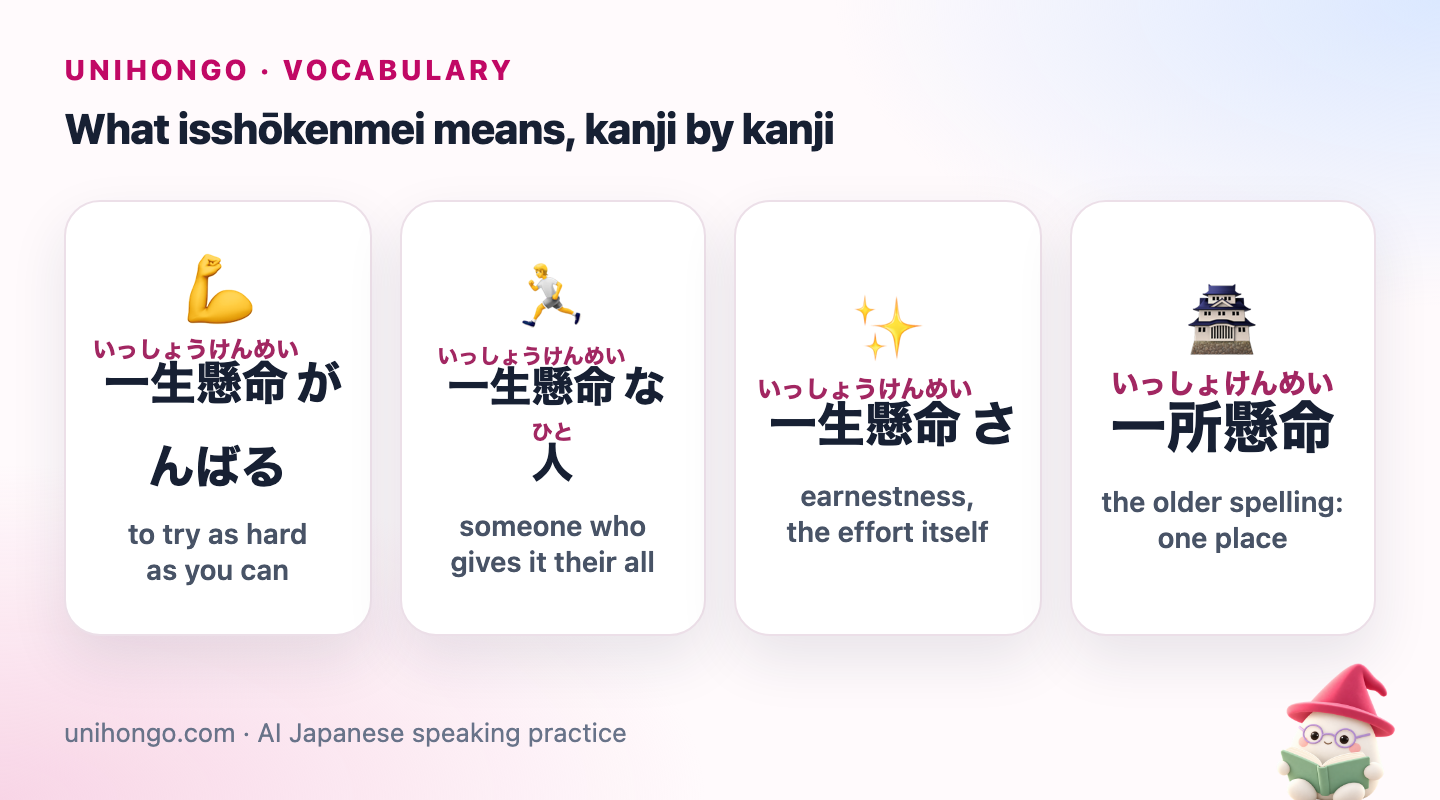
| Japanese | Romaji | Meaning |
|---|---|---|
| 一生懸命がんばる | isshōkenmei ganbaru | to try as hard as you can |
| 一生懸命な人 | isshōkenmei na hito | someone who gives it their all |
| 一生懸命さ | isshōkenmeisa | earnestness, the effort itself |
| 一所懸命 | isshokenmei | the older spelling: one place |
Three grammar slots: adverb, adjective and noun
Most often, isshōkenmei works as an adverb directly before a verb. You can add ni, isshōkenmei ni, but many speakers leave it out, and both are correct. As a na-adjective it describes a person, a face or an attitude: isshōkenmei na sugata, the sight of someone trying hard. With da or desu it becomes a comment: kare wa isshōkenmei da, he is giving it his all.
Add the suffix -sa and you get isshōkenmeisa, earnestness, the effort that other people can feel. This is the noun people use when they say your effort came across, even if the result was not perfect.
| Japanese | Romaji | Meaning |
|---|---|---|
| 毎日一生懸命勉強しています。 | Mainichi isshōkenmei benkyō shite imasu. | I study as hard as I can every day. |
| 一生懸命に説明してくれた。 | Isshōkenmei ni setsumei shite kureta. | He explained it to me so earnestly. |
| 一生懸命な姿に感動しました。 | Isshōkenmei na sugata ni kandō shimashita. | I was moved to see them try so hard. |
| みんな一生懸命です。 | Minna isshōkenmei desu. | Everyone is giving it their all. |
| 一生懸命さが伝わってきます。 | Isshōkenmeisa ga tsutawatte kimasu. | You can really feel their effort. |
Promising effort: self-introductions and new roles
The best-known use is the promise at the end of a self-introduction: on the first day at work, joining a club, starting a homestay or taking over a project. The full polite line is isshōkenmei ganbarimasu node, yoroshiku onegai itashimasu, I will do my very best, so I look forward to working with you. It is a set phrase, and people expect it in these moments; it does not sound boastful.
In more formal speeches and emails, people often swap in seiippai (精一杯), as much as I possibly can, or zenryoku de (全力で), with full strength. Seiippai sounds humble, because it suggests your best might be modest. Zenryoku sounds energetic and confident.
| Japanese | Romaji | Meaning |
|---|---|---|
| 一生懸命がんばりますので、よろしくお願いいたします。 | Isshōkenmei ganbarimasu node, yoroshiku onegai itashimasu. | I'll do my very best, so I look forward to working with you. |
| 一生懸命やります。 | Isshōkenmei yarimasu. | I'll give it everything. (plain polite) |
| 精一杯努めます。 | Seiippai tsutomemasu. | I will do my utmost. (formal, humble) |
| 全力で取り組みます。 | Zenryoku de torikumimasu. | I'll tackle it with everything I have. |
Praising effort, and who you can say it to
Isshōkenmei is also a warm way to praise effort rather than talent. Parents and teachers say it to children, coaches say it to players, and friends say it to each other after a tournament or a recital. The praise is about the process: you tried so hard, and that matters.
Be more careful upwards. Telling your manager or teacher isshōkenmei desu ne can sound like you are grading them. With seniors, thank them for something specific instead, such as teinei ni oshiete itadaite arigatō gozaimasu, thank you for teaching me so carefully. When someone praises you, a modest reply is natural: arigatō gozaimasu, mada mada desu, thank you, I still have a long way to go.
| Japanese | Romaji | Meaning |
|---|---|---|
| 一生懸命練習したね! | Isshōkenmei renshū shita ne! | You practised so hard! (to a child or friend) |
| 一生懸命やってくれてありがとう。 | Isshōkenmei yatte kurete arigatō. | Thanks for working so hard on it. (to a junior) |
| 丁寧に教えていただき、ありがとうございます。 | Teinei ni oshiete itadaki, arigatō gozaimasu. | Thank you for teaching me so carefully. (to a senior) |
| ありがとうございます。まだまだです。 | Arigatō gozaimasu. Mada mada desu. | Thank you. I still have a long way to go. |
Isshōkenmei, hisshi, nesshin, shinken: choosing the effort word
Japanese has several words that English might translate as hard or seriously, and each paints a different picture. Isshōkenmei is the broad, warm one. Hisshi (必死) is desperate, with real pressure behind it: running to catch the last train, studying the night before an exam. Nesshin (熱心) is keen and enthusiastic over time, a passion you keep. Shinken (真剣) is serious and not joking, a focused attitude. Muchū (夢中) is so absorbed that you forget everything else.
| Japanese | Romaji | Meaning |
|---|---|---|
| 必死で走って、終電に間に合った。 | Hisshi de hashitte, shūden ni ma ni atta. | I ran like mad and caught the last train. |
| 彼女は熱心な生徒です。 | Kanojo wa nesshin na seito desu. | She is a keen student. |
| 真剣に考えています。 | Shinken ni kangaete imasu. | I'm thinking about it seriously. |
| Word | Feeling | Typical use |
|---|---|---|
| isshōkenmei | Giving it your all, warm | Studying, working, a child's drawing |
| hisshi | Desperate, under pressure | A last-minute rush, a crisis |
| nesshin | Keen and enthusiastic | A devoted student, a passionate fan |
| shinken | Serious, not joking | A serious talk, a focused face |
| seiippai | As much as you can manage | Humble promises, doing what you can |
If you are unsure, isshōkenmei is the safe default: it is positive, it fits almost any effort, and nobody will misread it. Reach for hisshi only when there is real pressure or panic, and for nesshin when you are describing a lasting enthusiasm rather than one effort.
Where you will hear it: school, sport and daily life
Isshōkenmei is woven into school life. Teachers write it in report-card comments, sports-day speeches praise children who ran isshōkenmei, and school club members promise it before a tournament. Because the culture of praising effort is strong in many schools, children learn early that trying hard counts, not only winning.
Adults use it all the time in small, practical ways too: a delivery driver who runs to the door, a shop assistant who searches the whole stockroom for your size, a friend who explains a train route for ten minutes. In each case, isshōkenmei is a way of noticing and appreciating effort. You can also use it about animals and objects with a smile: a puppy chasing its tail isshōkenmei, a small fan blowing isshōkenmei on a hot day.
| Japanese | Romaji | Meaning |
|---|---|---|
| 子どもたちが一生懸命走っていました。 | Kodomotachi ga isshōkenmei hashitte imashita. | The children were running with all their might. |
| 店員さんが一生懸命探してくれました。 | Ten'in san ga isshōkenmei sagashite kuremashita. | The shop assistant searched so hard for me. |
| 結果より、一生懸命やったことが大事だよ。 | Kekka yori, isshōkenmei yatta koto ga daiji da yo. | What matters more than the result is that you tried your hardest. |
| 子犬が一生懸命しっぽを追いかけている。 | Koinu ga isshōkenmei shippo o oikakete iru. | The puppy is chasing its tail for all it's worth. |
Mini dialogue: the first day at a part-time job
Leo starts a part-time job at a neighbourhood café. The manager introduces him to the morning staff, and later in the day she gives him a word of praise. Notice how the promise and the praise use the same word in different registers.

| Japanese | Romaji | Meaning |
|---|---|---|
| 今日から働くレオさんです。 | Kyō kara hataraku Reo san desu. | Manager: This is Leo, who starts with us today. |
| レオです。一生懸命がんばりますので、よろしくお願いします。 | Reo desu. Isshōkenmei ganbarimasu node, yoroshiku onegai shimasu. | Leo: I'm Leo. I'll do my very best, so please treat me kindly. |
| よろしくね。わからないことは何でも聞いて。 | Yoroshiku ne. Wakaranai koto wa nan demo kiite. | Coworker: Nice to meet you. Ask me anything you're unsure of. |
| レオさん、今日は一生懸命やってくれたね。 | Reo san, kyō wa isshōkenmei yatte kureta ne. | Manager: Leo, you really worked hard today. |
| ありがとうございます。明日もがんばります。 | Arigatō gozaimasu. Ashita mo ganbarimasu. | Leo: Thank you. I'll keep it up tomorrow. |
Polish your self-introduction with Mocchi
- Write a four-line self-introduction for a new job or class and send it to Mocchi with /correct. Mocchi fixes the grammar, explains each change and suggests whether isshōkenmei, seiippai or zenryoku suits your situation best.
- Ask: explain the difference between isshōkenmei, hisshi and nesshin with two examples each. Mocchi keeps a note of the pair you confuse and slips it into a later /review.
- When the text feels right, say it out loud to AI Sensei. Choose Ibuki-sensei, ask her to play your new manager, and request polite Japanese; the session report afterwards lists any corrections.
Common learner mistakes
- Translating isshō as your whole life. Isshōkenmei ganbarimasu does not mean I will try for my entire life; it means I will try as hard as I can.
- Praising a superior with isshōkenmei desu ne. Thank them for something concrete instead.
- Using hisshi when you mean isshōkenmei. Hisshi de benkyō shite imasu sounds as if you are panicking, which may not be the impression you want.
- Writing isshōkenmei in romaji without the long vowel. The sound is isshō, with a long o; isshokenmei with a short o is the older 一所懸命 form.
- Repeating isshōkenmei ganbarimasu in every email. In writing, vary it with seiippai tsutomemasu or a specific promise, such as I will check the schedule by Friday.