

Breaking down mono, no and aware
The phrase has three parts. Mono means thing or things, in a broad sense that can include events, people and the world around you. No is the possessive particle, so a literal rendering is the aware of things. The difficult part is aware.
Aware began in classical Japanese as an exclamation of feeling, something like ah or oh, the sound the heart makes when it is struck. As an adjective and noun it came to describe that moved feeling itself: tenderness, admiration, sorrow or pity. In The Tale of Genji and Heian poetry, aware is used for moments that touch the heart deeply, whether sad or beautiful.
In modern Japanese, the word aware has narrowed. Written 哀れ, it now usually means pitiful or pathetic, as in a pitiful sight. That shift is useful to know, because it explains why the phrase mono no aware leans towards melancholy even though its classical sense was wider.
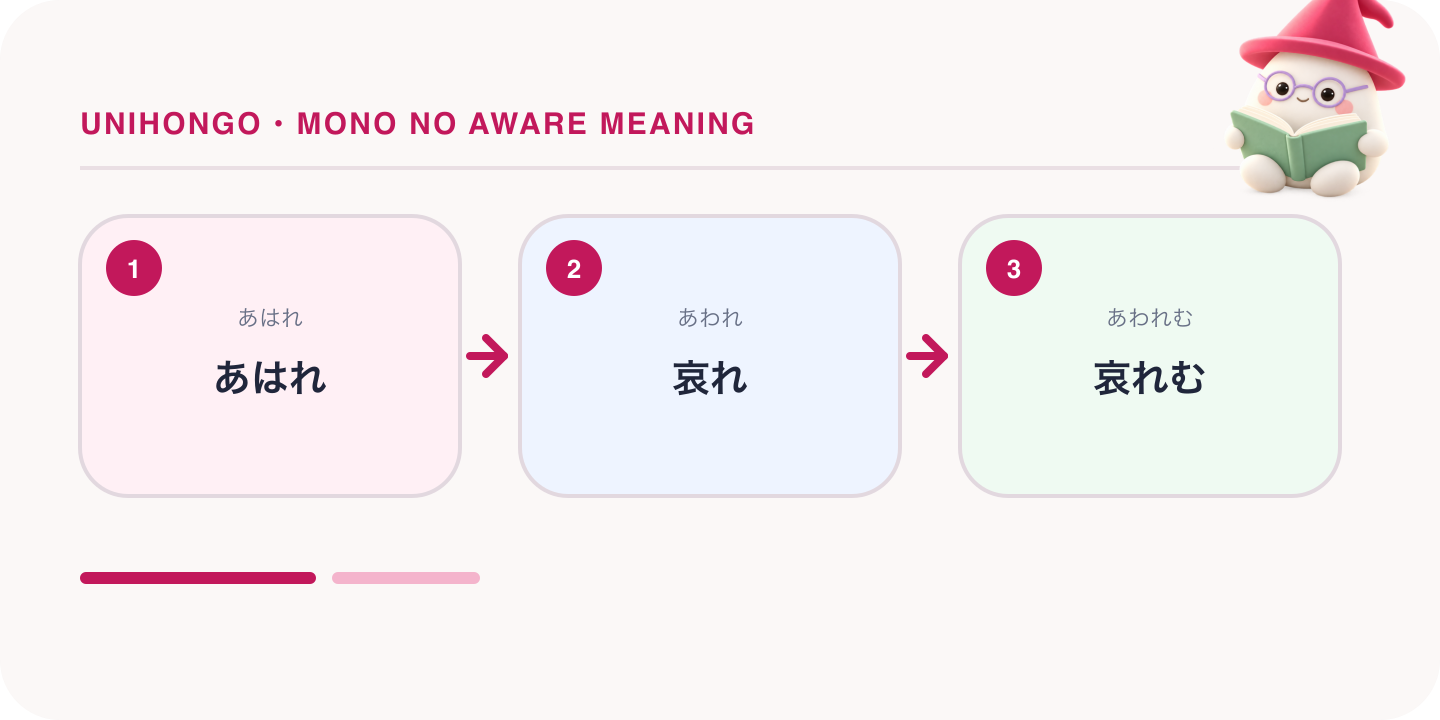
| Word | Reading | Meaning |
|---|---|---|
| 物 | mono | Thing, things; the world around you |
| の | no | Possessive particle: of |
| あはれ | aware | Classical: the heart being deeply moved |
| 哀れ | aware | Modern: pitiful, pathetic, pitiable |
| 哀れむ | awaremu | To pity, to feel compassion for |
| もののあわれ | mono no aware | Being moved by the passing nature of things |
Motoori Norinaga and The Tale of Genji
The word aware is ancient, but mono no aware as a central idea of Japanese literature owes a great deal to Motoori Norinaga, an Edo-period scholar of kokugaku, the school of national learning that studied Japan's classical texts. Norinaga argued that the value of The Tale of Genji lay not in moral lessons, as some earlier readings had claimed, but in its ability to show and stir mono no aware: the capacity to be moved by things as they are.
For Norinaga, knowing mono no aware, mono no aware o shiru, meant having a sensitive heart that responds to the world, to love, loss, seasons and people. This is why the idea is linked in Japanese schools to the Heian court, to Murasaki Shikibu, the author of Genji, and to waka poetry.
You do not need the whole history to use the word well. The useful points are that it is a classical literary idea, that Norinaga made it famous, and that it is about sensitivity to feeling, not only sadness.
- Heian period: aware is used widely in poetry and court literature for moments that touch the heart.
- The Tale of Genji: the novel most closely associated with mono no aware.
- Motoori Norinaga: the Edo-period scholar who made mono no aware a key idea for reading Genji.
- Modern schools: students meet the phrase in classical literature classes, often contrasted with okashi, the bright, witty charm associated with The Pillow Book.
Why cherry blossoms carry the feeling
Sakura are the classic image of mono no aware. The blossoms are at their best for a short time, and wind or rain can bring them down in a single day. Hanami, the custom of gathering under the blossoms, is a cheerful event with food and drink, yet many Japanese people describe a faint sadness in it as well, because everyone knows the flowers are about to go.
Falling petals have their own words. Chiru means to scatter or fall, and sakura fubuki, a cherry blossom blizzard, describes petals blown through the air in large numbers. Hazakura, leaf cherry, is the tree after the flowers have gone and fresh leaves have come in. These are the everyday vocabulary of the feeling.
Autumn leaves, fireflies, the last cicadas of summer, the first snow and the end of a school year carry the same mood. What connects them is not sadness itself but beauty that is noticed because it is short.
| Japanese | Romaji | Meaning |
|---|---|---|
| 桜が散り始めた。 | Sakura ga chirihajimeta. | The cherry blossoms have started to fall. |
| 桜吹雪がきれいだね。 | Sakura fubuki ga kirei da ne. | The storm of petals is beautiful, isn't it? |
| すぐ散っちゃうのが寂しい。 | Sugu chitchau no ga sabishii. | It's sad that they fall so soon. |
| もう葉桜だね。 | Mō hazakura da ne. | The trees are already in leaf. |
| 散るからこそ美しい。 | Chiru kara koso utsukushii. | It's beautiful precisely because it falls. |
Mujō: the Buddhist background of impermanence
Mono no aware is often discussed alongside mujō, the Buddhist idea of impermanence: nothing stays the same. Mujō is a religious and philosophical idea about the nature of existence, while mono no aware is an emotional and aesthetic response. They sit comfortably together, and in medieval literature the awareness of impermanence gives many scenes their quiet sadness.
Two famous classical openings express mujō and are still memorised in Japanese schools. The Tale of the Heike begins with the bell of the Gion temple echoing the impermanence of all things. Hōjōki, by Kamo no Chōmei, begins with the flowing river that never stops, whose water is never the same water. Japanese readers often associate both with the same mood as mono no aware.
| Japanese | Romaji | Meaning |
|---|---|---|
| 無常 | mujō | Impermanence |
| 諸行無常 | shogyō mujō | All things are impermanent |
| 祇園精舎の鐘の声、諸行無常の響きあり | Gion shōja no kane no koe, shogyō mujō no hibiki ari | The bell of Gion temple echoes the impermanence of all things |
| ゆく河の流れは絶えずして、しかももとの水にあらず | Yuku kawa no nagare wa taezu shite, shikamo moto no mizu ni arazu | The flowing river never stops, yet its water is never the same |
| 無常を感じる | mujō o kanjiru | To feel the transience of things |
How the phrase is used in Japan today
Today mono no aware is a textbook and essay phrase. You meet it in classical literature lessons, in books about Japanese culture, in reviews of films and anime with a bittersweet tone, and in travel writing about the seasons. Most adults recognise it and can explain it roughly, but it would sound unusual in a chat over lunch.
When it is used, the common patterns are mono no aware o kanjiru, to feel mono no aware, and mono no aware o shiru, to understand or be sensitive to it, which echoes Norinaga's phrasing. Writers also describe works as full of mono no aware or say a scene shows the Japanese sense of mono no aware.
| Japanese | Romaji | Meaning |
|---|---|---|
| この映画にはもののあわれを感じる。 | Kono eiga ni wa mono no aware o kanjiru. | I feel mono no aware in this film. |
| もののあわれを知る人 | mono no aware o shiru hito | A person sensitive to the pathos of things |
| 授業でもののあわれについて習った。 | Jugyō de mono no aware ni tsuite naratta. | We learned about mono no aware in class. |
| 日本人の美意識 | Nihonjin no biishiki | The Japanese aesthetic sense |
Related words: aware, setsunai, hakanai and more
The real everyday vocabulary of mono no aware is a set of ordinary emotion words. Setsunai describes a painful, bittersweet ache in the chest, and is common in songs about love and farewells. Hakanai means fleeting or short-lived, and suits blossoms, dreams, fireworks and life itself. Sabishii is lonely or sad at an absence, and natsukashii is the warm nostalgia of remembering something good from the past.
Learning these words is more useful than memorising mono no aware, because they let you say what you actually feel in any conversation.
| Japanese | Romaji | Meaning |
|---|---|---|
| 切ない | setsunai | Bittersweet, aching, heartrending |
| 儚い | hakanai | Fleeting, short-lived, ephemeral |
| 寂しい | sabishii | Lonely, missing someone or something |
| 懐かしい | natsukashii | Nostalgic, fondly remembered |
| 哀愁 | aishū | Pathos, a wistful melancholy |
| しみじみ | shimijimi | Deeply, quietly, from the heart |
| 名残惜しい | nagorioshii | Reluctant to part, sorry to see something end |
Shimijimi deserves special attention. Shimijimi to kanjiru, to feel something deeply and quietly, is perhaps the closest everyday expression to the experience that mono no aware names.
The Western image versus the Japanese idea
In English, mono no aware often appears in lists of untranslatable words and in writing about mindfulness, where it becomes a gentle lesson about accepting impermanence. That is a reasonable reading, but it can make the idea sound more like a philosophy of life than it is in Japan.
| Common Western image | Japanese understanding |
|---|---|
| A life lesson about letting go | A sensitivity of the heart to things and seasons |
| Always sad or melancholy | Sad and beautiful, sometimes simply moved |
| An everyday Japanese expression | A literary term; daily speech uses other words |
| Mainly about cherry blossoms | Cherry blossoms are the classic example among many |
Sharing the feeling in conversation
The natural way to express mono no aware in Japanese is to describe the scene and your reaction simply. A sigh of kirei da ne, followed by something about how soon it will end, carries the whole feeling. Japanese conversation often leaves the emotion slightly unsaid, and the listener fills it in.
| Japanese | Romaji | Meaning |
|---|---|---|
| きれいだけど、なんだか切ないね。 | Kirei da kedo, nandaka setsunai ne. | It's beautiful, but somehow bittersweet. |
| あっという間に終わっちゃうね。 | Atto iu ma ni owatchau ne. | It'll be over in no time. |
| この季節になると、しみじみするね。 | Kono kisetsu ni naru to, shimijimi suru ne. | This time of year always makes me reflective. |
| 来年もまた一緒に見たいね。 | Rainen mo mata issho ni mitai ne. | I hope we can see it together again next year. |
| 名残惜しいけど、そろそろ帰ろうか。 | Nagorioshii kedo, sorosoro kaerō ka. | I'm sorry it's ending, but shall we head home? |
These lines work at a hanami picnic, a summer festival, the last day of a course or a farewell dinner, which are exactly the places where the feeling comes up in real life.