
What Japanese baby talk is
Japanese has two names for baby talk. 幼児語 (yōjigo), literally toddler language, is the more technical term. 赤ちゃん言葉 (akachan kotoba), baby words, is what most people say. Both describe the words that adults use when speaking to babies and toddlers and that children use in their first years before switching to adult words.
Baby words follow a few simple patterns. Many are animal or vehicle sounds used as names. Many double a syllable: nenne, manma. Some add the polite prefix お to a body part, making it soft and gentle: otete, omeme. Children gradually drop them, usually without anyone teaching them to, as they pick up adult words at nursery and school.
| Japanese | Romaji | Meaning |
|---|---|---|
| ワンワンだね | wanwan da ne | Look, it's a doggy! |
| 幼児語 | yōjigo | baby talk (technical term) |
| 赤ちゃん言葉 | akachan kotoba | baby talk, baby words |
| 赤ちゃん | akachan | baby |
Animals and vehicles: names that are sounds
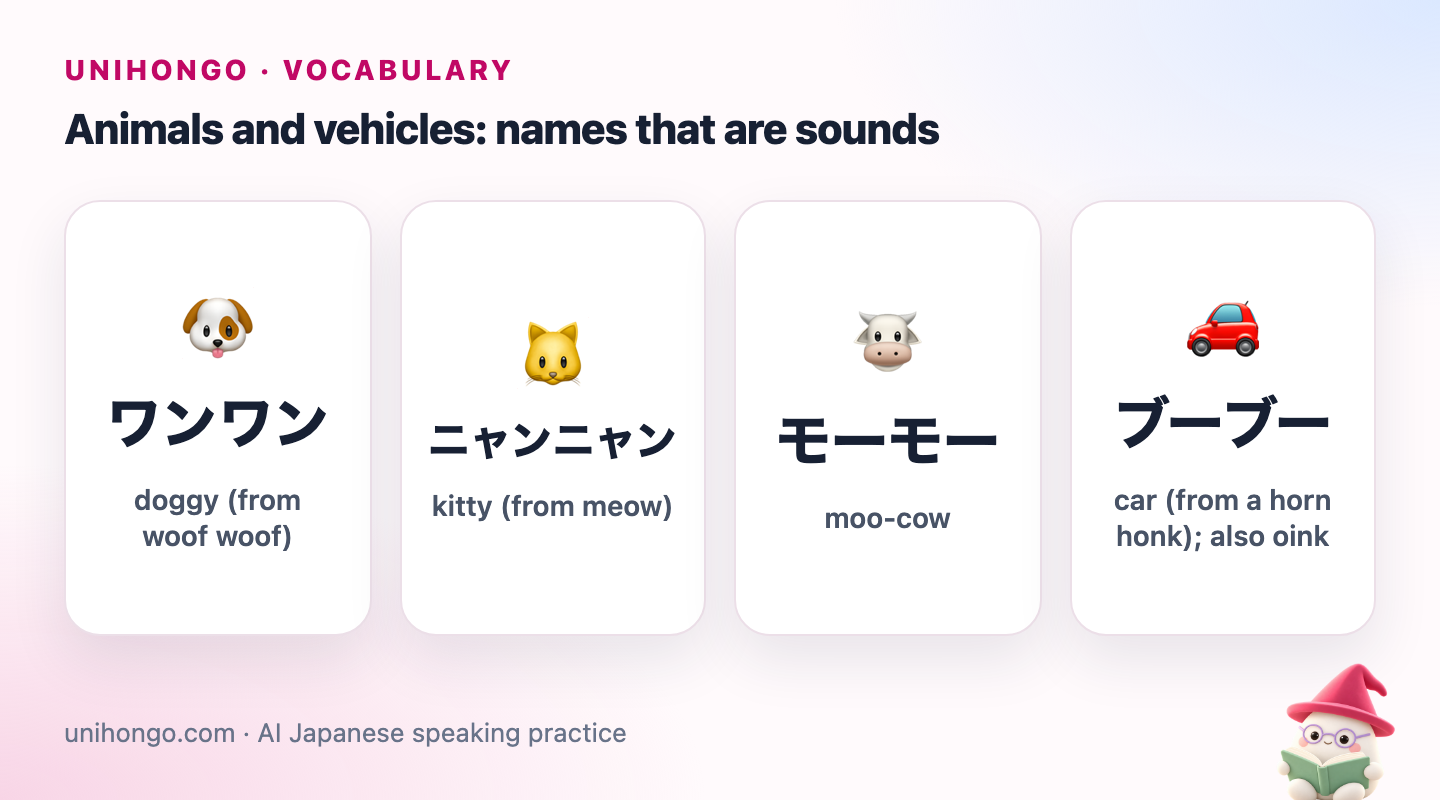
The first words many Japanese toddlers say are the sounds of animals and cars. Parents use the sound as the name until the child is ready for inu, neko and kuruma. These cards show four of the most common.
| Japanese | Romaji | Meaning |
|---|---|---|
| ワンワン | wanwan | doggy (from woof woof) |
| ニャンニャン | nyannyan | kitty (from meow) |
| モーモー | mōmō | moo-cow |
| ブーブー | būbū | car (from a horn honk); also oink |
| ポッポ | poppo | pigeon; choo-choo train |
| ピヨピヨ | piyopiyo | chick, tweet tweet |
| ガタンゴトン | gatan goton | the clickety-clack of a train |
| ワンワン、いたね。 | Wanwan, ita ne. | There was a doggy, wasn't there? |
Būbū has two meanings: the sound of a car horn or engine, and the oink of a pig. Context tells you which, and Japanese parents use both happily. Gatan goton is the sound of a train on the tracks, and it is the title rhythm of many picture books about trains.
The daily routine: sleep, food and carrying
These are the words you will hear every day in a family with a toddler. Parents often add shiyō ne, let's do it, to turn a routine into an invitation.
| Japanese | Romaji | Meaning |
|---|---|---|
| ねんね | nenne | sleep, sleepy time |
| おねむ | onemu | sleepy |
| まんま | manma | food, a meal |
| だっこ | dakko | carrying in your arms, a cuddle |
| おんぶ | onbu | carrying on your back, piggyback |
| ちょうだい | chōdai | give me, please (child to adult) |
| ばっちい | batchii | dirty, yucky |
| だめだよ。 | Dame da yo. | No, you mustn't. (gentle) |
| ねんねしようね。 | Nenne shiyō ne. | Let's go to sleep, okay? |
| だっこする? | Dakko suru? | Do you want me to carry you? |
| まんま、おいしいね。 | Manma, oishii ne. | Yummy food, isn't it? |
Dakko and onbu are both used by adults too: a tired child says dakko!, and parents talk about whether a baby prefers dakko or onbu. Batchii is often said when a child picks something up off the ground: batchii kara, poi shiyō, it's dirty, let's throw it away. Poi is the baby word for throwing something away.
Body parts with a soft お
Body parts in baby talk often take the polite prefix お, which makes them sound gentle rather than formal. Some also double or change a syllable. Adults use these words naturally with children, especially at bath time and when getting dressed.
| Japanese | Romaji | Meaning |
|---|---|---|
| おてて | otete | hands, little hands |
| あんよ | anyo | feet, legs; walking |
| おめめ | omeme | eyes |
| おくち | okuchi | mouth |
| ぽんぽん | ponpon | tummy |
| おてて洗おうね。 | Otete araō ne. | Let's wash your hands. |
| あんよが上手! | Anyo ga jōzu! | Look how well you're walking! |
| ぽんぽん痛い? | Ponpon itai? | Does your tummy hurt? |
Anyo ga jōzu is what adults say to a baby taking first steps, often with clapping. Ponpon is often heard at clinics and pharmacies too, when adults ask a small child where it hurts, because the child understands it better than onaka.
Comfort and praise
Some of the most useful baby talk is not a word but a phrase. These are the lines adults say to comfort, praise and encourage small children. They are worth learning even if you never have children, because you will hear them in parks, trains and dramas.
| Japanese | Romaji | Meaning |
|---|---|---|
| いたいのいたいの、とんでいけ! | Itai no itai no, tonde ike! | Pain, pain, fly away! |
| よしよし | yoshi yoshi | there there (while stroking) |
| いい子いい子 | ii ko ii ko | good child (while patting the head) |
| 上手だね! | Jōzu da ne! | Well done! |
| えらいね! | Erai ne! | Good job! (for behaving well) |
| いないいないばあ! | Inai inai bā! | Peekaboo! |
Erai literally means great or admirable, and adults use it with children for good behaviour: finishing their food, waiting patiently, tidying up. Inai inai bā, nobody here, nobody here, boo!, is the Japanese peekaboo, and babies everywhere seem to love it.
A visit to a friend's toddler
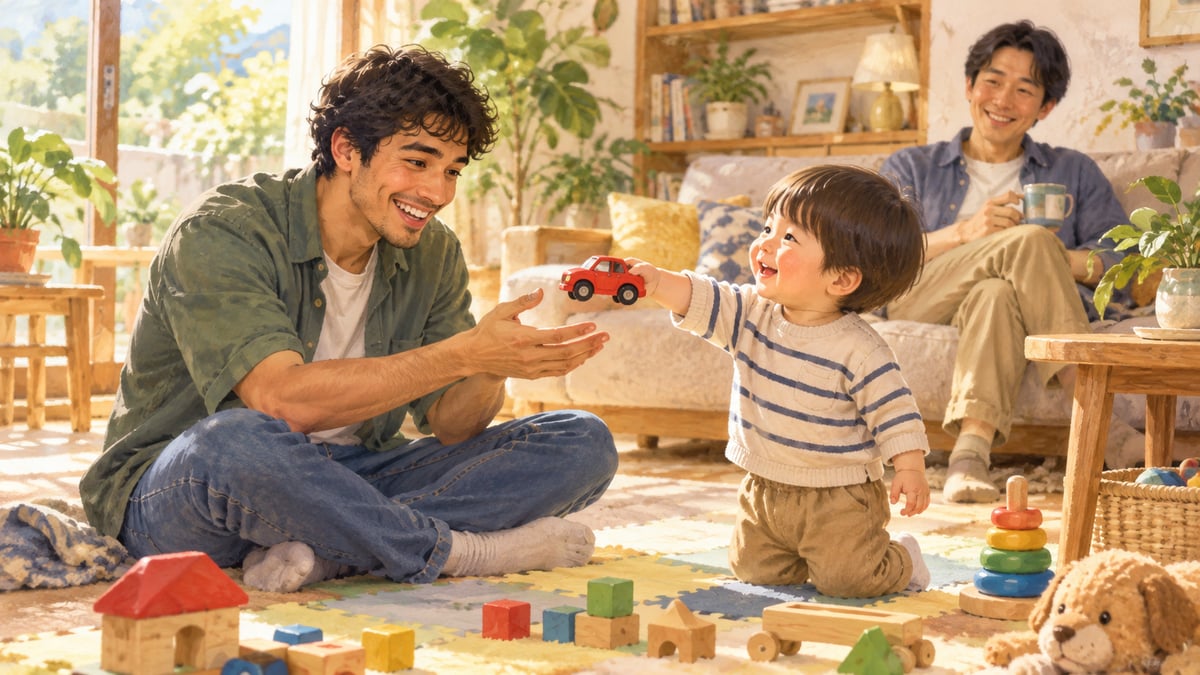
Here is a short scene of the kind you might have when you visit a friend with a two-year-old. The parent speaks to the child in baby talk and to you in normal casual Japanese, switching back and forth without thinking about it.
| Japanese | Romaji | Meaning |
|---|---|---|
| ほら、お兄ちゃんにブーブー見せてあげて。 | Hora, onīchan ni būbū misete agete. | Parent: Look, show the big brother your car. |
| ブーブー! | Būbū! | Toddler: Car! |
| わあ、かっこいいブーブーだね。 | Wā, kakkoii būbū da ne. | You: Wow, what a cool car. |
| 最近、車が大好きなんだ。 | Saikin, kuruma ga daisuki nan da. | Parent: He's crazy about cars lately. |
| だっこ! | Dakko! | Toddler: Carry me! |
| もうおねむかな。ねんねしようか。 | Mō onemu kana. Nenne shiyō ka. | Parent: Getting sleepy? Shall we go to bed? |
Notice that the parent calls you onīchan, big brother, from the child's point of view. Japanese adults often name people by their role in relation to the child: onīchan, onēchan, obachan. If you are an adult woman, you might be onēchan to a toddler, and you can take it as friendly.
When adults use baby words
A few baby forms are completely normal in adult speech. ワンちゃん (wanchan) is the standard friendly word for a pet dog, used by pet shops, vets and owners. ニャンコ (nyanko) and ネコちゃん (nekochan) are common for cats. Adults also use baby words jokingly about themselves: nenne no jikan, time for beddy-byes, after a long day.
Outside these cases, baby talk with adults can sound childish, or like flirting, and at work it is out of place. A good rule is to use it with children, with pets and in obvious jokes with close friends.
| Japanese | Romaji | Meaning |
|---|---|---|
| ワンちゃん | wanchan | doggy, pet dog (normal for adults too) |
| ニャンコ | nyanko | kitty, cat (friendly) |
| かわいいワンちゃんですね。 | Kawaii wanchan desu ne. | What a cute dog. (polite, to an owner) |
Learn the baby words with Mocchi
Ask Mocchi for a quick pairing quiz: Quiz me on Japanese baby words and their adult words, like nenne and neru. Mocchi asks one at a time, tells you which baby words adults also use, and keeps a note of the pairs you mix up so it can bring them back later. If you read Japanese picture books with a child, paste a line with /explain and Mocchi breaks it down word by word, including the sound words.
To hear the words rather than read them, add them to your Flash Card list and play Kotoba Tank with your own flashcards: hear wanwan or būbū and hit the right card.
Common learner mistakes
- Using baby talk with adults to sound cute. With children and pets it is warm; with coworkers it is strange.
- Calling your own pet dog inu-chan. The natural word is wanchan, or the dog's name.
- Saying dame! sharply for small things. Parents often use the softer me' or explain gently.
- Missing that būbū can mean a car or a pig. Look at what the child is pointing at.
- Thinking baby talk is only for babies. Parents keep phrases like itai no itai no tonde ike for years.