
Why rereading a list feels productive and is not
Reading a list of twenty words with their meanings is comfortable because every word looks familiar by the third pass. That familiarity is the problem. Recognising a word on a page you have just read is a different skill from producing it when a shop assistant is waiting, and the page never asks you to produce anything. You close the notebook feeling that the words are learned, and the next day half of them are gone.
What builds a durable memory is the effort of retrieval: being asked for the word and having to reach for it. The reach is uncomfortable, which is why learners avoid it, and the discomfort is the signal that the memory is being strengthened. A well-designed game makes that reach happen dozens of times in a few minutes and makes it feel like play rather than a test.
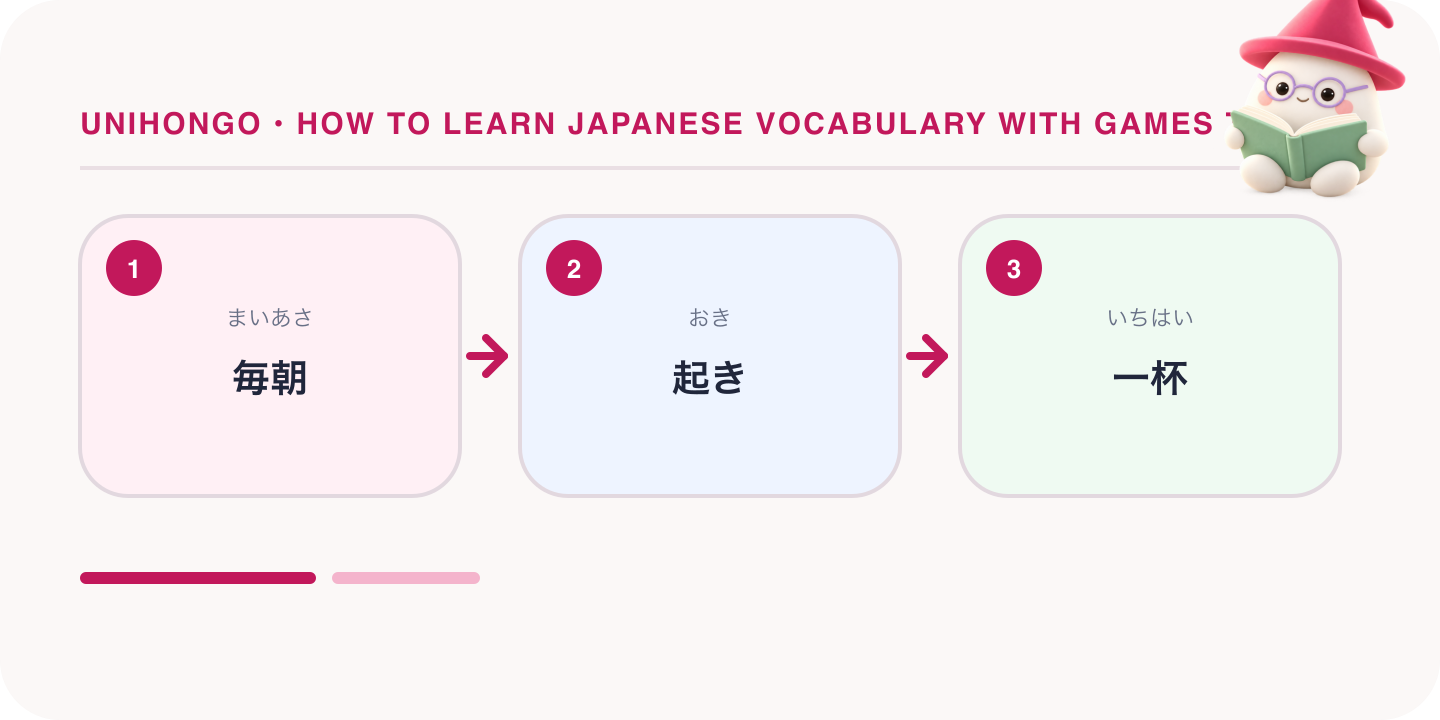
Retrieval under light time pressure
Time pressure adds one more useful thing. Without it, you can translate slowly through your first language: what was mizu, water, yes, water. With a few seconds on the clock, that route is too slow, and you start linking the Japanese word directly to its meaning. That direct link is what you need in conversation, where nobody waits while you translate. The pressure should be light. A timer that causes panic makes you guess rather than recall.
The other benefit of a timed round is that it ends. Three minutes of full attention beats twenty minutes of drifting, and a game that stops naturally makes it easy to do one more round tomorrow. Vocabulary is built by many short sessions across days, not by one long session, because each return to a word after a gap is worth more than a repetition made straight away.
What a good vocabulary game must do
- Force recall: the answer must not be visible before you commit to it.
- Mix directions: ask for the meaning of a Japanese word, and the Japanese for a meaning, in the same round.
- Keep rounds short so that attention stays high and a return tomorrow is easy.
- Feed back errors immediately, then bring the missed word back within the same round.
- Draw from a deck you actually need, such as travel words before a trip or the JLPT level you are sitting.
- Lead somewhere: the words should end up in flashcards and then in your own spoken sentences.
The arcade games and what each trains
| Game | What you do | What it trains |
|---|---|---|
| Vocabulary Dash | Run through a 3D lane and steer into the gate with the correct meaning or Japanese word | Fast recall in both directions under a timer |
| Kotoba Stack | Choose the Japanese word that matches the clue; each right answer adds a block to your tower | Meaning to Japanese recall, with a visible streak |
| Sushi Sort | Read the customer's Japanese order and send the right plate down the conveyor in time | Reading Japanese and acting on it quickly |
| Listen & Pick | Hear a Japanese word and choose its meaning without seeing the word first | Listening recognition of vocabulary |
| Sentence Builder | Tap Japanese chunks into the correct order | Word order and particles around the words you know |
| Quick Flip | Try to remember the meaning before you flip the flashcard | Pure recall of your own saved words |
| Say It! | Listen, say the word aloud, reveal the reading, and decide whether to clear it | Pronunciation and self-assessment |
The arcade lives at unihongo.com/games under the motto short rounds, real progress, and every game is free without an account. Vocabulary Dash offers Everyday, Travel and Food decks, your saved flashcards, and JLPT N5 to N1 vocabulary packs, so it is the natural centre of a routine. Hiragana and katakana have their own runner, Kana Dash, which belongs in your plan only until you can read kana without hesitation.
Vocabulary Dash and the Everyday deck
Vocabulary Dash is a 3D lane runner. Gates appear ahead showing words, and you steer into the one that matches: sometimes the meaning of a Japanese word, sometimes the Japanese for a meaning. That switch of direction is the feature to value, because most learners are much stronger at reading Japanese than at producing it, and the game refuses to let them stay on the comfortable side.
Start with the Everyday deck, whose words are the ones that fill ordinary sentences: morning, water, work, friend, phone, time. After a round, do not move straight to the next one. Take five words you passed through and put each into a sentence out loud. The sentences below show the kind of frames that make everyday nouns usable rather than merely recognised.
| Japanese | Romaji | Meaning |
|---|---|---|
| 毎朝七時に起きます。 | Maiasa shichi-ji ni okimasu. | I get up at seven every morning. |
| 水を一杯ください。 | Mizu o ippai kudasai. | A glass of water, please. |
| 今、仕事中です。 | Ima, shigoto-chū desu. | I am at work right now. |
| 友達に電話をかけます。 | Tomodachi ni denwa o kakemasu. | I will phone a friend. |
| 時間がありません。 | Jikan ga arimasen. | I have no time. |
| 今日は天気がいいですね。 | Kyō wa tenki ga ii desu ne. | The weather is nice today, isn't it? |
Kotoba Stack and Sushi Sort: reading and reacting
Kotoba Stack asks for the Japanese word that matches a clue and rewards each correct answer with a block on your tower. The tower gives you a streak you can see, which is motivating, but its real value is that the clue comes first and the Japanese has to be produced. Sushi Sort works the other way. A customer's order appears in Japanese, and you have to read it and send the right plate before time runs out, which is a small rehearsal for every menu, sign and station board you will ever have to act on quickly.
Food and travel words are the natural decks for these two games, because they are the words you will need at speed in real places. The rows below turn Food deck vocabulary into the sentences you would say across a counter, and the sushi lines are the kind of order Sushi Sort trains you to read.
| Japanese | Romaji | Meaning |
|---|---|---|
| 魚は好きですか? | Sakana wa suki desu ka? | Do you like fish? |
| 野菜をたくさん食べます。 | Yasai o takusan tabemasu. | I eat a lot of vegetables. |
| 卵は入っていますか? | Tamago wa haitte imasu ka? | Does it contain egg? |
| 肉なしでお願いします。 | Niku nashi de onegai shimasu. | Without meat, please. |
| お茶をもう一杯いかがですか? | Ocha o mō ippai ikaga desu ka? | Would you like another cup of tea? |
| ご飯は大盛りにできますか? | Gohan wa ōmori ni dekimasu ka? | Can I have a large serving of rice? |
| まぐろをひとつお願いします。 | Maguro o hitotsu onegai shimasu. | One tuna, please. |
| サーモンとえびをください。 | Sāmon to ebi o kudasai. | Salmon and prawn, please. |
| たまごを二皿お願いします。 | Tamago o futasara onegai shimasu. | Two plates of egg, please. |
Listen & Pick and Quick Flip: ears and memory
Listen & Pick removes the written word entirely. You hear a Japanese word and choose its meaning, and because the word is not shown first, you cannot lean on kanji or spelling. This is the game that exposes the gap between words you can read and words you can catch by ear, and that gap is usually larger than learners expect. Play it with the same deck you ran in Vocabulary Dash so that the ear catches up with the eye.
Quick Flip is the plainest game and the one to use first each day. A card shows one side, you try to remember the other before you flip, and you judge yourself honestly. Your saved flashcards appear here automatically, which means the words that came up in your own speaking sessions are the ones you drill. Travel words make a good test set because you will need them under pressure at a station.
| Japanese | Romaji | Meaning |
|---|---|---|
| 駅はどこですか? | Eki wa doko desu ka? | Where is the station? |
| 切符を二枚お願いします。 | Kippu o nimai onegai shimasu. | Two tickets, please. |
| 荷物を預けたいです。 | Nimotsu o azuketai desu. | I would like to leave my luggage. |
| 地図を見せてください。 | Chizu o misete kudasai. | Please show me the map. |
| ホテルまでどのくらいですか? | Hoteru made dono kurai desu ka? | How far is it to the hotel? |
| 出口はあちらです。 | Deguchi wa achira desu. | The exit is over there. (a typical reply) |
A ten-minute daily plan
The plan below is deliberately short so that it survives busy days. It moves from the easiest form of recall to the hardest, and it finishes with speech, because a word you have never said is not yet yours. On days when you have more time, add a Sentence Builder round or a Say It! quest rather than extending any single step.
| Minutes | Do this | Why it is there |
|---|---|---|
| 0 to 2 | Quick Flip through your saved flashcards, answering aloud | Warms up recall on the words that came from your own conversations |
| 2 to 5 | One Vocabulary Dash run on today's deck | Mixed-direction recall with a light timer |
| 5 to 7 | Listen & Pick on the same deck | Moves the words from eye to ear |
| 7 to 10 | Say five of the words in sentences to your AI Sensei in the 3D classroom | Turns recognition into production, and the report catches errors |
Keep the deck the same for a week. Rotating decks daily feels like progress but spreads the repetitions too thin, and a word needs to return several times across several days before it stays. When the Everyday deck feels easy in Listen & Pick, that is the signal to move to Travel or Food, or to the JLPT pack for the level you are preparing.
Saying the words in a sentence
The final three minutes are where the games pay off. Bring the words to your AI Sensei and use them, one per sentence, then answer whatever comes back. The exchange is small, but it is the only step in the plan that checks whether you can produce the word in a live turn, with the pronunciation and the particle attached. The lines below show how to run it, including asking for the reading of a word you only know by sight.
| Japanese | Romaji | Meaning |
|---|---|---|
| 今日、新しい言葉を五つ覚えました。 | Kyō, atarashii kotoba o itsutsu oboemashita. | I learned five new words today. |
| いいですね。ひとつ使ってみてください。 | Ii desu ne. Hitotsu tsukatte mite kudasai. | Good. Try using one. (Sensei) |
| 荷物が重いです。 | Nimotsu ga omoi desu. | My luggage is heavy. |
| 正しいです。荷物は何個ありますか? | Tadashii desu. Nimotsu wa nan-ko arimasu ka? | Correct. How many pieces of luggage do you have? (Sensei) |
| 二つあります。 | Futatsu arimasu. | I have two. |
| 「切符」はどう発音しますか? | "Kippu" wa dō hatsuon shimasu ka? | How do you pronounce kippu? |
| 「きっぷ」です。小さい「っ」で一拍止めます。 | "Kippu" desu. Chiisai "tsu" de ippaku tomemasu. | It is kippu. Pause for one beat on the small tsu. (Sensei) |
| この言葉の意味は何ですか? | Kono kotoba no imi wa nan desu ka? | What does this word mean? |
| 例文をお願いします。 | Reibun o onegai shimasu. | An example sentence, please. |
| もう一度言ってもいいですか? | Mō ichido itte mo ii desu ka? | May I say it once more? |
The trap of playing for score
Games come with scores, and scores are easy to chase. The trap is that a rising score in Vocabulary Dash measures recognition speed on the game's terms, not your ability to use the word with a person. It is entirely possible to reach a high score on the Travel deck and still freeze at a ticket counter. If you notice that you are replaying rounds to beat a number while the speaking step keeps getting skipped, the games have quietly replaced the goal instead of serving it.
The cure is a rule: no second round until the words from the first have been said in sentences. Use the score for what it is good for, which is showing you which words you keep missing and whether the ear is catching up with the eye, and let the session report from your speaking practice be the score that matters.