
Have a nice day in Japanese: four ways to say it
Instead of one phrase for every goodbye, Japanese gives you a small set, each tied to a situation. The four below cover most of the moments where English speakers would say have a nice day or have a good one.
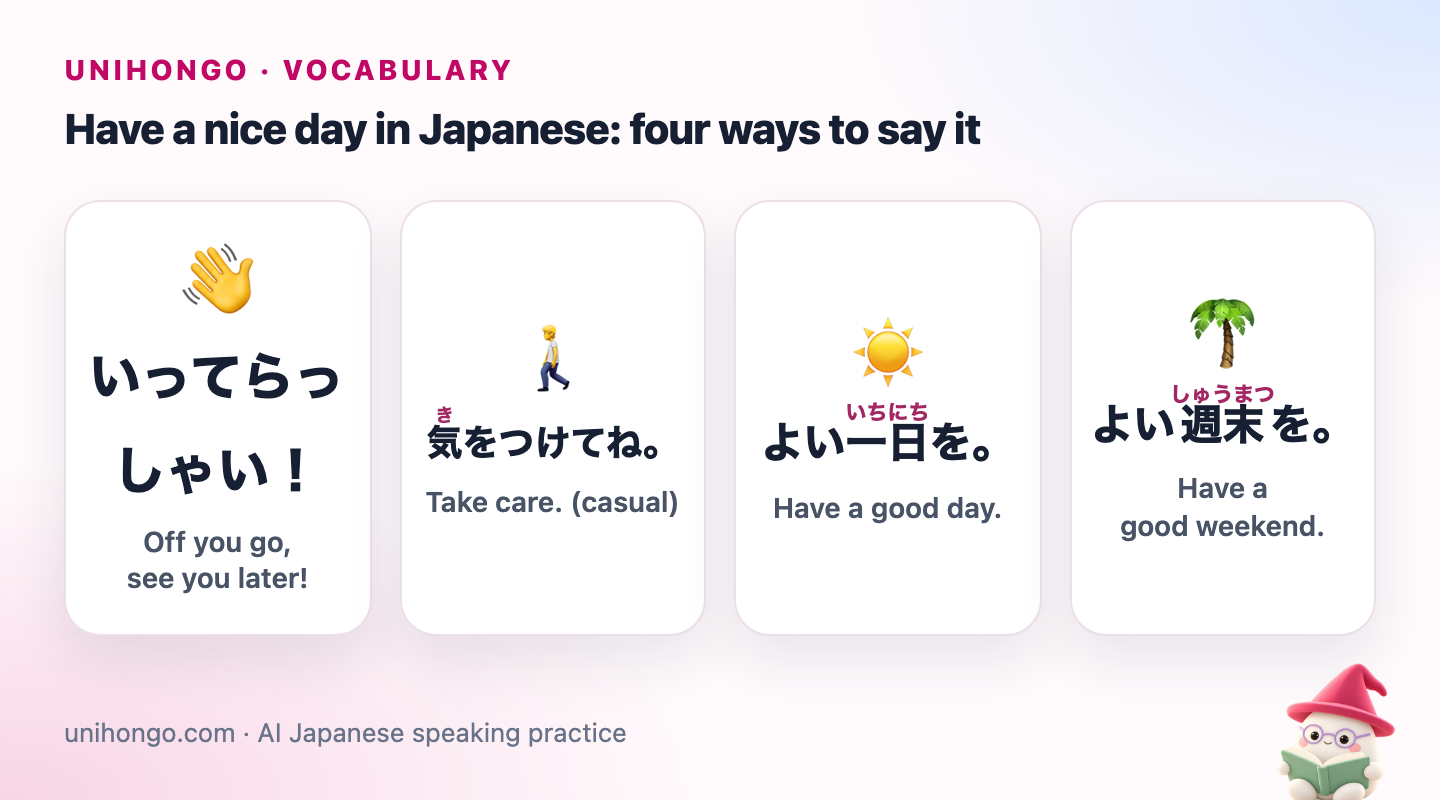
| Japanese | Romaji | Meaning |
|---|---|---|
| いってらっしゃい! | Itterasshai! | Off you go, see you later! |
| 気をつけてね。 | Ki o tsukete ne. | Take care. (casual) |
| よい一日を。 | Yoi ichinichi o. | Have a good day. |
| よい週末を。 | Yoi shūmatsu o. | Have a good weekend. |
Yoi is the slightly more formal form of ii, good, and the particle o leaves the verb unsaid, the same way English drops I wish you. The full polite form adds o-sugoshi kudasai, please spend it.
Why there is no direct equivalent
Have a nice day is a general, friendly wish that works with strangers. Japanese goodbye phrases are more specific: they comment on what the other person is about to do. Someone is going out, so you say go and come back. Someone has finished work, so you thank them for their effort. Someone is going home in the rain, so you tell them to be careful. The warmth is in recognising the situation rather than in wishing a good day in general.
Yoi ichinichi o is understood by everyone and is not wrong. It is just more at home in writing, social media posts, hotel and shop greetings, and announcements than in a quick spoken goodbye between friends. If you say it to a cashier, it sounds polite but slightly translated. Many people simply say arigatō gozaimasu and smile, and that is complete in Japanese.
Itterasshai and ittekimasu: the send-off pair
Ittekimasu, literally I'll go and come back, is what you say when you leave home, the office or a hotel. The people staying answer itterasshai, go and come back. It is one of the warmest exchanges in daily life: families say it every morning, coworkers say it when someone leaves for a client visit, and hotel staff say itterasshaimase to guests going out for the day.
When the person returns, the pair continues: tadaima, I'm back, and okaerinasai, welcome back. You can add ki o tsukete to itterasshai to turn it into a real wish for the day. Itterasshai is for someone who will come back, so it is not used for a final goodbye, such as a guest leaving your house for good.
| Japanese | Romaji | Meaning |
|---|---|---|
| いってきます。 | Ittekimasu. | I'm off. (said when leaving) |
| いってらっしゃい、気をつけてね。 | Itterasshai, ki o tsukete ne. | See you later, take care. |
| いってらっしゃいませ。 | Itterasshaimase. | Have a good day out. (hotel staff, very polite) |
| ただいま。 | Tadaima. | I'm back. |
| おかえりなさい。 | Okaerinasai. | Welcome back. |
Ki o tsukete and other parting wishes
Ki o tsukete (気をつけて) means be careful or take care, and it is the most useful spoken substitute for have a nice day when someone is leaving. Ki o tsukete ne is casual and warm, o-ki o tsukete is polite, and o-ki o tsukete o-kaeri kudasai, please get home safely, is what a host says to guests leaving in the evening.
Among friends, a parting wish often names the plan: tanoshinde ne, have fun, or ganbatte ne, good luck. At work in the evening, otsukaresama deshita, thank you for your hard work, does the job of have a good evening. Mata ashita, see you tomorrow, is fine between classmates and close colleagues.
| Japanese | Romaji | Meaning |
|---|---|---|
| お気をつけて。 | O-ki o tsukete. | Take care. (polite) |
| お気をつけてお帰りください。 | O-ki o tsukete o-kaeri kudasai. | Please get home safely. (polite) |
| お疲れさまでした。 | Otsukaresama deshita. | Thanks for your hard work today. |
| じゃあ、また明日。 | Jā, mata ashita. | Well, see you tomorrow. |
| 楽しんできてね。 | Tanoshinde kite ne. | Have fun out there. |
In shops, cafés and hotels
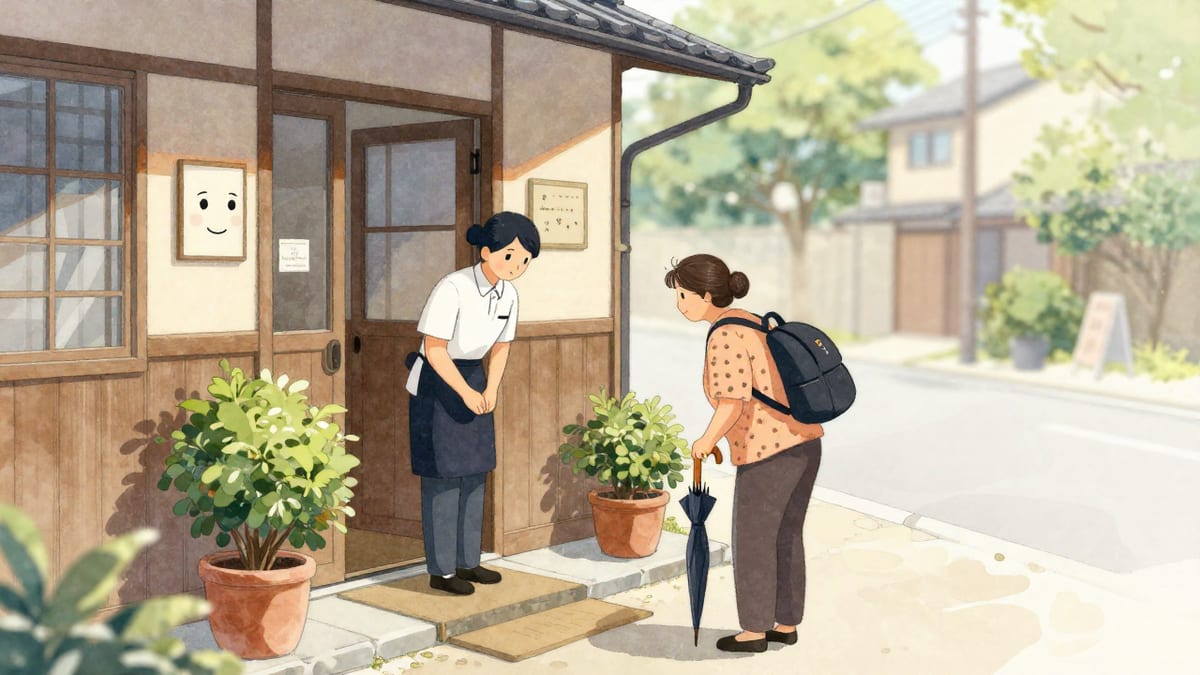
Staff use their own fixed phrases, and you mainly need to understand them. At the end of a purchase you will hear arigatō gozaimashita, thank you very much, and often mata o-koshi kudasaimase, please come again. Hotel staff may say itterasshaimase as you head out for sightseeing and okaerinasaimase when you come back.
As a customer, you do not need a matching wish. A small nod and arigatō gozaimasu, or gochisōsama deshita when you leave a restaurant, is the natural reply. Saying yoi ichinichi o to a cashier is not rude, but it may get a surprised smile.
| Japanese | Romaji | Meaning |
|---|---|---|
| ありがとうございました。 | Arigatō gozaimashita. | Thank you very much. (staff) |
| またお越しくださいませ。 | Mata o-koshi kudasaimase. | Please come again. (staff) |
| ごちそうさまでした。 | Gochisōsama deshita. | Thank you for the meal. (customer leaving) |
Weekends, holidays and email closings
Yoi shūmatsu o comes into its own on Friday afternoon, both spoken between colleagues and written at the end of an email. Before a long holiday, people say yoi o-yasumi o, have a good break, and at the end of December, yoi o-toshi o, have a good New Year, is the standard farewell for the last meeting of the year.
Business emails usually end with yoroshiku onegai itashimasu rather than a wish for a good day. If you want something friendlier, add a line about the weather or the season before it, such as go-jiai kudasai, please take care of yourself, which suits cold or very hot periods.
| Japanese | Romaji | Meaning |
|---|---|---|
| よい週末をお過ごしください。 | Yoi shūmatsu o o-sugoshi kudasai. | Have a good weekend. (polite, email) |
| よいお休みを。 | Yoi o-yasumi o. | Have a good holiday. |
| よいお年を。 | Yoi o-toshi o. | Have a good New Year. (said before it) |
| 寒い日が続きますので、ご自愛ください。 | Samui hi ga tsuzukimasu node, go-jiai kudasai. | It's staying cold, so please take care of yourself. (email) |
| 引き続きよろしくお願いいたします。 | Hikitsuzuki yoroshiku onegai itashimasu. | Thank you for your continued cooperation. (email closing) |
Mini dialogue: leaving the office on Friday
Here is the exchange you will hear in many offices at the end of the week. Notice that nobody says have a nice day: the thanks and the weekend wish carry the warmth.
| Japanese | Romaji | Meaning |
|---|---|---|
| お先に失礼します。 | Osaki ni shitsurei shimasu. | You: I'm heading off before you. |
| お疲れさまでした。よい週末を。 | Otsukaresama deshita. Yoi shūmatsu o. | Colleague: Thanks for today. Have a good weekend. |
| ありがとうございます。田中さんも。 | Arigatō gozaimasu. Tanaka-san mo. | You: Thank you. You too, Tanaka-san. |
| 雨なので、気をつけて。 | Ame na node, ki o tsukete. | Colleague: It's raining, so take care. |
Common mistakes
- Translating word for word: ii hi o motte kudasai, please hold a good day, is not Japanese.
- Saying sayōnara to colleagues at the end of the day. It sounds final; use otsukaresama deshita or osaki ni shitsurei shimasu.
- Using itterasshai for someone who is leaving for good. It assumes they will come back.
- Answering itterasshai with itterasshai. The person leaving says ittekimasu.
- Using yoi ichinichi o in every spoken goodbye. It is fine in writing and with staff, but a situational phrase sounds warmer.