
Ichiou in four everyday lines
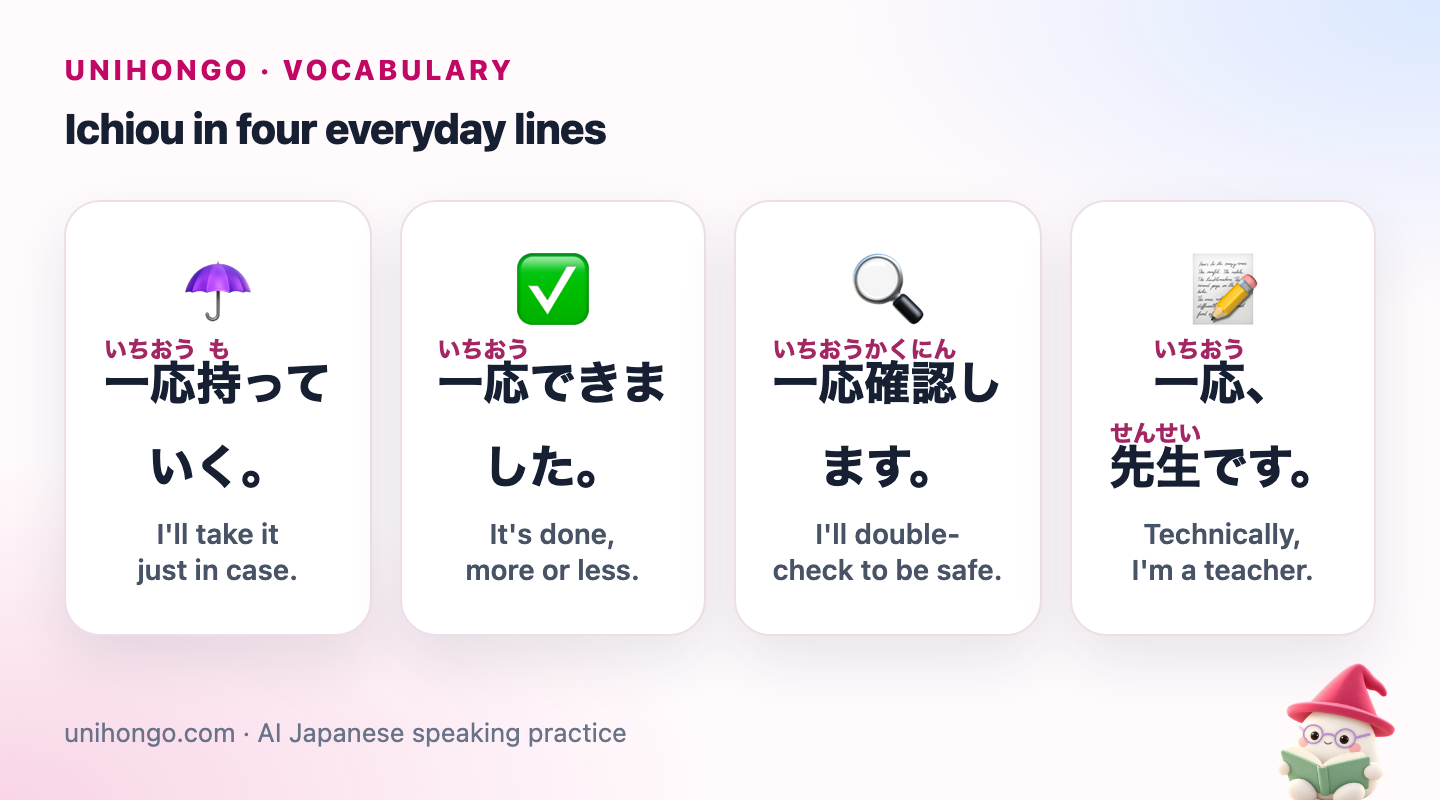
Here are the four uses you will meet most. In each line, ichiō takes a little weight off the sentence: the umbrella is only a precaution, the work is only 'more or less' done, the check is only to be safe, and the title is mentioned without pride.
| Japanese | Romaji | Meaning |
|---|---|---|
| 一応持っていく。 | Ichiō motte iku. | I'll take it just in case. |
| 一応できました。 | Ichiō dekimashita. | It's done, more or less. |
| 一応確認します。 | Ichiō kakunin shimasu. | I'll double-check to be safe. |
| 一応、先生です。 | Ichiō, sensei desu. | Technically, I'm a teacher. |
The word and its kanji
Ichiō is written 一応: 一 (one) and 応 (respond), the kanji you also see in hannō (反応), reaction, and taiō (対応), handling or response. Many dictionaries note that the word was once written 一往, 'one going', with a sense of 'once through' or 'for the moment', and that 一応 later became the standard spelling. Either way, the modern feeling is 'to a basic extent': done once, not thoroughly.
It is an adverb, so it usually comes at the start of a sentence or right before the verb. In speech it is often followed by a tiny pause, ichiō, ..., which signals that a hedge is coming. It is common in both writing and speech, and it is usually written in kanji.
| Japanese | Romaji | Meaning |
|---|---|---|
| 一応、伝えておきます。 | Ichiō, tsutaete okimasu. | I'll pass it on, just so they know. |
| 一応、聞いてみるね。 | Ichiō, kiite miru ne. | I'll ask anyway, just in case. |
| 一応、メモしておこう。 | Ichiō, memo shite okō. | Let me jot it down, just in case. |
Just in case: preparing for maybe
The most common everyday use is a precaution. The sky is blue but the forecast says showers, so you take an umbrella, ichiō. You are probably fine for the trip, but you pack medicine, ichiō. You think the restaurant will have space, but you reserve, ichiō. The speaker does not expect the problem; they are simply being careful.
This use sounds sensible and considerate, and Japanese speakers use it constantly in daily planning. It is close to English 'just in case', 'to be on the safe side' or 'anyway'.
| Japanese | Romaji | Meaning |
|---|---|---|
| 一応、傘を持っていこう。 | Ichiō, kasa o motte ikō. | Let's take an umbrella just in case. |
| 一応、予約しておいたよ。 | Ichiō, yoyaku shite oita yo. | I booked, to be on the safe side. |
| 一応、薬も入れておく。 | Ichiō, kusuri mo irete oku. | I'll pack some medicine too, just in case. |
| 一応、充電器も持ってる。 | Ichiō, jūdenki mo motteru. | I've got a charger too, just in case. |
A friend who sees you packing an umbrella on a sunny day might ask, kasa? hareteru yo, 'an umbrella? It's sunny'. The natural answer is simply ichiō ne, 'just in case', often with a shrug. Those two words are a complete reply, and you will hear them all the time.
You can also use ichiō when you pass on information that may or may not matter: ichiō tsutaete oku kedo, ashita wa yasumi da yo, 'just so you know, tomorrow is a day off'. It tells the listener you are being thorough, not insisting.
More or less: done, but not perfect
Ichiō before a result means 'more or less', 'basically' or 'in a rough form'. Ichiō dekita, I've more or less finished; ichiō wakatta, I sort of understand; ichiō tabereru, it's edible, technically. The speaker is lowering expectations, sometimes out of modesty and sometimes because the result really is rough.
Listeners often hear a quiet 'but...' after it. Ichiō dekimashita kedo, 'it's done, but...', invites the other person to check or comment. Among friends this is a friendly way to share work in progress. At work it can be useful when you genuinely want feedback, but it can also worry a manager who needed something finished.
| Japanese | Romaji | Meaning |
|---|---|---|
| 一応できたけど、見てもらえる? | Ichiō dekita kedo, mite moraeru? | It's more or less done; could you look? |
| 一応わかったと思う。 | Ichiō wakatta to omou. | I think I sort of get it. |
| 一応、日本語は話せます。 | Ichiō, Nihongo wa hanasemasu. | I can speak Japanese, to some extent. |
| 一応、食べられるよ。 | Ichiō, taberareru yo. | It's edible, technically. (joking about cooking) |
Technically: modest titles and facts
Ichiō also introduces a fact you do not want to sound proud of: technically, officially, on paper. Ichiō kachō desu, I'm technically the section manager. Ichiō, kore demo shufu desu, believe it or not, I'm a homemaker. It is a gentle, self-deprecating way to state your role, and it often comes with a smile or a small laugh.
It can also mark something true on paper but not really in practice: ichiō kinen desu kedo, minna sutte imasu, 'officially it's non-smoking, but everyone smokes'. Here ichiō carries a hint of irony.
When someone introduces themselves this way, do not take the hedge literally. If a new acquaintance says ichiō, ryōri kyōshitsu no sensei desu, they are a cooking teacher, and a warm reaction such as e, sugoi desu ne, oh, that's impressive, is the natural reply. The modesty invites your interest; it does not mean they are bad at the job.
| Japanese | Romaji | Meaning |
|---|---|---|
| 一応、課長です。 | Ichiō, kachō desu. | I'm technically the section manager. |
| 一応、英語の先生をしています。 | Ichiō, Eigo no sensei o shite imasu. | I work as an English teacher, for what it's worth. |
| 一応、禁煙ですけど… | Ichiō, kin'en desu kedo... | It's officially non-smoking, but... |
| 一応、ベジタリアンです。 | Ichiō, bejitarian desu. | I'm vegetarian, I should mention. |
Ichiō at work, and close relatives
At work, ichiō is everywhere in quick checks: ichiō kakunin shimasu, ichiō tsutaete okimasu. That is fine. The risk is ichiō with a report of finished work: a manager hearing ichiō owarimashita may wonder what is missing. If the work is done, say it is done. If you want a check, ask for one clearly.
For 'just to be sure' in polite or written Japanese, nen no tame (念のため) is the standard choice, and it sounds careful rather than unsure. The table compares ichiō with its neighbours.
| Japanese | Romaji | Meaning |
|---|---|---|
| 念のため、ご確認ください。 | Nen no tame, go-kakunin kudasai. | Please check, just to be sure. (polite) |
| 念のため、もう一度お送りします。 | Nen no tame, mō ichido ookuri shimasu. | I'll send it once more, to be sure. |
| 資料、完成しました。ご確認お願いします。 | Shiryō, kansei shimashita. Go-kakunin onegai shimasu. | The materials are finished. Please check them. |
| Word | Core feeling | Typical sentence |
|---|---|---|
| ichiō | Just in case; more or less; technically | Ichiō kakunin shimasu |
| nen no tame | Just to be sure (careful, formal) | Nen no tame, go-kakunin kudasai |
| toriaezu | For now, as a first step | Toriaezu kore de ikō |
| ittan | For the moment, then return | Ittan sōshin shimasu |
| mochiron | Of course (the opposite of hedging) | Mochiron dekimasu |
Mini dialogue: before the client meeting
Two coworkers prepare for a meeting. One uses ichiō in a helpful way, the other learns to say it less. Notice how the senior colleague reacts to 'more or less done'.
The fix is simple: the junior first states clearly that the work is finished, then names the one thing they want to check, using nen no tame. The senior's ichiō at the end is the good kind, a sensible precaution.
| Japanese | Romaji | Meaning |
|---|---|---|
| プレゼンの資料、できた? | Purezen no shiryō, dekita? | Senior: Are the presentation slides ready? |
| はい、一応できました。 | Hai, ichiō dekimashita. | You: Yes, more or less. |
| 一応って?何か残ってる? | Ichiō tte? Nanika nokotteru? | Senior: More or less? Is anything left? |
| いえ、全部できています。念のため数字だけ確認したいです。 | Ie, zenbu dekite imasu. Nen no tame sūji dake kakunin shitai desu. | You: No, it's all done. I'd just like to check the figures to be sure. |
| 了解。一応、プロジェクターも予約しておくね。 | Ryōkai. Ichiō, purojekutā mo yoyaku shite oku ne. | Senior: Got it. I'll book a projector too, just in case. |
Common learner mistakes
- Reporting finished work with ichiō. It can sound unfinished. If it is done, say owarimashita or kansei shimashita.
- Using ichiō where you mean 'definitely'. Ichiō weakens the sentence; for a firm promise, use kanarazu (without fail).
- Confusing ichiō and toriaezu. Toriaezu is a first step; ichiō is a hedge or precaution.
- Hedging every sentence. A few ichiō sound modest; too many sound as if you are never sure of anything.
- Writing it as いちお. The long vowel matters: いちおう, ichiō.
- Treating someone else's ichiō as weakness. When a Japanese speaker hedges about their own skills, it is usually modesty, so respond with interest rather than doubt.
- Putting it at the end of the sentence. Ichiō normally comes first or before the verb; tagged on at the end, as in dekita yo, ichiō, it sounds like a casual afterthought.
Turn ichiō into a habit with Mocchi
Write three sentences about your week with ichiō, then send them to Mocchi with /correct. Mocchi points out where the hedge sounds natural and where nen no tame or a plain statement would be better, and keeps a note of the pattern for your next quiz.
Then ask Mocchi to /create-flashcards for the four core lines, umbrella, more or less, double-check and technically, with a photo you pick for each. /review-flashcards brings them back over the next days, sooner for the ones you hesitate on.