
The strength ladder at a glance
Think of degree words as a ladder with two labels on every rung: how strong it is, and who you can say it to. Most learner mistakes are register mistakes rather than strength mistakes. Saying chō omoshiroi to a section manager is not wrong about the strength, it is wrong about the room. The general adverbs guide covers frequency and manner words such as itsumo and yukkuri; everything here is about degree only.
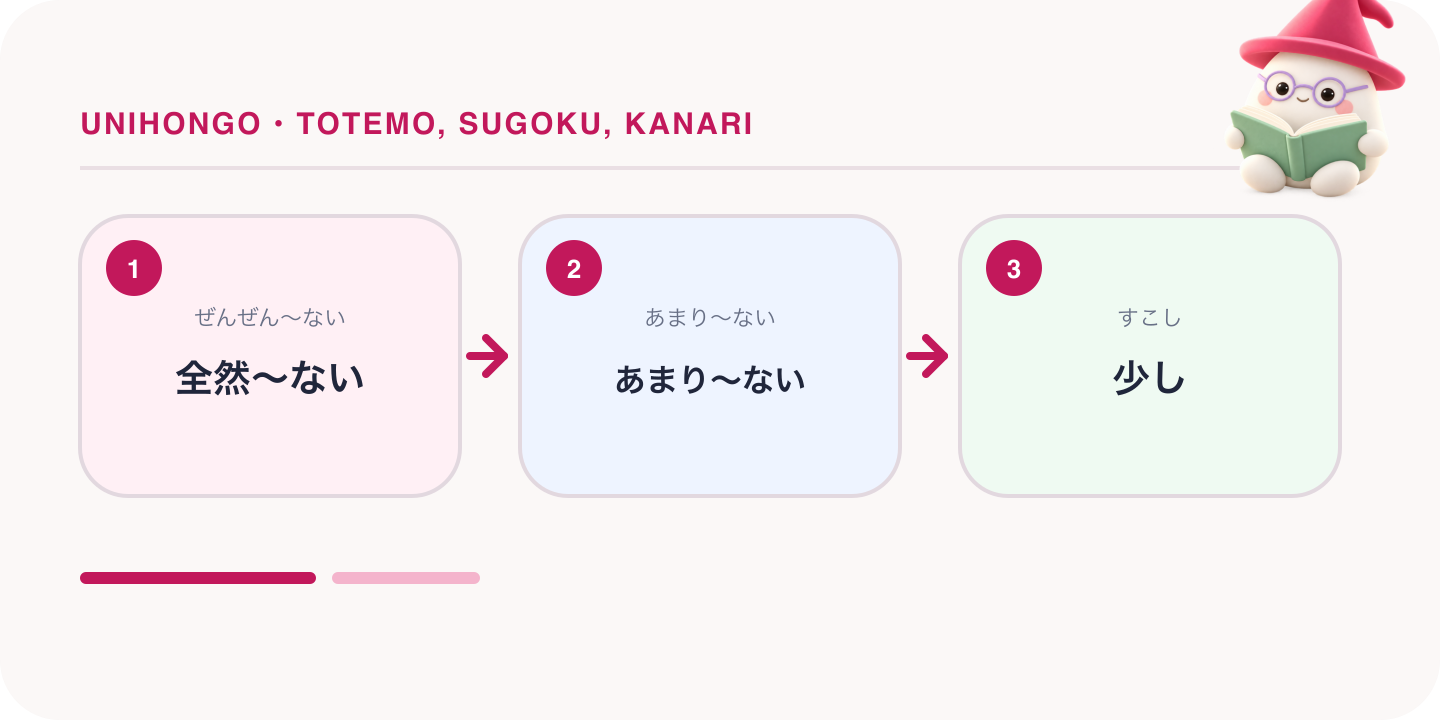
| Word | Romaji | Rough strength | Register |
|---|---|---|---|
| 全然〜ない | Zenzen ~nai | Zero | Neutral; needs a negative in careful speech |
| あまり〜ない | Amari ~nai | Low, negated | Neutral polite; anmari is the casual form |
| 少し | Sukoshi | Slight | Neutral, slightly formal, safe in writing |
| ちょっと | Chotto | Slight | Everyday spoken, also a softener |
| まあまあ | Māmā | Moderate | Casual to neutral, often lukewarm praise |
| 割と / 割合に | Warito / wariai ni | Moderate | Everyday; wariai ni sounds bookish |
| けっこう | Kekkō | Moderate to high | Spoken; carries mild surprise |
| かなり | Kanari | High | Neutral, fine at work and in writing |
| とても | Totemo | High | Neutral and safe everywhere |
| すごく | Sugoku | High | Spoken, casual to neutral |
| 本当に | Hontō ni | High, sincere | Neutral; adds truth rather than size |
| 大変 | Taihen | Very high | Formal polite speech and business writing |
| 非常に | Hijō ni | Very high | Formal and written; stiff in chat |
| ものすごく | Monosugoku | Extreme | Spoken and emphatic, still acceptable at work |
| めっちゃ | Meccha | Extreme | Young and casual, friends only |
| 超 | Chō | Extreme | Young and casual, friends only |
Read the register column first. A safe working set for a beginner is chotto, kanari, totemo and hontō ni, because none of them will embarrass you in any situation. Add sugoku for friends and colleagues, hijō ni for written Japanese, and leave meccha and chō until you can hear which of your friends use them.
Chotto and sukoshi at the quiet end
Chotto and sukoshi both mean a little, but they are not interchangeable in tone. Sukoshi is the tidier, slightly more formal word and the one you want in writing or in careful speech; shōshō is its very polite service-industry cousin. Chotto is the spoken default and does two jobs at once: it measures a small amount, and it softens whatever comes next. That second job is why chotto muzukashii desu is usually a polite refusal rather than a comment on difficulty, and why staff say chotto omachi kudasai to make a wait sound short.
| Japanese | Romaji | Meaning |
|---|---|---|
| ちょっと寒いですね。 | Chotto samui desu ne. | It is a bit cold, isn't it. |
| 少し高いですね。 | Sukoshi takai desu ne. | It is a little expensive. |
| 少々お待ちください。 | Shōshō omachi kudasai. | Staff: Please wait a moment. |
| ちょっとだけ疲れました。 | Chotto dake tsukaremashita. | I am only slightly tired. |
| もうちょっと大きい声でお願いします。 | Mō chotto ōkii koe de onegai shimasu. | A little louder, please. |
| それはちょっと難しいですね。 | Sore wa chotto muzukashii desu ne. | That would be a bit difficult. (usually a soft no) |
The comfortable middle: warito, kekkō and kanari
The middle of the ladder is where natural speech spends most of its time, and it is the part learners skip. Warito, and its stiffer relative wariai ni, mean comparatively or fairly: more than you might expect, but not remarkable. Kekkō sits a little higher and carries a flavour of pleasant surprise, so kekkō oishikatta means it was better than I assumed it would be. Kanari is the workhorse of the upper middle, meaning considerably, and it is safe in a meeting, an email or a chat with a neighbour.
Māmā deserves a warning. It looks like a middle intensifier but it functions as faint praise, roughly so-so, and answering māmā desu when someone asks how they cooked can land badly. Use it about your own performance, not about other people's.
| Japanese | Romaji | Meaning |
|---|---|---|
| 割と近いですよ。 | Warito chikai desu yo. | It is fairly close, actually. |
| 割合に静かな町です。 | Wariai ni shizuka na machi desu. | It is a comparatively quiet town. |
| けっこうおいしかったです。 | Kekkō oishikatta desu. | It was surprisingly good. |
| けっこう時間がかかりました。 | Kekkō jikan ga kakarimashita. | It took quite a while. |
| かなり混んでいますね。 | Kanari konde imasu ne. | It is quite crowded. |
| かなり難しい試験でした。 | Kanari muzukashii shiken deshita. | It was a seriously difficult exam. |
| 日本語はまあまあです。 | Nihongo wa māmā desu. | My Japanese is so-so. |
Totemo, sugoku and hijō ni
These three are the same strength and different clothes. Totemo is neutral: it will never be wrong, in speech or in writing, with a friend or with a client. Sugoku is the spoken version most people actually use with colleagues and friends, and it is the adverb form of the adjective sugoi. Hijō ni means the same thing in a suit, so it belongs in reports, announcements and formal apologies, and it sounds oddly stiff in a chat about lunch.
Taihen is the other formal option and it is worth learning as a set rather than as a free adverb. Taihen mōshiwake gozaimasen and taihen osewa ni narimashita are fixed business phrases you will hear daily, and they are the versions to memorise whole. Building new sentences with taihen is possible but easy to get slightly wrong, so keep hijō ni for those and let taihen live inside the set phrases where it belongs.
| Japanese | Romaji | Meaning |
|---|---|---|
| この本はとても面白いです。 | Kono hon wa totemo omoshiroi desu. | This book is very interesting. |
| とても助かりました。 | Totemo tasukarimashita. | That helped me a great deal. |
| すごく楽しかったです。 | Sugoku tanoshikatta desu. | It was really fun. |
| すごくうれしいです。 | Sugoku ureshii desu. | I am really happy. |
| 非常に残念です。 | Hijō ni zannen desu. | That is extremely regrettable. |
| 非常に重要な問題です。 | Hijō ni jūyō na mondai desu. | It is an extremely important issue. |
| 大変申し訳ございません。 | Taihen mōshiwake gozaimasen. | I am terribly sorry. |
| 大変お世話になりました。 | Taihen osewa ni narimashita. | Thank you very much for everything. |
Meccha, chō and the casual extreme
At the top of the spoken ladder sit monosugoku, meccha and chō. Monosugoku is emphatic but still respectable, so you can use it at work without anyone blinking. Meccha and chō are the young casual pair: meccha spread outward from western Japan and is now heard widely, and chō attaches directly to an adjective or even a noun. Both are for friends, and both sound strange in polite -masu speech, so if the rest of your sentence is formal, they will clash. Set phrases such as shinu hodo, meaning to the point of death, are stronger still and strictly casual.
| Japanese | Romaji | Meaning |
|---|---|---|
| ものすごく寒かったです。 | Monosugoku samukatta desu. | It was incredibly cold. |
| めっちゃおいしい。 | Meccha oishii. | So good. (casual) |
| めっちゃ眠い。 | Meccha nemui. | I am unbelievably sleepy. (casual) |
| 超楽しかった。 | Chō tanoshikatta. | It was super fun. (casual) |
| この店、超人気らしいよ。 | Kono mise, chō ninki rashii yo. | This place is supposedly super popular. (casual) |
| 死ぬほど疲れた。 | Shinu hodo tsukareta. | I am dead tired. (casual, strong) |
One sentence at ten intensities
The fastest way to feel the ladder is to keep the sentence still and move only the degree word. Read this set from top to bottom aloud, and notice that the polite -masu frame stays the same until the last two rows, where the casual intensifiers pull the whole sentence into plain form.
| Japanese | Romaji | Meaning |
|---|---|---|
| この映画は全然面白くないです。 | Kono eiga wa zenzen omoshiroku nai desu. | This film is not interesting at all. |
| この映画はあまり面白くないです。 | Kono eiga wa amari omoshiroku nai desu. | This film is not very interesting. |
| この映画はちょっと面白いです。 | Kono eiga wa chotto omoshiroi desu. | This film is a little interesting. |
| この映画はまあまあ面白いです。 | Kono eiga wa māmā omoshiroi desu. | This film is moderately interesting. |
| この映画は割と面白いです。 | Kono eiga wa warito omoshiroi desu. | This film is fairly interesting. |
| この映画はけっこう面白いです。 | Kono eiga wa kekkō omoshiroi desu. | This film is surprisingly interesting. |
| この映画はかなり面白いです。 | Kono eiga wa kanari omoshiroi desu. | This film is quite interesting. |
| この映画はとても面白いです。 | Kono eiga wa totemo omoshiroi desu. | This film is very interesting. |
| この映画はすごく面白いです。 | Kono eiga wa sugoku omoshiroi desu. | This film is really interesting. |
| この映画は非常に面白いです。 | Kono eiga wa hijō ni omoshiroi desu. | This film is extremely interesting. (formal) |
| この映画はものすごく面白いです。 | Kono eiga wa monosugoku omoshiroi desu. | This film is incredibly interesting. |
| この映画、めっちゃ面白い。 | Kono eiga, meccha omoshiroi. | This film is amazing. (casual) |
Record yourself saying all twelve and play them back. If the strong ones do not sound stronger than the weak ones, the problem is not vocabulary, it is delivery, and the last section of this guide is the one you need.
Amari and zenzen need a negative
Two of the most useful degree words are grammatically incomplete on their own. Amari and zenzen set up a negative, and the sentence has to finish with -nai, -masen or a negative adjective ending. Learners regularly produce amari suki desu meaning I quite like it, which is not a sentence a Japanese speaker would say; the natural version is amari suki de wa arimasen, I do not like it very much. Anmari is the same word in relaxed pronunciation. Sonna ni and chittomo behave the same way, and metta ni does the frequency version of the job.
This pattern is also the polite way to be negative, which makes it more useful than its textbook position suggests. Amari oishiku nai desu is far softer than mazui desu, and amari yoku wakarimasen is gentler than wakarimasen on its own. Reaching for a negated intensifier lets you decline an invitation, criticise a plan or disagree with a colleague while keeping the sentence mild, which is exactly how such things are usually said in Japanese.
| Japanese | Romaji | Meaning |
|---|---|---|
| あまり時間がありません。 | Amari jikan ga arimasen. | I do not have much time. |
| あまり好きではありません。 | Amari suki de wa arimasen. | I do not like it very much. |
| あんまり寝ていません。 | Anmari nete imasen. | I have not slept much. (relaxed pronunciation) |
| 全然分かりませんでした。 | Zenzen wakarimasen deshita. | I did not understand at all. |
| 全然覚えていません。 | Zenzen oboete imasen. | I do not remember it at all. |
| そんなに高くないですよ。 | Sonna ni takaku nai desu yo. | It is not that expensive. |
| ちっとも面白くなかった。 | Chittomo omoshiroku nakatta. | It was not the least bit interesting. (casual) |
| めったに行きません。 | Metta ni ikimasen. | I hardly ever go there. |
Zenzen with a positive, and what it signals
In casual modern speech, zenzen also appears in front of a positive word, where it means completely or not a problem at all. Zenzen daijōbu desu is the standard reassurance when someone apologises to you, and zenzen ii yo is its plain-form version among friends. Careful and written Japanese still expects the negative, and some older speakers dislike the positive use, so the safe rule is simple: use it as a warm reply in conversation and keep the negative pattern in anything formal.
| Japanese | Romaji | Meaning |
|---|---|---|
| 遅くなってすみません。 | Osoku natte sumimasen. | Sorry I am late. |
| いえ、全然大丈夫ですよ。 | Ie, zenzen daijōbu desu yo. | Reply: No, it is completely fine. |
| 全然いいよ。気にしないで。 | Zenzen ii yo. Ki ni shinaide. | It is totally fine. Do not worry. (casual) |
| これ、全然おいしいじゃん。 | Kore, zenzen oishii jan. | This is actually really good. (casual) |
| 全然平気です。 | Zenzen heiki desu. | I am perfectly all right. |
Intensifying verbs, not just adjectives
Degree words attach naturally to adjectives, but verbs need a different set. Quantity takes takusan, frequency and thoroughness take yoku, and change over time takes zuibun or daibu. Zuibun marks something you have noticed and are slightly surprised by, while daibu describes a gradual improvement, which is why daibu yoku narimashita is the standard answer when someone asks how your cold is. Sugoku and hontō ni do work in front of verbs of feeling and change, such as tsukaremashita or tasukarimashita.
Totemo has one important verb use worth memorising: with a negative potential form it means there is no way. Totemo taberaremasen is not I very much cannot eat, it is I could not possibly finish this, and it is a graceful way to leave food or decline an unrealistic deadline.
| Japanese | Romaji | Meaning |
|---|---|---|
| よく食べますね。 | Yoku tabemasu ne. | You really do eat a lot. |
| たくさん歩きました。 | Takusan arukimashita. | I walked a lot. |
| すごく疲れました。 | Sugoku tsukaremashita. | I got really tired. |
| 本当に助かりました。 | Hontō ni tasukarimashita. | You really saved me. |
| ずいぶん上手になりましたね。 | Zuibun jōzu ni narimashita ne. | You have got a great deal better. |
| だいぶ良くなりました。 | Daibu yoku narimashita. | I am considerably better now. |
| とても食べられません。 | Totemo taberaremasen. | There is no way I could eat all this. |
| とても間に合いません。 | Totemo maniaimasen. | There is no way I can make it in time. |
| もっと練習したいです。 | Motto renshū shitai desu. | I want to practise more. |
Doubling, stretching and intonation
A great deal of Japanese emphasis is carried by sound rather than vocabulary, which is why a native speaker can sound more emphatic than you while using a weaker word. Three moves do most of the work. Repeat the word: hayaku hayaku, hontō ni hontō ni. Insert a small tsu to double a consonant: sugoku becomes suggoku, takai becomes takkai, atsui becomes attsui. Stretch the final vowel and let the pitch fall away over it: nagāi, ureshī. The doubled-consonant and stretched forms are casual and belong in speech, not in a report.
The fourth move is pure intonation. Say totemo oishii desu with a high, held first syllable on oishii and a wide fall, and it outperforms meccha oishii said flatly. This is where learners lose most of their emphasis, and it costs nothing to fix.
| Japanese | Romaji | Meaning |
|---|---|---|
| 早く早く。 | Hayaku hayaku. | Hurry, hurry. (casual) |
| 本当に本当にすみません。 | Hontō ni hontō ni sumimasen. | I am truly, truly sorry. |
| ぜひぜひ来てください。 | Zehi zehi kite kudasai. | Please do come, really. |
| すっごく高いです。 | Suggoku takai desu. | It is really pricey. |
| たっかい。 | Takkai. | Wow, that is expensive. (casual) |
| あっつい。 | Attsui. | It is boiling. (casual) |
| ながーい会議でした。 | Nagāi kaigi deshita. | It was a very long meeting. |
| うれしー。 | Ureshī. | So happy. (casual, drawn out) |
Choosing the right rung in real situations
- With a customer or a manager you do not know: kanari, totemo, taihen, hijō ni.
- With colleagues over lunch: kekkō, kanari, sugoku, monosugoku.
- With friends your own age: sugoku, meccha, chō, plus doubling and stretching.
- In an email or a report: sukoshi, kanari, totemo, hijō ni, and never chō.
- When declining or criticising: amari plus a negative, which softens the blow.
- When reassuring someone who has apologised: zenzen daijōbu desu.
- When you want sincerity rather than size: hontō ni, which says you mean it.