
Why the counter is part of the number
In Japanese a bare number rarely stands next to a noun. You say the number, attach a counter that classifies the shape or nature of the thing, and the pair works as a single unit of speech. Because the counter is chosen by the object, learning a new noun means quietly learning which counter goes with it, the way you learn a gender in French. A separate beginner overview covers how the numbers themselves are formed; this guide assumes you can already count to a hundred and goes after the counters.
The practical order of learning is by frequency, not by category. Shop and restaurant life runs on tsu, ko, hon, mai, hai, and nin. Home and office life adds dai, satsu, and the two kai. Animals, floors, ages, and money fill in the rest. Learn each one inside a sentence you would really say, because a counter memorised on its own tends to disappear the moment you need it at a till.
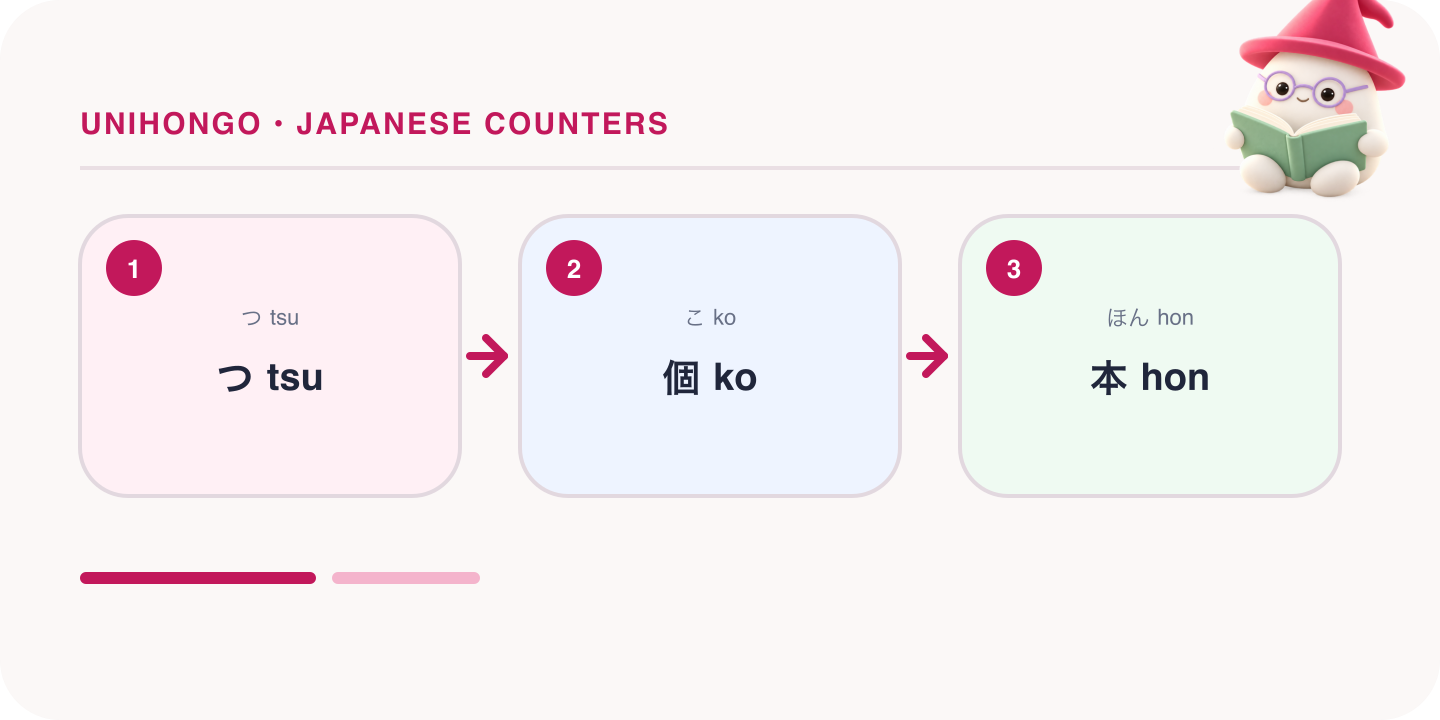
The counter table to keep
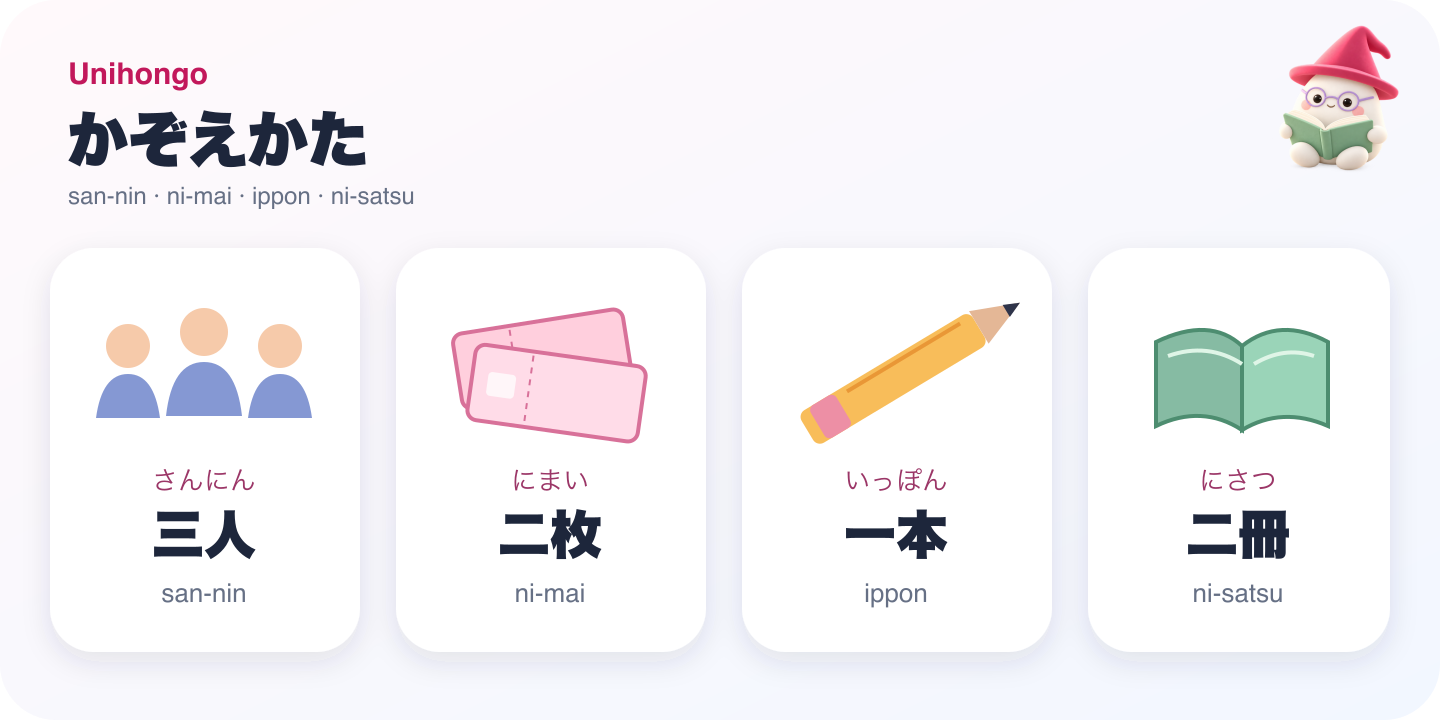
| Counter | What it counts | Irregular readings |
|---|---|---|
| つ tsu | General small objects, abstract items, young children's ages | Hitotsu, futatsu, mittsu, yottsu, itsutsu, muttsu, nanatsu, yattsu, kokonotsu, tō |
| 個 ko | Small solid objects: eggs, rice balls, batteries | Ikko, rokko, hakko, jukko |
| 本 hon | Long thin things: pens, bottles, umbrellas, trees, phone calls | Ippon, sanbon, roppon, happon, juppon |
| 枚 mai | Flat thin things: paper, tickets, shirts, plates, cards | None |
| 人 nin | People, in ordinary conversation | Hitori for one, futari for two, yonin for four |
| 名 mei | People in service and formal settings | None; the question is nanmei or nanmei-sama |
| 匹 hiki | Small animals: cats, dogs, fish, insects | Ippiki, sanbiki, roppiki, happiki, juppiki |
| 頭 tō | Large animals: cattle, horses, elephants | Ittō, hattō, juttō |
| 羽 wa | Birds and rabbits | Sanba, roppa, juppa |
| 台 dai | Machines and vehicles: cars, computers, fridges | None |
| 杯 hai | Cupfuls, glassfuls, bowlfuls | Ippai, sanbai, roppai, happai, juppai |
| 冊 satsu | Bound volumes: books, magazines, notebooks | Issatsu, hassatsu, jussatsu |
| 階 kai | Floors of a building | Ikkai, sangai, rokkai, jukkai |
| 回 kai | Times, occurrences, rounds | Ikkai, sankai, rokkai, jukkai |
| 歳 sai | Years of age | Issai, hassai, jussai, and hatachi for twenty |
| 円 en | Yen | Yo-en for four, nana-en for seven |
| 軒 ken | Houses, shops, restaurants as buildings | Ikken, sangen, rokken, jukken |
| 足 soku | Pairs of footwear and socks | Issoku, sanzoku, hassoku, jussoku |
| 着 chaku | Items of clothing as outfits | Itchaku, hatchaku, jutchaku |
| 泊 haku | Nights of a stay | Ippaku, sanpaku, roppaku, happaku, juppaku |
| 番 ban | Position in an order, numbered slots | None |
| 度 do | Times an event happened, degrees of temperature | None |
Read the middle column first when you are unsure. Most wrong-counter mistakes come from thinking about the English word rather than the physical thing: a phone call is long and thin in Japanese logic and takes hon, a shirt is flat and takes mai, and a bowl of ramen is a portion poured into a container and takes hai.
The sound changes behind ippon and sanbon
The irregular readings are not random. Numbers ending in a stop sound, which in practice means 1, 6, 8, and 10, squeeze into the following consonant and double it. Three behaves differently: it makes a following unvoiced consonant voiced in several counters. Once you hear it as one habit rather than forty separate facts, new counters become predictable on first meeting.
| Counter starts with | What 1, 6, 8, 10 do | What 3 does |
|---|---|---|
| h: 本, 杯, 匹, 泊 | It becomes a doubled p: ippon, roppon, happon, juppon | It becomes b: sanbon, sanbai, sanbiki |
| k: 回, 階, 個, 軒 | It doubles: ikkai, rokkai, hakkai, jukkai | Usually unchanged, but sangai and sangen are voiced |
| s: 冊, 歳, 足 | It doubles: issatsu, hassai, jussoku | Unchanged in satsu and sai, voiced in sanzoku |
| t: 頭, 着 | It doubles: ittō, hattō, itchaku, jutchaku | Unchanged: santō, sanchaku |
| Voiced or vowel: 枚, 台, 名, 円, 番 | Nothing changes: ichimai, rokudai, hachimei | Nothing changes: sanmai, sandai |
Two extra notes. Ten is written 十 and read either juk- or jik- before a doubled consonant, and both are correct, though juk- is more common in everyday Tokyo speech. Six behaves like one and eight only before h and k sounds, which is why it is roppon and rokkai but rokumai and rokudai.
Where the number goes in a sentence
The natural spoken position is after the noun and its particle, floating just before the verb. Ringo o mittsu kudasai is what a shopper says; mittsu no ringo o kudasai is grammatical but sounds written and stiff. The pattern noun plus particle plus number plus counter plus verb will carry almost every sentence you need, and it lets you add the quantity as an afterthought without rebuilding the sentence.
When the counted thing is the subject of an existence sentence, the same floating position applies: inu ga nihiki imasu. And when the noun is already obvious, drop it entirely and say only the number and counter, which is how most orders are actually placed once the item is on the table between you.
| Japanese | Romaji | Meaning |
|---|---|---|
| りんごを三つください。 | Ringo o mittsu kudasai. | Three apples, please. |
| ビールを二本お願いします。 | Bīru o nihon onegai shimasu. | Two bottles of beer, please. |
| 切手を五枚ください。 | Kitte o gomai kudasai. | Five stamps, please. |
| 犬が二匹います。 | Inu ga nihiki imasu. | There are two dogs. |
| これを三つ買いました。 | Kore o mittsu kaimashita. | I bought three of these. |
| 二つでいいです。 | Futatsu de ii desu. | Two is fine. |
The native series from hitotsu to tō
The tsu series is the old native Japanese counting set and it only runs from one to ten. After ten you switch to jūichi-ko or another counter. Because it does not classify shape, it works for anything small and concrete and for many abstract items such as questions, ideas, and reasons. It is also the series used for the ages of small children, so a three-year-old is mittsu.
Note the shape of each word rather than trying to derive it: hitotsu, futatsu, mittsu, yottsu, itsutsu, muttsu, nanatsu, yattsu, kokonotsu, and then plain tō with no tsu on the end. Adding -me makes an ordinal, so mittsu-me is the third one along, which is how directions are given in Japanese streets.
| Japanese | Romaji | Meaning |
|---|---|---|
| 一つください。 | Hitotsu kudasai. | One, please. |
| 二つで足りますか? | Futatsu de tarimasu ka? | Will two be enough? |
| 質問が四つあります。 | Shitsumon ga yottsu arimasu. | I have four questions. |
| 全部で九つあります。 | Zenbu de kokonotsu arimasu. | There are nine in total. |
| 十で終わりです。 | Tō de owari desu. | That is the last one, number ten. |
| 三つ目の角を右に曲がってください。 | Mittsu-me no kado o migi ni magatte kudasai. | Turn right at the third corner. |
Counting people
People take 人, but the first two are native words: hitori and futari, not ichinin and ninin. From three it is regular, except that four is yonin rather than yonnin. In restaurants, hotels, and clinics, staff switch to 名 with the honorific -sama, so the question you hear at a door is nanmei-sama desu ka, and answering sanmei desu or simply sannin desu both work.
| Japanese | Romaji | Meaning |
|---|---|---|
| 何名様ですか? | Nanmei-sama desu ka? | How many in your party? (staff) |
| 三名です。 | Sanmei desu. | Three of us. |
| 一人で来ました。 | Hitori de kimashita. | I came on my own. |
| 二人分お願いします。 | Futari-bun onegai shimasu. | Enough for two people, please. |
| 家族は四人です。 | Kazoku wa yonin desu. | There are four people in my family. |
| 何人来ますか? | Nannin kimasu ka? | How many people are coming? |
Long, flat, and small: hon, mai, ko
These three carry most shopping. Hon covers anything with length and slimness, including bottles, pens, umbrellas, bananas, and trains on a timetable. Mai covers anything thin and flat, including paper, tickets, plates, shirts, and plastic bags at a till. Ko covers small solid lumps such as eggs, rice balls, and batteries, and doubles as a general-purpose counter when the shape does not obviously fit anything else.
| Japanese | Romaji | Meaning |
|---|---|---|
| ペンを一本貸してください。 | Pen o ippon kashite kudasai. | Lend me a pen, please. |
| 傘を三本持っています。 | Kasa o sanbon motte imasu. | I have three umbrellas. |
| ビールを六本ください。 | Bīru o roppon kudasai. | Six bottles of beer, please. |
| 紙を八枚コピーしてください。 | Kami o hachimai kopī shite kudasai. | Please copy eight sheets. |
| シャツを二枚買いました。 | Shatsu o nimai kaimashita. | I bought two shirts. |
| 卵を六個ください。 | Tamago o rokko kudasai. | Six eggs, please. |
| おにぎりを一個お願いします。 | Onigiri o ikko onegai shimasu. | One rice ball, please. |
Animals take three different counters
Size decides. Small animals you could pick up take hiki: cats, dogs, fish, frogs, insects. Large livestock and animals bigger than a person take tō, which literally writes the character for head: cattle, horses, bears, elephants. Birds and, by old convention, rabbits take wa. The boundaries are fuzzy for medium dogs, and speakers differ, so hiki is the safe default for any pet you would carry.
| Japanese | Romaji | Meaning |
|---|---|---|
| 猫を二匹飼っています。 | Neko o nihiki katte imasu. | I keep two cats. |
| 犬が三匹います。 | Inu ga sanbiki imasu. | There are three dogs. |
| 魚を一匹釣りました。 | Sakana o ippiki tsurimashita. | I caught one fish. |
| 牧場に牛が十頭います。 | Bokujō ni ushi ga juttō imasu. | There are ten cows on the farm. |
| 鳥が二羽飛んでいます。 | Tori ga niwa tonde imasu. | Two birds are flying. |
Cupfuls, books, floors, machines, times, and ages
Hai counts what is in a container rather than the container itself, so a second bowl of rice is nihai-me even though you are holding one bowl. Satsu counts bound volumes. The two kai are written differently and behave slightly differently: 階 for floors gives sangai for the third floor, while 回 for occurrences keeps sankai. Dai is refreshingly regular for anything mechanical, and sai counts ages with the famous exception hatachi for twenty.
| Japanese | Romaji | Meaning |
|---|---|---|
| コーヒーを一杯ください。 | Kōhī o ippai kudasai. | One coffee, please. |
| 水を三杯飲みました。 | Mizu o sanbai nomimashita. | I drank three glasses of water. |
| 本を二冊借りました。 | Hon o nisatsu karimashita. | I borrowed two books. |
| カフェは三階です。 | Kafe wa sangai desu. | The cafe is on the third floor. |
| 六階で降ります。 | Rokkai de orimasu. | I get off on the sixth floor. |
| 車が一台あります。 | Kuruma ga ichidai arimasu. | I have one car. |
| パソコンを二台使っています。 | Pasokon o nidai tsukatte imasu. | I use two computers. |
| 日本は三回目です。 | Nihon wa sankai-me desu. | This is my third time in Japan. |
| 週に二回練習します。 | Shū ni nikai renshū shimasu. | I practise twice a week. |
| 二十歳になりました。 | Hatachi ni narimashita. | I turned twenty. |
| 娘は八歳です。 | Musume wa hassai desu. | My daughter is eight. |
| 全部で千八百円です。 | Zenbu de sen happyaku-en desu. | That is 1,800 yen altogether. |
When you do not know which counter to use
Nobody expects a learner to have all of these ready, and native speakers themselves hesitate over rare ones. What matters is that the sentence keeps moving, so build two escape routes and rehearse them until they are faster than the hesitation.
- Default to tsu for anything small, concrete, and under ten. Kore o futatsu kudasai is always acceptable in a shop.
- Default to ko if the thing is clearly a small solid lump or you need a number above ten.
- Point and say kore o kudasai, then hold up fingers. Not elegant, but the transaction completes.
- If the counter is wrong, listen for how staff repeat it back and copy that version in your next sentence.
- Collect the correct counter with the noun in your notes: bīru wa hon, chiketto wa mai. Never store a noun alone.
- Say the four irregular numbers whenever you learn a new counter, since those are the only ones that will catch you.
Counting in real situations
| Japanese | Romaji | Meaning |
|---|---|---|
| すみません、これを二つください。 | Sumimasen, kore o futatsu kudasai. | Excuse me, two of these, please. |
| 生ビールを三杯お願いします。 | Nama-bīru o sanbai onegai shimasu. | Three draught beers, please. |
| 大人二枚と子供一枚ください。 | Otona nimai to kodomo ichimai kudasai. | Two adult tickets and one child ticket, please. |
| 何個入りですか? | Nanko-iri desu ka? | How many are in the pack? |
| 一箱に十個入っています。 | Hitohako ni jukko haitte imasu. | There are ten in a box. (staff) |
| レジ袋は一枚五円です。 | Reji-bukuro wa ichimai go-en desu. | Carrier bags are five yen each. (staff) |
| 袋を一枚お願いします。 | Fukuro o ichimai onegai shimasu. | One bag, please. |
| お一人様一つまでです。 | Ohitori-sama hitotsu made desu. | One per customer. (staff) |
| 部屋を二つ予約しました。 | Heya o futatsu yoyaku shimashita. | I booked two rooms. |
| 二泊お願いします。 | Nihaku onegai shimasu. | Two nights, please. |
| もう一杯いかがですか? | Mō ippai ikaga desu ka? | Would you like another glass? (staff) |
| すみません、あと一つ追加できますか? | Sumimasen, ato hitotsu tsuika dekimasu ka? | Sorry, could I add one more? |
Notice how short the real sentences are. In a shop nobody says the noun twice, so the counter often carries the whole meaning by itself. Getting comfortable with these bare number-plus-counter answers does more for your fluency than memorising another twenty rare counters.