

Bikkuri suru, bikkuri shita and the basic grammar
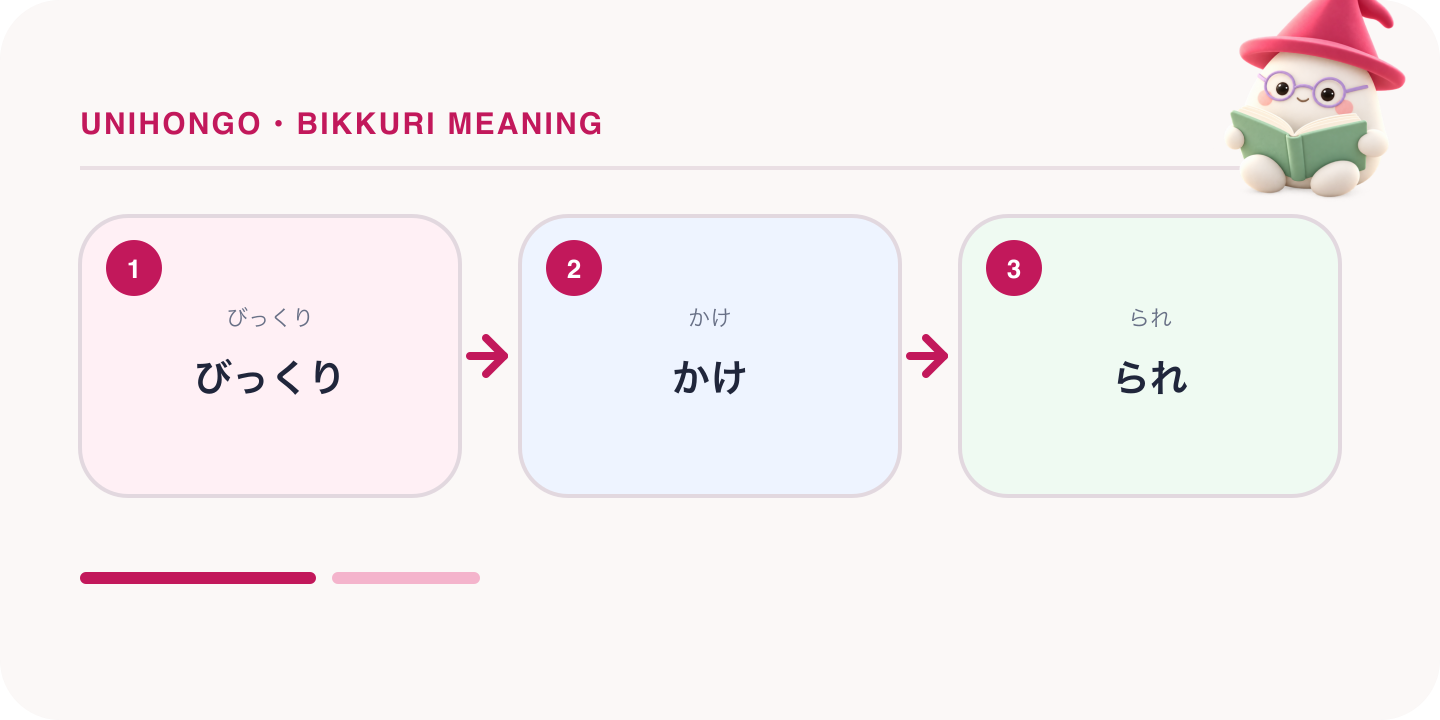
Bikkuri on its own is not a verb. Like many sound-symbolic words in Japanese, it becomes a verb with suru: bikkuri suru, to be surprised. The past, bikkuri shita, is by far the most common form, because surprise is something you report after it happens: bikkuri shita, that surprised me. The polite version is bikkuri shimashita, and the continuous bikkuri shite iru describes someone still in a state of surprise.
The cause of the surprise takes ni: totsuzen no denwa ni bikkuri shita, I was surprised by the sudden phone call. The thing that surprises you can also be a clause with the nominaliser no or koto: kare ga kita no ni bikkuri shita, I was surprised that he came. Adverbs sharpen the picture: hontō ni bikkuri shita, I was really surprised; chotto bikkuri shita, I was a little surprised.
Bikkuri also appears without suru in a few fixed shapes. Bikkuri da, it's a surprise, and bikkuri desu are used as short comments. Bikkuri no, surprising, works before a noun in casual speech: bikkuri no kekka, a surprising result.
| Japanese | Romaji | Meaning |
|---|---|---|
| びっくりした! | Bikkuri shita! | That made me jump! |
| 急に声をかけられてびっくりしました。 | Kyū ni koe o kakerarete bikkuri shimashita. | I was startled when someone suddenly spoke to me. |
| 値段にびっくりした。 | Nedan ni bikkuri shita. | The price surprised me. |
| まだびっくりしている。 | Mada bikkuri shite iru. | I'm still in shock. |
| ちょっとびっくりしただけ。 | Chotto bikkuri shita dake. | It just surprised me a little. |
| びっくりの結果だった。 | Bikkuri no kekka datta. | It was a surprising result. |
Bikkuri saseru: giving someone a surprise
To surprise someone, use the causative bikkuri saseru, to make someone be surprised. It covers both deliberate surprises, such as a party, and accidental ones, such as walking in quietly. The person surprised takes o: tomodachi o bikkuri saseru, to surprise a friend. The passive of that, bikkuri saserareru, means to be given a surprise, and bikkuri saserareta yo, you gave me a surprise, carries a hint that the surprise was someone's doing.
In planning talk you will hear bikkuri saseyō, let's surprise them, and bikkuri saseru tsumori, I mean to surprise them. If the surprise was unwelcome, bikkuri sasenaide yo, don't scare me like that, is the standard complaint, and it is what a parent says to a child who jumps out from behind a door.
| Japanese | Romaji | Meaning |
|---|---|---|
| 誕生日に彼をびっくりさせたい。 | Tanjōbi ni kare o bikkuri sasetai. | I want to surprise him on his birthday. |
| びっくりさせないでよ。 | Bikkuri sasenaide yo. | Don't startle me like that. |
| みんなをびっくりさせよう。 | Minna o bikkuri saseyō. | Let's surprise everyone. |
| すっかりびっくりさせられた。 | Sukkari bikkuri saserareta. | I was completely taken by surprise. |
| びっくりさせてごめん。 | Bikkuri sasete gomen. | Sorry for startling you. |
Bikkuri as an exclamation, and the words around it
Bikkuri is also shouted on its own, especially when something physical happens: a door bangs, a cat leaps off a shelf, a friend appears out of nowhere. Bikkuri! or bikkuri shita! is the same reaction as a sharp English whoa. It is usually preceded by a noise, waa or uwa, and followed, once the heart settles, by an explanation or a complaint.
Around bikkuri sits a family of reaction words. E, with a rising tone, is the small question of disbelief, what? Uso, literally a lie, means no way, and hontō, really, asks for confirmation. Masaka means it can't be. Ee, drawn out, is mild astonishment, and heee is the sound of learning something interesting rather than shocking. Learners who only have bikkuri shita tend to sound flat; the small noises are what make surprise sound natural.
Written casually, びっくり appears in messages with exclamation marks, and the stretched びっくりー shows a bigger reaction. Katakana ビックリ is common in headlines and shop signs promising a surprise.
| Japanese | Romaji | Meaning |
|---|---|---|
| うわっ、びっくりした! | Uwa, bikkuri shita! | Whoa, you scared me! |
| え、うそ、本当に? | E, uso, hontō ni? | What? No way, really? |
| まさか、そんなことが。 | Masaka, sonna koto ga. | It can't be, not that. |
| へえ、知らなかった。 | Hee, shiranakatta. | Oh, I didn't know that. |
| びっくりだよ、もう。 | Bikkuri da yo, mō. | Honestly, what a shock. |
Bikkuri, odoroku and gyotto compared
Japanese has several words for surprise, and the differences are about register and physical feeling. Bikkuri is casual and bodily; it is the jump. Odoroku is a standard verb meaning to be surprised or astonished, neutral in register, and it works at every level: odoroita, odorokimashita, odorokubeki, astonishing. It is what newspapers, reports and polite conversation use. Gyotto suru is a startled flinch with a touch of fright or unease, the feeling when you see something unpleasant unexpectedly. Hatto suru is a sudden realisation, and dokitto suru is the thump of the heart, often at something attractive or alarming.
The table sets them side by side, with a rough register and the situation that fits each one.
| Word | Reading | Register and feeling |
|---|---|---|
| びっくりする | bikkuri suru | casual; the jolt of surprise, any cause |
| 驚く | odoroku | neutral to formal; surprised, astonished |
| 驚きました | odorokimashita | polite past; the safe choice at work |
| ぎょっとする | gyotto suru | a startled flinch with fright or disgust |
| はっとする | hatto suru | a sudden realisation or catching yourself |
| どきっとする | dokitto suru | a thump of the heart; alarm or attraction |
| 仰天する | gyōten suru | to be flabbergasted; strong, a little literary |
| 面食らう | menkurau | to be caught off guard, flustered |
| 唖然とする | azen to suru | to be dumbfounded, speechless |
| 意外 | igai | unexpected; adjective, not a reaction |
Igai is worth a note: it is the adjective for unexpected and does not describe your feeling. Igai deshita, that was unexpected, is a calm, polite way to register surprise without any drama, and it is common in meetings.
Bikkuri bako and the onomatopoeic origin
Bikkuri belongs to the large family of Japanese sound-symbolic words called giongo and gitaigo, words that imitate sounds or describe states. Its shape, a short syllable with a doubled consonant, is typical of words for sudden movements: bikkuri for a jump, gakkuri for a slump, hikkuri for flipping over. The doubled k is the suddenness itself. Related words such as hikkuri kaeru, to flip over, share the idea of a body moving abruptly, and bikkuri has been in daily use for centuries.
The most famous compound is bikkuri bako, a surprise box, the Japanese name for a jack-in-the-box. It is also used figuratively for a person or an event full of surprises. You will see bikkuri in commercial names too: bikkuri kakaku, surprise prices, on shop banners, and family restaurants that promise a surprise in their name. The list below gathers the common compounds and set phrases.
- Bikkuri bako: a jack-in-the-box; anything full of surprises
- Bikkuri kakaku: surprise prices, on sale banners
- Bikkuri gyōten: utterly astounded, an emphatic four-character style set phrase
- Bikkuri manako: eyes wide with surprise
- Bikkuri suru hodo: surprisingly, to a surprising degree
- Bikkuri sasete gomen: sorry for startling you
- Bikkuri suru yō na: the kind that surprises you, before a noun
Bikkuri suru hodo is especially useful: bikkuri suru hodo yasui, surprisingly cheap; bikkuri suru hodo oishii, surprisingly delicious. It turns the reaction into an intensifier.
Reacting to surprising news in conversation
When a friend tells you something unexpected, the Japanese reaction usually runs in stages. First a noise: e, or uso. Then a check: hontō ni? or maji de? among young people. Then the feeling: bikkuri shita, or if the news is good, yokatta ne or sugoi. Then a question that shows you are engaged: itsu kara?, since when?; dō shite?, why? The stages are fast and often overlap, but skipping straight to a full sentence can sound cold.
The nature of the news changes the follow-up. Good surprises get omedetō or yokatta ne. Bad surprises get taihen datta ne or daijōbu?. Neutral surprises, such as a friend revealing a hidden talent, get shiranakatta, I had no idea, or sō datta n da, so that's how it was. Bikkuri shita fits all three, which is why it is so common.
| Japanese | Romaji | Meaning |
|---|---|---|
| え、結婚するの?びっくりした!おめでとう! | E, kekkon suru no? Bikkuri shita! Omedetō! | What, you're getting married? Wow! Congratulations! |
| うそ、引っ越すの?いつから? | Uso, hikkosu no? Itsu kara? | No way, you're moving? When? |
| そうだったんだ。全然知らなかった。 | Sō datta n da. Zenzen shiranakatta. | So that's how it was. I had no idea. |
| びっくりしたけど、嬉しい。 | Bikkuri shita kedo, ureshii. | I'm surprised, but I'm happy. |
| びっくりして声も出なかった。 | Bikkuri shite koe mo denakatta. | I was so surprised I couldn't even speak. |
| それは驚いたね。大丈夫? | Sore wa odoroita ne. Daijōbu? | That's a shock. Are you okay? |
Showing surprise politely at work
In a Japanese office, surprise has to be shown with care. A bare bikkuri from a junior in a meeting sounds childlike, and shouting uso at a manager is out of the question. The polite standard is odorokimashita, I was surprised, often softened into sore wa odorokimashita or shōjiki odorokimashita, honestly, that surprised me. When the surprise is that you did not know something, zonjimasen deshita, I was not aware, is the humble form of shiranakatta.
Surprise at bad news, such as a cancelled contract, is often expressed as concern rather than shock: sore wa taihen desu ne, that is serious. Surprise at good news is expressed as pleasure: sore wa ureshii o-shirase desu, that is happy news. Bikkuri shimashita is acceptable between colleagues of similar rank, and bikkuri itashimashita is a humble version that appears in emails, but for anything formal, odoroku is the safer verb. Igai deshita, that was unexpected, lets you register surprise at a decision without seeming to object to it.
| Japanese | Romaji | Meaning |
|---|---|---|
| 正直、驚きました。 | Shōjiki, odorokimashita. | Honestly, I was surprised. |
| それは存じませんでした。 | Sore wa zonjimasen deshita. | I wasn't aware of that. (humble) |
| 意外でしたが、承知しました。 | Igai deshita ga, shōchi shimashita. | That was unexpected, but understood. |
| 急なお知らせで驚いております。 | Kyū na o-shirase de odoroite orimasu. | I am surprised by the sudden news. (formal) |
| それは嬉しいお知らせですね。 | Sore wa ureshii o-shirase desu ne. | That is happy news. |
| びっくりいたしました。 | Bikkuri itashimashita. | I was surprised. (humble, semi-formal) |
Common mistakes with bikkuri
The first mistake is using bikkuri as a verb without suru: bikkuri ta or bikkurimasu do not exist. Always bikkuri suru, bikkuri shita, bikkuri shimashita. The second is the particle: the cause of surprise takes ni, not o, so nedan ni bikkuri shita, surprised by the price. Bikkuri o is only possible in the causative bikkuri saseru, where o marks the person being surprised.
The third is register. Bikkuri in a formal email, a presentation or in front of a client sounds light; switch to odorokimashita or igai deshita. The fourth is reaching for bikkuri when the feeling is really fright or dread; kowakatta, that was scary, or gyotto shita, I flinched, are better. Finally, do not confuse bikkuri with yukkuri, slowly. They rhyme, and tired learners swap them, producing bikkuri hanashite kudasai, please speak in a surprised way, when they meant yukkuri, slowly.
| Japanese | Romaji | Meaning |
|---|---|---|
| 値段にびっくりした。 | Nedan ni bikkuri shita. | The price surprised me. (ni, not o) |
| 妹をびっくりさせた。 | Imōto o bikkuri saseta. | I surprised my sister. (o with saseru) |
| ゆっくり話してください。 | Yukkuri hanashite kudasai. | Please speak slowly. (not bikkuri) |
| 怖かった。ぎょっとした。 | Kowakatta. Gyotto shita. | That was scary. I flinched. |