
The four phrases every band uses
Almost every band story in Japanese runs through four steps. Someone says let's start a band, you rent a studio room by the hour to rehearse, you play the songs together until they fit, and then you go on stage at a gig. Learn these four expressions first and you can already follow most band conversations.
Kumu (組む) means to put together or to team up. You use it for forming a band, bando o kumu, and also for teaming up with a partner. Sutajio here means a rehearsal studio, a soundproofed room with amps and a drum kit that you book by the hour, not a recording studio. Oto awase (音合わせ) is literally matching sounds: the first time a band plays together, or a run-through to check that everything fits.
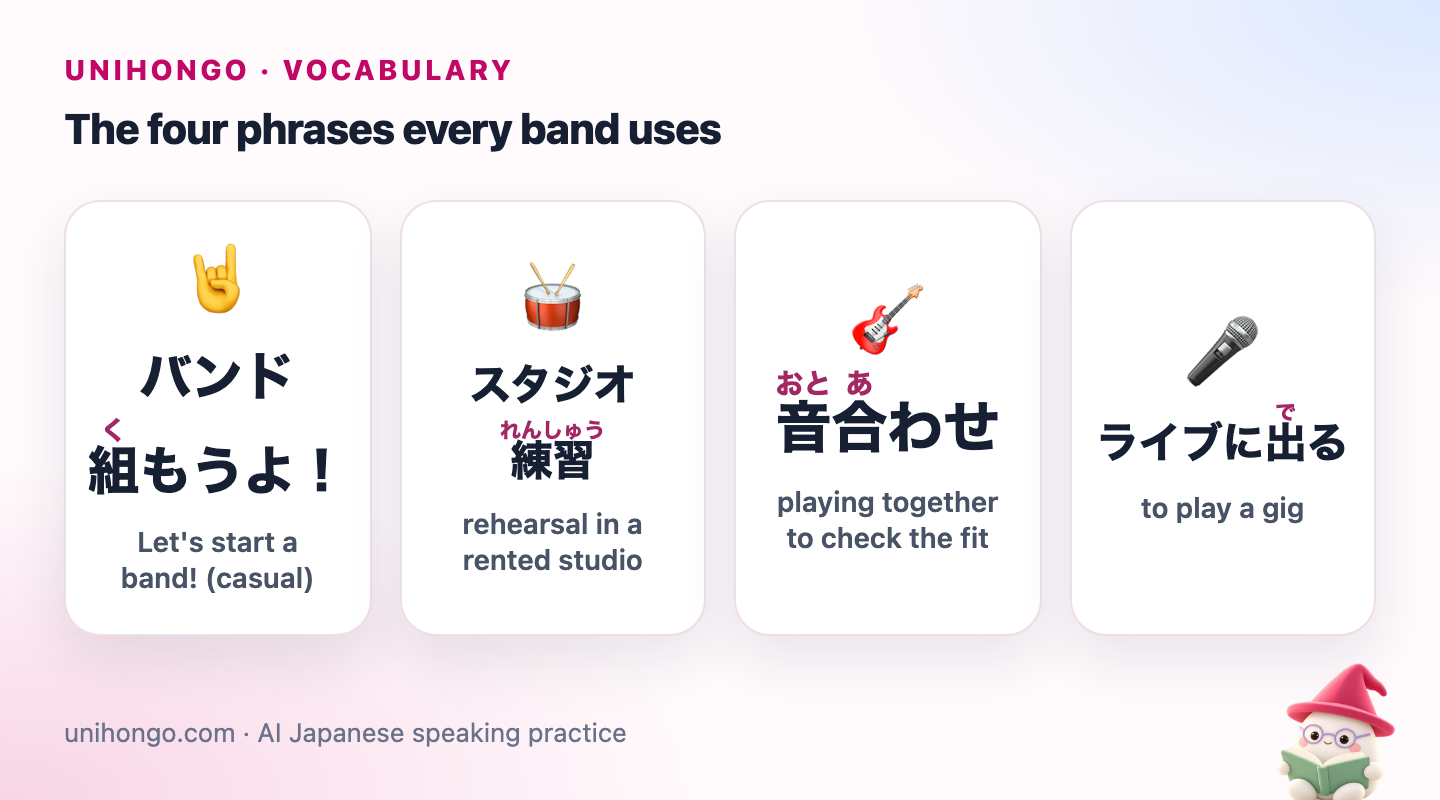
| Japanese | Romaji | Meaning |
|---|---|---|
| バンド組もうよ! | Bando kumō yo! | Let's start a band! (casual) |
| スタジオ練習 | sutajio renshū | rehearsal in a rented studio |
| 音合わせ | oto awase | playing together to check the fit |
| ライブに出る | raibu ni deru | to play a gig |
| 今度、音合わせしない? | Kondo, oto awase shinai? | Want to have a first jam sometime? |
Parts, instruments and the right verb
In Japanese bands your instrument is your pāto (パート), part, and the person who plays it is that instrument's tantō (担当), the one in charge. Asking pāto wa? or pāto nani? is the standard way to ask what someone plays. Most instrument names are katakana loanwords, but a few native words are common among musicians: kenban (鍵盤) for keyboards in general, and gakki (楽器) for instrument.
| Japanese | Romaji | Meaning |
|---|---|---|
| パートは何ですか。 | Pāto wa nan desu ka. | What do you play? (polite) |
| ギター担当です。 | Gitā tantō desu. | I'm on guitar. |
| ボーカルとギターをやってます。 | Bōkaru to gitā o yattemasu. | I sing and play guitar. |
| ベースを弾いています。 | Bēsu o hiite imasu. | I play bass. |
| ドラムを叩いています。 | Doramu o tataite imasu. | I play drums. |
| サックスを吹いています。 | Sakkusu o fuite imasu. | I play saxophone. |
| 鍵盤もちょっと弾けます。 | Kenban mo chotto hikemasu. | I can play a bit of keyboard too. |
| Verb | Used for | Note |
|---|---|---|
| hiku (弾く) | Guitar, bass, piano, keyboard, violin | Anything you pluck, strum or press with your fingers |
| tataku (叩く) | Drums, percussion | Literally to hit; drummers say it about themselves too |
| fuku (吹く) | Trumpet, saxophone, flute, harmonica | Literally to blow |
| utau (歌う) | Vocals | The vocalist is bōkaru or the casual bōkaru-san |
| yaru (やる) | Any instrument | Casual and very common: doramu yatteru |
Gear words, including a few false friends
Most gear is katakana, so you can often guess it: anpu (amp), pikku (pick), chūnā (tuner), sutikku (drumsticks). A few words, though, are Japanese-made or used differently from English, and they are the ones that cause confusion in a music shop. Efekutā (エフェクター) is an effects pedal. Shīrudo (シールド) is an instrument cable. Gen (弦) is the native word for a string, and changing strings is gen o harikaeru or simply gen kōkan.
| Japanese | Romaji | Meaning |
|---|---|---|
| シールド持ってきた? | Shīrudo motte kita? | Did you bring a cable? |
| エフェクターを足で踏む | efekutā o ashi de fumu | to step on an effects pedal |
| 弦が切れちゃった。 | Gen ga kirechatta. | I broke a string. |
| 弦を張り替えなきゃ。 | Gen o harikaenakya. | I need to restring my guitar. |
| チューニング合ってる? | Chūningu atteru? | Are you in tune? |
| ピック貸してくれる? | Pikku kashite kureru? | Can you lend me a pick? |
| スティック忘れた! | Sutikku wasureta! | I forgot my drumsticks! |
Two more useful words: oto zukuri (音作り), literally building the sound, means dialling in your tone on the amp and pedals, and hauru, a verb made from hauringu, means the system is howling with feedback. You will hear hauru in nearly every small venue at some point.
In the rehearsal studio
Rented studios are booked by the hour, so rehearsal talk is quick. Bands usually run a song, stop, fix one thing and run it again. Song sections have their own Japanese names that you will hear constantly: intoro (intro), A-mero and B-mero (the verse and the pre-chorus, from melody), sabi (サビ, the chorus or hook), kansō (間奏, the instrumental break) and autoro (outro). Sabi is the one learners most need, because there is no obvious way to guess it.
Kojin ren (個人練), short for kojin renshū, is practising alone, and it is also the name for booking a studio room for one person. Zentai ren or simply awase is a full-band rehearsal.
| Japanese | Romaji | Meaning |
|---|---|---|
| もう一回、頭から。 | Mō ikkai, atama kara. | Once more from the top. |
| サビから行こう。 | Sabi kara ikō. | Let's start from the chorus. |
| サビ前、ちょっと走ってない? | Sabi mae, chotto hashitte nai? | Aren't we rushing just before the chorus? |
| テンポ、もう少し上げよう。 | Tenpo, mō sukoshi ageyō. | Let's push the tempo up a little. |
| ベース、もうちょっと上げて。 | Bēsu, mō chotto agete. | Turn the bass up a bit. |
| カウントお願い。 | Kaunto onegai. | Count us in, please. |
| ちょっと休憩しよう。 | Chotto kyūkei shiyō. | Let's take a short break. |
| あと十分で時間だよ。 | Ato juppun de jikan da yo. | Ten minutes left on the room. |
Playing a gig at a live house
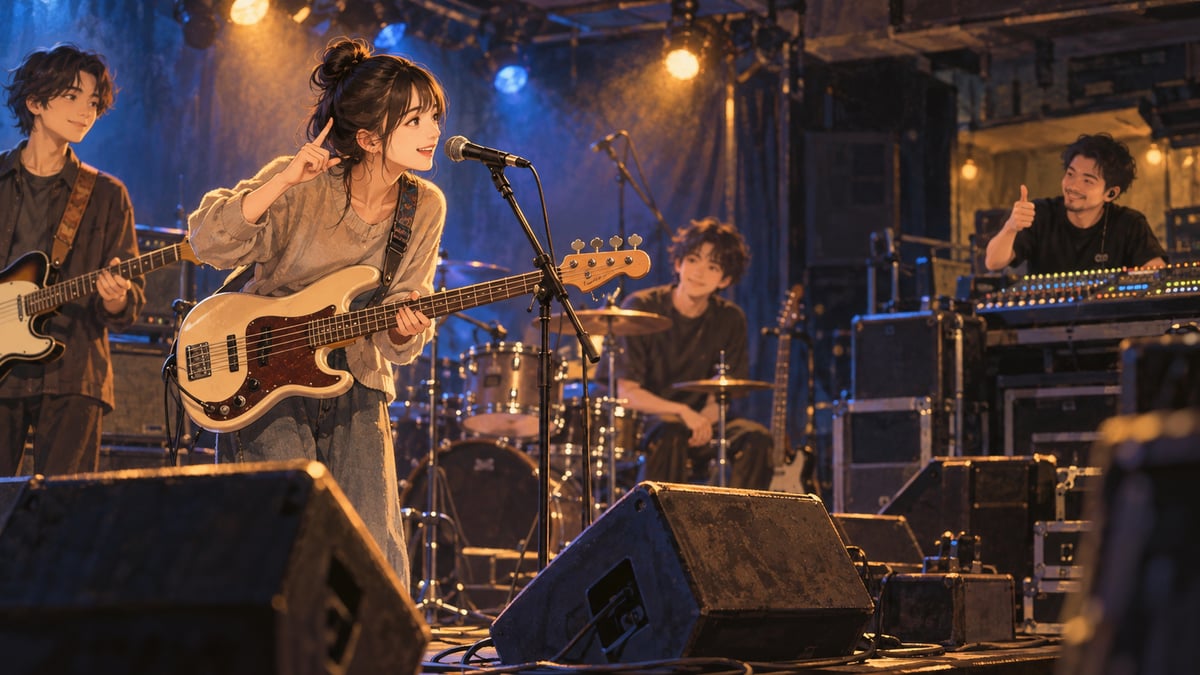
Small venues in Japan are called raibu hausu, and the word raibu covers any live show, from a stadium concert to three bands in a basement. On a typical night several bands share the bill, and the afternoon starts with riha (リハ), short for rehearsal: each band does a soundcheck in reverse order of the show. Your set list is the setto risuto, usually shortened to setori, and the talking between songs is called emu shī, MC.
During the soundcheck you talk to the PA, the sound engineer, through the microphone. This is the moment to switch to polite Japanese. Monitor speakers on stage are called kaeshi (返し), literally the return, and requests usually follow one simple pattern: kaeshi ni X o mō sukoshi kudasai, a little more X in my monitor, please.
| Japanese | Romaji | Meaning |
|---|---|---|
| リハお願いします。 | Riha onegai shimasu. | We're ready for our soundcheck, please. |
| 返しにギターをもう少しください。 | Kaeshi ni gitā o mō sukoshi kudasai. | A bit more guitar in my monitor, please. |
| ボーカルのリバーブを少し下げてもらえますか。 | Bōkaru no ribābu o sukoshi sagete moraemasu ka. | Could you reduce the reverb on the vocals a little? |
| 一曲通してもいいですか。 | Ikkyoku tōshite mo ii desu ka. | May we play one song through? |
| 大丈夫です。ありがとうございます。 | Daijōbu desu. Arigatō gozaimasu. | That's fine. Thank you. |
| 本日はよろしくお願いします。 | Honjitsu wa yoroshiku onegai shimasu. | Thank you in advance for today. (to staff) |
| 今日のセトリ、決まった? | Kyō no setori, kimatta? | Have we decided today's set list? |
Venue customs vary. Some live houses ask each band to sell a quota of tickets, called noruma, and others take a fee or a share of the door. Ask the booker politely when you apply, and do not assume your home country's arrangement applies.
Mini dialogues: finding and joining a band
Bands recruit members through friends, music shops, studios and online posts titled menbā boshū (メンバー募集), member wanted. The first meeting is usually a casual chat and then a jam in a studio. Here are two short exchanges: one when you answer a recruitment post, and one in the studio after the first session.
| Japanese | Romaji | Meaning |
|---|---|---|
| メンバー募集を見て連絡しました。 | Menbā boshū o mite renraku shimashita. | You: I'm contacting you about your member-wanted post. |
| ありがとうございます!パートは何ですか。 | Arigatō gozaimasu! Pāto wa nan desu ka. | Band: Thank you! What do you play? |
| ドラムです。ドラム歴は五年くらいです。 | Doramu desu. Doramu reki wa gonen kurai desu. | You: Drums. I've been playing about five years. |
| 今度スタジオで合わせてみませんか。 | Kondo sutajio de awasete mimasen ka. | Band: Would you like to try playing together in a studio? |
| 今日すごく楽しかった! | Kyō sugoku tanoshikatta! | Guitarist: Today was so much fun! |
| うん、またやりたいね。 | Un, mata yaritai ne. | You: Yeah, I'd love to do it again. |
| じゃあ、正式にメンバーになってよ。 | Jā, seishiki ni menbā ni natte yo. | Guitarist: Then join us officially. |
| いいの?よろしく! | Ii no? Yoroshiku! | You: Really? Count me in! |
Notice how the first exchange is polite and the second is casual. The switch to casual speech often happens after the first session, when someone like the guitarist starts using it. Following their lead is the natural choice.
Common learner mistakes
- Using asobu for playing an instrument. Asobu means to play like a child or to hang out with friends; gitā de asobu sounds like messing around. Use hiku, tataku, fuku or yaru.
- Saying purei suru for playing music. It exists for sports and games, and in a few musician phrases, but for everyday band talk it sounds odd. Use the instrument verb.
- Calling every show a konsāto. Konsāto suggests a concert hall or an orchestra. For a rock gig, even a big one, Japanese speakers say raibu.
- Asking for a kēburu in a shop and getting confused looks. It may be understood, but shīrudo is what most Japanese musicians say.
- Staying in casual speech with the sound engineer. Bandmates are casual; venue staff, the PA and senior club members get polite Japanese.
- Forgetting to thank the other bands. At the end of the night, a quick otsukaresama deshita to everyone, including the staff, is expected in many venues.
Learn your band's Japanese with Mocchi
Before your next rehearsal, type a request like this to Mocchi: Quiz me on the verbs for playing guitar, drums, saxophone and vocals, then give me five rehearsal lines to translate. Mocchi checks each answer, explains why you hiku a bass but tataku a snare, and keeps a note of the ones you miss so a later quiz brings them back.
Then make the gear and section words visual with /create-flashcards: shīrudo, efekutā, sabi, kaeshi and setori, each with a photo you pick, reviewed with spaced repetition so the tricky ones return sooner. When the cards feel easy, put them into Kotoba Tank, where you hear a word and hit the right one, which is good training for catching these words in a noisy studio.