

Masaka as an exclamation: no way!
The simplest use is masaka on its own, as a reaction. Someone tells you that your quiet colleague is quitting to become a pro wrestler, and you say masaka!, no way! It signals that the news goes against everything you expected. The tone can be shocked, delighted or worried depending on the situation and how you say it.
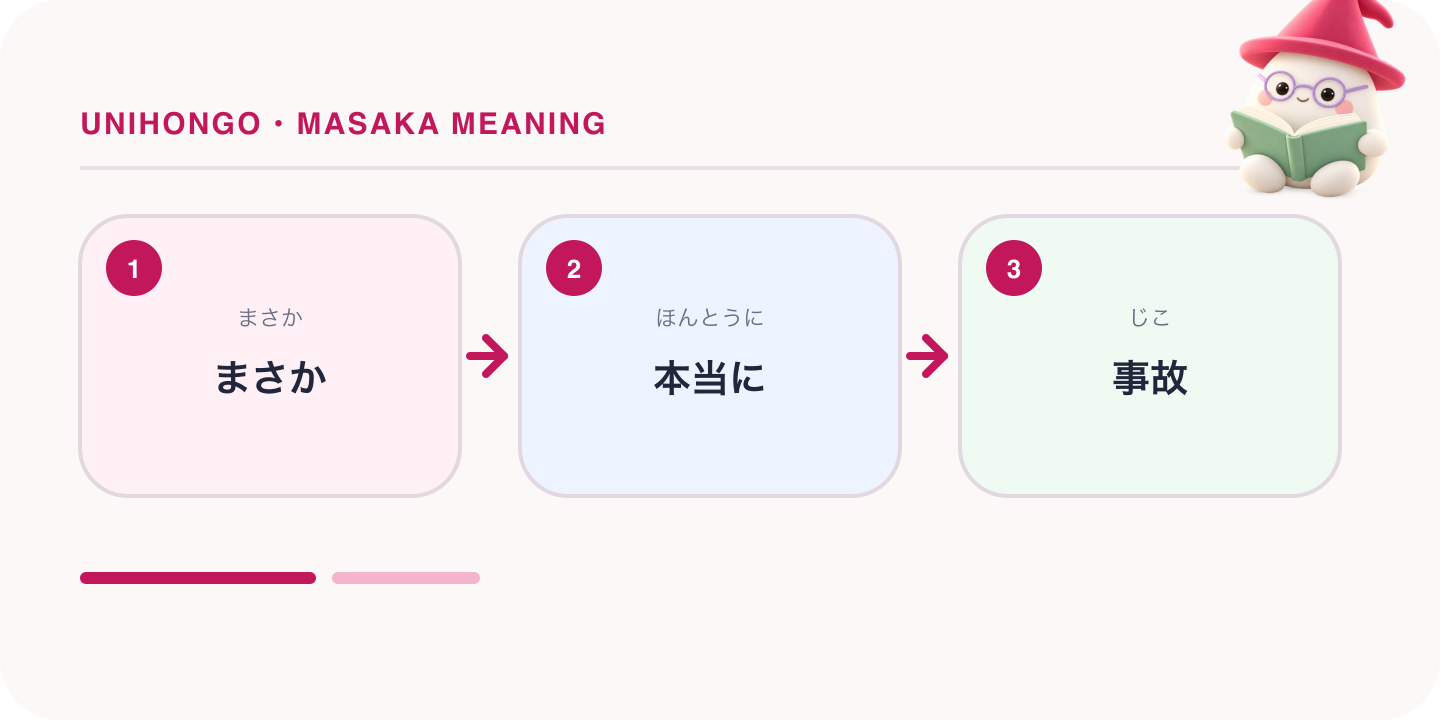
Masaka often stretches into a short sentence. Masaka, hontō ni? no way, really? and masaka, sonna koto aru? no way, can that really happen? are common in casual speech. When the news is bad, masaka can sound close to oh no, as in masaka, jiko? not an accident?
| Japanese | Romaji | Meaning |
|---|---|---|
| まさか! | Masaka! | No way! |
| まさか、本当に? | Masaka, hontō ni? | No way, really? |
| まさか、そんなことある? | Masaka, sonna koto aru? | No way, can that actually happen? |
| まさか、事故? | Masaka, jiko? | Oh no, not an accident? |
| いや、まさか。 | Iya, masaka. | No, surely not. (dismissing an idea) |
Surely not: suspicions you hope are wrong
At the start of a sentence, masaka introduces something you suspect but hope is untrue. The sentence usually ends with a question or a softening pattern such as ja nai yo ne, n ja nai deshō ne or to wa omou kedo. The feeling is like English you don't mean ..., surely not ..., or please tell me you didn't.
This pattern is very common when checking whether someone has made a mistake, or when you suddenly think of a bad possibility. Masaka wasureta n ja nai yo ne, you didn't forget, did you? carries both suspicion and hope that the answer is no.
| Japanese | Romaji | Meaning |
|---|---|---|
| まさか忘れたんじゃないよね? | Masaka wasureta n ja nai yo ne? | You didn't forget, did you? |
| まさか一人で行くつもり? | Masaka hitori de iku tsumori? | You're not planning to go alone, are you? |
| まさか今日が締め切りじゃないよね。 | Masaka kyō ga shimekiri ja nai yo ne. | Surely the deadline isn't today. |
| まさかとは思うけど、鍵持ってる? | Masaka to wa omou kedo, kagi motteru? | I'm sure you do, but have you got the key? |
| まさか雨は降らないでしょう。 | Masaka ame wa furanai deshō. | Surely it won't rain. |
Masaka to wa omou kedo, I don't think so, but, is a gentle way to check something without accusing anyone. It is a handy softener even in fairly polite conversation, as masaka to wa omoimasu ga.
I never thought: masaka about the past
Masaka is also used when looking back on something that did happen even though you never expected it. The key patterns are masaka ... to wa omowanakatta, I never thought that ..., and masaka no plus a noun, which describes an unbelievable event: masaka no gyakuten, an unbelievable turnaround, or masaka no kekka, a shocking result.
Sports commentary and news headlines love masaka no. A team losing a game it was expected to win easily is masaka no haiboku, a stunning defeat. In your own speech, masaka konna koto ni naru to wa, I never imagined it would come to this, is a natural way to reflect on a surprising turn of events.
| Japanese | Romaji | Meaning |
|---|---|---|
| まさか合格するとは思わなかった。 | Masaka gōkaku suru to wa omowanakatta. | I never thought I would pass. |
| まさかここで会うとは! | Masaka koko de au to wa! | Fancy meeting you here! |
| まさかの逆転勝ち | masaka no gyakuten-gachi | An unbelievable come-from-behind win |
| まさかの結果 | masaka no kekka | A shocking result |
| まさかこんなことになるとは。 | Masaka konna koto ni naru to wa. | I never imagined it would come to this. |
| まさかと思った。 | Masaka to omotta. | I couldn't believe it. |
Masaka no toki: planning for emergencies
As a noun, masaka means the unexpected moment, and masaka no toki is an emergency or a time of crisis. It appears constantly in disaster preparedness materials, insurance adverts and advice about savings. Masaka no toki no tame ni means for when the unexpected happens, which English would often translate as just in case.
Japan has frequent earthquakes and typhoons, so this phrase is part of everyday life. You will hear it when a landlord explains where the emergency supplies are, when a colleague talks about keeping water at home, or when someone recommends travel insurance. Similar words are kinkyū-ji, an emergency, which is more official, and man ga ichi, one in ten thousand, used for unlikely but serious possibilities.
| Japanese | Romaji | Meaning |
|---|---|---|
| まさかの時のために水を用意しておく。 | Masaka no toki no tame ni mizu o yōi shite oku. | Keep water ready in case of an emergency. |
| まさかの時はここに集まってください。 | Masaka no toki wa koko ni atsumatte kudasai. | In an emergency, please gather here. |
| まさかに備える | masaka ni sonaeru | To prepare for the unexpected |
| 万が一の場合 | man ga ichi no baai | In the unlikely event |
| 緊急時 | kinkyū-ji | In an emergency (official) |
Masaka versus uso, hontō ni and maji
Japanese has many ways to say no way, and they differ in tone and politeness. Uso!, literally a lie, is a quick casual you're kidding! It does not accuse anyone of lying; it simply expresses surprise. Maji de? or maji?, seriously?, is slangy and common among younger people and friends. Hontō ni? really? is neutral and friendly.
Masaka sits in the middle. It is stronger than hontō ni because it says the news seemed impossible, and it is less slangy than maji. Shinjirarenai, I can't believe it, is a full sentence of disbelief, and e? or ē! are the instant sounds that often come first.
| Reaction | Nuance | Register |
|---|---|---|
| まさか masaka | No way, that seemed impossible | Casual to neutral |
| うそ uso | You're kidding! | Casual |
| マジで maji de | Seriously? | Very casual, slangy |
| 本当に hontō ni | Really? | Neutral |
| 信じられない shinjirarenai | I can't believe it | Neutral |
| 本当ですか hontō desu ka | Is that true? | Polite |
| それは驚きました sore wa odorokimashita | That's surprising | Polite |
Politeness: reacting to surprising news at work
A bare masaka! is fine with friends and family, but with a manager, client or someone you have just met, it sounds abrupt. In those settings, use a full polite sentence. Hontō desu ka, is that true?, and sore wa odorokimashita, that's surprising, are safe choices. Masaka itself can stay if it sits inside a polite sentence, such as masaka koko de o-ai suru to wa omoimasen deshita, I never expected to meet you here.
Avoid uso and maji with superiors. Uso desu ka is sometimes heard, but because uso means a lie, some listeners find it slightly rude in formal contexts. It is simpler to say hontō desu ka.
| Japanese | Romaji | Meaning |
|---|---|---|
| 本当ですか。 | Hontō desu ka. | Is that true? |
| それは驚きました。 | Sore wa odorokimashita. | That's surprising. |
| まさかここでお会いするとは思いませんでした。 | Masaka koko de o-ai suru to wa omoimasen deshita. | I never expected to meet you here. |
| まさか中止になるとは思いませんでした。 | Masaka chūshi ni naru to wa omoimasen deshita. | I never thought it would be cancelled. |
| 信じられません。 | Shinjiraremasen. | I can't believe it. |
The kanji trap: masaka and magyaku
Masaka is written in hiragana in modern Japanese. Older texts sometimes used the characters 真逆 for it, but today 真逆 is normally read magyaku and means the exact opposite, as in magyaku no iken, completely opposite opinions. If you type masaka and your input method offers kanji, stick with hiragana.
Magyaku itself is a useful word to learn alongside masaka. It became popular in casual speech relatively recently, and some people still consider it informal, so seihantai or mattaku gyaku are safer in formal writing.
- まさか masaka: no way, surely not (write in hiragana)
- 真逆 magyaku: the exact opposite (casual)
- 正反対 seihantai: the complete opposite (neutral, safe in writing)
- まったく逆 mattaku gyaku: totally the reverse