
What daijōbu actually carries
The core sense of 大丈夫 is that nothing is wrong. Everything else grows out of that. If a person is daijōbu, they are unhurt or coping. If a plan is daijōbu, it holds together. If a time slot is daijōbu, it causes no problem. And if you are daijōbu, you need nothing more, which is exactly how it turns into a refusal. The word never says yes or no by itself; it says the situation is in order, and the listener works out what follows from that.
This is why translation fails so often. A learner who has memorised daijōbu equals okay will hear a shop assistant offer a bag, answer daijōbu desu meaning yes please, and walk out without one. The assistant did nothing wrong. In the context of an offer, saying that you are already in order means you do not need what is being offered. Read the question first, then decide what being in order implies.
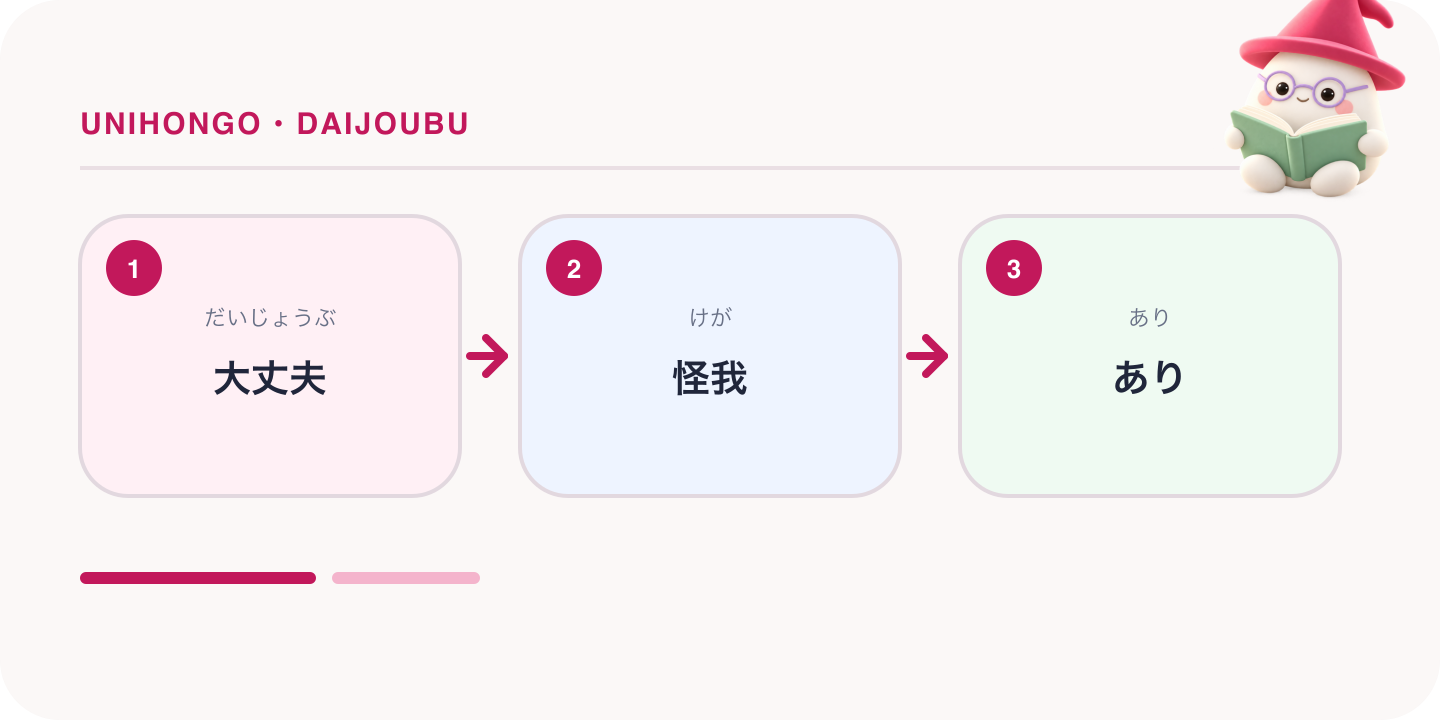
The situations and the meaning each one carries
| Situation | What daijōbu means there | Unambiguous alternative |
|---|---|---|
| Someone trips and you check on them | Are you all right? | Okega wa arimasen ka? |
| You answer that check | I am fine, nothing is broken | Kega wa arimasen |
| Staff offer a bag, receipt or refill | No thank you | Kekkō desu / Onegaishimasu |
| Someone offers to help you | No need, I can manage | Onegaishimasu if you do want help |
| You ask whether a time works | Does that suit you? | Gotsugō wa ikaga desu ka? |
| You answer about a time | Yes, that works | Sore de onegaishimasu |
| You ask whether something is allowed | May I? Is it permitted? | Te mo ii desu ka? |
| A colleague asks about a deadline | Yes, I can make it | Ma ni aimasu |
| A friend asks how you are after bad news | I am coping, do not worry | Nantoka yatte imasu |
| Checking a payment method or size | Is this acceptable? | Kono hōhō de yoroshii desu ka? |
Notice the pattern in the middle column. When the other person put something on the table, daijōbu pushes it back. When the other person asked about a state of affairs, daijōbu confirms it. Almost every confusing case in real life is a sentence where the listener could reasonably read it either way, and those are the ones worth replacing.
Checking that someone is unhurt
This is the original everyday use and the one that never misfires. Someone drops a bag, stumbles on the stairs, or goes quiet in a meeting, and you ask daijōbu desu ka. The polite form works with strangers and colleagues; the bare daijōbu is for friends and family. The expected answer is short and reassuring, and Japanese speakers routinely say they are fine when they are only mostly fine, so a follow-up question is normal.
| Japanese | Romaji | Meaning |
|---|---|---|
| 大丈夫ですか? | Daijōbu desu ka? | Are you all right? |
| 大丈夫です。ありがとうございます。 | Daijōbu desu. Arigatō gozaimasu. | I am fine, thank you. |
| お怪我はありませんか? | Okega wa arimasen ka? | You are not hurt, are you? |
| ちょっと痛いですが、大丈夫です。 | Chotto itai desu ga, daijōbu desu. | It hurts a little, but I am all right. |
| 大丈夫じゃないです。病院に行きたいです。 | Daijōbu ja nai desu. Byōin ni ikitai desu. | I am not all right. I would like to go to a hospital. |
| 大丈夫? | Daijōbu? | You okay? (casual) |
| うん、大丈夫。 | Un, daijōbu. | Yeah, I am fine. (casual) |
Daijōbu as no thank you
Shop and cafe staff make a fixed set of offers many times an hour, and daijōbu desu is the standard soft decline for all of them. It works because it says you are already in order, so nothing more is needed. Add a small a or sumimasen at the front and a slight downward tone, and it sounds warm rather than curt. This is where learners lose bags, receipts and free extras without realising why.
| Japanese | Romaji | Meaning |
|---|---|---|
| 袋はご利用ですか? | Fukuro wa goriyō desu ka? | Would you like a bag? (staff line) |
| あ、大丈夫です。 | A, daijōbu desu. | Oh, no thank you. |
| レシートはご入用ですか? | Reshīto wa goiriyō desu ka? | Do you need the receipt? (staff line) |
| 大丈夫です。捨ててください。 | Daijōbu desu. Sutete kudasai. | No thanks. Please throw it away. |
| お代わりいかがですか? | Okawari ikaga desu ka? | Would you like a refill? (staff line) |
| もう大丈夫です。ごちそうさまでした。 | Mō daijōbu desu. Gochisōsama deshita. | I have had enough, thank you. That was a good meal. |
| お手伝いしましょうか。 | Otetsudai shimashō ka. | Shall I help you? |
| 大丈夫です。自分でやります。 | Daijōbu desu. Jibun de yarimasu. | It is fine. I will do it myself. |
The mistake to avoid is nodding while you say it. A nod plus daijōbu desu is genuinely ambiguous and staff will often ask again, which is the moment learners panic. Keep your head still, or add a small hand gesture, and the refusal reads cleanly.
Daijōbu as yes, that works
When someone asks whether a time, a price, a quantity or an arrangement suits you, daijōbu desu is a plain yes. This is the use that trips people going the other way: having learned that daijōbu means no in shops, they start refusing appointments they meant to accept. The clue is that nothing is being handed to you. A question about whether something is workable takes daijōbu as agreement.
| Japanese | Romaji | Meaning |
|---|---|---|
| 三時でも大丈夫ですか? | San-ji demo daijōbu desu ka? | Would three o'clock also be all right? |
| はい、大丈夫です。 | Hai, daijōbu desu. | Yes, that works. |
| 明日の午後は大丈夫です。 | Ashita no gogo wa daijōbu desu. | Tomorrow afternoon works for me. |
| すみません、その日はちょっと難しいです。 | Sumimasen, sono hi wa chotto muzukashii desu. | Sorry, that day is a little difficult. |
| この値段で大丈夫ですか? | Kono nedan de daijōbu desu ka? | Is this price acceptable? |
Asking whether something is allowed
The te-form plus mo daijōbu desu ka asks for permission in a way that sounds everyday rather than formal. It is slightly softer than te mo ii desu ka and much more common in speech than the textbook forms suggest. You can also attach daijōbu to a noun plus de to ask whether a method or option is acceptable, which is how people check payment types, sizes and substitutions.
| Japanese | Romaji | Meaning |
|---|---|---|
| ここに座っても大丈夫ですか? | Koko ni suwatte mo daijōbu desu ka? | Is it all right if I sit here? |
| はい、大丈夫ですよ。 | Hai, daijōbu desu yo. | Yes, that is fine. |
| 写真を撮っても大丈夫ですか? | Shashin o totte mo daijōbu desu ka? | Is it all right to take photos? |
| すみません、こちらは撮影禁止です。 | Sumimasen, kochira wa satsuei kinshi desu. | Sorry, photography is not allowed here. (staff line) |
| カードで大丈夫ですか? | Kādo de daijōbu desu ka? | Is card payment all right? |
| 現金のみとなります。 | Genkin nomi to narimasu. | We take cash only. (staff line) |
When you are the one granting permission, answer with daijōbu desu yo or dōzo. Dōzo is the friendliest single word for go ahead and removes any risk of being heard as a refusal, so it is worth reaching for whenever you are saying yes to a request.
The same word, opposite answers
Here are the pairs worth drilling. In each pair the reply is identical and the meaning flips, decided entirely by whether the first speaker offered something or asked about a condition. Say both halves of each pair aloud until the difference feels obvious from the question rather than from the answer.
| Japanese | Romaji | Meaning |
|---|---|---|
| 砂糖はいかがですか? → 大丈夫です。 | Satō wa ikaga desu ka? → Daijōbu desu. | Would you like sugar? → No thank you. |
| 砂糖を入れても大丈夫ですか? → 大丈夫です。 | Satō o irete mo daijōbu desu ka? → Daijōbu desu. | Is it all right if I add sugar? → Yes, go ahead. |
| 手伝いましょうか。 → 大丈夫です。 | Tetsudaimashō ka. → Daijōbu desu. | Shall I help? → No need, thanks. |
| 手伝ってもらっても大丈夫ですか。 → 大丈夫です。 | Tetsudatte moratte mo daijōbu desu ka. → Daijōbu desu. | Would it be all right if I got some help? → Yes, that is fine. |
If you are ever the one hearing daijōbu desu and cannot tell which way it went, ask. Sumimasen, hai no imi desu ka, iie no imi desu ka is direct but entirely acceptable, and Japanese speakers ask each other this too when an order or a booking depends on it.
How to be unambiguous when it matters
Daijōbu is a good default for low-stakes moments and a poor one for anything that costs money, time or a seat on a train. The fix is not to stop using it but to keep a second sentence ready for the moments when a misreading would be expensive. Every one of these lines is shorter than the confusion it prevents.
| Japanese | Romaji | Meaning |
|---|---|---|
| いいえ、結構です。 | Iie, kekkō desu. | No, thank you. (firm and clear) |
| 袋はお願いします。 | Fukuro wa onegaishimasu. | I would like a bag, please. |
| 袋は要りません。 | Fukuro wa irimasen. | I do not need a bag. |
| はい、お願いします。 | Hai, onegaishimasu. | Yes, please do. |
| はい、それで問題ありません。 | Hai, sore de mondai arimasen. | Yes, there is no problem with that. |
| すみません、「はい」の意味ですか、「いいえ」の意味ですか? | Sumimasen, "hai" no imi desu ka, "iie" no imi desu ka? | Sorry, do you mean yes or no? |
| もう一度お願いできますか? | Mō ichido onegai dekimasu ka? | Could you say that once more? |
| 確認させてください。 | Kakunin sasete kudasai. | Let me confirm that. |
| それで大丈夫です。お願いします。 | Sore de daijōbu desu. Onegaishimasu. | That is fine. Please go ahead. |
Daijōbu at work
In an office, daijōbu does three jobs: checking someone's availability, checking their condition, and confirming that a plan or deadline holds. Toward a superior, prefer the fuller forms and add a cushion, since a bare daijōbu desu ka can sound abrupt. Toward a colleague who looks unwell or overloaded, follow the check with muri shinaide kudasai so the question does not read as pressure to say they are fine.
| Japanese | Romaji | Meaning |
|---|---|---|
| 今、お時間大丈夫ですか? | Ima, ojikan daijōbu desu ka? | Do you have a moment now? |
| 申し訳ありません、今は少し立て込んでいます。 | Mōshiwake arimasen, ima wa sukoshi tatekonde imasu. | I am sorry, I am a little tied up right now. |
| この資料、明日までで大丈夫でしょうか。 | Kono shiryō, ashita made de daijōbu deshō ka. | Would it be all right if these documents are ready by tomorrow? |
| はい、それで大丈夫です。 | Hai, sore de daijōbu desu. | Yes, that is fine. |
| 体調は大丈夫ですか? | Taichō wa daijōbu desu ka? | Are you feeling all right? |
| 無理しないでくださいね。 | Muri shinaide kudasai ne. | Please do not push yourself. |
| 大丈夫だと思いますが、念のため確認します。 | Daijōbu da to omoimasu ga, nen no tame kakunin shimasu. | I think it will be fine, but I will check just in case. |
| スケジュール的に大丈夫そうです。 | Sukejūru-teki ni daijōbu-sō desu. | It looks manageable in terms of the schedule. |
Daijōbu da to omoimasu is a useful hedge when you are fairly confident but not certain, and it is far safer than a flat daijōbu desu that turns out to be wrong. If you genuinely do not know, say wakarimasen node, kakunin shimasu rather than reassuring someone by reflex.
Casual, polite and formal versions
| Form | Register | Where it fits |
|---|---|---|
| 大丈夫? Daijōbu? | Casual question | Friends, family, close colleagues |
| 大丈夫だよ。 Daijōbu da yo. | Casual reassurance | Telling a friend not to worry |
| 大丈夫です。 Daijōbu desu. | Polite default | Shops, offices, strangers |
| 大丈夫ですか? Daijōbu desu ka? | Polite question | Checking on almost anyone |
| 大丈夫でしょうか。 Daijōbu deshō ka. | Softer polite question | Asking a superior or a client |
| 大丈夫じゃない。 Daijōbu ja nai. | Casual negative | Admitting you are not coping |
| 大丈夫ではありません。 Daijōbu de wa arimasen. | Formal negative | Written or careful speech |
| 大丈夫でした。 Daijōbu deshita. | Polite past | Reporting that something went fine |
| 問題ありません。 Mondai arimasen. | Formal equivalent | Work confirmations, no ambiguity |
One further form is worth knowing: daijōbu sō desu, meaning it looks fine, which reports an appearance rather than a fact. It is the honest choice when you are judging from outside, as with a colleague's workload or a repair someone else made.
A drill that fixes the ambiguity
- List the five offers you hear most often where you live and write both answers for each: the daijōbu refusal and the onegaishimasu acceptance.
- Say each pair back to back so the two directions live in the same practice block, never separately.
- Record yourself refusing with daijōbu desu and check that your head is still and your tone falls at the end.
- Rehearse the permission pattern with three verbs a day: totte mo, suwatte mo, tsukatte mo daijōbu desu ka.
- Once a week, deliberately answer an offer with kekkō desu instead, so the firmer refusal is available when you need it.
- Keep a note of every time someone asked you again after your daijōbu; those are the sentences to replace first.