
Two families of sound words
Japanese groups these words by what they imitate. Giseigo copy a sound that exists in the world: a dog barking, thunder rolling, rain hitting a roof. Gitaigo copy nothing audible at all. They give a word to a texture, a movement, a shine, or a mood, which is the part that surprises learners, because English has no comparable habit of naming how something feels through sound shape.
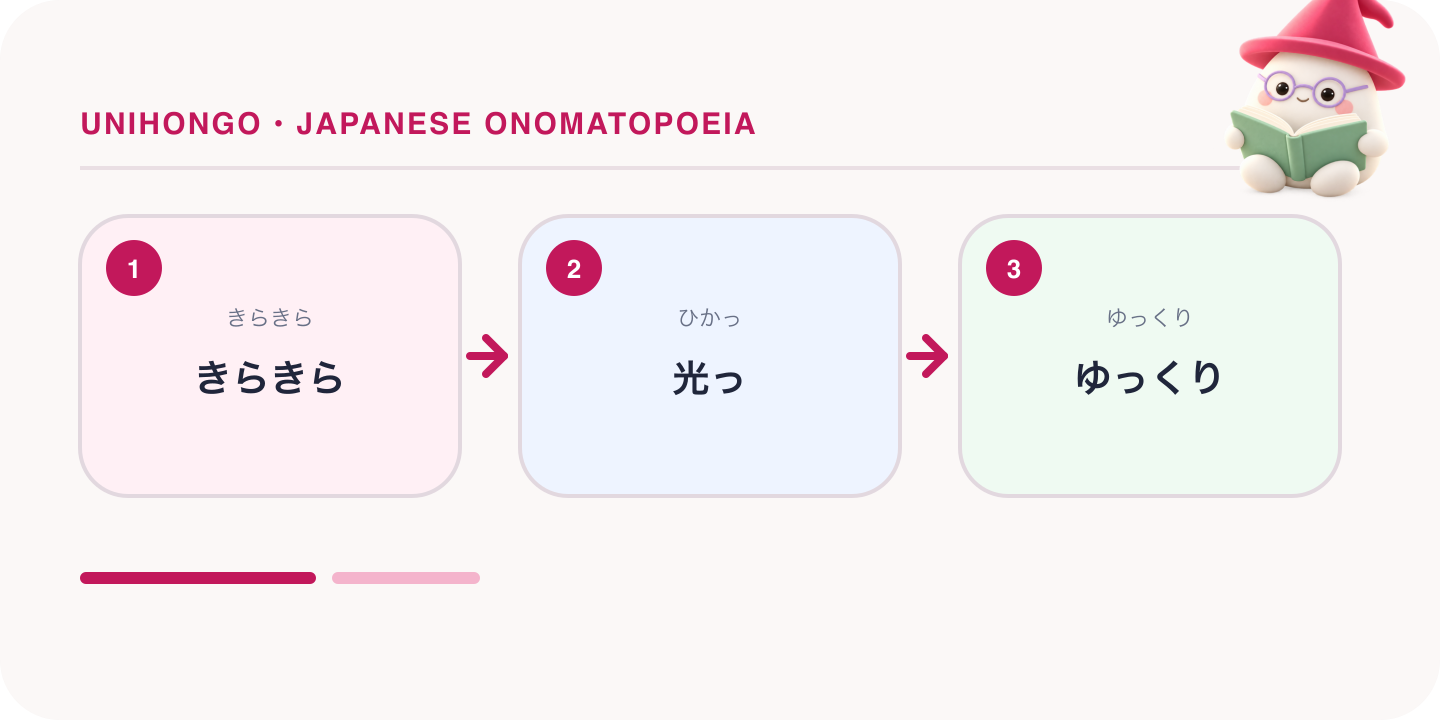
- Giseigo: sounds made by living things and objects, such as wanwan and gatagata. A small, closed group you mostly need to recognise.
- Gitaigo: states and manner with no sound at all, such as kirakira, fuwafuwa, and nonbiri. Open, enormous, and the half you will actively use.
- Katakana usually signals a sound; hiragana usually signals a state, though this is a tendency rather than a rule.
- A few words sit in both camps, such as gorogoro, which is thunder rumbling and also lazing around at home.
Why these count as core vocabulary
It is tempting to file sound words under decoration and come back to them later. That misreads how Japanese distributes meaning. Where English has a rich stock of specific verbs and adjectives, Japanese often uses a general verb plus a sound word to supply the detail. Aruku is simply walk; the difference between strolling, trudging, and hurrying lives in burabura, tobotobo, and sekaseka rather than in the verb.
The consequence is that removing them does not make your Japanese plainer, it makes it vague. A doctor asking about pain expects zukizuki, chikuchiku, or kirikiri because each points to a different cause. A cook describing rice, a colleague describing a hectic week, and a review describing a crisp fried chicken all reach for the same tool. This is also why they are so frequent in speech, comics, advertising, and food television.
The shapes they come in
Nearly all of these words are built from a short root of one or two syllables put into one of four shapes. The doubled shape repeats the root: kira becomes kirakira, doki becomes dokidoki. This is by far the most common and usually suggests something repeated or continuous. The -ri shape, as in yukkuri and nonbiri, describes a manner spread over time. The small-tsu shape, as in patto or zatto, marks a sudden single burst. The -n shape, as in batan and pon, marks one impact that ends.
The shape carries meaning independently of the root, so one root gives a whole family: korokoro is something rolling along, korori is a single tumble or a sudden change, and koron is one small roll that stops. Hearing the shape tells you the aspect of the event even when the root is new.
| Japanese | Romaji | Meaning |
|---|---|---|
| 星がきらきら光っています。 | Hoshi ga kirakira hikatte imasu. | The stars are twinkling. |
| ゆっくり話してください。 | Yukkuri hanashite kudasai. | Please speak slowly. |
| ドアがばたんと閉まりました。 | Doa ga batan to shimarimashita. | The door shut with a bang. |
| 資料にざっと目を通しました。 | Shiryō ni zatto me o tōshimashita. | I skimmed quickly through the documents. |
How to attach them to a sentence
There are four connections and you can hold all of them in your head at once. Before a verb, the word often works bare or with to: ame ga zāzā futte imasu, or zāzā to futte imasu. Doubled forms drop to comfortably in speech, while single-burst forms such as batan keep it. With naru or suru meaning become, ni marks the resulting state: kutakuta ni narimashita.
Third, many gitaigo take suru directly and become verbs of feeling or condition: dokidoki suru, iraira suru, nonbiri suru. Fourth, some behave as na-adjectives or simply sit before desu, as in taoru ga fuwafuwa desu. If you are unsure which applies, listen for how you first heard the word and copy the frame whole rather than assembling it from rules; the particles guide covers to and ni in their wider uses.
| Japanese | Romaji | Meaning |
|---|---|---|
| 雨がざあざあ降っています。 | Ame ga zāzā futte imasu. | The rain is pouring down. |
| はっきりと言ってください。 | Hakkiri to itte kudasai. | Please say it clearly. |
| くたくたになりました。 | Kutakuta ni narimashita. | I ended up exhausted. |
| 今日は家でのんびりしました。 | Kyō wa ie de nonbiri shimashita. | I took it easy at home today. |
| タオルがふわふわです。 | Taoru ga fuwafuwa desu. | The towel is lovely and fluffy. |
| 彼は日本語がぺらぺらです。 | Kare wa Nihongo ga perapera desu. | He is completely fluent in Japanese. |
Sounds you actually hear
Start with giseigo because they are the easiest to trust: the word sounds roughly like the thing. Animal cries take the verb naku, which covers barking, mewing, chirping, and buzzing alike, so inu ga wanwan naite imasu is the standard frame. Objects and weather take their own verbs, and the sound word slots in front of them.
| Japanese | Romaji | Meaning |
|---|---|---|
| 犬がワンワン鳴いています。 | Inu ga wanwan naite imasu. | The dog is barking. |
| 猫がニャーニャー鳴いています。 | Neko ga nyānyā naite imasu. | The cat is mewing. |
| 電車がガタガタ揺れました。 | Densha ga gatagata yuremashita. | The train rattled and shook. |
| 雷がゴロゴロ鳴っています。 | Kaminari ga gorogoro natte imasu. | The thunder is rumbling. |
| ドアをコンコンとノックしました。 | Doa o konkon to nokku shimashita. | I knocked on the door. |
| お腹がぐうぐう鳴っています。 | Onaka ga gūgū natte imasu. | My stomach is rumbling. |
States you can see
This is where gitaigo start doing work no English word does in one piece. Kirakira is a fine, moving sparkle; pikapika is a hard, polished shine, which is why a cleaned kitchen and a new coin are both pikapika. Fuwafuwa is soft and full of air, guchagucha is squashed and disordered, and bishobisho is soaked through. Each one packs a picture that would otherwise need a clause.
| Japanese | Romaji | Meaning |
|---|---|---|
| 机の上がぴかぴかです。 | Tsukue no ue ga pikapika desu. | The desk is spotless. |
| 部屋がぐちゃぐちゃです。 | Heya ga guchagucha desu. | The room is a complete mess. |
| 雨でびしょびしょになりました。 | Ame de bishobisho ni narimashita. | I got soaked in the rain. |
| 子どもがうろうろしています。 | Kodomo ga urouro shite imasu. | The child is wandering about. |
| 字がぐにゃぐにゃです。 | Ji ga gunyagunya desu. | The handwriting is all wobbly. |
| 公園をぶらぶら歩きました。 | Kōen o burabura arukimashita. | I strolled around the park. |
Feelings and how the body feels
These are the highest-value items for a learner, because they answer questions you get asked constantly. Dokidoki is the heart beating fast from nerves or excitement, and it is what you say before an interview or an exam. Kutakuta is worn out to the point of collapse, pekopeko is properly hungry, and karakara is a dry throat. Zukizuki names a throbbing pain and iraira names low-grade irritation.
Notice which ones take suru and which do not. Dokidoki and iraira are events happening inside you, so they take suru. Pekopeko and kutakuta are states you are in, so they take desu or ni naru. Getting this pairing right is most of what makes these words sound natural.
| Japanese | Romaji | Meaning |
|---|---|---|
| 面接の前はどきどきしました。 | Mensetsu no mae wa dokidoki shimashita. | I was nervous before the interview. |
| 頭がずきずきします。 | Atama ga zukizuki shimasu. | I have a throbbing headache. |
| 今日はくたくたです。 | Kyō wa kutakuta desu. | I am worn out today. |
| お腹がぺこぺこです。 | Onaka ga pekopeko desu. | I am starving. |
| 喉がからからです。 | Nodo ga karakara desu. | My throat is completely dry. |
| 待たされていらいらしました。 | Matasarete iraira shimashita. | Being kept waiting made me irritated. |
Texture words on menus and television
Japanese food language is built almost entirely out of gitaigo, and a food programme will use a dozen in a minute. Mochimochi is the springy chew of good bread or fresh noodles. Sakusaku is a light, dry crispness, while paripari is thinner and snappier. Torotoro is thick and molten, funwari is airy, and atsuatsu is piping hot straight from the pan.
| Japanese | Romaji | Meaning |
|---|---|---|
| このパンはもちもちしています。 | Kono pan wa mochimochi shite imasu. | This bread has a lovely springy chew. |
| 衣がさくさくしています。 | Koromo ga sakusaku shite imasu. | The batter is light and crisp. |
| 卵がとろとろです。 | Tamago ga torotoro desu. | The egg is soft and runny. |
| スープがあつあつです。 | Sūpu ga atsuatsu desu. | The soup is piping hot. |
| 麺がつるつるしています。 | Men ga tsurutsuru shite imasu. | The noodles are smooth and slippery. |
| ケーキがふんわりしています。 | Kēki ga funwari shite imasu. | The cake is light and airy. |
These are also the safest compliments you can pay a cook, because they describe the food rather than judging it. Oishii desu is fine, but mochimochi de oishii desu tells the person you noticed what they made.
The everyday set, grouped
| Word | Romaji | Group | Typical use |
|---|---|---|---|
| ワンワン | Wanwan | Sound | A dog barking |
| ガタガタ | Gatagata | Sound | Something rattling or shaking |
| ざあざあ | Zāzā | Sound | Heavy rain falling |
| ゴロゴロ | Gorogoro | Sound | Thunder, or lazing about at home |
| きらきら | Kirakira | State | A fine, moving sparkle |
| ぴかぴか | Pikapika | State | Polished, spotless shine |
| ふわふわ | Fuwafuwa | State | Soft and full of air |
| ぐちゃぐちゃ | Guchagucha | State | Squashed, messy, disordered |
| どきどき | Dokidoki | Feeling | Nerves or excitement |
| いらいら | Iraira | Feeling | Low-grade irritation |
| わくわく | Wakuwaku | Feeling | Happy anticipation |
| くたくた | Kutakuta | Body | Worn out |
| ぺこぺこ | Pekopeko | Body | Very hungry |
| ずきずき | Zukizuki | Body | Throbbing pain |
| もちもち | Mochimochi | Texture | Springy and chewy |
| さくさく | Sakusaku | Texture | Light and crisp |
| とろとろ | Torotoro | Texture | Thick and molten |
Learn them in the frame you will say them in, not as a bare list. Onaka ga pekopeko desu is one unit of memory; pekopeko on its own is a word you will recognise but never produce in time.
The ones learners overuse or get wrong
Perapera is the classic trap. It means fluent, but saying Nihongo ga perapera desu about yourself sounds boastful in a way the English word fluent does not; Japanese speakers use it about other people. Say sukoshi hanasemasu or benkyō-chū desu about yourself and let someone else supply perapera.
The second trap is attaching suru to words that do not take it, or that change meaning when they do. Pekopeko suru is not being hungry, it is bowing and scraping to someone. Gorogoro suru is lounging around, not making thunder. Kirakira takes suru rarely and prefers hikaru or shite iru, so kirakira hikatte imasu is the reliable phrasing.
- Do not scatter them through formal writing or business email; they are speech-first vocabulary and read as casual on the page.
- Do not translate one word one way. Gorogoro covers thunder, rolling, lounging, and a lumpy texture, and only context decides.
- Do not use dokidoki as a general word for excited; wakuwaku is anticipation, dokidoki is the pounding heart itself.
- Do not stretch animal sounds to adult conversation beyond the standard set; wanwan for a dog is fine, invented cries are not.
- Do not force to into every sentence. With doubled forms in casual speech, leaving it out usually sounds more natural.
Putting them into your own speech
- Bind each word to a moment you actually experienced, then say the whole sentence aloud on the spot.
- Pick one category a week: weather, food, tiredness, moods. Narrow beats broad here.
- Describe your own day with two sound words every evening, aloud, in a full sentence.
- Every time you eat something, name its texture before you name whether you liked it.
- Watch two minutes of a Japanese food programme and write down every texture word you catch.
- Check each new word against its frame: does it take suru, ni naru, desu, or a bare verb?