

Three words for why, and what each one signals
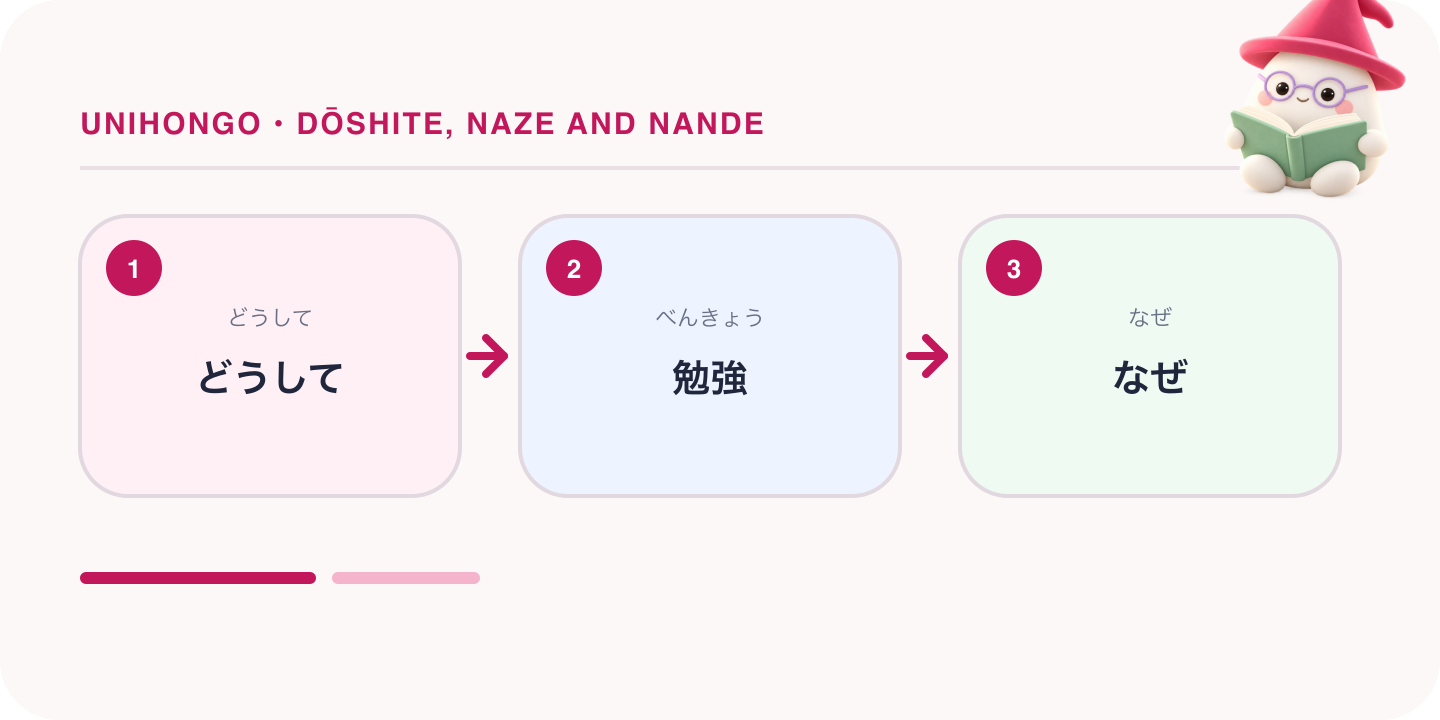
Dōshite (どうして) is built from dō, how, and shite, doing, so it originally asks how something came about. That history gives it a gentle, open feel: it asks for the story, not just the cause. It is polite enough for most conversations, including with teachers and colleagues, and it is the word to use when you are not sure which one fits.
Naze (なぜ) is the formal, intellectual why. It appears in written questions, exam prompts, news headlines and serious discussions. In speech, it sounds slightly careful or grave, which is right for a doctor, an interviewer or a manager asking about a problem, and slightly stiff between friends.
Nande (なんで) is the everyday spoken why among friends, family and classmates, and by far the most frequent in casual conversation. It is quick and light when the tone is flat, but with a rising tone or stress it turns into a challenge: nande konakatta no, why didn't you come. It also has a second meaning, by what means, as in nande ikimasu ka, how are you going, which context normally settles.
| Japanese | Romaji | Meaning |
|---|---|---|
| どうして日本語を勉強しているんですか。 | Dōshite nihongo o benkyō shite iru n desu ka. | Why are you studying Japanese? |
| なぜこの会社を選んだのですか。 | Naze kono kaisha o eranda no desu ka. | Why did you choose this company? |
| なんで来なかったの? | Nande konakatta no? | Why didn't you come? (casual) |
| なんで行きますか。電車ですか。 | Nande ikimasu ka. Densha desu ka. | How are you getting there? By train? |
| どうしてですか。 | Dōshite desu ka. | Why is that? |
| なぜでしょうか。 | Naze deshō ka. | I wonder why (formal). |
Asking why politely
A bare why question can feel like a demand for justification, in any language. Japanese softens it in three ways. First, add desu ka to the why word alone as a follow-up: dōshite desu ka, why is that, after the other person has said something. Second, wrap the question in n desu ka, which signals that you are asking for an explanation rather than challenging: dōshite kyanseru ni natta n desu ka, so why did it get cancelled. Third, add an apology or a cushion: sumimasen, or sashitsukae nakereba, if you don't mind me asking.
In formal contexts, replace why entirely with a request for the reason: riyū o oshiete itadakemasu ka, could you tell me the reason. This is what you say to a landlord, a bank or a company that has declined something. It sounds calm and gives the other person room to explain.
| Japanese | Romaji | Meaning |
|---|---|---|
| どうしてキャンセルになったんですか。 | Dōshite kyanseru ni natta n desu ka. | Why did it get cancelled? |
| 差し支えなければ、理由を教えていただけますか。 | Sashitsukae nakereba, riyū o oshiete itadakemasu ka. | If you don't mind, could you tell me the reason? |
| すみません、どうしてこの書類が必要なんですか。 | Sumimasen, dōshite kono shorui ga hitsuyō na n desu ka. | Sorry, why is this document needed? |
| 何かあったんですか。 | Nanika atta n desu ka. | Did something happen? (gentle why) |
| どういうことですか。 | Dō iu koto desu ka. | What do you mean by that? |
Answering why: kara desu and n desu
The basic answer pattern is reason plus kara desu, because. The reason is a plain-form clause: ame ga futta kara desu, because it rained; yasukatta kara desu, because it was cheap; shigoto na node, because of work, using node when you want to sound softer. Kara desu on its own is a complete answer, and it is what an interviewer expects after naze.
N desu, or no desu in careful speech, is the explanatory ending. It presents your reason as background the listener needs: jitsu wa, kinō netsu ga atta n desu, the thing is, I had a fever yesterday. It answers a why question without the slightly defensive feel of kara desu, which is why Japanese speakers use it constantly for excuses, apologies and personal reasons. Combining the two, kara na n desu, is common but not necessary.
For a written or carefully spoken explanation, naze nara, the reason is, introduces the reason and kara desu closes it: naze nara, kōtsūhi ga takai kara desu. It is the formal frame you would use in a presentation, an essay or a formal complaint, and it sounds odd in casual chat.
| Japanese | Romaji | Meaning |
|---|---|---|
| 電車が遅れたからです。 | Densha ga okureta kara desu. | Because the train was late. |
| 実は、昨日熱があったんです。 | Jitsu wa, kinō netsu ga atta n desu. | The thing is, I had a fever yesterday. |
| 仕事なので、行けません。 | Shigoto na node, ikemasen. | I can't go, because of work. |
| なぜなら、交通費が高いからです。 | Naze nara, kōtsūhi ga takai kara desu. | The reason is that travel costs are high. |
| 安かったからです。 | Yasukatta kara desu. | Because it was cheap. |
| 特に理由はありません。 | Toku ni riyū wa arimasen. | There's no particular reason. |
Dōshite mo and nande mo: why words that are not questions
Adding mo to a question word turns it into an all-inclusive expression, and two of these are essential. Dōshite mo means no matter what, by any means, whatever happens. With a positive verb it states a firm wish: dōshite mo kono daigaku ni hairitai, I want to get into this university no matter what. With a negative verb it states a hard limit: dōshite mo omoidasenai, I just cannot remember however I try. It is polite and common, and it is the phrase to use when you need to insist without sounding rude.
Nande mo means anything or whatever: nande mo ii desu, anything is fine; nande mo arimasu, they have everything. Nande mo nai means it's nothing, the standard reply when someone asks what is wrong and you do not want to say. Note that nande mo comes from nani, what, not from nande, why, even though they look related.
| Japanese | Romaji | Meaning |
|---|---|---|
| どうしてもこの大学に入りたいです。 | Dōshite mo kono daigaku ni hairitai desu. | I want to get into this university no matter what. |
| どうしても思い出せません。 | Dōshite mo omoidasemasen. | I just can't remember, however hard I try. |
| どうしても無理なら、来週でも大丈夫です。 | Dōshite mo muri nara, raishū demo daijōbu desu. | If it really isn't possible, next week is fine. |
| 何でもいいです。 | Nande mo ii desu. | Anything is fine. |
| 何でもないです。 | Nande mo nai desu. | It's nothing. |
Nande ya nen: a Kansai aside
If you watch Japanese comedy, you will hear nande ya nen within minutes. It is the Kansai dialect version of nande da yo, why on earth, or what are you talking about, and it is the signature line of the tsukkomi, the straight man in a manzai comedy duo, who uses it to react to the boke partner's nonsense, often with a light slap of the hand. Outside Kansai, people quote it as a joke, sometimes as a self-deprecating nande ya nen when their own plan falls apart.
Kansai dialect also uses nande for ordinary why, just like standard Japanese, and the ya nen ending replaces da yo or nan da. Do not try nande ya nen on a boss or a customer, but understanding it will make a great deal of television clearer.
| Japanese | Romaji | Meaning |
|---|---|---|
| なんでやねん! | Nande ya nen! | What on earth? (Kansai retort) |
| なんでやねん、それ。 | Nande ya nen, sore. | What is that supposed to be? |
| なんで知ってるん? | Nande shitteru n? | How come you know that? (Kansai casual) |
The three why words at a glance
The table below summarises the register, tone and typical settings for each word, along with the related expressions covered in this guide. Use it as a quick check before you ask.
| Expression | Reading | Register and use |
|---|---|---|
| どうして | dōshite | neutral, polite; safe default; hint of how |
| なぜ | naze | formal, analytical; writing, exams, serious talk |
| なんで | nande | casual; friends and family; can sound accusing |
| どうしてですか | dōshite desu ka | polite follow-up: why is that? |
| なぜですか | naze desu ka | formal follow-up |
| なんで? | nande? | casual follow-up |
| どうしても | dōshite mo | no matter what; firm wish or hard limit |
| 何でも | nande mo | anything, whatever |
| なぜなら | naze nara | the reason is (formal opener) |
| からです | kara desu | because (standard answer ending) |
| んです | n desu | explanatory ending, softer answer |
| なんでやねん | nande ya nen | Kansai: what on earth; comedy retort |
A related word, dō iu wake de, for what reason, sits between naze and a request for an explanation and is common in polite speech: dō iu wake de kimarimashita ka, how did that come to be decided.
Mistakes with why questions
The first mistake is using nande in polite situations. Learners hear it constantly in anime and dramas and assume it is neutral; to a shop assistant or a supervisor it sounds curt. Use dōshite or naze with desu ka. The second is the opposite: using naze with friends, which sounds like a detective. The third is tone. Even dōshite can sound like a challenge if you stress it and raise your pitch, so keep why questions low and even, and add n desu ka to show you want an explanation.
The fourth is answering without kara or n desu. A bare clause, densha ga okuremashita, states a fact but does not present it as a reason, and the listener may wait for more. The fifth is reading dōshite mo as a question, which produces baffled replies. And the sixth is asking why at all when a Japanese speaker would ask something softer: nanika atta n desu ka, did something happen, or daijōbu desu ka, are you all right, often gets the reason with none of the pressure.
- Use dōshite desu ka, not nande, with anyone senior or unfamiliar
- Keep the pitch flat; a rising why sounds like a complaint
- End answers with kara desu or n desu so they read as reasons
- Remember dōshite mo is a statement, no matter what, not a question
- Try nanika atta n desu ka before a direct why