
Two meanings in one sigh
Yare yare is not a sentence and has no grammar to learn. It is a sound people make when a feeling escapes, like "oh dear" in English. The feeling comes in two kinds.
The first is tired annoyance: the dog has chewed the slippers again. The second is relief: the long meeting is finally over. Both share the idea of letting out a breath after something troublesome. The cards put the famous line next to two expressions that people use every day.
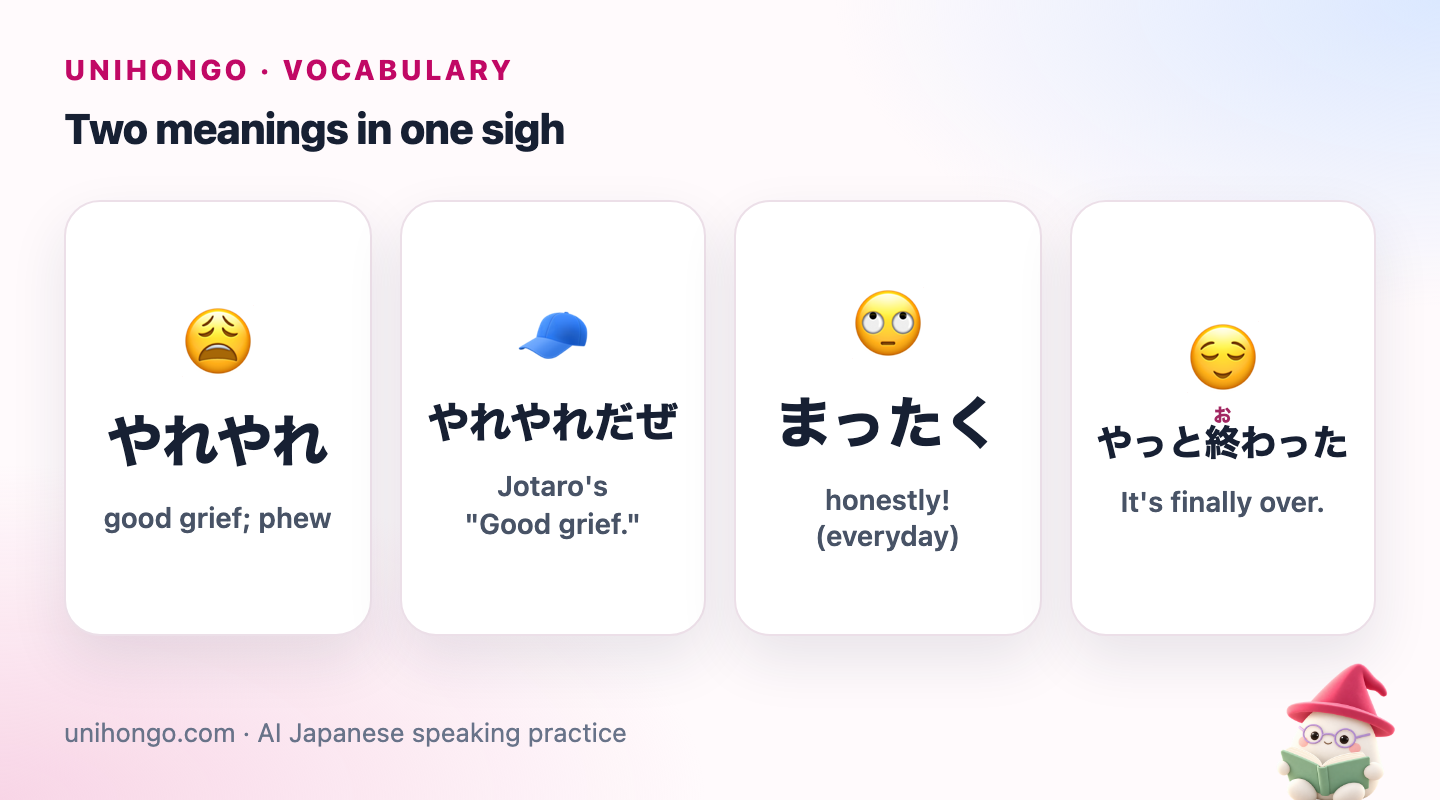
| Japanese | Romaji | Meaning |
|---|---|---|
| やれやれ | yare yare | good grief; phew |
| やれやれだぜ | yare yare da ze | Jotaro's "Good grief." |
| まったく | mattaku | honestly! (everyday) |
| やっと終わった | yatto owatta | It's finally over. |
| やれやれ、また雨か。 | Yare yare, mata ame ka. | Good grief, rain again? |
| やれやれ、やっと着いた。 | Yare yare, yatto tsuita. | Phew, we finally made it. |
Jotaro's version: what daze adds
Yare yare daze is the sigh plus two small words. Da is the plain form of "is". Ze (ぜ) is a sentence-ending particle that asserts something in a rough, masculine way. Together they turn a private sigh into a cool remark, something like "What a pain".
Ze belongs mostly to fiction now. You will hear it from tough heroes, delinquents and rivals in anime far more often than from men on the street. A later hero of the same series, Jolyne Cujoh, says yare yare dawa, with the feminine ending wa, and that ending is also heard more in fiction than in real life.
| Japanese | Romaji | Meaning |
|---|---|---|
| やれやれだわ | yare yare da wa | Jolyne's version, with wa |
An old word with a literary life
Yare is an old interjection, a short cry of surprise or feeling, and doubling it gives yare yare. Dictionaries list it as an interjection in its own right, separate from the command yare, "do it", which happens to sound the same.
The phrase has had a long life in print. Readers of Haruki Murakami know it as the quiet sigh of his narrators. Because so many people meet the word on the page, it has a bookish colour that everyday sighs do not have.
Who actually says yare yare
Whether the phrase sounds natural depends on who is speaking and where. This guide is a rough map, not a rule.
| Speaker or place | How yare yare sounds |
|---|---|
| Novels and essays | Normal: a quiet, wry sigh on the page |
| Anime and manga | The signature of a cool or weary character |
| Older speakers at home | Natural, especially as relief after a chore |
| Young adults talking with friends | Rare; it sounds like quoting a character |
| Polite talk with a boss or customer | Avoid it; sighing at someone is rude in any words |
For a learner this means the phrase is safe to understand and risky to copy. If you say it with a smile among anime fans, people will enjoy the reference. If you say it flatly in an office, people may wonder who you think you are.
Natural alternatives for exasperation
These are the sighs you will hear from people of every age. Most are said half to oneself.
| Japanese | Romaji | Meaning |
|---|---|---|
| まったく。 | Mattaku. | Honestly! / For goodness' sake. |
| まったくもう。 | Mattaku mō. | Oh, honestly! |
| しょうがないな。 | Shōganai na. | Oh well, it can't be helped. |
| またか。 | Mata ka. | Not again. |
| 勘弁してよ。 | Kanben shite yo. | Give me a break. |
| マジか。 | Maji ka. | Seriously? (slang) |
| はあ。 | Hā. | Sigh. |
Mattaku literally means "completely" and is short for a longer complaint that is left unsaid. Shōganai na is gentler: it accepts the situation and often comes just before the speaker helps anyway. All seven are casual, so keep them for friends, family and yourself.
Natural alternatives for relief
The second meaning of yare yare has even more everyday replacements, and several have polite forms you can use at work.
| Japanese | Romaji | Meaning |
|---|---|---|
| やっと終わった。 | Yatto owatta. | It's finally over. |
| よかった。 | Yokatta. | Thank goodness. |
| ほっとした。 | Hotto shita. | What a relief. |
| 助かった。 | Tasukatta. | Phew, that saved me. |
| 疲れた。 | Tsukareta. | I'm worn out. |
| やっと終わりました。 | Yatto owarimashita. | It's finally done. (polite) |
| ほっとしました。 | Hotto shimashita. | I'm relieved. (polite) |
Saying it well, and knowing when to stay quiet
A real yare yare is slow and low. The pitch falls, the second yare is weaker than the first, and a breath out often follows. Jotaro's version is flatter and cooler, almost bored. Try both and you will feel how much of the meaning is in the voice.
Remember that a sigh has a target. Said alone on a train platform, it is a comment on life. Said while looking at a colleague, it is a criticism of that colleague. In polite situations Japanese speakers usually turn the feeling into something positive, such as tasukarimashita, "you saved me", or otsukaresama deshita, "thank you for your hard work".