
One verb, five kanji
Every sense of toru starts from the same picture: you bring something under your control. You bring an object into your hand, a qualification into your record, a seat into your name, a stain off a shirt, or an image into your camera. Japanese writes that single verb with different kanji depending on which kind of taking you mean, and choosing among them is where learners lose time. The good news is that 取る is the default and covers most of the range on its own.
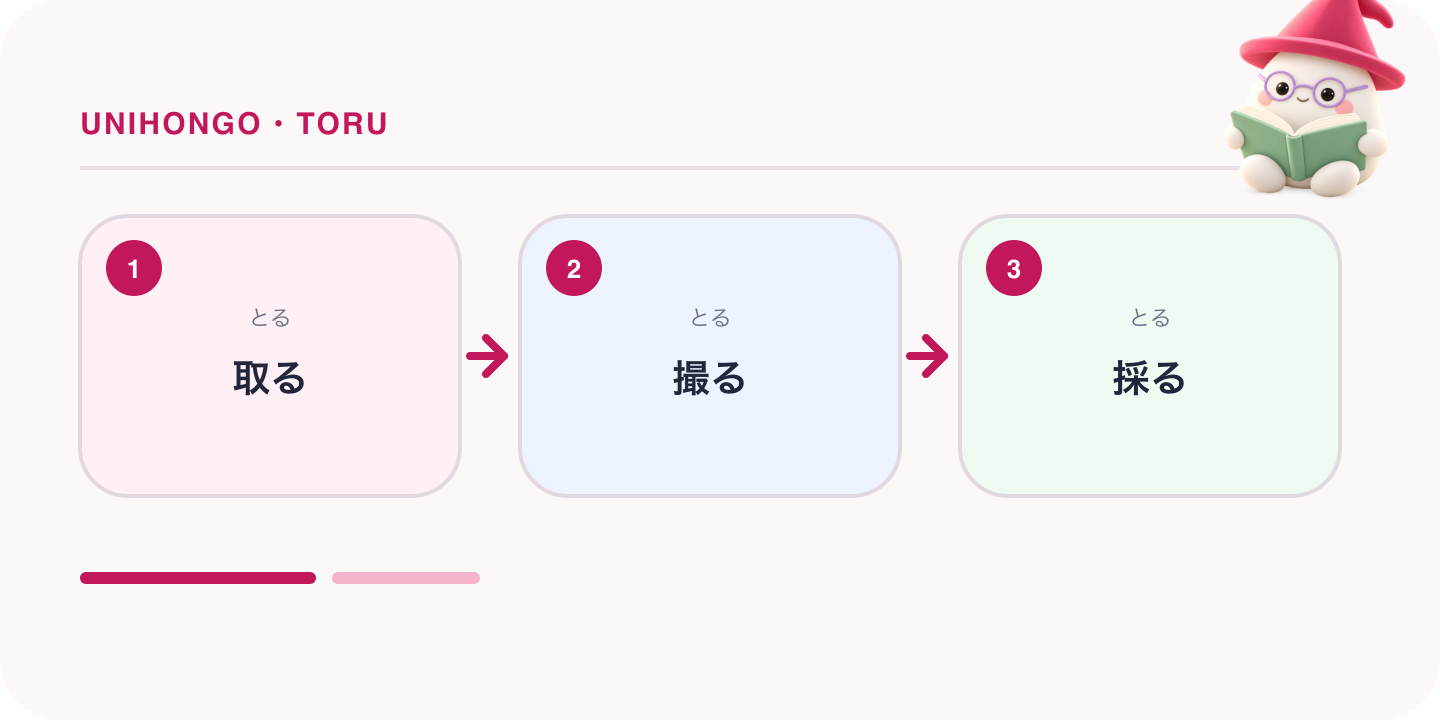
The other four are specialists. 撮る is only for photographs and moving images. 採る is for adopting a method, hiring a person and gathering something you have selected. 捕る and 獲る are for catching living things, with 捕る for catching or capturing and 獲る leaning toward hunting and fishing for a catch you keep. There is also 摂る for taking in food or nutrition, which many writers replace with 取る or kana.
| Sense | Kanji | Collocation | Example |
|---|---|---|---|
| Take in your hand | 取る | 塩を取る shio o toru | 塩を取ってください。 |
| Pick up, collect | 取る | 荷物を取る nimotsu o toru | 荷物を取りに行きます。 |
| Get a qualification | 取る | 免許を取る menkyo o toru | 運転免許を取りたいです。 |
| Book, reserve | 取る | 予約を取る yoyaku o toru | 七時に予約を取りました。 |
| Take time off | 取る | 休みを取る yasumi o toru | 明日、休みを取ります。 |
| Take notes | 取る | メモを取る memo o toru | メモを取ってもいいですか。 |
| Get in touch | 取る | 連絡を取る renraku o toru | 連絡を取ってみます。 |
| Take responsibility | 取る | 責任を取る sekinin o toru | 責任は私が取ります。 |
| Grow older | 取る | 年を取る toshi o toru | 年を取っても続けたいです。 |
| Remove, get rid of | 取る | 汚れを取る yogore o toru | 汚れが取れません。 |
| Photograph, film | 撮る | 写真を撮る shashin o toru | 写真を撮ってもいいですか。 |
| Adopt a method | 採る | 方法を採る hōhō o toru | その方法を採りました。 |
| Hire, recruit | 採る | 人を採る hito o toru | 新しい人を採ります。 |
| Gather, collect | 採る | きのこを採る kinoko o toru | 山できのこを採りました。 |
| Catch, capture | 捕る | 虫を捕る mushi o toru | 息子は虫を捕るのが好きです。 |
| Catch as a catch | 獲る | 魚を獲る sakana o toru | この川で魚を獲ります。 |
Taking something in your hand
This is the physical core, and it is the sense you use at a table, in a shop and in an office. The polite request is totte kudasai, and totte itadakemasu ka is the softer version for strangers. Watch the te-form: totte has a small tsu and takes two beats, so a rushed tote sounds like a different word. Also note that toru is taking something toward you, while removing clothing such as a hat or glasses uses the same verb: bōshi o torimasu.
| Japanese | Romaji | Meaning |
|---|---|---|
| すみません、塩を取ってください。 | Sumimasen, shio o totte kudasai. | Excuse me, please pass the salt. |
| そのペンを取っていただけますか? | Sono pen o totte itadakemasu ka? | Could you pass me that pen? |
| 一つ取ってもいいですか? | Hitotsu totte mo ii desu ka? | May I take one? |
| 棚から本を取りました。 | Tana kara hon o torimashita. | I took a book down from the shelf. |
| 室内では帽子を取ります。 | Shitsunai de wa bōshi o torimasu. | You take your hat off indoors. |
| 荷物を取りに行きます。 | Nimotsu o tori ni ikimasu. | I am going to collect my luggage. |
| 電話を取りますね。 | Denwa o torimasu ne. | I will get the phone. |
Getting and securing: licences, bookings, time off
This group is the reason toru matters so much in daily life in Japan. You take a qualification, a booking, a seat, a day off and a full night of sleep, all with the same verb. The pattern for asking permission at work is a soft question with mo ii desu ka or a request with the reason first. When you book by phone, the useful frame is yoyaku o toritai n desu ga, which leaves the sentence politely unfinished so the staff member can lead.
| Japanese | Romaji | Meaning |
|---|---|---|
| 運転免許を取りたいです。 | Unten menkyo o toritai desu. | I want to get a driving licence. |
| 去年、日本語の資格を取りました。 | Kyonen, Nihongo no shikaku o torimashita. | I got a Japanese qualification last year. |
| ビザを取るのに時間がかかります。 | Biza o toru no ni jikan ga kakarimasu. | It takes time to get a visa. |
| 七時に予約を取りたいんですが。 | Shichi-ji ni yoyaku o toritai n desu ga. | I would like to make a booking for seven. |
| 予約は取れましたか? | Yoyaku wa toremashita ka? | Were you able to get a booking? |
| 明日、休みを取ります。 | Ashita, yasumi o torimasu. | I am taking tomorrow off. |
| 来週、有給を取ってもいいですか? | Raishū, yūkyū o totte mo ii desu ka? | May I take paid leave next week? |
| テストでいい点を取りました。 | Tesuto de ii ten o torimashita. | I got a good mark on the test. |
| 睡眠をしっかり取ってください。 | Suimin o shikkari totte kudasai. | Please make sure you get enough sleep. |
The replies you should expect are short. For a booking, moshiwake gozaimasen, sono jikan wa ippai desu means the slot is full, so be ready with hoka no jikan wa aite imasu ka. For leave, a manager usually answers with hai, dōzo or a question about cover, dare ka kawari ni onegai dekimasu ka.
Notes, contact, responsibility and time
A second abstract group appears constantly at work. Memo o toru is taking notes, renraku o toru is getting in touch, sekinin o toru is taking responsibility, and jikan o toru is taking up or sparing time. Baransu o toru and komyunikēshon o toru follow the same shape with loanwords. These are fixed collocations, so learn the noun and verb as one unit rather than translating take each time.
| Japanese | Romaji | Meaning |
|---|---|---|
| メモを取ってもいいですか? | Memo o totte mo ii desu ka? | May I take notes? |
| あとで連絡を取ってみます。 | Ato de renraku o totte mimasu. | I will try to get in touch later. |
| 責任は私が取ります。 | Sekinin wa watashi ga torimasu. | I will take responsibility. |
| 少しお時間を取っていただけますか? | Sukoshi ojikan o totte itadakemasu ka? | Could you spare me a little time? |
| お時間を取らせてしまい、すみません。 | Ojikan o torasete shimai, sumimasen. | I am sorry for taking up your time. |
| チーム内で連絡を取り合っています。 | Chīmu-nai de renraku o toriatte imasu. | We keep in contact within the team. |
| 仕事と生活のバランスを取るのが難しいです。 | Shigoto to seikatsu no baransu o toru no ga muzukashii desu. | It is hard to balance work and life. |
| 年を取っても日本語を続けたいです。 | Toshi o totte mo Nihongo o tsuzuketai desu. | I want to keep studying Japanese as I get older. |
Removing things, and what toreru means
Toru also means taking something away: a stain, a smell, tiredness, pain. Its intransitive partner toreru describes the same event happening by itself, so yogore o torimashita is what you did and yogore ga toremashita is what happened. Toreru doubles as the potential form, which is why yoyaku ga toremasen can mean the booking cannot be secured. Nothing is ambiguous in practice, because the noun tells you which reading makes sense.
| Japanese | Romaji | Meaning |
|---|---|---|
| シャツの汚れを取りたいです。 | Shatsu no yogore o toritai desu. | I want to get the stain out of my shirt. |
| この汚れは取れません。 | Kono yogore wa toremasen. | This stain will not come out. |
| ボタンが取れてしまいました。 | Botan ga torete shimaimashita. | A button has come off. |
| 寝ても疲れが取れません。 | Nete mo tsukare ga toremasen. | My tiredness does not go away even when I sleep. |
| 薬で痛みが取れました。 | Kusuri de itami ga toremashita. | The medicine took the pain away. |
| 予約が取れませんでした。 | Yoyaku ga toremasen deshita. | I was not able to get a booking. |
撮る: photographs and filming
When the object is an image, the kanji is 撮る and nothing else. Shashin o toru is take a photo, dōga o toru is shoot a video, and eiga o toru is make a film. The polite ways to ask are worth memorising exactly: shashin o totte mo ii desu ka asks for permission to photograph, while shashin o totte itadakemasu ka asks someone to take a photo of you. Learners mix these two up regularly, and the difference is who holds the camera.
| Japanese | Romaji | Meaning |
|---|---|---|
| ここで写真を撮ってもいいですか? | Koko de shashin o totte mo ii desu ka? | May I take photos here? |
| すみません、写真を撮っていただけますか? | Sumimasen, shashin o totte itadakemasu ka? | Excuse me, could you take a photo for us? |
| 一緒に撮りませんか? | Issho ni torimasen ka? | Shall we have a photo taken together? |
| 動画も撮りました。 | Dōga mo torimashita. | I filmed a video as well. |
| この映画は北海道で撮ったそうです。 | Kono eiga wa Hokkaidō de totta sō desu. | They say this film was shot in Hokkaido. |
| 店内は撮影禁止です。 | Tennai wa satsuei kinshi desu. | Photography is not permitted inside the shop. (staff line) |
If a member of staff says satsuei wa goenryo kudasai, that is a polite refusal, and the right answer is shitsurei shimashita rather than an argument. In museums you may also hear furasshu wa goenryo kudasai, meaning photos are fine but flash is not.
採る, 捕る and 獲る: the narrow kanji
These three appear less often, but they show up in work and in nature writing. 採る is choosing and taking in: a method a team adopts, a new employee a company hires, blood taken for a test, mushrooms gathered on a hillside. 捕る is catching or capturing something that moves, from an insect to a ball. 獲る is used for hunting and fishing, where the catch is the point. In casual writing, many people simply use 取る or kana for all three.
| Japanese | Romaji | Meaning |
|---|---|---|
| その方法を採ることにしました。 | Sono hōhō o toru koto ni shimashita. | We decided to adopt that method. |
| 今年は新しい人を採ります。 | Kotoshi wa atarashii hito o torimasu. | We are hiring new people this year. |
| 検査で血を採ります。 | Kensa de chi o torimasu. | They will take blood for the test. |
| 山できのこを採りました。 | Yama de kinoko o torimashita. | I gathered mushrooms in the mountains. |
| 息子は虫を捕るのが好きです。 | Musuko wa mushi o toru no ga suki desu. | My son likes catching insects. |
| 猫がねずみを捕りました。 | Neko ga nezumi o torimashita. | The cat caught a mouse. |
| この川で魚を獲ります。 | Kono kawa de sakana o torimasu. | They catch fish in this river. |
Which kanji to type
When you type toru on a Japanese keyboard, the conversion list offers several options in a row, and picking the wrong one is a common written mistake. The table below is the quick decision you need. Keep in mind that hiragana is a legitimate choice: abstract collocations such as baransu o toru, tsukare o toru and jikan o toru appear in kana constantly, and no reader will think less of you for writing them that way.
| If you mean | Type this | Note |
|---|---|---|
| Take, get, book, remove | 取る | The default; safe for most sentences |
| Take a photo or video | 撮る | Only for images; never for objects |
| Adopt, hire, gather, draw blood | 採る | Choosing and taking in |
| Catch something that moves | 捕る | Insects, animals, a ball |
| Catch as game or a haul | 獲る | Hunting and fishing contexts |
| Take in food or nutrients | 摂る | Often replaced by 取る or kana |
| Record sound or a broadcast | 録る | Informal; 録音 and 録画 are the formal nouns |
| Not sure which one fits | とる | Kana is normal for abstract uses |
Compound verbs built on tori
The stem tori joins other verbs to make a family of high-frequency compounds, and toru also appears as the second half of some. Uketoru is to receive, kikitoru is to catch what someone said, torikesu is to cancel, torikaeru is to exchange, and torikumu is to tackle a task. Kikitoremasen deshita is one of the most useful sentences a learner can own, because it says you did not catch the words without claiming you do not understand Japanese at all.
| Japanese | Romaji | Meaning |
|---|---|---|
| 荷物を受け取りました。 | Nimotsu o uketorimashita. | I received the parcel. |
| すみません、聞き取れませんでした。 | Sumimasen, kikitoremasen deshita. | I am sorry, I could not catch that. |
| 予約を取り消してもいいですか? | Yoyaku o torikeshite mo ii desu ka? | May I cancel my booking? |
| 新しいのと取り替えていただけますか? | Atarashii no to torikaete itadakemasu ka? | Could you exchange it for a new one? |
| かばんから財布を取り出しました。 | Kaban kara saifu o toridashimashita. | I took my wallet out of my bag. |
| 今、新しい仕事に取り組んでいます。 | Ima, atarashii shigoto ni torikunde imasu. | I am working on a new project at the moment. |
| Compound | Reading | Meaning |
|---|---|---|
| 受け取る | uketoru | receive, accept |
| 聞き取る | kikitoru | catch, make out what is said |
| 取り消す | torikesu | cancel |
| 取り替える | torikaeru | replace, exchange |
| 取り出す | toridasu | take out, produce from a bag |
| 取り上げる | toriageru | take up a topic, confiscate |
| 取り入れる | toriireru | adopt, bring in |
| 取り組む | torikumu | tackle, work on |
| 書き取る | kakitoru | write down, take dictation |
| 引き取る | hikitoru | collect, take back |
Te-form helpers you will say every day
Toru combines with the ordinary te-form helpers, and each one changes the social meaning. Totte oku means take it in advance and leave it ready, which is how you reserve a seat or keep a portion aside. Totte kuru means go and fetch it. Totte ageru offers to get it for someone, totte kureru thanks someone who did, and totte itadaku is the humble version you use with a customer or a superior.
| Japanese | Romaji | Meaning |
|---|---|---|
| 席を取っておきます。 | Seki o totte okimasu. | I will keep a seat for you. |
| 飲み物を取ってきます。 | Nomimono o totte kimasu. | I will go and get some drinks. |
| それ、取ってあげましょうか? | Sore, totte agemashō ka? | Shall I get that for you? |
| 写真を撮ってくれてありがとう。 | Shashin o totte kurete arigatō. | Thank you for taking the photo. (casual) |
| この書類を受け取っていただけますか? | Kono shorui o uketotte itadakemasu ka? | Could you accept these documents? |
| メモを取っておいてください。 | Memo o totte oite kudasai. | Please make a note of it in advance. |
Mistakes to fix while you speak
- Do not use 撮る for taking an object; a photograph is the only thing you 撮る.
- Pronounce the te-form with the small tsu, totte, not tote.
- Say yasumi o torimasu for time off; yasumimasu on its own means you are absent today.
- Use jikan ga kakarimasu for something that takes time, and jikan o torimasu for taking up someone's time.
- Remember the particle switch: yogore o toru but yogore ga toreru.
- When you cannot recall the kanji while typing, write とる in kana rather than guessing.