
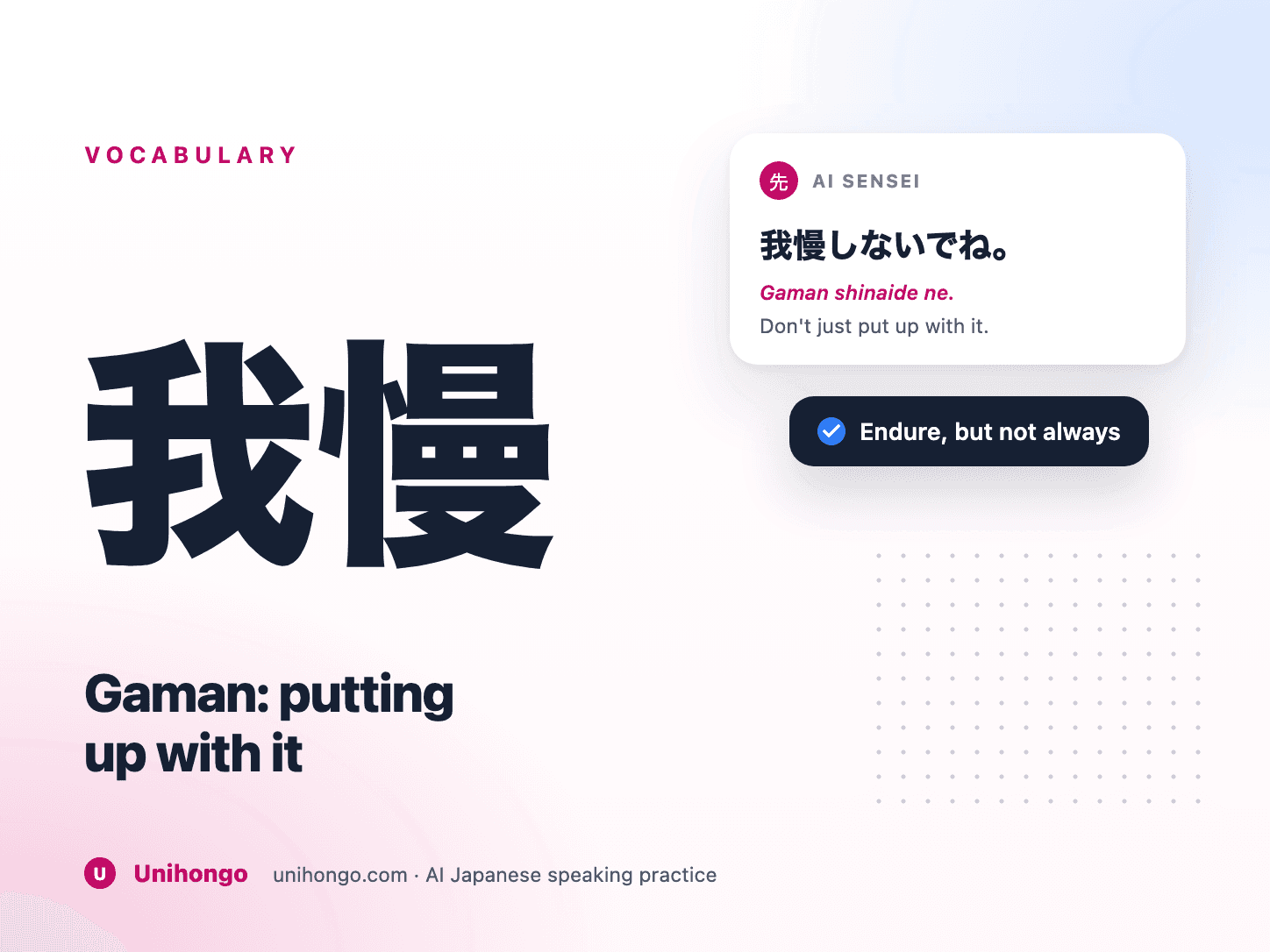
What gaman means in daily speech
Gaman, written 我慢, is a noun that becomes a verb with suru. It covers two closely related actions: enduring something you do not like, and resisting something you want.
Its range runs from trivial to serious in the same sentence pattern, so the object tells you the weight: a snack, a noisy room, a toothache, a difficult job.
| Japanese | Romaji | Meaning |
|---|---|---|
| 我慢する | gaman suru | To put up with, to hold back |
| もう少し我慢して。 | Mō sukoshi gaman shite. | Hang on a little longer. |
| 甘いものを我慢しています。 | Amai mono o gaman shite imasu. | I'm cutting back on sweets. |
| トイレ、もう我慢できない! | Toire, mō gaman dekinai! | I can't wait any longer for the toilet! |
Enduring and resisting
The object of gaman is either the unpleasant thing you tolerate or the desire you suppress. Both use o, and both are extremely common in family and workplace conversation.
| Japanese | Romaji | Meaning |
|---|---|---|
| 隣の工事の音を我慢しています。 | Tonari no kōji no oto o gaman shite imasu. | I'm putting up with the construction noise next door. |
| 寒いのを我慢して待ちました。 | Samui no o gaman shite machimashita. | I waited, putting up with the cold. |
| 欲しかったけど、我慢しました。 | Hoshikatta kedo, gaman shimashita. | I wanted it, but I held back. |
| 我慢の限界です。 | Gaman no genkai desu. | I've reached the limit of my patience. |
Gaman shinaide: don't suffer in silence
The negative request gaman shinaide is a caring phrase. Medical staff use it constantly, because patients who endure pain quietly may not get the treatment they need.
It is also used between friends and at work, when someone is holding in stress, frustration or a request.
| Japanese | Romaji | Meaning |
|---|---|---|
| 痛かったら我慢しないで言ってください。 | Itakattara gaman shinaide itte kudasai. | If it hurts, please tell us rather than putting up with it. |
| 我慢しないでね。 | Gaman shinaide ne. | Don't just put up with it. |
| 三日前から痛いのを我慢していました。 | Mikka mae kara itai no o gaman shite imashita. | I've been putting up with the pain for three days. |
| 我慢しすぎは体に悪いですよ。 | Gaman shisugi wa karada ni warui desu yo. | Holding everything in is bad for you. |
Gamanzuyoi and related words
Gamanzuyoi describes someone with strong endurance, and parents and teachers often use it as praise for children who wait patiently or do not cry at the doctor.
Nearby words carry different shades. Shinbō is persistence over time, and nintai is formal, written endurance.
| Japanese | Romaji | Meaning |
|---|---|---|
| 我慢強い子ですね。 | Gamanzuyoi ko desu ne. | What a patient child. |
| 辛抱強く待ちました。 | Shinbōzuyoku machimashita. | I waited patiently for a long time. |
| 忍耐力が必要です。 | Nintairyoku ga hitsuyō desu. | It takes perseverance. |
An honest look at the idea
Articles in English often describe gaman as a defining national virtue, with people enduring hardship calmly and without complaint. The value is real and is taught, but the picture is incomplete. People in Japan complain, argue and ask for help like anyone else, and gaman is widely discussed as a cause of problems, not only as a strength.
In recent years, phrases like gaman shinakute ii, you do not have to put up with it, have become common in conversations about overwork, harassment and mental health. Understanding both sides helps you use the word the way people actually do.
| Japanese | Romaji | Meaning |
|---|---|---|
| 我慢しなくていいんですよ。 | Gaman shinakute ii n desu yo. | You don't have to put up with it. |
| Context | How enduring is usually viewed |
|---|---|
| Waiting calmly in a queue or a delay | Normal and expected |
| A child not crying at an injection | Praised |
| Hiding pain from a doctor | Discouraged |
| Staying silent about overwork or harassment | Increasingly criticised |
| Resisting a craving while dieting | Everyday, often joked about |
Gaman, ganbaru and akirameru
Learners sometimes confuse gaman with ganbaru and akirameru. Ganbaru means to make an effort towards a goal, gaman means to endure or restrain, and akirameru means to give up. Someone can gaman through a hard job while ganbaru at their studies and akirameru a plan that will not work.
| Japanese | Romaji | Meaning |
|---|---|---|
| 試験に向けて頑張っています。 | Shiken ni mukete ganbatte imasu. | I'm working hard for the exam. |
| 遊びに行くのを我慢しています。 | Asobi ni iku no o gaman shite imasu. | I'm holding off going out. |
| 今年の旅行はあきらめました。 | Kotoshi no ryokō wa akiramemashita. | I've given up on travelling this year. |