

Tsukuru for food, drinks and things you can hold
The core meaning is the one you already know: to make something with your hands. Ryōri o tsukuru is to cook, o-bentō o tsukuru is to pack a lunch box, kōhī o tsukuru is to make a coffee and kēki o tsukuru is to bake a cake. The object takes o and the verb is a u-verb: tsukurimasu, tsukutte, tsukutta, tsukuranai. There is no separate everyday verb for bake or brew; tsukuru does all of them, and the noun tells you which.
The same verb covers craft and small construction. Fuku o tsukuru is to sew clothes, hon-dana o tsukuru is to build a bookshelf and mokei o tsukuru is to build a model. For factory goods, tsukuru is still normal in conversation, though the formal verb is seizō suru, to manufacture.
Tsukuru describes the process, not the result. To say something is finished you switch to dekiru: ban-gohan ga dekimashita, dinner is ready.
| Japanese | Romaji | Meaning |
|---|---|---|
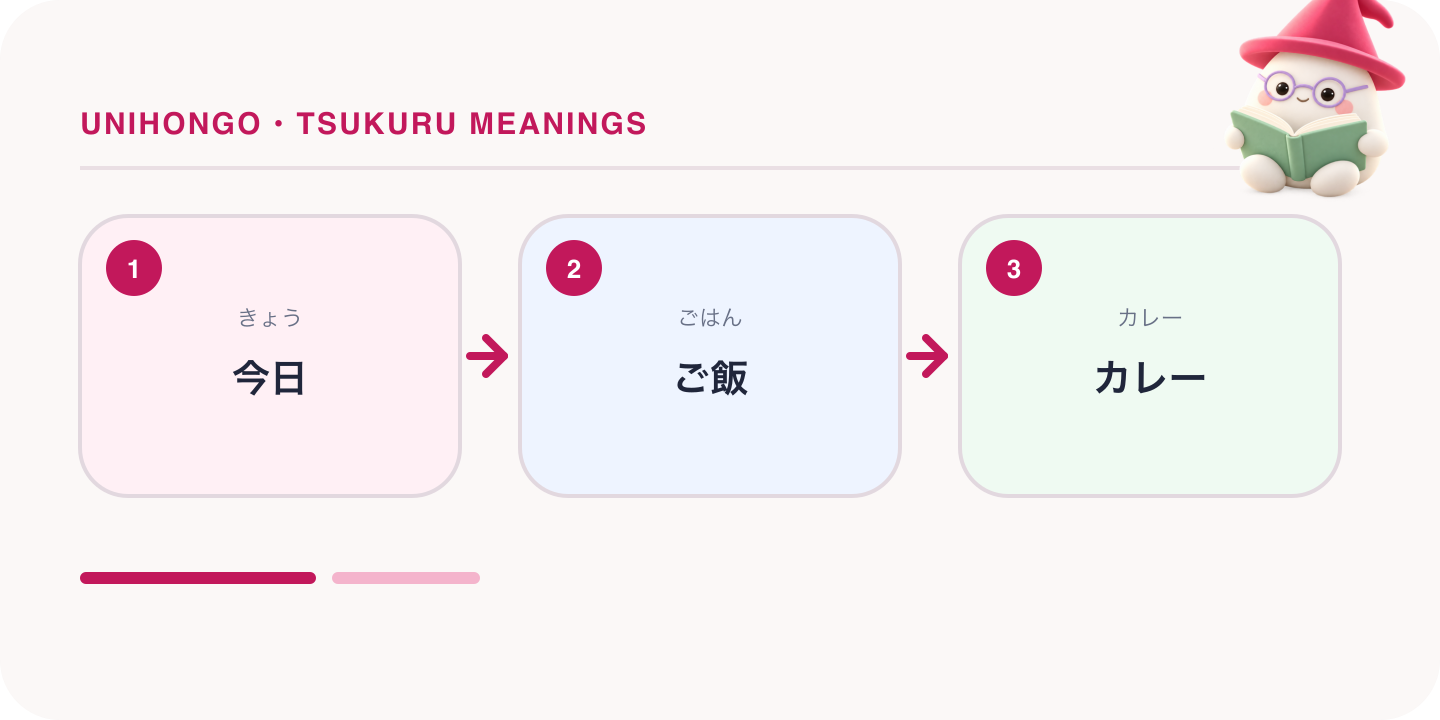
| 今日は晩ご飯にカレーを作ります。 | Kyō wa ban-gohan ni karē o tsukurimasu. | I'm making curry for dinner tonight. |
| 毎朝お弁当を作っています。 | Maiasa o-bentō o tsukutte imasu. | I make a packed lunch every morning. |
| コーヒーを作りましょうか。 | Kōhī o tsukurimashō ka. | Shall I make some coffee? |
| この棚は父が作りました。 | Kono tana wa chichi ga tsukurimashita. | My father made this shelf. |
| 晩ご飯ができましたよ。 | Ban-gohan ga dekimashita yo. | Dinner's ready. |
| ケーキを作るのが好きです。 | Kēki o tsukuru no ga suki desu. | I like baking cakes. |
Tomodachi o tsukuru and jikan o tsukuru: people and time
The first surprise for English speakers is that you make friends and make time with exactly the same verb. Tomodachi o tsukuru is the standard way to talk about building a circle of friends: nihon de tomodachi o tsukuritai, I want to make friends in Japan. It is neutral and positive; nobody hears it as calculating. For becoming friends with one particular person, the warmer phrase is nakayoku naru, and for making a friend of someone you already know, tomodachi ni naru.
Jikan o tsukuru is to make time, freeing a slot in a full schedule for something that matters. It is close to jikan o akeru, but tsukuru stresses the effort: you rearrange things to create time that was not there. Kikai o tsukuru, make an opportunity, kikkake o tsukuru, create an opening, and ba o tsukuru, set up a chance to talk, work the same way.
Kodomo o tsukuru, to have children, is common between partners and in surveys, but it sounds blunt to some listeners. With people outside the family, kodomo o motsu, to have a child, or kodomo ga umareru, a child is born, are safer.
| Japanese | Romaji | Meaning |
|---|---|---|
| 日本で友達を作りたいです。 | Nihon de tomodachi o tsukuritai desu. | I want to make friends in Japan. |
| 忙しいですが、時間を作ります。 | Isogashii desu ga, jikan o tsukurimasu. | I'm busy, but I'll make time. |
| 話す機会を作ってくれてありがとう。 | Hanasu kikai o tsukutte kurete arigatō. | Thanks for making the chance to talk. |
| 彼女と仲良くなりました。 | Kanojo to nakayoku narimashita. | I became friends with her. |
| みんなで話せる場を作りましょう。 | Minna de hanaseru ba o tsukurimashō. | Let's set up a chance for everyone to talk. |
| 来年、子どもを持ちたいと思っています。 | Rainen, kodomo o mochitai to omotte imasu. | We're thinking of having a child next year. |
Money, documents, companies and rules
Okane o tsukuru means to raise or put together money for a purpose, not to earn a salary. A student saving for a trip says ryokō no okane o tsukuru; someone who earns money says okane o kasegu, and someone who saves says okane o tameru. Learners who use tsukuru for a monthly wage sound as though they are printing it.
For documents, tsukuru is the everyday verb and sakusei suru is its formal partner. Shiryō o tsukuru, make the materials, is what you say to a colleague; shiryō o sakusei shimashita is what you write to a manager. Risuto o tsukuru, keikaku o tsukuru and yotei o tsukuru, make a list, a plan and a schedule, follow the same pattern.
Organisations and rules use tsukuru too. Kaisha o tsukuru is to found a company, with setsuritsu suru as the formal term. Chīmu o tsukuru is to form a team and kurabu o tsukuru to start a club. Rūru o tsukuru means to set rules, and hōritsu o tsukuru is to make a law, which becomes seitei suru in formal writing. Rekishi o tsukuru, make history, and kiroku o tsukuru, set a record, are the uses you hear on the news.
| Japanese | Romaji | Meaning |
|---|---|---|
| 留学のためにお金を作らなければなりません。 | Ryūgaku no tame ni okane o tsukuranakereba narimasen. | I have to put together money for studying abroad. |
| 会議の資料を作っておきます。 | Kaigi no shiryō o tsukutte okimasu. | I'll prepare the materials for the meeting. |
| 買い物リストを作りました。 | Kaimono risuto o tsukurimashita. | I made a shopping list. |
| 友達と会社を作りました。 | Tomodachi to kaisha o tsukurimashita. | I started a company with a friend. |
| 新しいルールを作る必要があります。 | Atarashii rūru o tsukuru hitsuyō ga arimasu. | We need to set new rules. |
| 彼女は新記録を作りました。 | Kanojo wa shinkiroku o tsukurimashita. | She set a new record. |
The kanji: 作る, 造る and 創る
All three kanji are read tsukuru, and the choice tells the reader about scale and creativity. 作る is the default: food, clothes, documents, friends, time, plans, rules and almost anything you would make in a day. If you only learn one, learn this one, and use it whenever you are unsure. 造る is for large, structural or industrial making: ships, buildings, bridges, roads, gardens and, by tradition, sake, miso and soy sauce. The word 酒造, shuzō, on a brewery wall uses it. 創る is for bringing something genuinely new into being: a work of art, a brand, a culture, a future. It appears in company slogans and speeches far more than in daily life.
In practice, most people write 作る unless the object is clearly a big construction or a creative act. When you see 造 or 創, the writer wants you to feel weight or originality.
| Kanji | Reading | When it appears |
|---|---|---|
| 作る | tsukuru | Everyday making: food, objects, documents, friends, time |
| 造る | tsukuru | Large or industrial building: ships, houses, roads, sake |
| 創る | tsukuru | Creating something new: art, a company culture, a future |
| 作り方 | tsukurikata | The way to make something; a recipe or instructions |
| 手作り | tezukuri | Handmade, home-made |
| 作成 | sakusei | Formal creation of documents or data |
| 製造 | seizō | Manufacture in a factory |
| 建造 | kenzō | Construction of ships or large structures |
| 創造 | sōzō | Creation in the artistic or original sense |
| 創業 | sōgyō | Founding of a business |
| 作品 | sakuhin | A work of art, writing or craft |
| 作者 | sakusha | The author or maker of a work |
The compounds show the same three-way split: sakusei and seizō sit with 作, kenzō with 造, and sōzō and sōgyō with 創. Learning the compound helps you remember which kanji the plain verb takes.
Tsukurikata, tezukuri and other useful forms
Attach kata to the stem and you get tsukurikata, the way of making something. Karē no tsukurikata is a curry recipe, and tsukurikata o oshiete kudasai is how you ask for one. Tezukuri, handmade, is a noun used like an adjective: tezukuri no kukkī, home-made cookies; tezukuri desu ka, did you make it yourself. It carries warmth, especially for food and gifts, and shops advertise it as a selling point.
Other forms come up constantly. Tsukutte oku, make in advance, is what you do with a bentō the night before. Tsukurinaosu is to make again after something went wrong. Tsukuritate, freshly made, is on signs at bakeries and tofu shops.
- Tsukurikata: the way to make something, a recipe or instructions
- Tezukuri: handmade or home-made, a compliment for food and gifts
- Tsukutte oku: make something in advance so it is ready
- Tsukurinaosu: make again, redo a dish or a document
- Tsukuritate: freshly made, seen on signs at bakeries and tofu shops
- Tsukuri: the build or construction of an object or a house
Tezukuri shows the sound change from tsukuri to zukuri, which also appears in monozukuri, craftsmanship.
Tsukuru versus suru and koshiraeru
The tsukuru and suru line is about result versus activity. Tsukuru produces a thing that exists afterwards; suru performs an action. Keikaku o tsukuru is to draw up a plan you can show someone, while keikaku suru is to plan. Yoyaku o suru, make a reservation, and denwa o suru, make a call, use suru because nothing physical is produced. Shukudai o suru, do homework, uses suru; shukudai o tsukuru would mean writing the homework as a teacher.
Koshiraeru is an older, gentler synonym of tsukuru, still alive in Kansai and among older speakers. O-bentō o koshiraeru, prepare a lunch box, and okane o koshiraeru, get money together, are typical. It sounds homely and nostalgic, so recognise it and use tsukuru yourself. Kōsei suru is for composing or structuring, as in a report made of three parts, and kumitateru is for assembling from parts, such as furniture.
| Japanese | Romaji | Meaning |
|---|---|---|
| 計画を作ってから、計画します。 | Keikaku o tsukutte kara, keikaku shimasu. | We'll draw up a plan and then plan the details. |
| レストランの予約をしました。 | Resutoran no yoyaku o shimashita. | I made a restaurant reservation. |
| 祖母がお弁当をこしらえてくれました。 | Sobo ga o-bentō o koshiraete kuremashita. | My grandmother made me a lunch box. |
| この棚は自分で組み立てました。 | Kono tana wa jibun de kumitatemashita. | I assembled this shelf myself. |
| 報告書は三つの部分で構成されています。 | Hōkokusho wa mittsu no bubun de kōsei sarete imasu. | The report is made up of three parts. |
Learner mistakes and how to fix them
The most common mistake is using tsukuru for actions that produce nothing: yoyaku o tsukuru, denwa o tsukuru, kettei o tsukuru. Use suru for these. The second is okane o tsukuru for earning a salary; say okane o kasegu for earning and okane o tameru for saving. The third is kodomo o tsukuru in polite company, where kodomo o motsu is gentler. The fourth is the conjugation: tsukuru is a u-verb, so the te form is tsukutte and the potential is tsukureru, never tsukurete or tsukuranai desu with a ru-verb pattern.
One subtler point: when a friend serves you a dish, the compliment is tezukuri desu ka or jibun de tsukutta n desu ka, not anata ga tsukurimashita ka, which sounds like an interrogation. Learn each collocation as a unit, and the verb takes care of itself.
| Japanese | Romaji | Meaning |
|---|---|---|
| 決定をしました。 | Kettei o shimashita. | We made a decision. |
| アルバイトでお金を稼いでいます。 | Arubaito de okane o kaseide imasu. | I earn money with a part-time job. |
| これ、自分で作ったんですか。 | Kore, jibun de tsukutta n desu ka. | Did you make this yourself? |
| 一人でも作れますよ。 | Hitori demo tsukuremasu yo. | You can make it on your own, you know. |
| 時間があれば、もう一度作り直します。 | Jikan ga areba, mō ichido tsukurinaoshimasu. | If there's time, I'll make it again. |